



You give to the people who bring you service at Christmas. Please give to Meridian in a voluntary subscription by clicking here. We really need your help to bring you the quality magazine you love to receive.
This is part 3 of the serialization of Stone Manger: The Untold Story of the First Christmas. See part 1 here and part 2 here.
Nothing Is Impossible

No one knows how the Son of God was conceived within the young virgin Miryam. The details have never been revealed. (Consider “The Concept of Virgin Birth” in Afterword #1 at the end of this book.)
Nor do we know just where the miraculous event took place, although Mary was living in Nazareth. But we can reckon about when it must have occurred. The miraculous conception seems to have taken place very soon after the angel’s visit, perhaps immediately. This would have been late in Adar, near the end of the month we call March.
We know this because of what Luke tells us. He reports that after the angel’s appearance, Miryam immediately went south to Judea (the text of Luke says “with haste”) and visited an older female relative named Elisabeth. Right at the beginning of that visit, the elder woman sensed that Miryam was pregnant.
Elisabeth was filled with the Holy Spirit, and she cried out with a loud voice, and said: Blessed you are, among women, and blessed is the fruit of your womb. (Luke 1:41-42)
This blessing may have been especially meaningful to Miryam, because Elisabeth was the daughter of a Jewish priest, and like the virgin herself, of the ancient lineage of Aaron. Elisabeth’s words not only confirm to us that Miryam was already pregnant, but also recognize the divine nature of the newly conceived child which the young woman from Nazareth was carrying.
Miryam’s famous response to Elisabeth has become known as the Magnificat:
My soul magnifies the Lord, and my spirit has rejoiced in God my Savior! For he looked upon the humility of his servant; for behold, from now on all generations will regard me as blessed! (Luke 1:46-48)
The journey south from Nazareth to Judea took place within days of the angel’s visit and Miryam’s conception. Again, this places that conception at the mid to end part of March, in other words at the end of Adar, the sixth Jewish month.
But Miryam certainly did not travel to Judea alone. No single young woman would have made such a long trip unaccompanied. And Miryam did not go to Judea merely to visit Elisabeth.
The annual Passover festival was held in Jerusalem at just this time each spring, during the month of Nisan. Jewish families in the Galilee travelled to the capital early in Nisan, in order to be there well before the festival week began. It would surely have been during her family’s visit to Jerusalem for Passover that Miryam had her initial conversation with Elisabeth.
Miryam would probably have walked the one hundred mile path to Jerusalem at the beginning of Nisan, on a five day journey with a party that included not only her two parents, Yo’akim and Hannah, and sister Shlomit, but other relatives and friends from Nazareth as well. In Jerusalem they would enjoy an extended family reunion.
Passover was a family oriented festival. A day or two after arriving, in the tenth of Nisan, Yo’akim would have secured a live lamb, and set it apart for four days. On the fourteenth of Nisan, Yo’akim’s party would have taken the lamb to the court of the Jewish Temple in Jerusalem, the famous Temple of Herod. Though the outer porticoes were still under construction, it was the largest and most ornate Temple complex in the entire Roman empire. Tens of thousands of people crowded the thirty-six acre plaza on the fourteenth of Nisan to have their Passover lambs slain near the Temple altar.
Each family roasted their lamb all afternoon in a clay brick oven specially prepared in the courtyard of their individual homes, if they were residents of Jerusalem. Similar ovens were prepared in the courtyards of the city’s inns, and in many hundreds of camping sites located around Jerusalem, just outside the city walls. It was only at Jerusalem that the ritual meal of roasted lamb, unleavened bread, and bitter herbs, could be eaten. The feast was supplemented, of course, by other festive foods prepared for the occasion. Jews from all over the Land of Israel, from all over the Roman empire, and from the Persian controlled region of Babylon, came annually to Jerusalem to celebrate Passover.
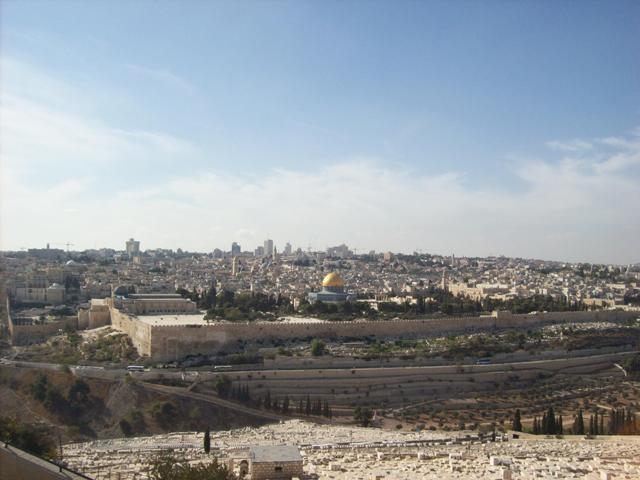
Miryam and the rest of Yo’akim’s family might have stayed with relatives for Passover week, perhaps even with the family of Zakarya and Elisabeth. Or they may have stayed at one of the many guest houses in the capital city. On the other hand, they might have stayed at one of the many hundreds of permanent campsites that existed outside the city. We are not told.
But we do know that Miryam stayed on in Judea after the Passover festival was over. She did not return to Nazareth with her family that spring. Instead, with her parents’ approval, she stayed at the home of Zakarya and Elisabeth.
Luke tells us that Miryam lived with Elisabeth for three months before returning home to Nazareth. She was only two or three weeks into her own pregnancy when Passover arrived. For another eleven or twelve weeks after the festival Miryam lived with her Judean relatives. She must have found welcome conversation with her older kinswoman, for Elisabeth was also pregnant, and six months along, carrying the child that would become known as John the Baptist. Helping Elisabeth during the older woman’s final trimester was one way Miryam passed her own first trimester. Helping Elisabeth may even have been the reason that Yo’akim and Hannah left their daughter behind.
Luke only tells us that Zakarya and Elisabeth lived in a city of Judea. He does not name the town, but it was not Jerusalem. Fourth century Christians preserved competing traditions about where John the Baptist was born. One tradition placed the event at Yutah, a village near Hebron, about twenty-five miles south-west of Jerusalem. Another tradition, more widely believed, and perhaps more likely, was that John’s birth occurred at at Ein Kerem, a small Jewish village about four miles west of Jerusalem. Most probably, Zakarya and Elisabeth lived at Ein Kerem.
If this was the case, Miryam could have visited Jerusalem on a number of occasions after Passover, during her stay with Elisabeth in Judea. Almost certainly, a visit to the capital and the Temple Mount would have taken place fifty days after Passover, at the biblical “festival of weeks.” Also known as Shavu’ot in Hebrew, the holiday usually occurs near the end of our month of May. It is called Pentecost in the New Testament’s Greek.
In spite of the work involved in assisting Elisabeth, Miryam must have enjoyed her time in Judea and her stay at Ein Kerem, far away from the slow regularity of life in Nazareth.
During the difficulty and discomfort of her own first trimester, which may have included morning sickness as well as the usual physiological changes that normally occur during early pregnancy, Miryam probably cherished Elisabeth’s advice and understanding.
But according to Luke, after three months Miryam left Zakarya’s home, just before Elisabeth gave birth to John. No reason was given. Perhaps word of Miryam’s pregnancy, which would have become obvious by then, had made its way back to her parents, and her father had come to fetch her home. Miryam’s five day trip north, back to Nazareth, would have occurred around the end of our month of June. The hundred mile trip over the hills of Samaria and the valley of Jezreel would have been more arduous for the young woman this time around, not only because of her condition, but because the hot weather of summer had arrived.
As Miryam arrived in the forested hills of Galilee and entered the village of Nazareth that summer, just at the beginning of July, she was also entering her fourth month of pregnancy. This was a visible fact that everyone in the town would soon notice, including the young man to whom she was engaged to be married. “What,” Miryam must have wondered, “would Yosef think?”
Chapter 5
Yosef Son of David
Yosef of Nazareth was a genuinely remarkable young man. Among all men of human history he stands out – strong, thoughtful, and heroic. But much of what has been said about him in commentaries needs correction.
One false tradition that circulated about Yosef for many centuries is that he was an older man who, prior to meeting the young virgin Miryam, had already been married himself. This tradition also claims that Yosef had several sons and daughters from the previous marriage. These allegations first appeared in the Protoevangelion, a third century work of fiction, written in Greek, which became popular among Christians in the fourth century. But the Protoevangelion is wholly inconsistent with the original New Testament accounts about Yosef and Miryam (see the note at the end of this chapter). Its description of both Yosef and Miryam is almost entirely incorrect.
On the other hand, what we can say about Yosef with some surety is far more interesting. He was probably born around 30 BC, give or take a year or so, and was likely in his mid-twenties when he married Miryam. This means that Yosef was as much as eight or nine years older than Miryam. But this was not unusual for his culture and time. Young men often had to work several years to save money for the dowry that was given to a girl’s family in order to take her as a bride.
Tradition also incorrectly portrays Yosef as a poor carpenter. The facts were surely different. While Yosef was definitely a working class man, he was not the destitute woodworker the world has been led to believe. In fact, he wasn’t even a carpenter at all. He made his living as a stone mason.
The original Greek text of the New Testament used the word tekton to describe both Yosef and his adopted son, Jesus. (The New Testament passages where tekton appears are Matthew 13:55 and Mark 6:3.) The Greek word tekton literally meant “builder.” Traditional English translations of the Bible mistakenly render tekton as “carpenter.” Perhaps the translators can be forgiven for the error, since many buildings in England and Europe were made of wood. But in the ancient Land of Israel, all buildings were made of stone. Furniture and appliances were carved from stone. Professional builders in the Land of Israel, like Yosef and the boy he raised to manhood, were not wood carpenters at all. They were stone masons.
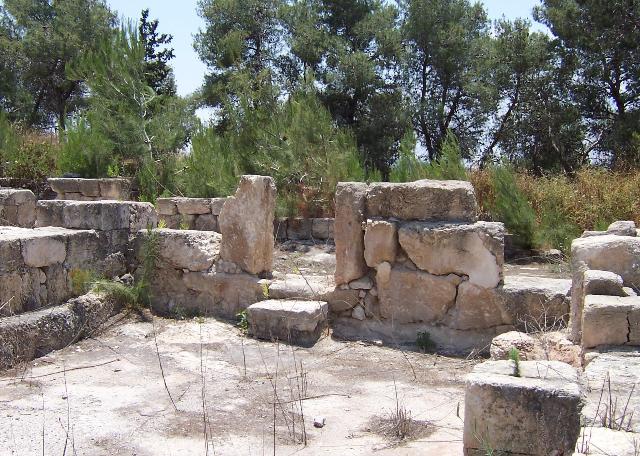
In the Hebrew and Aramaic which Yosef spoke with his friends and neighbors, the term for a stone mason or builder was boneh (with emphasis on the second syllable). To say “the builder” one added the definite article ha to the term boneh. Yosef the stone mason would have been called Yosef ha-Boneh.
For a moment, let’s consider how this would have applied to Jesus. Growing up, Jesus learned the skills of a master stone mason from Yosef. As a young man, Jesus himself worked as a builder for more than fifteen years before beginning his activities as a rabbi. During that time he would have been called Yeshua ha-Boneh –“Jesus the builder.” But later, as a rabbi, with his construction days behind him, he became better known by the name of the town where he had grown up, and was called Yeshua ha-Natzri – “Jesus the Nazarene,” or as we more often say, “Jesus of Nazareth.”
In his own teachings and parables, Jesus never spoke of wood carpentry. There is not a single instance of wood carpentry imagery or symbolism in any of his recorded sayings in the New Testament. But he did employ images and symbolism taken from the building and stone masonry crafts he knew so well. A few well known examples are these sayings:
You look at the chip which is in your brother’s eye, but do not notice the beam in your own eye. (Matthew 7:3)
A wise man built his house upon bedrock … a foolish man built his house upon sand. (Matthew 7:24)
The same stone which the builders rejected has become the cornerstone. (Matthew 21:42)
Jesus even gave his chief apostle, whose name was Shimon, the symbolic name Kefa (which appears as “Cephas” in the King James Version of the Bible). In Galilean Aramaic, kefa was a word meaning a rough-cut block of stone. Kefa is the term that was translated into Greek as Petros, and that has come to us in English as Peter – both of these also mean “stone.” The man whom we call “Simon Peter” was actually called Shimon Kefa by Jesus. Images of stone masonry are present in the life and words of Jesus in many other ways.
But let’s get back to Yosef. Two distinct genealogical lines are reported for Yosef in the New Testament. Matthew’s account names Yosef’s father as Yakov (Jacob), and his grandfather as Mattan. But Luke’s account names Yosef’s father as Eli, and his grandfather as Mattat (a variant spelling of Mattan). The two different names reported for Yosef’s father – Yakov and Eli – probably indicate that he had actually been given both names. This would not be unusual. His full given name would probably have been Yakov Eli, the son of Mattan. So Yosef the stone mason was the son of Yakov Eli, who in turn was the son of Mattan.
Matthew and Luke listed different male genealogical lines for Yosef from his grandfather Mattan backward (see chart 8 below). Luke did not report Miryam’s genealogy, as is often alleged – he reported one of Yosef’s lines. Matthew’s report was most likely Mattan’s mother’s male line, and Luke’s report was probably Mattan’s father’s male line.
This, too, would not be unusual. The significant thing for Yosef (and essentially for Jesus) was that both of Yosef’s genealogical lines led back to David, the biblical king who had ruled Israel a thousand years earlier.

Yosef was not unique in his Davidic lineage. Many men of his era could claim descent from Judea’s ancient royal family. The “house of David” had been large – a dynasty that had ruled for over four centuries, from 1000 BC down to 586 BC. The Babylonian attack that destroyed Iron Age Jerusalem and Judea also ended the reign of David’s heirs. But through Zerubbabel (who lived about 530 BC) the dynasty’s descendants lived on. And Yosef of Nazareth was special, in that he was one of a small number of Jewish men who possessed more than one line of descent from David the King.
There was an important reason why Davidic lineage was significant to the Jewish people of Yosef’s era. Biblical prophets, from Isaiah to Daniel, had predicted an eventual renewal of the ancient Israelite kingdom, to be ruled by a descendant of David – commonly referred to as the “son of David.” This man was expected to be raised up and anointed by God as a righteous king who would redeem the Jewish people from oppressive rule, and usher in a period of spiritual redemption for the House of Israel.
The Hebrew term Meshiah (which means “anointed one”) was used to describe this prophesied “son of David.” In the Greek text of the New Testament, the term Christos (which also means “anointed one”) was employed to describe the Jewish Meshiah. In English, however, we say “Messiah” rather than Meshiah, and instead of Christos we say “Christ.” In other words, the name-title “Jesus the Messiah” is the same as saying “Jesus the Christ.”
To download Stone Manger by Jeffrey Chadwick as an ebook click here
Chapter V Notes
Note #5:1 – Protoevangelion
The Protoevangelion was a work of religious fiction, written in Greek in the third century AD, which became popular among some Christians in the fourth century. It claimed to tell the story of Miryam and Yosef before (proto) the events described in the authentic gospels of Matthew and Luke.
We noted the Protoevangelion already in Chapter III, because it mentions the names of Miryam’s parents, Yo’akim and Hannah. These are authentic Jewish names, and are probably the only correct information in the text of the Protoevangelion. Other than the names therein, the Protoevangelion is inconsistent with the original New Testament accounts about Yosef and Miryam, and also with what is known by archaeologists and historians about Jewish life, culture, and religion in Israel. It is riddled with errors about the land of Israel, the city of Jerusalem, the Temple and its administration, the priestly order and procedures of the Temple, and almost every aspect of the land, culture, and era it pretends to portray.
The Protoevangelion was produced more than two centuries after Jesus lived, by people who had not known Yosef or Miryam, who were not Jewish, and who had not even lived in the Land of Israel. Its bizarre portrayal of the couple is often absurd and almost entirely incorrect, which is why we warn readers about it here.