






This is Part 6 of “The Real Elder Price” series. The rest of the articles are available here.
Note: This essay is lovingly dedicated to the memory of Elder Marion Duff Hanks.
Disclaimer: Obviously, The Book of Mormon Musical is intended to entertain, not to serve as a primer on Mormonism. This series of essays is offered simply as a view of what missionary life is actually like for Mormon missionaries in Africa, not as a direct response to the musical—though there are a few responses. The missionaries featured in these essays served in the Republic of Congo and Cameroon. The missionaries in the musical are in Uganda. Of course, each African country is distinctive. Nonetheless, for the purposes of these essays, I often refer to Africa as a whole rather than to the specific countries of Cameroon or the Congo.

Comedy, particularly satire, tends to simplify and exaggerate characters and content. So it’s no surprise that LDS Church leaders, as depicted in The Book of Mormon Musical, are either goofy or tyrannical—and capable of teeter-tottering to either extreme. In the satire, the mission president is an implacable hard-liner. When it’s clear that the African converts haven’t received the orthodox gospel from the missionaries, but something profanely different, the president explodes. He pronounces the missionaries all failures, and then declares that he’s sending them ignominiously home. The same guy who had gushed that these teenaged ministers had “become Africa” is now in a rage, and fulfilling every fear provoked by the “spooky Mormon Hell dream.” All he lacks is a pitchfork and a tail.
In real, unexaggerated life, I know a lot of currently serving and former mission presidents. The one I know best is my father. I remember well when he got a phone call inviting him and my mother to Salt Lake City for something. For a week, we Blair kids were left to speculate about what our father was being asked to do. Finally, we had a family meeting, and Dad reported what had happened.
He and Mom had been invited to talk to Elder Dallin Oaks, sustained by Mormons as an apostle. As it happens, Elder Oaks is also a family friend, someone we have joked with, eaten cake with at wedding receptions, and greeted at funerals. But in this setting, he was acting in that apostolic assignment. He told Dad that the Church was ready to open a mission in the Baltic States—which had been behind the Iron Curtain since the 1940s, and asked if Dad, with Mom at his side, would preside over it. They both agreed, not mentioning the other things in their lives which would make such service difficult. (Two of my siblings would marry during my parents’ time in the Baltics. Mom returned for one of the weddings, but we Blair kids represented our parents at the other.) There would be no financial compensation for this service; the three years were consecrated time.

In the LDS religion, we are asked to offer our time and talents to the service of God—which (since we believe that service to one’s fellow beings is service to God) means that we go where we’re asked to, and offer ourselves in humanitarian efforts, congregational service, or missionary work. My uncle, John Groberg, was called to be a General Authority when he was in his early forties and had a young family. He had already served as a bishop and as a mission president. When he was invited to be a member of the Quorum of the Seventy, he understood that if he accepted, he would be devoting the rest of his life to church service. That meant that he would leave his home in Idaho Falls and go wherever the Church assigned him. Anyone familiar with John Groberg’s life (made a bit famous in the film The Other Side of Heaven) knows that he accepted. Ultimately, he and his family lived in Tonga, Hawaii, Argentina, and Hong Kong. They had a home in Bountiful, Utah, which they rented out when they were on long (meaning several years) assignments. He received a stipend, but it was far less than what he would’ve made as a savvy businessman in Idaho.
This is the level of commitment a Mormon is asked to sustain, and a level both of my parents already had when they accepted this onerous responsibility.
For my husband, Bruce, and me, the experience of witnessing my parents being set apart for this assignment was awe-inspiring. When Elder Oaks entered the room, it was with a power which distinguished him from Dallin Oaks, the attorney and friend who we laughed with in everyday associations. This was no social gathering, but as serious and as sacred as when Christ sat in Peter’s boat and asked him to “thrust out a little from the land” (Luke 5:2).
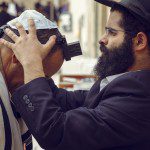
John (functioning as Elder Groberg) placed his hands on his sister’s head, and pronounced a blessing of comfort. Mom was desperately insecure about leaving her home and family. He told her she could do this thing, and that she had been prepared in ways she didn’t realize.
Elder Oaks laid his hands on my father’s head and set him apart. Until he spoke the blessing, I had not been aware that Dad was worried about his unfinished tasks and projects. When Elder Oaks instructed him to not concern himself with what he was leaving behind, my father openly wept. The blessing also included a promise that my parents’ children would be watched over, that others would be brought into their lives to help and support them.
And so Mom and Dad went to Eastern Europe, where my family and I visited them a year later. One of their missionaries said to me, “Your father is the most inspired man I have ever met.”
Since I knew my father much better than this young man, that pronouncement was two degrees shy of mind boggling. “My father?”
“The most inspired man I’ve ever met!”
That generous imagination and the Mormon sense that anyone who answers the call to discipleship may be duly empowered had added a divine dimension to the man I called simply Dad.
In my own little family, we have also experienced this magnification. My husband and I were released from our calling at the Missionary Training Center when he was asked to be our congregation’s bishop.
I remember the voicemail which let me know a change was before us: “Brother Young, the stake president would like to meet with you. Sister Young, we’d like you to come as well.” I knew immediately what was before us, and knew that our time in the MTC was about to end.
In his office, our stake president pulled a letter from his desk. It authorized him to extend this call to my husband. I did not want to leave the missionaries, and Bruce had no idea of how difficult this stewardship would be.
We said yes.
Such is the line of authority we Mormons accept. There are some things only a stake president or a bishop or an apostle is authorized to do. This hierarchal order has troubled some, who think we worship men rather than God, and put them on absurd pedestals if they have high callings.
(Well yes, we do have rather high pedestals, which is a natural outgrowth of the LDS claim to continuing revelation and the amazing possibility that there are still prophets on earth.)

According to this line of authority, only an apostle will dedicate a land for the preaching of the gospel. It was Elder Jeffrey R. Holland who dedicated Cameroon (part of the DR-Congo mission) when “my” missionaries were there.
As it happens, Elder Holland is also a friend of mine. I have even been known to tease him in casual settings. When he arrived in Cameroon, he told the missionaries I missed them so much that I tried to grab his coattails as he boarded the plane.
But there was only a little joking when he arrived in Cameroon—one of seven African countries he would visit during his tour. It was serious business he was about, and everyone understood that. Though I know him to be a fun-loving man and a friend, I have utter respect for him as an apostle. I honor his mantle.
His dedication of Cameroon was the fulfillment of a one-hundred and thirty-three-year-old old prediction, articulated in the Deseret News on December 7, 1877:
Stanley the traveler has furnished the world with a complete map of the course of that mighty river, the Congo, down in Africa. A fresh field is opened to missionary labor. The benighted tribes of the wilds of Africa will not long be left without the knowledge of the world’s Redeemer. This is the great and last dispensation in which all that is hidden shall be disclosed, and all nations and lands with their history and relationship to each other will be made manifest. The emancipation of the colored race in the United States and opening up of the long hidden regions of interior Africa are indications of the workings of the Almighty towards the lifting up and final redemption of this branch of the human family. The fullness of the gospel may not reach them for years. But the angel which restored it to earth proclaimed the glad tidings that it should be preached ‘to every nation and kindred and tongue and people.’
Of course, the article is imbued with the prejudice of its time and the concepts which undergirded colonialism, but the Mormon view of ever-increasing light and progress is unmistakably present, as is the understanding that all mankind comprise the “human family”.
It also responds to the fictional Elder Price’s singing “I believe that in 1978, God changed his mind about black people.” No, the principle that “all are alike unto God” is eternal. God has never changed His mind about that, regardless of what any mortal has said.
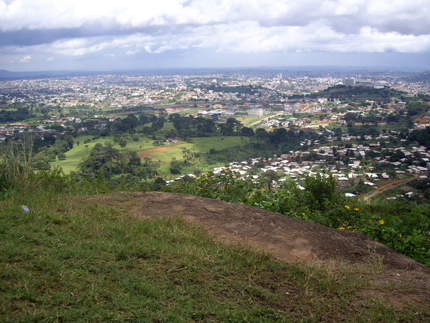
And so Elder Holland dedicated the land of Cameroon for the preaching of the gospel
I’ll let the missionaries describe the events in their own words:
Elder Henry Lisowski: It turned out we would NOT be able to go to the dedication after all. So, we eight missionaries sat silently at 7:30 in the morning, looking out towards the mountains, and waiting as our country was dedicated. There was no parting of clouds, no brilliant rays of sunshine frying the wicked, and no falling fireballs. But it was still pretty cool.

Elder Jared Wigginton: We heard of the power of the Spirit that was present [at the dedication]. Elder Holland’s prayer compared the missionary work to the rock upon which it was given in the hill—a rock of Christ with the potential to roll and grow beyond measure. He put to shame with Apostolic authority that Africans were ‘fence sitters’ in the pre-existence and admitted that the reason for the Priesthood restriction is still not known today. He edified us. I understand so much more clearly why I am serving.
Elder Chiloba Chirwa: We shook the hand of Elder Holland. I will never forget the experience of today. He pronounced a blessing upon all the people of this country, and I know that everything he said in his dedicatory prayer will be fulfilled. I am still trying to compose myself. What a privilege it was to gaze into those piercing blue eyes and listen to his apostolic voice.
Elder Kendell Coburn: We had the wonderful opportunity to have a zone conference with Elder Holland. The most powerful thing he did was to bear testimony of the Savior. His apostolic testimony was one of the most powerful moments of my life. My joy is full. I am overflowing with happiness and peace. And I am so grateful to be a missionary here in Africa.
Elder Seth Lee: We got the opportunity to meet Elder Holland personally and be taught by him His message to us focused on three important things: focusing on the scriptures to teach the doctrines; enjoying our time on our missions; and his personal testimony of the truthfulness of the Church and the divinity of what we are doing in Cameroon. I love that man, and now I’ve got a new favorite quote form an Apostle. He said, “A boy becomes a man when he has served in Cameroon!

Elder Daniel Kesler: Elder Holland didn’t have to recite some preplanned talk, but he was able to just share exactly what he needed to. It was huge when he looked at us and said “Nothing on earth can change my testimony. You can make me happy or disappointed, but nothing you can do will subtract from my testimony.”
Elder John Ternieden (who translated for Elder Holland): I was very nervous and had my face in Liahonas for about 2 weeks practicing translation. I wish I could have thanked him because it was a real testimony building experience for me. I felt the Spirit SO strongly with his message, and that same Spirit translated the words. I just happened to be the mouthpiece.
Elder Brandon Price: Elder Holland talked about how our church doesn’t have a ‘symbol’ like many others. He said that if he could choose a symbol, it would be two missionaries. Then he said, “You are worthy symbols.”

The missionaries asked if they could take a picture with Elder Holland.
He agreed, but said there would be one condition: Complete silence.
Elder Price explains:
He told us that he wanted us to remember an apostolic testimony, not a photo. His last counsel was that as quickly as the spirit comes, it can go away. Then, he got in the car and was off to the airport. It was all finished just as quickly as it began. But, the blessings of his short visit were great. Nearly 400 members and investigators got to hear and be taught by an apostle, the country was dedicated for missionary work and blessed, and a small group of 16 missionaries had an incredible experience.

This attention to reverence has drawn my thoughts often as I’ve considered the principle of dedication. We Mormons dedicate ourselves, our homes, temples, churches, and land—whether the land is for someone’s burial or for the preaching of the gospel.
A spirit of reverence accompanies the dedication, but it can be easily disrupted by the chaos of everyday living, the incessant lure of music with a good beat, of a situation comedy, or of a Broadway musical. The thought makes me wonder if I can fully appreciate the kind of stillness which leaves space for the calming breath of God to be heard and felt and to linger. It makes me want to take long walks and simply meditate, or to be on a hill overlooking a promised land and hear the timeless strain of hymns—past, present, and future.
As it happens, I also knew and loved the man who presided over the British Isles mission when Elder Jeffrey Holland served there in his youth: Elder Marion D. Hanks. My family and I visited Elder Hanks periodically until his death on Aug. 5, 2011. Any mention of Elder Holland always brought these words from him: “I love Jeff.”

My parents, nearly a decade after their service in the Baltic States, still get visits from their missionaries. The missionaries, said Dad, were “my friends, my sons.” He trusted them, and found them worthy of that trust. Sometimes, the “line of authority” is simply the cord of the affection lacing one heart to another.

On the first evening I met them at the Missionary Training Center, I told the missionaries that the French language would become sacred to them, because it would be the language they spoke at holy times. I told them that the countries in which they would serve would also become sacred because of what they would experience. In Mormonism, we believe that a grove of trees was sanctified by a young man’s answered prayer; that a normal piece of land did actually contain buried scriptures. In a more personalized perspective, any place where our yearnings have found comfort and direction is sanctified. At the ends of our lives, we could map out our own “sacred groves”—those places in our minds or in our rooms where we met something divine and heard an answer to prayer, even if we didn’t realize we were praying.

.