








This column, our final foray into the wide world of sports, covers two games that exist on opposite ends of my personal ranking of favorite team sports. If there is a sport of which I am a true fan, it’s baseball. Our hometown has a short-season single-A minor league team and my family and I look forward to the late-June opening game all the dreary winter and wet spring long. We usually make it to eight or so games a year and it’s truly a highlight of our summer.
On the other hand, we occasionally attend a single game of the local major junior ice hockey team each winter – only when we get the tickets for free – and I just don’t look forward to it. You may have heard the saying, “I went to a fight and a hockey game broke out.” In my limited experience, there’s more than an element of truth to that and, frankly, it makes me cringe. However, I fully recognize that my perspective is not the only one and that there are those who are passionate about their love of hockey and those who despise “America’s pastime”. Read on for additional insight into these two sports.
“Hockey is the quirkiest and most capricious of sports”
The Boys of Winter: The Untold Story of a Coach, a Dream, and the 1980 U.S. Olympic Hockey Team
By Wayne Coffey
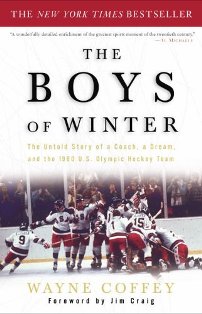 By 1980, the Soviets had dominated Olympic ice hockey for decades. After World War II, as tensions grew between the Soviet Union and the West, the Soviet leadership realized that sports could be an incredibly powerful propaganda tool. Sports became another field upon which to fight the Cold War of contrasting ideals, where besting the United States, or any Western country, in an international competition was seen as a triumph for communism and a blow against capitalism. Toward this end, the Soviet government began devoting a great deal of time, money and effort to a variety of athletic endeavors including, of course, ice hockey.
Canada, which had held unquestioned dominance since hockey became an Olympic sport in 1920, was caught almost completely off guard in 1956 when the Soviet Union won gold for the first time. Then the Soviets really caught fire, snagging gold again in 1964, 1968, 1972, and 1976. With the 1980 Olympic Games approaching, they were again the favorites to claim gold. A well-oiled, state-funded machine that trained together nearly year-round, the 1980 Soviet team roster was filled with experienced hockey legends. Almost no one thought any other country had a chance to knock them off their pedestal.
Bound by eligibility rules and definitions regarding “amateurs” and “professionals,” the United States was fielding eclectic teams of talented young college players, many of whom had never played together before. Rob McClanahan, one of the U.S. forwards in 1980 described the team succinctly: “We were just naïve college punks.” The team was recruited and coached by Herb Brooks, an enigmatic man who held his players at arms’ length, often publicly berating, demeaning and humiliating them while molding them into a better, more unified hockey team than anyone, even the players, thought possible. Mr. Coffey explains: “Brooks was a complicated man, one who teemed with contradictions.” Some players thrived in this environment and held no ill will toward Mr. Brooks. Others were deeply hurt and resentful, even when attending Mr. Brooks’s funeral more than twenty years later. One commented almost wistfully, “I wonder if coaches’ careers shouldn’t be measured by wins and losses as much by the number of weddings and christenings they’re invited to.” Mr. Brooks was demanding and pushed his players incessantly; compliments were almost never given. As Mr. Brooks himself said once, “The greatest compliment I can give you is a sweater,” or, in other words, a place on his team.
Much of Mr. Coffey’s book consists of a play-by-play recounting of the 1980 “Miracle on Ice.” For those who are not well-versed in hockey terms and rules, these recap sections can be somewhat confusing, but the essence of the game comes through. Mr. Coffey inserts asides explaining which plays were good, which were bad, and which were phenomenal, allowing hockey dunces, like myself, to keep up. Interspersed throughout the replay are personal portraits of the individual players and staff involved, usually after the player performed some key play in the game. These vignettes provide insight into the players’ pasts, how they came to the game of hockey, and what they did post-1980, as well as a broader view of the history of the game itself. Mr. Coffey also includes brief snippets from interviews with some of the Soviet players, though not as many as I would have liked.
The motif of the underestimated underdog triumphing over the better advantaged opponent is always compelling and has been since before David and Goliath. Even though this famous game wasn’t actually for the gold medal – the U.S. had to beat Finland in its final game to clinch the title – the”Miracle on Ice” truly was a miraculous event for the United States as well as for the individual players. On paper, the Soviet team seemed to have all the advantages, but somehow a group of college kids, ages ranging from 19 to 25, were able to overturn an entire sports dynasty of older, more experienced players. No wonder Sports Illustrated proclaimed it to be the Top Sports Moment of the 20th Century.
“Baseball and its statistics are inseparable, as lovingly intertwined as the swirls of a candy cane”
The Numbers Game: Baseball’s Lifelong Fascination with Statistics
By Alan Schwarz
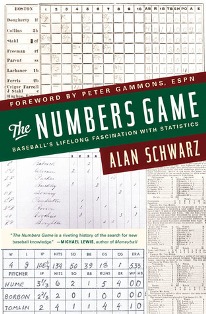 Baseball and statistics go together like mustard and hot dogs, peanuts and Cracker Jack. From the games earliest beginnings, fans, spectators, coaches, and owners have been obsessed with gathering and analyzing runs, outs, hits, and innumerable other aspects of the game. Mr. Schwarz’s book traces the development of this companionship with, well, relish.
Starting as far back as the mid-1800s, Mr. Schwarz begins by profiling “The Father of Baseball,” Henry Chadwick, and his half-century-long relationship with the game. Mr. Chadwick was the first of many to devote hours and eventually years to designing new scoring methods, box scores and statistics in order to advance his vision of the sport. In fact, the scoring grid he developed is essentially the same box score used today.
It was fascinating to learn how the game has changed over the past 150 years or so. Initially, for example, the pitcher was just a mechanism by which the ball was put into play rather than, arguably, the most important single player on the field today. The rules changed frequently as the professional leagues tried to find the right balance between offense and defense, as the pitcher became more vital, and as the size of the field standardized. All these changing rules wreaked havoc on the state of statistics. Depending on the year, batting averages could include walks as well as hits, stolen bases could include any extra bases a runner advanced, or sacrifice bunts could be excluded from a players’ at-bat stats.
Arguments ensued, and frequently still continue, over which stats were the most meaningful, the most important, the most helpful in selecting lineup or choosing strategy, and over the best and most accurate way to calculate those numbers.
There have even been occasional backlashes throughout the history of the sport against the emphasis on statistics. In 1880, critics charged that focusing on individual players’ statistics encouraged them to “play for their records rather than for their side.” In 1958, a Sports Illustrated columnist complained that “the greatest menace to big-time sports today…is a nonsense of numbers [and] the stupefying emphasis on meaningless statistics which is draining the color from competition.” As recently as 2003, the Boston Red Sox hired a sabermetrician (a statistician who specializes in baseball) as a senior adviser to baseball operations and were accused of turning the team management into “a pack of number-mumbling zombies.”
Regardless of these recurring complaints, the fans’ thirst for stats was, and still is, insatiable. However, as different people or organizations calculated those statistics, publications often went to press with conflicting information, coming to a head in the late 1980s and early 1990s. If The Baseball Encyclopedia and Total Baseball didn’t agree, just who was the average fan supposed to trust? Did Ty Cobb have 4,190 hits or 4,191? Was Honus Wagner’s batting average .327 or .329? Changes were sometimes made arbitrarily and explanations were hard to come by for the discrepancies. “Baseball’s records, so important and so revered, were hopelessly screwed up, and the average fan now knew it.” Mr. Schwarz outlines the numerous efforts that have been made by dozens, if not hundreds of baseball fans and statisticians over the years to clean up the confusing mess of facts and ensure accuracy in the sports’ historical records. Even famous career totals engraved on bronze plaques in the Baseball Hall of Fame were not exempt from mistakes as a sign in the gallery warns: “The data on all players was taken from reliable sources at the time the plaques were made.” While many fans, players, and managers protested changing these sacrosanct numbers after so many years, John Thorn, a noted baseball author, stated “There can be no statute of limitations on historical error.”
Despite resistance from many old-school traditionalists, by 2002, most major league organizations were working with sabermetrics either through hiring a consultant or actually having someone on staff. Statistical analysis is now standard practice when determining lineup order or when to put a relief pitchers in and is being embraced by newer generations of both managers and fans. Because of the efforts of so many to track, analyze, and calculate the stats, fans can obsess over and revel in the numbers and more thoroughly enjoy America’s favorite pastime.
**************************
On My Bedside Table…
Just finished: Bill Moyers Journal: The Conversation Continues by Bill Moyers
Now reading: Think: Straight Talk for Women to Stay Smart in a Dumbed Down World by Lisa Bloom
On deck: How to Write a Sentence and How to Read One by Stanley Fish
**************************
I hope you’ve enjoyed learning more about sports! New topic in two weeks…Come find me on goodreads.com or email suggestions, comments, and feedback to egeddesbooks (at) gmail (dot) com.