








Modern society sometimes endows physicians with something close to omnipotence, or at least omniscience. When illness strikes either us or a loved one, we crave answers from an authoritative-looking person, complete with white coat (name embroidered neatly on the left breast pocket), stethoscope around the neck, and a sympathetic but sober demeanor. We want someone who knows what is wrong and how to fix it. We expect every ailment to have a cure, some pill or treatment or exercise that will help us feel better again. We want a timeline, a concrete explanation of how long it will take to improve. A specific and detailed understanding of the present is required, along with a clear vision of the future.
But physicians and other medical professionals are fallible. They are not omnipotent, or omniscient. They aren’t psychics or seers. They may not have the answers we so desperately desire. They have bad days, make erroneous judgments on first impressions, even simply make mistakes, just as we all do. The vast majority are truly dedicated to easing pain, relieving suffering, and improving the lives of their patients and their own ability to help others and practice their craft. The books below acknowledge both the human frailties and the constant drive to improve found in the medical profession.
“By opening my mind I can more clearly recognize its reach and its limits”
How Doctors Think
By Jerome Groopman, MD
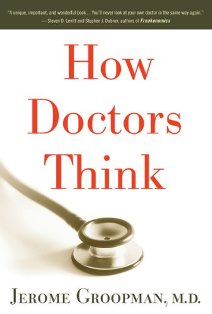
Everyone makes mistakes every day. We dial a wrong number, or accidentally put bleach in the washing machine with the jeans, or don’t see the stop sign. Some mistakes have minor consequences; others can be life-changing. Physicians make dozens, if not hundreds, of decisions a day, many significantly affecting the health and life of others; but in spite of the stakes, it would be unrealistic to expect perfection on every single one. In How Doctors Think, Dr. Groopman investigates how physicians make those decisions, identifies possible “weak links” in the thought process, and helps us as patients understand how we can influence a physician’s decision-making for good.
Emotional involvement is a constant paradox for physicians. Dr. Groopman explains the conflict: “If we feel our emotions deeply, we risk recoiling or breaking down. If we erase our emotions, however, we fail to care for the patient.” Several of the common classes of errors that Dr. Groopman discusses occur because of this interplay between emotions and information. For example, Dr. Groopman details attribution error in the case of an unkempt seventy-three-year-old patient with alcohol on his breath. On presenting himself to the emergency room with complains of fatigue and swelling in his legs and abdomen, this man was quickly assumed to have alcoholic cirrhosis. Only after the attending physician pushed the interns treating him to consider other options was it discovered that he had a rare condition called Wilson’s disease. The snap judgment based on their initial reaction of disgust was wrong and almost led them to miss a serious illness. An important key in finding the right balance is to be aware of how those emotions affect interactions with patients and the decision-making process.
To demonstrate representativeness error, Dr. Groopman relates the story of a doctor who, despite a thorough work-up and appropriate testing, missed the warning signs for an acute myocardial infarction (in lay terms, a heart attack) in an active, non-smoking, forty-year-old forest ranger. He realized later that he was “overinfluenced by how healthy this man looked.” The patient didn’t fit the prototype in the physician’s mind of someone with unstable angina. Dr. Groopman goes on to catalog affective errors, availability errors, anchoring errors and confirmation bias, all of which can also lead to narrowed thinking and misdirection in any field, not just medicine.
Dr. Groopman encourages readers to speak up and to help physicians make better decisions by simply asking questions. Ask for clarification if you don’t understand a diagnosis, a treatment or why a test was ordered. Dr. Groopman quotes his mentor, Dr. Linda Lewis, in saying, “There is nothing in biology or medicine that is so complicated that, if explained in clear and simple language, cannot be understood by any layperson.” Expect to be able to understand and continue asking questions until you do. If concerned about a possible misdiagnosis or if you’re simply not getting better, Dr. Groopman suggests three specific questions to help a physician see through common errors in thinking and come to a better solution:
- What else could it be?
- Is there anything that doesn’t fit?
- Is it possible I have more than one problem?
By clearly laying out how mistakes can happen, Dr. Groopman increases our awareness and ability to prevent them, empowering both physicians and patients to make a difference. While it can be uncomfortable to live with uncertainty when we want solid answers from omniscient experts, we often have a better chance of finding the solution by acknowledging the uncertainty and being willing to continue searching. As Dr. Groopman concludes, “uncertainty sometimes is essential for success.”
“Doctors must be good storytellers”
What Patients Taught Me
By Audrey Young, MD
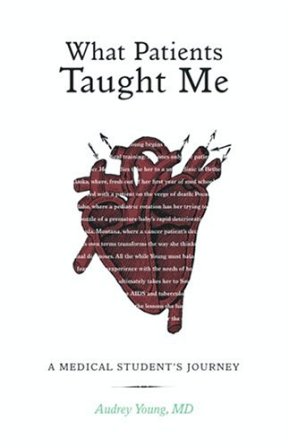
Dr. Audrey Young chronicles her varied clinical experiences through her medical school and training. Participating in a program designed to encourage physicians to consider rural medicine, Dr. Young travels from the bustling Seattle metropolis to the tiny town of Bethel, Alaska, for her first experience with “real” patients. Among the heavily Yupik Eskimo population, she begins to glimpse the depth of the challenges that physicians juggle. She discovers that the social and cultural context is vital to understanding the patient’s story, a story that she, as a physician, needs to know in order to help relieve suffering, especially when it comes from a place that is foreign to her own experience.
After another grueling year of courses, textbooks, and exams in Seattle, Dr. Young ventures to Spokane, Washington, for a rotation in obstetrics and witnesses a birth for the first time. She meets patient after patient who don’t fit neatly into the pre-fabricated boxes in her mind; they are each startlingly individual. She gives a pregnant teenager a first glimpse of her baby by ultrasound. She delivers the news to a woman in her forties that her baby may have Down Syndrome. She is touched by the overwhelming love she observes over and over that these mothers, so different in so many ways, have for their babies.
A later rotation in pediatrics takes Dr. Young to Pocatello, Idaho. Her idealism smacks against reality as she sees cases of domestic abuse and alcoholism, child abuse and shaken-baby syndrome. Despite anything she could do as a physician, she begins to realize “how much that outside world mattered.” Her optimistic desire for a “revolution” where patients “snap off their televisions, quit smoking, protect their homes with dogs rather than guns, and ease down from the excesses of the American diet” is tempered by her realization that life is often messier and grayer than that. A one-year-old patient with asthma and a perpetual runny nose has parents who smoke and cannot be convinced to quit. A sixteen-year-old girl must passively wait on a transplant list for a new heart. She describes her emotions as a “combination of irritation, empathy, and the heaviness of knowing she could not alter the overarching reality of lives.
“
Dr. Young continues to draw touching and poignant vignettes. Of her internal medicine rotation is Missoula, Montana where she learns from Martha and Milo that “there was such a thing as dying a good death.” Of John and Ginny who decide not to continue John’s chemotherapy against an aggressive cancer so they can “go back to the ranch and enjoy our lives, have one more wonderful summer.” Of the vast chasm that exists between first-world and third-word when she practices in Swaziland – poverty, lack of basic medical supplies like penicillin, the high incidence of HIV and tuberculosis – but the commonalities of the human element.
Through her experiences across the Pacific Northwest and the world, Dr. Young concludes that “doctoring is a human act.” From her time in Swaziland, in particular, she embraces the belief that “a doctor who sees suffering must act, rejecting the choice of not acting, even when futility and risk run high.” What Patients Taught Me conveys not only her awareness of, but also her reverence for the sacred, intimate, vulnerable moments of every human life.
**************************
On My Bedside Table…
Finally(!) finished: American Grace: How Religion Divides and Unites Us by Robert D. Putnam and David E. Campbell
Now reading: Moonwalking with Einstein: The Art and Science of Remembering Everything by Joshua Foer
On deck: Alcatraz versus the Knights of Crystallia by Brandon Sanderson
**************************
One more column’s worth of books on medicine and physicians…I’d love to hear from you about any books you’ve found enlightening on the topic! Come find me on goodreads.com or email suggestions, comments, and feedback to egeddesbooks (at) gmail (dot) com.