



This column falls between two spiritually noteworthy occasions for Latter-day Saints: General Conference and Easter. Consequently, I thought it would be fitting to focus on some books about the Savior this time around.
 “’There would be no Christmas if there hadn’t been Easter’”
God So Loved the World: The Final Days of the Savior’s Life
By Eric D. Huntsman
There are a myriad of books, articles and advent calendars that encourage us to make Christmas a more Christ-centered holiday. Starting even before the Thanksgiving turkey is cooked, we have our pick of various media or manipulatives to help us focus on Jesus’ birth during what can be an overwhelmingly commercial time of the year. On the other hand, Easter, which commemorates the culmination of Christ’s mortal life, sometimes seems to get short shrift in the LDS culture. There may be a talk or two in Sacrament Meeting and a choir number, but generally not much else. This may be partly because the date changes every year, allowing the holiday to sneak up on us unawares, but whatever the reasons, I’ve often been left with a nagging feeling that my personal Easter observances are lacking something that a honey-glazed ham, dozens of deviled eggs and bunnies bearing gifts can’t fill. Enter Dr. Huntsman’s book, God So Loved the World: The Final Days of the Savior’s Life.
After a short introduction, “Rediscovering Easter,” Dr. Huntsman has organized his 135-page book with a chapter for each day of the Holy Week, starting with Palm Sunday. Sidebars at the beginning of each chapter list the scriptural references for the events of that day, and red-bordered boxes highlight hymns and other sacred music that are especially applicable. Artwork, photographs of sacred sites in Jerusalem (complete with crowds of tourists and pilgrims), well-drawn maps, and illustrations of less familiar items (do you know what hyssop looks like?) add depth and beauty to the book.
As explained in the appendix, Dr. Huntsman approaches the occasional chronological discrepancy between the Gospels with both a scholarly and a devotional eye. Rather than harmonizing the four different accounts at all costs, he attempts to parse out the message each Gospel writer was trying to communicate to his readers. He is particularly adept at explaining symbolism and he draws connections between events that deepen the reader’s understanding and appreciation for the week before the Passion and Resurrection. In blue-bordered boxes throughout the book, Dr. Huntsman shares his testimony and experiences as well, showing how a personal application of these concepts has enriched his life and his family’s Easter celebrations.
Each night in December we, as a family, spend a few minutes before bedtime reading scriptural accounts of the Savior’s birth, singing a Christmas carol or Primary song, and reading a Christmas story. I’m looking forward to this coming Sunday when we’ll start this same process leading up to Easter with the scriptures and music mentioned by Dr. Huntsman in this beautiful book. Dr. Huntsman suggests that “to use the holiday more effectively to commemorate the sacred events that surround it, perhaps we need to choose to celebrate it, or at least prepare for it, a bit differently than we do now.” God So Loved the World provides not only the encouragement, but also many tools to put this more devotional approach to Easter in practice for families and individuals.
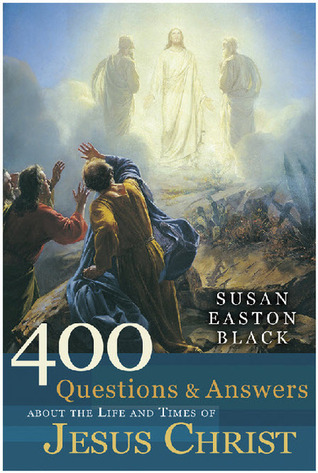 “Fishing on Galilee is always better at night”
400 Questions and Answers about the Life and Times of Jesus Christ
By Susan Easton Black
I feel a little thrill every time I pick up a book written by Dr. Black. From past experience, I know that the pages will contain a deluge of pertinent information presented in an accessible manner that will enrich my understanding of whatever topic the book covers. 400 Questions and Answers about the Life and Times of Jesus Christ is no different. Dr. Black distills the essential facts regarding common and not-so-common questions about life in Palestine under Roman rule from dozens of authoritative resources.
As the title suggests, the book is laid out in a question-and-answer format, color-coded and chronologically grouped into periods of the Savior’s life: “The Child Jesus,” “Early Galilean Ministry,” and “The Last Week,” for example. Sometimes the questions seem a bit leading (i.e., “Is it symbolic that the baptism of Jesus was in the lowest river on earth?”) but most are forthright queries, many of which I have asked myself while reading the New Testament. A few examples:
- What was the dominant language spoken by the Galileans at that time?
- What medical options did the sick have for alleviating afflictions at that time?
- Was there a strict order to worship services in the synagogues?
- What rituals were associated with the Feast of the Tabernacles?
- Was it unusual to lend an upper room to strangers during the Passover festivities?
As a Gospel Doctrine teacher in my ward, 400 Questions and Answers about the Life and Times of Jesus Christ has been invaluable to me as a resource while studying and preparing lessons. Knowing a bit more about the Jewish customs and traditions of the time provides a deeper, richer understanding of the events documented by the Gospel writers and the truths they convey.
My major complaint about the book is that there is no index and no table of contents, so in order to find information for my upcoming lesson or re-find a relevant fact I read earlier, I have to do quite a bit of flipping and skimming. Some of the answers are tantalizingly brief, occasionally even a little too terse, and almost every answered question raises even more questions that aren’t addressed in the book. Dr. Black does relate alternate interpretations when her sources differ and endnotes point readers to those sources for additional in-depth reading, if desired.
400 Questions and Answers about the Life and Times of Jesus Christ is a useful, basic resource for better understanding the context of the Gospels. Unless you are already a New Testament scholar, you will find numerous insights to enrich your personal study, as I have.
 “Both a visual and spiritual feast”
This Is the Christ
Art by Carl Heinrich Bloch, text by Paul Thomas Smith
Anyone who has set foot in an LDS church building has probably seen a Carl Bloch painting of the Savior. They are ubiquitous in LDS media. Seven prints of his works can be found in my outdated Gospel Art Kit and there are six in the newer Gospel Art Book (available from store.lds.org). Several of his paintings crop up so frequently on our walls, in Church magazines, and in lessons that they unfortunately carry a slightly stale, timeworn aura. Because we’ve peripherally registered “The Last Supper” hanging on the foyer wall every week when we arrive for Sacrament Meeting, we assume we know it. But we don’t see the cup that has been knocked over spilling wine on the tablecloth, or the cushion carelessly fallen to the floor in Judas’s haste to escape the upper room, or the reverent but concerned expressions on the faces of the other eleven apostles. In our familiarity, we gloss over the details that make this piece so powerful. This Is the Christ helps us slow down and notice, truly see, the specific details of these magnificent paintings that testify of the Savior and His life.
In This Is the Christ the paintings are arranged roughly chronologically, with each painting reproduced on a full page and accompanied by text written by Paul Thomas Smith.
He quotes heavily from the Gospels and books by General Authorities (notably Jesus the Christ by James E. Talmage) to describe the setting for the particular painting. Detailed insets in the text highlight small sections of each painting that the casual observer may have missed: the angry and contemptuous expression on Lucifer’s face when Christ rejects his temptations, the greedy moneychanger clutching his scales and coins spilling on the ground while Christ is cleansing the temple, the young child reaching for a butterfly during the Sermon on the Mount. While perhaps not as affecting as viewing the life-sized paintings in person, the focus on these tiny details is the next best thing.
Carl Bloch’s “Gethsemane” was one piece I don’t recall seeing before opening this book. It shows the angel sent to comfort and strengthen Christ during his anguish in the Garden (see Luke 22:43). Unlike many depictions of this scene that have the angel standing in the background, or floating slightly above and separate from Christ, this angel physically supports and cradles the Savior, stroking His hair. It’s a strikingly intimate view of the Savior’s suffering that brought tears to my eyes.
Published as a companion to the exhibit of Carl Bloch paintings on display at Brigham Young University through May 7, 2011, This Is the Christ pairs these moving pieces of art with scriptural texts and cultural insights to create a touching chronicle of the life of Christ. (If you are able, make plans to view these paintings in person and also be sure to check out the article in this month’s Ensign about the exhibit, “Carl Bloch: Reaching toward Heaven.”)
* Disclosure: I received review copies of each of these three books from the publishers.
**************************
On My Bedside Table…
Just finished: A Strange Stirring by Stephanie Coontz
STILL reading: American Grace (It’s really good – it was even referenced by Elder Cook in General Conference! – I just keep getting distracted by other, shorter books.)
On deck: China: A History by John Keay
**************************
Come find me on goodreads.com or email suggestions, comments, and feedback to egeddesbooks (at) gmail (dot) com.