


Latter-day Saints exhibit their original paintings at the Washington DC Temple Visitors’ Center through March 27th. Come take an online view.
If poetry is an economy of words, how would we describe fine art? Does a painting, a sculpture or a photo need to be immediately or universally appealing to be deemed art? Does it need to have a commonly interpreted message to have meaning?
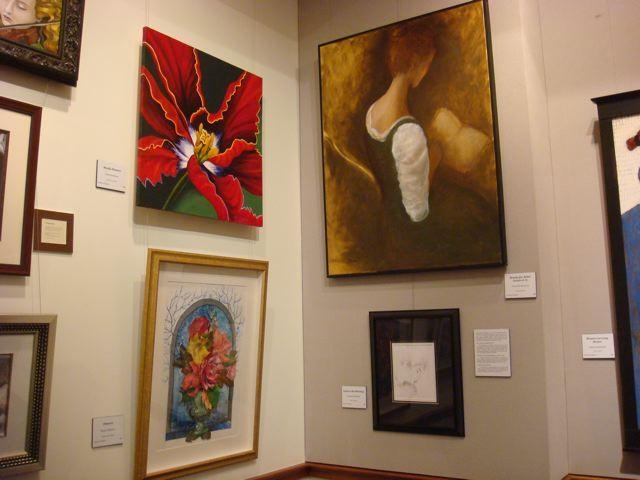
Elder Dallin H. Oaks once said that “a scripture is not limited to what it meant when it was written but may also include what that scripture means to a reader today.” If we apply that principle to the sixty-seven pieces of art—paintings, sculpture, glasswork, jewelry, drawings– on display at the Washington DC Temple Visitors’ Center, we can come away with a wealth of meaning.
Says Rose Datoc Dall, a contributing artist to the exhibit, “Every viewer brings to the table a different set of experiences and levels of sensitivity and what may deeply touch one person on one level, may or may not elicit the same sentiment from another, or a piece may simply elicit no response at all. To a degree, we react to the scriptures and spiritual messages much the same way. We bring to the table our experience, our level of sensitivity. This is why art can be so powerful (as well as dangerous).”

Kayla Probeyahn is a young artist. Her sculpture Mary is among the collection on display. She says simply, “Art is meant to be understood in the heart.”
Sharon and Gary Fuller, members of the McLean, VA Stake, and organizers of “Fulfill the Vision,” the fine arts exhibit open at the DC Temple Visitors’ Center through March 27th, describe their feelings as they walk into this exhibit: “We find that a few moments of focused thought there are almost more than we can bear. It exhausts us to open ourselves to what is there to be seen, and then to have that followed by what we feel. The emotional impact of those visions and the abilities of the artists to stimulate feelings and personal insights is overwhelming.”
The work on display, like any worthy art, speaks to visitors on several levels. Even from outside of the exhibit room, the visual impact of the artwork is a draw. Color, texture, media, perspective, all please or intrigue, appealing to our senses. As we look long enough to imagine what inspired these artists and to recognize what they inspire in us, the art, of course, speaks to our minds and hearts.
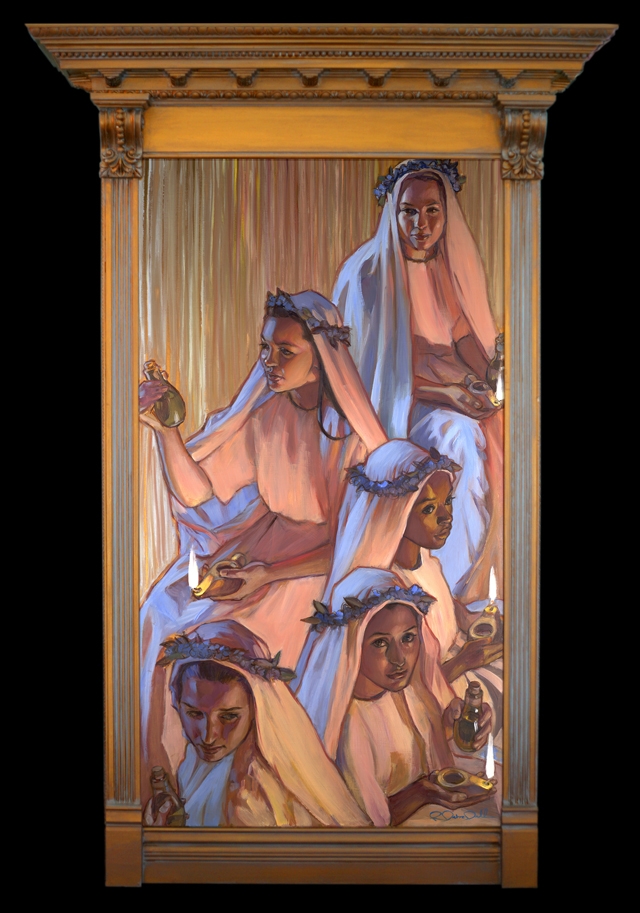
These works were created and solicited in accordance with a broad unifying theme. According to Brother Fuller, “’Fulfill the Vision’ was introduced to submitting artists as an invitation to realize and interpret the Father’s vision for us, His children; and for the world, His creation. No attempt was made to define or otherwise restrict the artist’s conceptualization or portrayal of the theme’s substance. We offered no suggestions, clues, hints or ideas by way of explanation. We considered the broad fertility of the sentiments contained in those three words as adequate, and relied on the feelings, experiences and insights of the artists, and their capabilities to distill and present them to the world.” The result, according to the Fullers, is that “the interpretations embodied in the submitted works are profound and astonishing, mysterious and humbling, confirmatory and contradictory.”
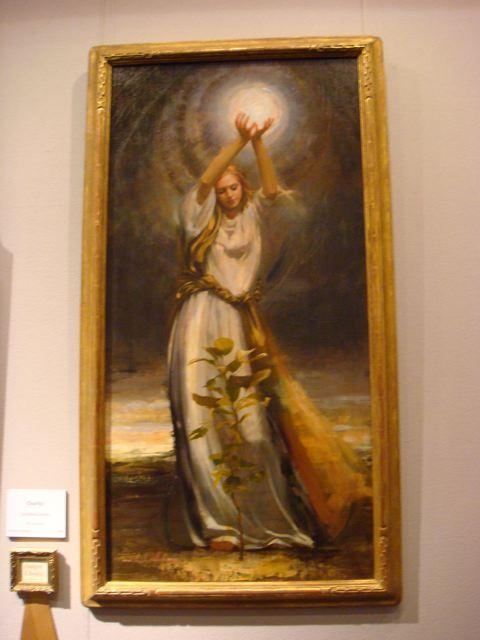
Jonathan Linton, whose oil-on-linen-on-panel painting Charity Never Faileth received a Judges’ Choice distinction, says, “I love the broad-based theme. It helps give a new way to look at all the artwork. The gospel is so rich in concepts that lend themselves to visual poetry. Hopefully, presenting these concepts in this manner helps us ponder the concepts anew. I felt like Charity could help people visualize an aspect of the gospel—a small drop in the ocean of future creations in this theme.” Indeed, Charity Never Faileth is but one of Linton’s paintings illustrating gospel principles. His Justice and Mercy is currently on display at the Conference Center in Salt Lake City.
The sacred nature of the theme asks us to appreciate these pieces on a spiritual level. As a result, there is every kind of beauty on display. I, too, was overwhelmed when I walked into that room and saw what had been submitted. This artwork is a physical and powerful and wide-reaching representation of the things we seek after.

Every piece has a story; in some cases, the poignancy of works that may not have instant, mainstream appeal becomes startlingly clear by virtue of their titles. A detailed watercolor by Rob Talbert of a cowboy squatting with a strand of wire in one hand and a tool in the other is labeled Mending Fences. In another oil painting, Lester Yocum portrays a father sitting outside a crude home, holding an infant, gazing into his face. Its placard reads While Mary Sleeps.
Often, the circumstances of an artist illuminate meanings that would otherwise have eluded us. As an example, a trio of beautiful submissions by three different individuals are more powerful still when we learn that the artists are a mother and her two daughters. An oil-on-glass painting titled My Father is in Heaven was done on the window, still in the window frame, through which the artist used to watch for her father to come home.
An artist’s own stated hope for his or her work is certainly a rich source of insight for viewers. Probeyahn found inspiration for Mary in Michelangelo’s La Pieta. About her sculpture Probeyahn says, “I wanted others to see Mary as I do. After studying Mary in Michelangelo’s version, I began to realize that her expression while looking at her son isn’t all that sad. To me she looked almost proud–in awe. Her heart was aching for Him, but she must have realized the value of what she was holding in her arms.”

Dall’s painting Weathering Autumn “might on the outward appearance be about the fall, but its inception was more or less a commentary on weathering the different seasons not only of mortality, but in marriage. My sister-in-law thought it was rather grim and sad being about the fall, but on the contrary, I feel it is very optimistic. While the leaves in the image have begun to change to autumn, no longer the verdant green of Eden, in my mind the image is about challenges in the moment and yet ahead in mortality and in marriage; but despite them, we are not only to be steadfast and determined, clinging to each other, but we also need to be able see beauty & joy during those challenges which are designed to bring us to our knees often and bring us closer to God.
Thus we are invited to recognize the tender mercies of the Lord all along the way of this journey, even to enjoy that autumn splendor, as it were.”
Of Charity Linton says, “I painted a figurative interpretation of charity. The painting depicts a deserted scene with the single figure of charity holding a light source above a young plant. The light represents the pure love of Christ, which emanates throughout the universe, giving life to everything. Were it not for charity, we would not be able to grow and progress. Thus, the tree represents every good thing. It also represents the principle that our trees of faith, as in Alma 32, will grow if we seek after charity. The painting is of a single figure in a standing position, but it is quite gestural. I want people to see this painting as one of depicted action—something that is alive and applicable in our lives. I also wanted to illustrate the crucial nature of charity, which I feel is as important to life as light to a plant.”

The gospel of Jesus Christ is so fertile a topic as to give rise to myriad expressions of appreciation and worship. Art is certainly one of those expressions, and a singular conduit for the Spirit of Jesus Christ, allowing us to see in a way apart from spoken language the richness of a gospel principle. We most often learn, perhaps, through verbal communication. But art can remove the constraints of words, directing us toward other avenues to understanding. During my visit, many works begged contemplation, the reward being a sudden awakening of insight and a flood of appreciation for the artist and for messages unfolded to me in each piece—an experience common to those willing to give themselves over to the work of an able artist. “Fulfill the Vision” enhances and enriches that common experience with the uncommon strength of gospel principles. Linton hopes that his work “gives people a sense of joy, as truth does when it arrives clearly to our souls.” Linton sees his painting “as a means to experiencing understanding.”
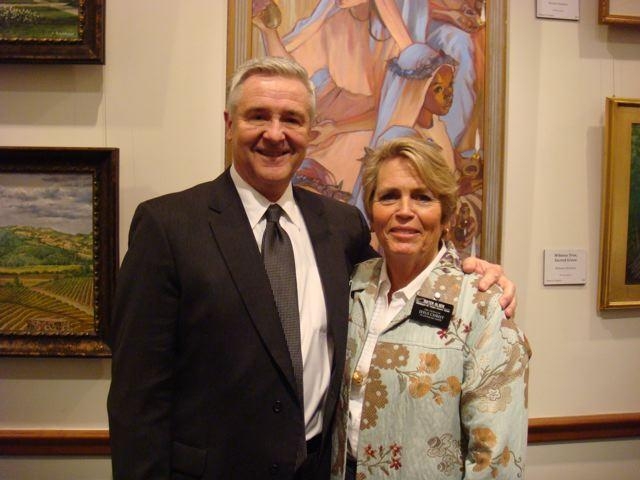
“’Fulfill the Vision’ was installed within the first ten days of our assignment here,” says Elder Don Olsen. Elder Olsen and his wife, Sister Lucille Olsen, have been called to serve as the directors of the DC Temple Visitors’ Center. “We could not be more pleased or honored that an event of this caliber would take place on our watch. The purpose of the exhibit is to bring people to Christ and to His gospel. These artists have shown remarkable talent in creating works that encourage people to do that. When I walk into the exhibit room I can feel the Spirit so strongly. The artwork coupled with sacred music chosen by Kathleen Moorehead, chairman of the Visitors’ Center Cultural Arts Committee, just brings the Spirit into that room. There is no question that it is helping to fulfill the mission of this center.”
“Fulfill the Vision” is a juried exhibit. Because Sister Fuller is a painter, she and Brother Fuller have acquaintances within the art community, from whom they were able to recruit qualified judges. The great number of submissions and the reality of space limitations mean that many worthy entries are not on display. For this reason and more, we look forward to future fine arts exhibitions at the Visitors’ Center.