








I just love diving deep into a topic and learning that what I thought I knew is completely off base. It’s such an unsettling feeling, but also one full of discovery and possibilities. Each of the books in this column cover aspects of Christmas – its history, traditions, and stories – that I thought I knew something about, only to find out while reading these books that the truth is far more interesting than my original misconceptions.
“The secret is to be intentional, not just reactive”
Christmas: A Candid History
By Bruce David Forbes
 Mr. Forbes traces the history of Christmas from its very earliest intimations up through the oft-lamented commercialism and multi-cultural holiday season of today. I don’t want to give away too many of the little treasures I gleaned from this book – you’ll have to discover them on your own – but as a teaser, did you know that in 1939, in the midst of the Great Depression, President Franklin D. Roosevelt moved Thanksgiving up a week? He wanted to give the economy a leg up by extending the Christmas shopping season! This book is chock full of fun historical nuggets like that.
For the most part, Mr. Forbes works chronologically, starting hundreds of years before the birth of Christ with pagan midwinter festivals. Many pre-Christian cultures held these celebrations simply “as a human coping mechanism.” Winter is generally cold and dark, with higher incidences of depression and chemical dependency than other seasons of the year. Midwinter festivals were “an understandable human impulse, to help people survive winter” and often featured large family gatherings, feasts, lights to “push back the oppressive darkness,” and evergreens as reminders that life goes on, even in the winter, and spring will eventually come. Any of that sound similiar to our modern Christmas trappings?
It was fascinating to learn that the early Christian church did not celebrate Jesus’ birth. Early Christianity was, according to Mr. Forbes, “an Easter-centered religion” which focused on the death and resurrection of Christ. In fact, Origen, an influential early Christian writer, roundly condemned the recognition of birthdays. After all, the Bible records that both Pharaoh and Herod, hardly paragons of virtue, celebrated their birthdays in nefarious ways – the Pharaoh killed his chief baker while Herod had John the Baptist beheaded. Jeremiah, Job, and David, on the other hand, all cursed the day they were born. What self-respecting, God-fearing Christian would rather be associated with heathens and murderers than prophets and saints?
Despite that inauspicious start, by the fourth century there was a general recognition of December 25 as Christmas, at least in the western Christian world. Mr. Forbes largely credits the Emperor Constantine’s support of Christianity and the resultant ebb in persecution, which allowed Christians to more openly seek converts. Taking away people’s highly-anticipated midwinter parties was not thought to be a very effective missionary tool, so the church adapted. “Some way or another,” Mr. Forbes states, “Christmas was started to compete with rival Roman religions, or to co-opt the winter celebrations as a way to spread Christianity, or to baptize the winter festivals with Christian meaning in an effort to limit their excesses.” Indeed, “from its very beginnings, Christmas was a fusion of preexisting winter festivals and Christian themes.”
After the Puritans stifled Christmas celebrations in the 1600s, and Charles Dickens and Queen Victoria helped revive it in the mid-1800s (more on that below), the holiday continued to evolve. Mr. Forbes recounts the growth of gift-giving with the rise of consumer culture and industrialization. He tracks the criticisms of the commercialization of the season that started cropping up in newspapers and sermons of the early 1900s. He covers the development of Santa Claus, Christmas cards, wrapping paper, and Christmas-themed music and movies.
Mr. Forbes concludes with a remarkably insightful final chapter that considers three issues surrounding our modern Christmas. First, how can we make Christmas more spiritually meaningful for ourselves and our families? Second, how can we simplify Christmas and escape from the materialism and stress of the season? And finally, what’s the best way to be inclusive of those who don’t share our Christian faith, and may feel like “outsiders” at this time of the year? For each topic, he presents thoughtful suggestions designed to provoke individual introspection and lead to conscious, intentional decisions about how to celebrate the Christmas season.
“A deceptively innocent form to do such serious work”
The Man Who Invented Christmas
By Les Standiford
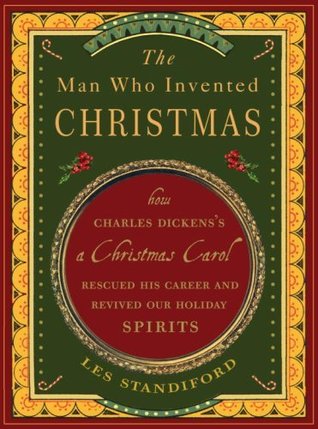 If somehow you have managed to get to this point in your life without reading Charles Dickens’s A Christmas Carol – and watching one of the twenty-eight movie adaptations doesn’t count – stop right now. Run to the nearest library or bookstore, pull it off your shelf or google it (there are some wonderful online renditions at www.archive.org), clear your schedule for an hour or two and read it. It’s short; we’re not talking Great Expectations or David Copperfield. But it’s a powerful little novella that was a catalyst for significant change in the mid-19th century and continues to touch thousands of lives today.
Charles Dickens came from a poor family. His father was chronically in debt, which landed him in debtors’ prison several times. Dickens started working at a young age to try to cover his father’s debts and provide food for the family. Eventually, he won a job as a reporter for a newspaper, writing sketches and short stories on the side to supplement his income. Publishers began to take note of his “keen eye and caustic wit” and his first book, Sketches by Boz, was a runaway success when published in weekly installments in 1836. Pickwick Papers, Oliver Twist, and Nicholas Nickleby soon followed with Dickens’s popularity reaching a dizzying pinnacle with The Old Curiosity Shop. Then came a slump. Sales for his next novel, Barnaby Ridge, were underwhelming. A five-month tour in 1842 across the United States resulted in the not-well-received American Notes for General Circulation. Then, installments of Martin Chuzzlewit were met with markedly less enthusiasm, too. After this series of disappointments, Dickens began to doubt himself and his abilities.
Then, in 1843, Dickens visited Manchester, England, headlining the fundraiser for the town’s Athenaeum, a cross between a library and an extended learning center. Manchester was, at the time, the center of the country’s industry with hundreds of factories and mills and tens of thousands of poor laborers living in squalor. Conditions were terrible. Mr. Standiford points out a bleak statistic that made me catch my breath: fifty-seven percent of children born to working-class parents in Manchester died before they reached the age of five. During this visit to Manchester, Dickens had the first glimmers of A Christmas Carol and quickly became passionate about the idea, returning to London to write feverishly. Coming from a poor background, Dickens was always sympathetic to the struggles of the lower class and felt strongly that society must reform to help those in need, eliminating the “wretched, abject, frightful, hideous, miserable” twin specters of Ignorance and Want. He despised the hypocrisy he saw in much of the organized religion of the day that preached charity, but fell short on practicing it.
Mr. Standiford states, “Dickens believed that a reasonable capitalistic society could be made to recognize its responsibility to all its citizens, and that it was the duty of those most fortunate to share a portion of their gain with those whose grasp had slipped while pulling at their bootstraps.” This simple ghost story was his contribution toward that end.
As remarkable as the book is for its “bald-faced parable” emphasizing themes of charity, goodwill and celebration, the story is also interesting for what isn’t there. While it’s observed in passing that Scrooge “went to church” on Christmas Day, the book never mentions Jesus or Mary by name, only obliquely referring to the Nativity once. Wrapped gifts and Christmas trees don’t make an appearance, though Scrooge does anonymously send the Crachit family a “big prize turkey.” (Incidentally, until A Christmas Carol was published, the traditional centerpiece of Christmas dinner was the goose. The story proved a boon to the turkey farmers, but dealt the goose-raising industry quite a blow.) Instead, the “sanctification of the family,” epitomized by the warm and loving Crachits, and Scrooge’s nephew Fred, holds the place of honor. Even the expectation of Christmas being a holiday from work wasn’t widespread until after Scrooge grudgingly allowed Bob Crachit the day off. Through A Christmas Carol, Charles Dickens spurred a “reinvention” of Christmas celebrations that still influences us today.
“An amazingly short twenty-five-year period – a sort of ‘Big Bang’ of our Christmas”
Inventing Christmas: How Our Holiday Came to Be
By Jock Elliott
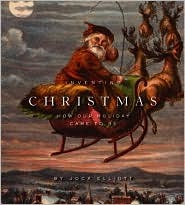 Inventing Christmas covers a great deal of the ground covered more extensively by Christmas: A Candid History and The Man Who Invented Christmas above, but its strength is the beautiful, full-color illustrations throughout. Almost every page has a reproduction of an illuminated manuscript or an old magazine cover or one of the first Christmas cards, from the author’s own collection. (Mr. Elliott counts more than 3,000 Christmas books in his possession, including the first printing of the Nativity story in the Americas – in Algonquian! – and Charles Dickens’s reading copy of A Christmas Carol. What I wouldn’t give for a week in his library!)
Each chapter gives a brief written explanation on how one narrow aspect of Christmas came to be (for example, carols, Christmas trees, and Christmas cards) and then embellishes with stunning images. The text reads like a story rather than a historical compendium, avoiding the multiple scholarly views on topics in favor of a flowing narrative. Its main purpose is simply to provide a framework and background for the illustrations. The chapter on “How Our Santa Claus Was Invented” is completely engrossing. The reader can literally watch the evolution of the saintly man in bishop’s vestments to the pipe-smoking, chimney-descending “jolly old elf” and finally to the modern red-robed, rotund, full-bearded man we now see at every mall during the month of December.
Mr. Elliott displays a copy of the Pennsylvania Packet newspaper dated December 25, 1781, in which Christmas is not even mentioned! He includes wonderfully detailed illuminations from a fifteenth-century Book of Hours showing St. Nicholas and depictions of several of the miracles attributed to him. There’s the famous illustration of Queen Victoria, Prince Albert and their children that launched the Christmas tree fashion in both England and the United States in the mid-1800s and dozens of other fascinating pictures. This book is truly a visual Christmas feast!
**************************
On My Bedside Table…
Just finished: The Girl Who Chased the Moon by Sarah Addison Allen
Now reading: Uglies by Scott Westerfeld
On deck: Half the Sky by Nicholas Kristof and Sheryl WuDunn
**************************
Merry Christmas to all! Next time we’ll move on to a brand new topic for a brand new year. Come find me on goodreads.com or email suggestions, comments, and feedback to egeddesbooks (at) gmail (dot) com.