






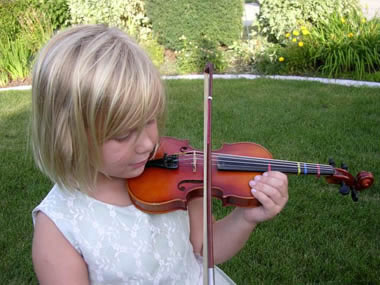
Shinichi Suzuki developed a method of music study, primarily for stringed instruments, in which students listen many times over to the pieces they are to learn. Suzuki postulated that children, after hearing music played in tune and with beautiful tone, would be able to easily reproduce such sounds. Reading music is not introduced until later in their studies.
One only has to attend a Suzuki violin concert to see scores of very young children on stage playing the Bach “Double Minuet,” Dvorak’s “Humoresque,” or a Vivaldi concerto on quarter- and half-size violins to know that his method really works.
Our own children studied violin and piano a la Suzuki. It always seemed that we had a beginner and were continually listening to the variations of “Twinkle, Twinkle, Little Star.” I’m sure that anyone in our family could play the 4th variation on any instrument put in front of him or her. It was a happy day when one of our budding virtuosos graduated to Book 2 and we could start “The Happy Farmer.”
With the busyness of a family of six children and some of them not fond of practice or lessons, we were not the model Suzuki family. I didn’t turn on the tape recorder often enough, and several children over the years pronounced, “I quit.” However, our daughter loved playing the violin, practiced diligently, and later graduated from BYU in violin performance. And our sons ventured for a time into playing the trumpet, trombone, and guitar.
How does this synopsis of the Peterson family’s musical endeavors relate to scripture study?
At the time our oldest two children were listening to Books 1 and 2 on their tape recorders, our third child, Tom, became fascinated with stories on tape. One sure way to get this active little boy to settle down at night, after story time and prayer, was to insert a cassette of a Disney or other story – often with music – into his portable tape player. We discovered a wonderful series of Church-related books and accompanying tapes, produced by former Ensign editor Jay Todd. Tom especially loved the story of Lehi and the Liahona and the Creed Haymond story. He played these tapes over and over.
I didn’t realize how these stories were as much a part of him as the Twinkle variations were a part of his siblings until he was asked to give a talk in Primary. Tom said he wanted to talk about Creed Haymond. I thought we should review Creed’s story and how he refused the wine that his track coach insisted his team drink before an important meet. Tom just started reciting the entire book! When he got to the end, he looked at me and said, “I guess I shouldn’t say, ‘And other books in this series are …’ “
My husband and I have been long-time audio book fans. We’re both avid readers but don’t have as much time to sit down and enjoy books as we would like. This method allows us to “read” while we are exercising, jogging, gardening, driving, cooking, or cleaning. We have a fairly large library of audio books, we borrow from the library or friends, and we have belonged to audio book clubs. Some books, such as the Harry Potter series, are better listens than reads. However, very few books we have listened to more than once.
Listening is one form of learning; reading is another. Audio repetition is a great teacher. If one listens to music or words often enough, they become part of one’s mindset. If one can become a virtuoso violinist or have a quick recall of story material by simply listening, one can also become very versed in the scriptures by listening to them.
Listening, I have found, is a wonderful way to enhance my study of the scriptures. Unlike most other books, listening to the scriptures never grows old. I have had many enlightening and spiritual experiences as I have listened while engaged in such mundane tasks as weeding, folding laundry, or using exercise equipment. In keeping with President Gordon B. Hinckley’s challenge to read the Book of Mormon by the end of 2005, I am listening to the Book of Mormon as well as reading it. The voices of Nephi, Mosiah, King Benjamin, Alma, and Moroni brighten my day, lift my soul, and echo in my mind, long after I turn off my player.
Audio scriptures are available in a variety of formats. Although fast disappearing on the technology scene, cassette tapes are still available but are more bulky and require numerous tapes for any of the standard works. CDs hold much more, are less cumbersome, and require fewer discs per standard work. Newest on the scene is the MP3 player, which holds a vast amount of material, is compact, and doesn’t require changing discs or tapes. Through the Church Web site (www.ldschurch.org), not only can all four standard works be downloaded but so also can Church magazines and manuals.
The scriptural phrases listen, hear, give ear remind us to pay careful heed to the words of the Lord that we may learn what we must do to “come unto Christ and be perfected in him.” (Moroni 10:32):
- So then faith cometh by hearing, and hearing by the word of God (Romans 10:17).
- My son, if thou wilt receive my words, and hide my commandments with thee: So that thou incline thine ear unto wisdom, and apply thine heart to understanding (Proverbs. 2:1-2).
- He that hath ears to hear, let him hear (Matt 11:15).
- Hearken, O ye elders of my church, and give ear to my word and learn of me (D&C 58:1).
- Listen to the words of Christ, your Redeemer, your Lord and your God (Moroni 8:8).
- Hearken, O ye people, and open your hearts and give ear from afar; and listen, you that call yourselves the people of the Lord, and hear the word of the Lord and his will concerning you (D&C 63:1).