







After getting a broad foundation and basic understanding of American history from the books in the last column, we’re ready to explore some specific events and time periods in more detail. Our books today focus on three fairly narrow topics and how the people of those times thought, worked, and lived. We’ll start back at the beginning of the European settlements in North America, check in at the Revolutionary War, and end up at the Astor Place Riot in 1849.
“Caught in a dirty struggle to survive…hoping for redemption”
Savage Kingdom
By Benjamin Woolley
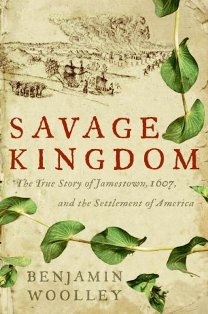 Early this year, in preparation for a family vacation to Virginia’s Historic Triangle (Jamestown, Yorktown, and Williamsburg), I checked out a big stack of books from my local library about the history of Jamestown. This book was the very last of the thirteen – yes, thirteen – Jamestown books I read. And fortunately, it was a solid one to end with.
After an odd prologue set in 1907, the 300th anniversary of the Jamestown settlement, the book steps back to 1565 and the early Protestant Huguenot attempt to colonize Florida – a direct challenge to Catholic Spain’s claims to all of North America. It quickly moves on to the political and social climate of England in the 1590s and early 1600s that influenced individuals to risk everything on traveling to this mysterious land called Virginia. Mr. Woolley excels at providing rich context for the Jamestown settlement and the decisions made by those in authority over it. He wades through an enormous scope of cultural, religious, political, social and economic history across the known world at the time and creates a thorough narrative about Jamestown without over-simplifying the complexities involved and (mostly) not overwhelming the reader with detail. With all that depth and breadth, it would be easy to ignore the individuals involved, but Mr. Woolley manages to draw insightful portraits of monarchs, adventurers, Native Americans and early settlers.
This book provides a comprehensive look at all aspects of the Jamestown experience, from the earlier, unsuccessful English attempts to colonize to the political intrigues back in London, delving further into the reasons for the Starving Time and including a more extensive consideration of settler/Native American interactions than any of the other Jamestown books I read. The settlement at Jamestown is traced from its first conception through the dissolution of the Virginia Company and the takeover by King James, weaving in the Spanish colonization of the New World, Native American culture and politics, and biographical sketches on an astounding number of characters who influenced the colonization of Virginia.
This is not light reading, though, and there were definitely some dry stretches; I wouldn’t recommend this to a casual reader with a passing interest in Jamestown. There were a few editing errors – labels on the two maps showing John Smith’s path while exploring the Chesapeake Bay were switched and the Starving Time was once referred to as the winter of 1608/09 instead of 1609/10. (Yes, I noticed. Did I mention that I read thirteen books about Jamestown?!) But overall, this is a close and thorough look at how and why the Jamestown settlement came about and developed the way it did. Even those who are familiar with this history will learn a great deal.
“Too often the war for independence is portrayed as an exclusively male event”
Revolutionary Mothers
By Carol Berkin
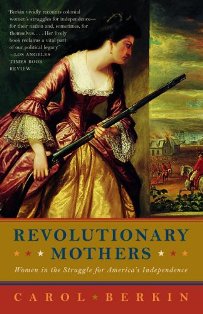 Revolutionary Mothers is a fascinating, intimate look at a wide variety of women and their experiences during the American Revolution. At only 161 pages, it is a quick read, but bursting with incredible stories, most of which you have likely never heard. The women Ms. Berkin profiles are so varied you’re sure to find one who inspires you, from well-known icons like Martha Washington and Abigail Adams, to the anonymous but essential camp followers and Native American negotiators.
I love catching glimpses of remarkable individuals like Molly Brant, a prominent Mohawk Indian who married the British northern superintendent of Indian affairs and was instrumental in negotiating treaties and alliances between those two worlds. Twenty-two year old Deborah Champion acted as a spy and messenger for the Continental Army, traveling long distances and outwitting British soldiers. Esther DeBerdt Reed and Sarah Franklin Bache organized a Ladies Association and launched the largest domestic fundraising campaign of the war. They raised $300,000 – an astonishing amount for the time – and, at General Washington’s request, purchased cloth to make shirts for the soldiers, utilizing the sewing skills of the Ladies Association rather than use any of the valuable contributions to pay others.
Ms. Berkin has a comfortable flow to her writing; I felt like I was reading a story book rather than a history text. She uses first person accounts extensively and effectively. I was especially moved by her recognition of the sacrifice and bravery of women on both sides of the conflict. The chapter on Loyalist women filled a gaping hole in my understanding of the Revolutionary War. Not every colonist wanted freedom from England and those who didn’t were viewed as traitors, subjected to eviction from their homes, confiscation of their property and even beatings, imprisonment, and death. For a woman, this often meant that “loyalty to her husband, once a private commitment, had become a political act.” The chapters from the perspective of Native American women and African American women, frequently invisible in traditional accounts of the war, pointed out that for some the American Revolution led to less freedom, not more.
Ms. Berkin has gathered together powerful stories that give a rounded perspective of a complex time and truly put a human face on the events of the Revolutionary War.
“It was Shakespeare who brought [them] together, and it was Shakespeare who tore them apart”
The Shakespeare Riots
By Nigel Cliff
 Many Americans, and I include myself here, have a limited knowledge of the time period this book covers. We seem to skip over the seventy or so years after the Constitutional Convention and go straight to the Civil War. Reading The Shakespeare Riots will begin to remedy that ignorance. Ostensibly about two actors in the 1840s, one American and one English, this book is actually much broader in scope than the rivalry between Macready and Forrest. With the bloody, seminal Astor Place riot of May 10, 1849, as a launching pad, Mr. Cliff elucidates the state of relations between the two countries, the role theatre (in general) and Shakespeare (in particular) played in the contemporary culture, growing class distinctions in America, the westward expansion due to Manifest Destiny, changing attitudes toward acting as a profession, and government control of the London theatre scene. As if that weren’t enough, he also includes short excursions into the history of the performance of Shakespeare’s plays, Charles Dickens’ trip through America and the Five Points gangs of New York. This book has range!
William Macready, the British “Eminent Tragedian,” and Edwin Forrest, the American “Native Tragedian,” were in the right place at the right time (or, considering the loss of life and destruction of property during the riot, the wrong place at the wrong time) to become symbols of diametrically opposed value systems held by diverging groups.
The two larger-than-life characters started as mutually admiring friends drawn together by their similar experiences and isolated status, but jealousy eventually destroyed the friendship, allowing their personal falling-out to become the focal point for festering national and local resentments. A tragic story all around, the Astor Place riot was a turning point in American history. Class relations, who attended the theatre, what was considered acceptable behavior by an audience, and the use of police vs. military for riot control were all affected by this event and its aftermath.
This book provides fascinating insights into mid-1800s society, but I’ll admit that occasionally I found my mind drifting away from the words on the page. Mr. Cliff’s style leans heavily towards longer, more convoluted sentences with lots of dependent phrases and big words (I have a more-than-decent vocabulary, and still had to visit dictionary.com several times). It’s still well worth picking up for a close look at this facet of American and British history, but I’d recommend reading it in short bursts rather than all at once.
**************************
On My Bedside Table…
Just finished: Mockingjay by Suzanne Collins
Now reading: The Other 8 Hours by George Pagliarini
On deck: Angela’s Ashes by Frank McCourt
**************************
Next column we’ll finish up this brief look at American history with three selections about somewhat more recent events. Come find me on goodreads.com or email suggestions, comments, and feedback to egeddesbooks (at) gmail (dot) com.