






Editor’s note: This is (part 1-A) of a series of articles exploring whether the Liahona that was used in the Book of Mormon contained a magnetic needle similar to those found in compasses today. To read the introduction to this series, click here.
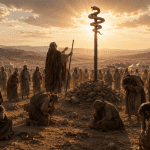
An instrument called a “ball” or “director” [i] is first introduced into the Book of Mormon narrative just prior to Lehi’s leaving the Valley of Lemuel (near the Gulf of Aqaba on the Red Sea)[ii] and setting off into the wilderness of Arabia towards a promised land.
This promised land (the Americas) was seen by Nephi in vision while at the Valley of Lemuel (1 Ne 12-13). He saw that this New World was separated from the Old World by “many waters” (1 Ne 13:12). Hence a trip across a great sea or an ocean was inevitable.
However, Lehi and Nephi were apparently ignorant of many of the details related to how all this was going to take place. It is reasonable to assume that they entertained a myriad of questions as they enquired of the Lord regarding their future. One of these concerns apparently had to do with navigation, both across the desert and across the ocean, and was addressed by the Lord just prior to their leaving the Valley of Lemuel. Nephi records the events as follows:
And it came to pass that as my father arose in the morning, and went forth to the tent door, to his great astonishment he beheld upon the ground a round ball of curious workmanship; and it was of fine brass. And within the ball were two spindles; and the one pointed the way whither we should go into the wilderness. (1 Ne 16:10)
Later in the text we find that this “ball” was specifically termed the “Liahona” (Alma 37:38). The major question I will address here in Part 1 is, “Can the Book of Mormon narrative and other scriptures support the idea that the Liahona contained a magnetic needle?” I will approach the subject from different points of view to determine whether or not further research is justified.
Point #1: What about those who say that I shouldn’t speculate on the idea of a magnetic compass when the scriptures are silent on the matter?
The text of 1 Nephi is silent on many matters. Lehi’s group spent eight years in the wilderness (1 Nephi 16:17:4), yet from the time of the appearance of the Liahona in the narrative until the group reached Bountiful[iii] there are only 34 verses to describe the experience.
In his narrative, Nephi fails to mention other people outside his immediate family group when we know they must have had contact with any number of persons. No mention is made of any animals, yet camels were surely needed to transport tents and supplies (1 Nephi 2:4) and animals were surely needed in order to offer sacrifice and burnt offerings (1 Nephi 2:7,5:9).
Even more telling is the lack of details regarding Nephi’s boat. Although Nephi tells us that the Lord showed him where to find ore in order to make some tools (1 Nephi 17:10) Nephi provides no details on the construction of the ship other than saying that they “worked the timbers” (1 Nephi 18:1) and that “I, Nephi, did go into the mount oft, and I did pray oft unto the Lord; wherefore the Lord showed unto me great things” (1 Nephi 18:3). And the record is completely silent regarding how Nephi as well as the others acquired the skills to sail the ship.
Given such lack of cultural detail I have two choices: (1) I can say nothing more than is written in the text, or (2) I can attempt to try to understand the cultural and historical background in order to gain insight into what is written. Under such circumstances I prefer to think that if I don’t ask any questions I can’t expect to receive any answers, and if I don’t actively seek for knowledge I shouldn’t expect any constructive ideas to come into my mind. “Ask, and it shall be given you; seek, and ye shall find; knock, and it shall be opened unto you” (Matthew 7:7). On that assumption I will proceed.
Point #2: Why did Lehi need to receive the Liahona at the time that he did?
I know to some this might seem like a stupid question. Anybody that has read the Book of First Nephi and most any LDS statement on the Liahona is fully instructed as to how, through “faith and diligence,” the instrument helped Lehi and Nephi get through the desert wilderness to the land Bountiful where Nephi would construct a ship (1 Nephi 16:10-17:5; Alma 37:38-42). However, although I readily acknowledge that “faith and diligence” were extremely important traits for Nephi to learn and acquire, there might be more to the story than this.
Scholarly investigation over the past half century has revealed details of how Lehi and Nephi must have been following a caravan route called the Frankincense Trail,[iv] a route traveled in groups led by experienced caravaneers who knew where they were going and took much less time than eight years to reach their destination.
What then would have been the purpose in having Lehi travel separately, with only a Liahona for guidance? And how would this have any bearing on whether the Liahona was in part magnetic?
Scholarship has also revealed that the only politically appropriate place where (1) key materials for constructing an ocean-going ship were available; where (2) the basic knowledge and skills of how to build such a ship had been perfected and passed down through generations; and where (3) master sailors experienced in navigating seafaring ships spent the winter months relating their trials at sea, was located on the other side (or southeastern shores) of the Arabian peninsula.[v]
There, in the land of Bountiful (proposed as being near the port of Khor Rori in the present-day country of Oman on the Dhofar coast of the Indian Ocean[vi] ), Nephi would be able to obtain the specialized hardwoods for the massive hull and masts, the large amounts of cloth for the many sets of sails, the thousands of feet of rope, and other necessities.
There Nephi would be able to acquire the skills and knowledge of his time so that in overseeing the building of his ship he would know what things to do “after the manner of men” (1 Nephi 18:2) There he also would consult with the Lord on how to construct the tools necessary to make changes such that he could remark:
Now I, Nephi, did not work the timbers after the manner which was learned by men, neither did I build the ship after the manner of men; but I did build it after the manner which the Lord had shown unto me; wherefore, it was not after the manner of men. (1 Nephi 18:2)
And there Nephi would be able to sit at the feet of the master ship captains and learn to sail an ocean-going ship not just out of the harbor (a feat in itself) but across the vast Indian Ocean and beyond. Yet if all this learning and preparation (which must have required “faith, heed and diligence”) were to take place in Bountiful, what was it about the Liahona that required Nephi and Lehi to acquire it and learn to use it before they ever got to Bountiful?
I believe one answer to the above question lies in the art of navigation.
Navigational training for ocean-going vessels has to do with learning various techniques for ascertaining directions and locations while at sea. The lessons of building a boat, and even sailing a boat, while significant, would not qualify one to navigate that ship on open seas.
In Nephi’s time, navigational techniques involved measuring the position of the sun, the position the stars, the directions and intensities of the storms, the flights of birds, and other variables (see part 3). Suffice it to say, and contrary to what some might believe, these techniques worked quite well most of the time — but not always.
There were times when conditions on the sea became sufficiently difficult as to negate the accuracy of every technique. At these perilous times perhaps the usefulness of the Liahona might have made it superior to all the other navigational arts.
Local maritime training alone could not cover all difficult navigational situations. And long-term maritime training could not be accomplished by Nephi without significant risk of losing his special ship, his family, and the Liahona itself. [vii]
Yet by learning to use this “compass” or Liahona to guide his family across the desert under difficult conditions, Nephi would face some very similar navigational problems to those encountered while on the ocean, and furthermore he would be able to acquire this orienteering training without putting a “one-of-a-kind” ship in jeopardy.
Now I know that the above navigational scenario can be seen from the perspective that God provided everything for Nephi, but it can also be seen in light of Nephi learning to navigate by means of a Liahona that was, in part, magnetic.
Point #3: Who made the ‘ball’ and how did it come to be placed by the tent door”?
The next thing I would probe here (and which is seldom discussed) is the question, “Who made the ‘ball’ and how did it come to be placed by the tent door” (1 Nephi 16:10)? I know this sounds like another stupid question; the text is clear that it was “prepared by the hand of the Lord,” but some discussion might be insightful.
Unlike Joseph Smith’s story about obtaining the plates and interpreters from the angel Moroni, Nephi’s narrative record (the Small Plates) is almost void of details concerning the Liahona’s origin. He says nothing about the instrument’s origin in his retrospective telling of his desert travels (1 Ne. 16:10-30)[viii] or his travels at sea (1 Ne 18:12-22).
And the only thing that Nephi does state in his last comment is that, “the ball, or compass … was prepared for my father by the hand of the Lord, according to that which is written” (2 Ne 5:12). Yet nothing is written about that preparation!
One might suppose that there were details mentioned in the account on the Large Plates of Nephi (which account was translated by Joseph Smith but subsequently lost). However, neither a subsequent author of those Large Plates (Alma) nor the abridger (Mormon) adds any details. When given the chance, Mormon only notes that the Liahona “was prepared by the hand of the Lord” (Mosiah 1:16). And Alma writes only that “the Lord prepared it” (Alma 37:38).
Thus my focus moves from the lack of details to the question, What does the phrase “prepared by the hand of the Lord” imply?
I realize that in helping mankind to move forward in the Lord’s work, the Lord has infinite power. I also realize that the Lord usually directs men to help accomplish His work using their own resources and nature as much as they are able. I always refer to this relationship as the Law of Stewardship — that is, the Lord only does for man what man cannot do for himself. [ix] Nevertheless, in the scriptural record it seems that whatever mixture of the Lord’s help and man’s effort, it is all acknowledged to be “by the hand of the Lord.”
For example, Moroni acknowledges that his father Mormon “made this record” and Moroni also acknowledges that “great and marvelous is the destruction of my people, the Nephites.” But Moroni then declares that “it is the hand of the Lord which hath done it.” (Mormon 8:5-8)
Moroni was fully aware that his father, Mormon, gathered ore to molten, then fashioned the plates, after which he painstakingly inscribed the history of his people on them. Moroni was also aware that Mormon directed his people to prepare for battle for years and then led his people into the final battles against the Lamanite armies in which carnage the Nephite armies fought to the death against the victorious Lamanite armies. But instead of pointing to any military actions of the people on either side for the outcome, Moroni simply writes that, “it is the hand of the Lord which hath done it.”[x]
In view of the above, the question I have is this: Did other Nephite writers have this same perspective in regards to the Liahona? Alma not only noted that “the Lord prepared it,” but added that “there cannot any man work after the manner of so curious a workmanship.” (Alma 37:38) But did Alma mean by this phrase that no man had a hand whatsoever in the Liahona’s “curious workmanship”? Perhaps not.
In a similar situation, Nephi writes that in building his ship, even his brothers were able to “work timbers of curious workmanship” (1 Nephi 18:1), so it is clear that “curious workmanship” can be worked by ordinary men. What is key to this process of creating “curious workmanship,” however, as Nephi acknowledges, is that “the Lord did show [Nephi] from time to time after what manner [he] should work the timbers of the ship.” Nephi writes:
And it came to pass that they did worship the Lord, and did go forth with me; and we did work timbers of curious workmanship. And the Lord did show me from time to time after what manner I should work the timbers of the ship.
Now I, Nephi, did not work the timbers after the manner which was learned by men, neither did I build the ship after the manner of men; but I did build it after the manner which the Lord had shown unto me; wherefore, it was not after the manner of men. (1 Nephi 18:1-2)
In other words, by following the directions and inspirations of the Lord, these men were able to achieve a result that was something more than if they had done it completely on their own knowledge and power.
Although the timbers were physically shaped by men’s hands, the result was “curious workmanship” suitable for the Lord’s purposes because the Lord was giving inspiration and direction to Nephi. Nephi’s statement that he “did not work the timbers after the manner which was learned by men” implies that Nephi had apparently expended the effort to acquire the knowledge and ability to build a ship in the normal way “after the manner of men,” because he knew the differences.
These differences weren’t so mysterious as to prevent Nephi’s brethren from feeling competent enough to remark that the ship “was good, and that the workmanship thereof was exceedingly fine” (1 Nephi 18:4) especially in view of the fact that they were the ones that had supposedly built the ship and done the workmanship. Once again, while the hand of the Lord is over everything, his purposes are usually accomplished through at least some effort on the part of men. Nephi was required to fulfill his stewardship and do his part.
So with these perspectives in mind I will go back to the original major question in point #2: Who made the ball? There are several possible answers. Stay tuned for the next installment to read my conclusions.
[i] . For some illustrations depicting the Liahona see the following websites:
www.en.wikipedia.org/wiki/Liahona
[ii] . For an illustrated map of a proposed location for the Valley of Lemuel near the Gulf of Aqaba see www.Nephiproject.com/map_room.htm
[iii] . For an illustrated map of a proposed location for Bountiful see www.Nephiproject.com/map_room.htm
[iv] . For some key pioneering studies, see Hugh Nibley, Ph.D, Lehi in the Desert and The World of the Jaredites, Salt Lake City: Bookcraft, 1952; Lynn and Hope Hilton, In Search of Lehi’s Trail, SLC: Deseret Book, 1976; George Potter and Richard Wellington, Lehi in the Wilderness, Springville, UT: Cedar Fort, 2003.
[v] . See the discussion in Part 2
[vi] . See George Potter and Richard Wellington, Lehi in the Wilderness, Springville, UT: Cedar Fort, 2003. For an illustrated map depicting Potter & Wellington’s proposed location for Bountiful see www.Nephiproject.com/map_room.htm
[vii] . It is interesting to note here that Nephi’s situation might be compared in some ways to that of the brother of Jared. The brother of Jared planned and implemented his solution on how he was going to get across the sea by first gathering special stones. Only after this did the Lord do his part (Ether 2:22—3:6). In Nephi’s situation, he was given a vision of the promised land across the sea. He could have planned a solution. One might ask, Did part of that solution involve a magnetic compass? And if it was, What was Nephi’s part in regards to this instrument before the Lord did His part?
[viii] . It is worthy of note, however, that in the verse just preceding the discovery of the Liahona, Nephi records that, “it came to pass that the voice of the Lord spake unto my father by night, and commanded him that on the morrow he should take his journey into the wilderness” (1 Ne 16:9). Whether the Lord communicated any details concerning the Liahona is not specified in the record. Nephi also notes that Lehi was “astonished” upon finding the Liahona at his tent door (1 Ne 16:10). Yet Nephi does not detail the reasons why he was astonished.
[ix] . “This is the principle in action. If you want the blessing, don’t just kneel down and pray about it. Prepare yourselves in every conceivable way you can in order to make yourselves worthy to receive the blessing you seek. . . . When we are situated that we cannot get anything to help ourselves, then we may call upon the Lord and His servants who can do all. But it is our duty to do what we can within our own power.” (Harold B. Lee) quoted in Stand ye in Holy Places, pp. 244-45) (https://www.gospeldoctrine.com/Ether2.htm)
[x] . Some additional examples might be profitable here. In the book of Omni, Amaleki records that the people of Zarahemla “journeyed in the wilderness, and were brought by the hand of the Lord across the great waters, into the land where Mosiah discovered them . . .” (Omni 1:16). Yet I have never heard anyone interpret this passage to mean that the Lord miraculously transported the Mulekites across the ocean and made them suddenly appear one morning in the Americas without any effort on their part.
Another example is found in the book of Ether. Moroni comments on Ether’s knowledge of Joseph (the birthright son of the house of Israel) who was sold by his brothers and taken into Egypt, only to rise to prominence and save his whole family from starvation and death by bringing them to him. This salvation of the lineage of Joseph (and of Israel) is then compared with Lehi and Nephi’s deliverance from the destruction of Jerusalem by journeying to the new world promised land. He writes:
For as Joseph brought his father down into the land of Egypt, even so he died there; wherefore, the Lord brought a remnant of the seed of Joseph out of the land of Jerusalem, that he might be merciful unto the seed of Joseph that they should perish not, even as he was merciful unto the father of Joseph that he should perish not. (Ether 13:7)
Here once again, while Lehi and Nephi made great personal efforts to save their family from destruction, it is the Lord that is credited with the overall shaping of these historical matters in the same manner as the Lord is credited with previously shaping history by bringing Joseph and his father to Egypt in order to preserve the lineage.