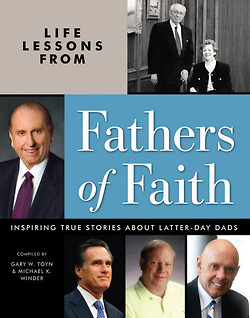




Virginia Hinckley Pearce is the daughter of President Gordon B. Hinckley. This excerpt is from a new book, Fathers of Faith, which features many well-known Latter-day Saints like Jane Clayson Johnson, Stephen R. Covey, Mitt Romney, Larry H. Miller, and Janice Kapp Perry either writing about their fathers or having their children write about them. It is a beautifully presented, coffee-table book, rich in illustration which celebrates the extraordinarily significant role of father.
How does a father pass on his most deeply held values and beliefs—what really matters to him—what really guides his life—and what, by virtue of his teaching them, will most certainly guide the lives of his children?
One summer Dad took my two older siblings and me on a vacation. We drove to a little town in southern Nevada to visit his sister and her family. It’s the only time I remember going on a vacation without Mother, and I never thought to ask why. I was about six years old, my older brother was ten, and our older sister was about twelve. I’m assuming that Mother and Dad simply couldn’t face taking our three-year-old brother on a car trip.
He couldn’t sit still for longer than three seconds and would have definitely been a family problem on a road trip. Perhaps that was it. Or perhaps Mother just needed a break from the rest of us. Impossible to know now, and only a matter for speculation. We visited, swam in the warm spring swimming hole, had a Dutch-oven dinner amidst the red rocks, and took a few of the older cousins over to Hoover Dam on a little side trip. But the memory from that trip that is still written into my heart and mind was the experience at Mountain Meadow. I don’t believe Dad had been there before. He asked my uncle for directions, piled the three of us into the car, and we drove what seemed to me a long distance—there were no houses, no farms, no other people.
When he finally parked the car, we got out and walked quite a distance until we came to an inauspicious but distinct rock cairn. It was, I believe, surrounded by a simple low rock wall. We all sat down on the wall and after a few moments of silence, Dad told us the story of the Mountain Meadow Massacre.
I don’t remember, of course, the exact words he used, or even the chronology of the events he recited. What I do remember is the compassion and heartbreak evident in Dad’s voice. He wasn’t angry. He said nothing about who was to blame; he simply related as much of the story as he knew, and expressed incredible sadness about the inhumanity of it all.
That little side trip was book-ended for me just a few years before Dad’s death. I had gone with Mother and him to southern Utah for a couple of days following General Conference. He was exhausted and thought it would be good to get away and just rest a bit—something he rarely did. The night before we were to leave to go back to Salt Lake,
Dad asked his security man to leave early enough in the morning that we could go to Mountain Meadow on our way out of town. He said, “I want to see it one more time.”
Once again we drove that lonely road off into the countryside. This time, when we parked, we walked down a long paved sidewalk. It was drizzling rain, and Mother stayed in the car while Dad and I and the security man walked down to the beautiful and solemn monument memorializing the gravesite of those who had been massacred on September 11, 1857. Nobody spoke as we walked around each side of the monument reading the words on the plaques. Dedicated by Dad on September 11, 1999, this rock edifice replaced the little cairn of my childhood.
I looked over at Dad. His eyes were wet with tears as he stood holding the black umbrella. And then I heard him say quietly to himself, “We’ve done everything we can do.” A long silence followed. Then, shaking his head slightly as he turned to leave, he said, “I can’t think of anything else to do.”
I have heard my father give scores of eloquent and inspiring talks—beautifully crafted and full of counsel and testimony—but none has had a more powerful impact on me than those two quiet times in the obscure valley that hosted a terrible tragedy more than a hundred years ago.
What did I learn? First of all, that history matters. Those who have gone before us have things to teach us. Next, I learned that you grapple with hard things. You face them, find out about them, and then you do all you can to help. I learned as I listened to Dad tell the story of the Baker-Fancher party that individuals—all individuals—are important. Their hopes, dreams, mistakes, and pain matter. And lastly, I learned that you reserve harsh judgments—that you let them be swallowed up in compassion and turn your efforts toward reconciliation.
Virginia Hinckley Pearce served as first counselor in the general presidency of the Young Women organization of the Church from 1992 to 1997. A member of the board of directors of Deseret Book, she has written two books for adults and has co-authored four children’s books.
Her father, Gordon B. Hinckley, was the fifteenth president of the Church. After graduating from the University of Utah, he served a mission to Great Britain before beginning a lifetime career of service to the Church. He served as executive secretary of the Church Radio, Publicity, and Literature Committee before being called as an Apostle in 1961. He eventually served as counselor to President Spencer W. Kimball, President Ezra Taft Benson, and President Howard W. Hunter. He became known for an era of unprecedented temple building and for leveraging the power of technology and the media in advancing the gospel of Jesus Christ.