


In phone conversations before our mission and then in face-to-face meetings with our president, we were told of the need for activities directors in Chile – a calling that’s been almost unknown in the Church’s 50-year history in this country. Our job would be to persuade stakes, wards, districts and branches to call these directors and committees, then train them and make them a viable, essential entity that missionaries could rely on for fellowshipping opportunities with investigators and new converts.
We would then provide, upon request, ready-made “activity kits” with detailed instructions, visual aids, films, and other resources needed for a particular activity. We went to work getting ideas, kits, and a selection of family-friendly DVDs together.
Despite months of concerted efforts on our part, little progress has been made with activities. After about the first two months, we began to realize how hard it is to change old habits and ways of doing things, no matter how good the change might be. If this activities thing wasn’t going to work, then we needed to find some other ways to use our time purposefully. We realized we needed to “go and do,” and it would be our responsibility to make our mission happen!
Saving Our Sanity
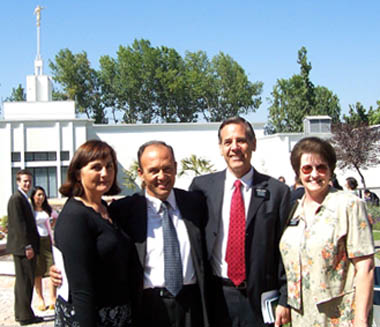
The Santiago Temple came to our rescue, as I offered my services as a journalist to the public affairs department on the eve of the open house in January. They were thrilled with the offer and glad for the coverage in Meridian and Church News about the remodeled temple. My writing skills would also be used by the Liahona‘s local Chile pages.
In addition, we served as hosts on those very warm January days when thousands walked through the temple and visited afterward in the chapel next door. We ferried many of our young sister missionaries back and forth for open-house guide duty.
The rededication events in March will stand out as a highlight of our mission. President Hinckley was scheduled to arrive any moment on the stand at the national stadium, where thousands of Saints had gathered for a devotional and then a cultural program. Security was adamant that no photographers would be allowed on the stand with the prophet, but after a while, they relented and said Church News and Liahona would be allowed. Since I was the assigned Liahona reporter, that meant me, and my husband-companion got to tag along.
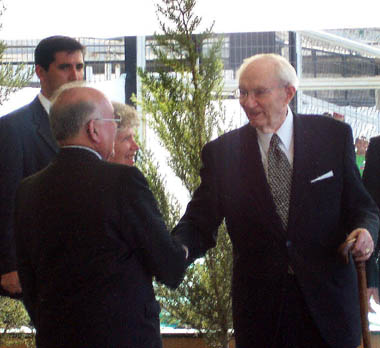
I remember feeling it was one of those rare moments in my life when I’d rather be nowhere else. My article appeared in Meridian, with pictures, the day after the dedication, and many of my photos appeared along with my dedication article in the Liahona three months later. I continue to enjoy interviewing Chilean members for occasional articles.
We also started talking to stake presidents about organizing music directing courses in their stakes, using the course book produced by the Church. We made the classes fun, teaching note values and rhythm and coming up with a Jeopardy-style review game partway through the course.
Interestingly, teaching music is what I’d always envisioned myself doing on a mission, although it was not what the mission president had originally asked us to do. Music skills are rare here, and we are happy to have brought some basic knowledge of music to more than 100 members throughout our mission over the past several months.
Our mission president has also been sensitive to our need to fill our daytime hours and has invited us to teach a variety of things during interview sessions and zone conferences. We love being with the young missionaries! We’ve taught such topics as music directing, social skills, budgeting and use of the mission allowance (which couples don’t get, by the way), using personal experiences in teaching, and so on.
We recently started doing inspections of missionary pensions (apartments) and find a lot of value in helping them keep the 70 places in good order. (And, we’re doing their future wives a big favor!) We have replaced several items, including Teflon fry pans that were so coated with tar and who-knows-what that they were unrecognizable, not to mention unusable. I’ve added to my Spanish vocabulary several new verbs that deal with cleaning – and I use the command form in conjugations when I talk to the elders!
Survival Strategies
Steve’s morning runs have become walks sometimes, just so he can see some different scenery (other than the nearby stadium track) in our flat terrain. He’s taken the elders hiking up a couple of the really tall hills near us but doesn’t feel safe going there alone. I’ve learned to drive several places by myself, out on country roads or to the closest mall on Santiago’s outskirts.
We’ve also hit on a compromise: Steve will stay in the car and “study Spanish” while I go into a mall and do whatever I want to for an hour or so. Occasionally, we try to attend family home evening or go out to dinner with the many couples who work in the area offices in Santiago. Their company gives us a mental and spiritual boost. (And, they speak English!)
Our car – although gas has been around $5 per gallon – gives us much freedom that the area couples in Santiago don’t have (because they live across the street from the offices), so we’ve taken some of them out to the “campo” (the countryside where we live), through the verdant valley of vineyards and farm fields, to the ocean – only an hour away from Talagante. (That one-hour drive is one of the great discoveries we’ve made, and one which keeps us sane.) We’ll never forget the elation of two Peruvian missionaries we took there one P-day – the first time in their lives they’d ever seen the ocean!
After eight months, we finally invested in a DVD player and TV (only the DVD works; the TV’s not hooked up to the cable). This has allowed us to invite local families into our home to see a Church-produced DVD in Spanish without having to agonize over the language ourselves. Other missionaries can have their investigators come to our home to see a DVD. We also enjoy an occasional late-night movie from the local Blockbuster – another one of those perks for couples that young missionaries aren’t allowed.
I’ve been blessed with good books to read, some sent by our daughter, some brought by a longtime friend when she visited in May, some brought by our son and wife when they visited for a week in September, some lent by the president’s wife (who was in my book group before the mission). It’s also been enjoyable passing some of them around to other couples in the area offices who appreciate a good read.
The San Diego-type climate is quite agreeable – 90 percent of the time. Our June-August winter, while mild though rainy outside and rarely below about 48 in the daytime, often wasn’t much warmer inside, as houses here are not heated. We learned to wear several layers, at home and even at church, where heat is available but generally not turned on.
We discovered that we could close all the other doors in the house and turn on our little electric heater in a single room, and after a while, if we were dressed warmly enough, it might get almost comfortable. In bed on those cold nights when it dipped into the 30s, it was something akin to being in a tent during Scout winter camp in Utah, drippy nose and all. We learned to haul our little heater with us to music classes at night in cold church buildings. (I am so glad to know that I am unlikely to experience such a cold winter ever again! At least at home, when it’s cold outside, you can get warm inside!)
September’s springtime brought glorious, vibrant colors to Chile and welcome relief to my freezing feet!
Challenges Still
Although the people here are warm-natured, it’s still a challenge to understand their rapid-fire speech that’s missing the S’s and many other parts of words. At this point, I’ve resigned myself to the fact that although I will never be fluent in Spanish, I’m just going to do the best I can and not obsess over it. In fact, people here are so kind as to correct me or fill in the blank if I’m looking for a word.
My husband (who I will note here, for the record, is going back to work for a few years after we get home), says he has no desire to serve another mission where he can’t speak English. He feels he could do much more here if he could speak Spanish adequately. He is still very much out of his comfort zone language-wise, but I think his unwavering testimony and leadership skills compensate for a lot. His leadership training, every week in some branch or the district, is sure to have a lasting impact.
We’ve been reminded time after time in various situations over the past year that we are not dealing with our fully-functioning Wasatch Front wards, and that we need to develop more patience. But that patience is tempered with a feeling of urgency to make progress in the things that really matter, such as integrating new converts, having more members who enjoy the blessings of paying a full tithe and being worthy to attend the temple, having more families sealed together, preparing and sending more missionaries out – all of which Steve is working on diligently, along with helping the leaders realize their responsibility in these matters.
But relatively lesser things still bother us, like meetings that rarely start on time. But it probably won’t happen in our lifetime, so we’ve learned to take something to read or work on while we wait for the inevitable latecomers. We’ve also learned to eat before a branch dinner, because it won’t really start until 90 minutes after the announced time, which by then will be about our bedtime.
We miss our grandkids the most, but there will be more of them to hold when we get home. We are thinking about how nice it will be to buy a bag full of carrots that are already peeled, lettuce that doesn’t have to be washed leaf-by-leaf (and then turns rusty a day later anyway), an oven that has accurate temperatures and not just “one flame or two,” and a stove that doesn’t require matches to light. (The kitchen always smells like a birthday cake, but at $10 each, I’ve never made any cake here!)
Steve, who’s always washed the dishes, really misses the dishwasher and is looking forward to a flea bite-free life in Utah. I haven’t had a good haircut since I left home, as I’m leery of going into the ubiquitous peluquerias that don’t wash their combs, brushes, or scissors between clients. We don’t always notice the train nearby anymore, but I don’t think we will ever get used to the chorus of barking dogs at night.
We’ve seen blessings poured out on our family at home, and miracles happen with our missionary son in Germany. We’ve rejoiced and commiserated with other senior couples as we’ve shared emails about our varied experiences. We’ve felt the love and support of friends, family, and ward members at home, and as a couple, we appreciate each other more.