






Pilgrimage to Plymouth
by Laurie Williams Sowby
PLYMOUTH, MASS. — Plymouth Rock. Pilgrims. The Mayflower.
Ever since my first visit to Plymouth more than 30 years ago, these three words have evoked images of windswept shores, crude log huts, and Thanksgiving dinner.

The dinner, I’ve since learned, was just part of a common harvest celebration that had been part of English tradition for years, and it wasn’t dubbed “Thanksgiving” until the Continental Congress declared a national day for it in 1777, some 150 years after Pilgrims landed on American shores. A connection between the Pilgrims and Thanksgiving wasn’t even suggested until 1841.
So much for historical origins.
The folks at Plimoth Plantation — a living-history museum with costumed actors filling modern-day visitors in about their origins and daily life in the re-created Plimoth Colony — make it a point to dispel common myths about the Pilgrims and that “first Thanksgiving.”
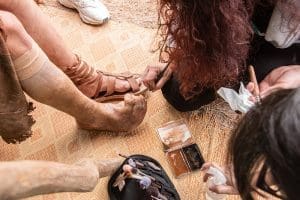
Role-players stand at the doorways, along the lanes, in the small herb gardens, or inside the one-room log homes built to resemble 17th-Century Plimoth. Each actor, whether portraying Myles Standish or some lesser-known resident, has studied his character’s history, gleaned through careful research. And each is ready and able to converse with visitors about any aspect of their lives, past or present, sounding a lot like Shakespeare.

After a stop at the visitor center for the 15-minute orientation film, we got to witness a display of powder muskets as rows of armed men advanced across a field in a military exercise a la 1627; watch present-day artisans demonstrate their crafts such as basket weaving, boot making and tatting in the Crafts Center; sit on the hard benches in the church/fortress that doubled as the town meeting hall; and see Indians in the small Wampanoag village within Plimoth Plantation fashioning a canoe.
In certain areas, the smell of cows, hogs, and other farm animals overwhelmed any other senses, making the Eel River Nature Walk a most welcome diversion with a terrific view of Cape Cod Bay.
Plimoth Plantation is about three miles south of the larger part of Plymouth, where a 6-ton rock carved with “1620” lies under a columned granite portico on Water Street.

In the harbor three miles north stands a full-sized replica named Mayflower II, built in England, which crossed the Atlantic in 1957. Again, costumed role-players portray Pilgrims, giving all the details of that first 66-day voyage.
It costs nothing to gaze at the rock. For the rest, you can buy a combination ticket which is good for visits to both Plimoth Plantation and Mayflower II over two days. (See below.)

On the hillside above Plymouth Rock, in front of a wax museum, a bronze statue of Massasoit overlooks the whole scene. (It was created by Springville, Utah, native Cyrus Dallin; replicas stand in the Springville Museum of Art and in front of the Utah State Capitol.)
The hill, Cole’s Hill, was where Pilgrims that first harsh winter buried their dead at night, so the local Indians wouldn’t know how few the survivors were.
Relics of the first voyage and its voyagers are exhibited in Pilgrim Hall, 75 Court Street, and there are several old houses around that make for an interesting visit if you have more time.
If you go: Plimoth Plantation is three miles south of downtown Plymouth, Mass. Sites are open daily, April 1-November 30, 9 a.m.- 5:30 p.m.
The plantation costs $22 for adults, $20 for college students with I.D., and $14 for children 6-12; ages 5 and under is free. A family ticket admitting two adults and two children 12 and under is $72, plus $8 for each additional child. Order online at least three days in advance to avoid lines.
Find out lots more about Plymouth, the Pilgrims, and Thanksgiving by visiting www.plimoth.org on the Web.
2003 Meridian Magazine. All Rights Reserved.