







The Kirtland Temple Quarry: A New Tour Partners Church and Community
By Sunny McClellan Morton
A creek trickles over a rocky ledge. Dense foliage shades a quiet path in the woods. This is Church history? Yes. Visitors to Kirtland, Ohio can now enjoy guided tours at the Stannard Quarry, where Joseph Smith helped cut stone for the Kirtland Temple in the 1830s. [1]
A tour of the Stannard Quarry offers more than just a pleasant walk through the forest. The lush scenery places visitors in the natural landscape of early Kirtland. Tour guides explain the quarrying process and how the temple was built.
But the tour itself results from a unique partnership between the Church of Jesus Christ of Latter-day Saints (Historic Kirtland), Community of Christ Church (Kirtland Temple), and the park district that encompasses the forest. This partnership enriches the tour: visitors learn about geology, the building of a temple and community, and the shared history of two churches. All while walking in the woods.

The Stannard Quarry, which supplied the stone for the construction of the Kirtland Temple, lies in a forest maintained by the county park district. Photo courtesy of Richard Anderson, Historic Kirtland.
Kirtland
When Newel Whitney opened his general store in 1823, white settlement was still sparse in Kirtland, Ohio, only a few miles inland from Lake Erie. “The country for many miles around had been for centuries the hunting-ground of the Indians,” wrote one pioneer. “The forest-trees were of endless variety and of the tallest kinds. A thick growth of underbrush grew beneath, flowers of rare beauty blushed unseen, birds of varied plumage filled the air with their music, [and] the air itself was fragrant and invigorating.” [2]
But towns sprang up steadily in the early 1800s. When missionaries arrived around 1830, they found hundreds of ready listeners, including the influential preacher Sidney Rigdon. As local congregations grew, other converts gathered to “the Ohio.” Soon the Church had grown sufficiently that the Lord commanded them to build the Kirtland Temple.
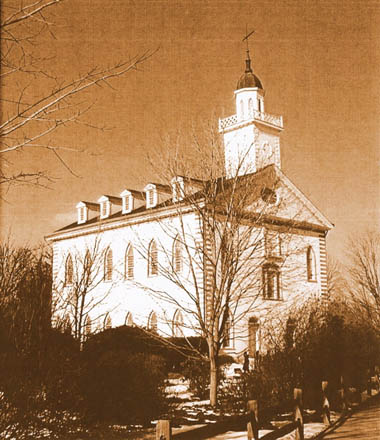
An old photo of the Kirtland Temple, date unknown.
The Quarry
“The stone quarry is an integral part of our early Church history,” explains Elder Pat Brian, Director of Historic Kirtland. “It was at the stone quarry that members of the Church – at the height of their poverty – found suitable materials to build their temple.”
Local Latter-day Saints were the first to take a hammer to the quiet, rocky creekbed. “The earliest use [of the quarry] that we know of is by the Mormons for the Kirtland Temple, and they began to extract stone in 1833,” says Chris Worrell of Lake Metroparks, which maintains the quarry site. “There’s also evidence that it has been used into the early twentieth century, because there are some deeper drill marks and smoother cuts that involved more modern technology than the chisels, wedges, and sledgehammers used by the Mormons.”
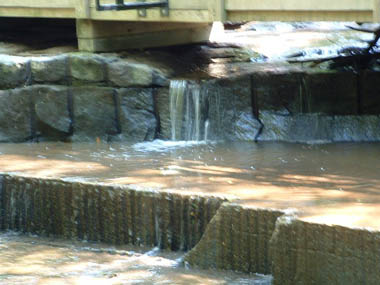
Note the long vertical cuts in the stone. These marks remain from later stone extraction (early 1900s), but more subtle evidence of the Latter-day Saints’ more primitive quarrying methods can be seen all along the creek bed.
The stone is Berea sandstone, a sedimentary rock that dates back about 340 million years. “Go to the beach, grab a handful of loose sand and glue it together, and you have Berea sandstone,” explains David Saja, Ph.D., Curator and Head of the Department of Mineralogy at the Cleveland Museum of Natural History.
Saja was mapping Lake County geological formations when he was asked by the Metroparks to verify that the Stannard stone matched that used in the Kirtland Temple. Yes, said Saja after taking a look, the Temple stone “most likely” came from that quarry. He did not visit other local sites, but taught Metroparks staff how to match a quarry rock against its exported stone.
Now it appears that the quarry supplied much of the community. A nearby church and homes, built in the 1800s, are thought to be built from the same bed of rock. Even several road abutments – some still in use – contain stone from the Stannard Quarry.
“Kirtland is built upon the natural resources of the land,” says Worrell. “One of the neatest aspects of this tour is that here you can see the direct relationship between the quarry and the community it built.”
Early Church members used primitive methods of “plug-and-feather” quarrying. A natural fissure was found – or one was created by a chisel – and a wedge was driven in with a sledgehammer. Sometimes long metal plates would be used along the fissure to more evenly distribute the pressure. Though some of the earliest marks in the stone have been obliterated by later quarrying, there is evidence of the more primitive type of quarrying all along the creek bed.
The temple “was built out of rubblestone, a very irregular shape of stone that today would give a stone mason fits,” continues Elder Brian. “But it was the building material that the Church members found available, two miles south of the temple.” Joseph Smith himself was a foreman at the site.
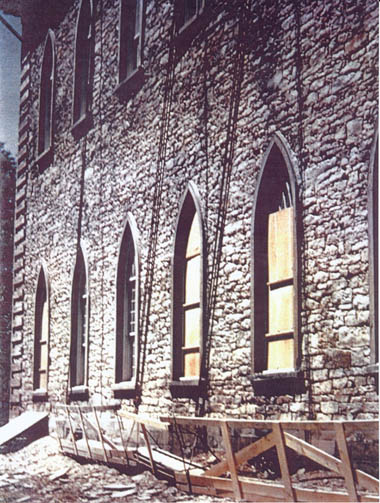
This rare view of the Kirtland Temple walls shows the rubblestone construction beneath the stucco surface.
The Partnership
A tour so rich in geological, historical, architectural and community perspectives could only come about through a unique partnership of researchers. Historic Kirtland missionaries worked side-by-side with staff from the Kirtland Temple (Community of Christ Church) and Lake Metroparks to develop the script and confirm its accuracy.
“Basically our main contribution has been research of the accuracy of the information. There have always been stories about what the stone was used for, and we really focused on all of the places the stone was used,” says Pat Morse of Lake Metroparks. “We developed the script. Some of the site enhancements [including a boardwalk, signage and a kiosk] were joint projects with Historic Kirtland, and some were routine maintenance on our part.”
The Community of Christ provided valuable insights into the building of the Kirtland Temple. Their archive of original research, photographs, and architectural information informed the quarry tour script.
The Church of Jesus Christ of Latter-day Saints provided the volunteer hours – more than 1800 last summer alone. Senior missionary couples trained as volunteer representatives of the park system and wore green park vests while on duty. “Last year the volunteers worked seven days a week, two shifts, and met with almost 6500 visitors,” reports Morse. “Anybody I talked to really appreciated the friendliness of the volunteers and how welcoming they were and easy to approach. It was nice to have a hands-on person there, taking them on the short walk and showing them a couple of things, rather than just reading a sign.”
Pat Morse summarizes the quarry tour partnership. “It was just nice to have all the different perspectives and resources available. Each group has different resources to share. We always like to have the community members involved in our parks. It’s a win-win situation for everybody.”
Lake Metroparks hopes that local residents and Church history tourists alike will enjoy the tours. Says Worrell, “It’s for anyone who wants to learn about the work involved in the construction of that magnificent temple – when there really wasn’t much technology to do the work.”
Details
A handicap-accessible boardwalk and level path make the Stannard Stone Quarry walking tour pleasurable for everyone. Park amenities include picnic areas and pavilions with grills; drinking water; restrooms; hiking trails; horseback riding lessons and groomed trails; playground; pond fishing; ball/game fields; and limited bridle trails. During the summer, tours run Monday through Saturday, 10:00 a.m. – 6:00 p.m., and Sundays, 11:30 a.m. – 6:00 p.m. For more information, call the Lake Metroparks at 440/256-1404 or Historic Kirtland at 440/256-9805.
[1] Interpretive Script for Stannard Quarry at Chapin Forest, 2006. Developed by joint partnership between Lake Metroparks, Historic Kirtland and the Kirtland Temple. Copy in possession of Historic Kirtland. Historic photos used in this article come from the Interpretive Script materials as well.
[2] Quoted in Karl Ricks Anderson, Joseph Smith’s Kirtland. Salt Lake City: Deseret Book, 1996, p.2-3, from History of Geauga and Lake Counties, Ohio. Philadelphia, 1878. p.246
2007 Meridian Magazine. All Rights Reserved.