






Saving One Soul: My Own Story
By Jennifer Sabin Sattley, with Marilyn Faulkner
This is the first of a two-part article about the author’s struggles with cystic fibrosis, and the miracles that happened in her life. Read part 2 tomorrow in Meridian Magazine.
As a preface to my own story I’ll quote a story told by Ben Banks from the November 1999 Ensign:
Several years ago my wife, Susan, and I had the opportunity to tour the New Zealand Mission. As part of the tour we include a preparation day involving stopping at several beautiful scenic sites along the way.At one of those stops, as we walked back to the bus, I became curious about a group of passengers standing in a circle on the road taking photographs. As I peered over the people, I saw in the circle a frightened little baby lamb on wobbly legs. It appeared to be no more than a few hours old. I have seen a lot of sheep in my life, since my father-in-law was in the sheep business. Consequently, I had no interest in taking a photograph of a solitary lamb, so I boarded the bus and waited.
After all the passengers finally boarded the bus, the driver picked up the frightened little lamb in his arms, held it tenderly against his chest, and brought it on the bus. He sat down, closed the door, picked up his microphone, and said to us: “Undoubtedly a band of sheep has gone through here this morning, and this little lamb has strayed. Perhaps if we take it with us, we might find the band of sheep farther up the road and return this baby lamb to its mother.”We drove through several kilometers of beautiful forests and finally came to a beautiful meadow of tall, flowing grass. Sure enough, there in the meadow was a band of sheep feeding. The bus driver stopped the bus and excused himself. We all thought he would put the lamb down on the side of the road and come back, but he didn’t. With the lamb in his arms, he carefully and quietly walked out through the grass toward the band of sheep. When he got as close as he could without disturbing them, he gently put the lamb down and then remained in the field to make sure the baby lamb returned to the fold.
As he returned to the bus, he once again picked up his microphone and said, “Oh, can’t you hear that mother sheep saying, ‘Oh, thank you, thank you, thank you for bringing my lost lamb back home to me!’ “
The Savior’s admonition to go the extra mile to find His lost sheep is evident throughout the scriptures. “What man of you, having an hundred sheep, if he lose one of them, doth not leave the ninety and nine and go into the wilderness after that which is lost, until he find it?” (Joseph Smith Translation, Luke 15:4).
The Good Shepherd knew when one of His sheep was missing: “He numbereth his sheep, and they know him” (1 Ne. 22:25), “and he calleth his own sheep by name” (John 10:3). He went “into the wilderness,” which at times has been defined as “a confusing multitude or mass” (Merriam-Webster’s Collegiate Dictionary, 11th ed. [2003], “wilderness,” 1432), and He searched for that which was lost.
In the parable of the Good Shepherd, we are not told how long it took the Good Shepherd to find the lost sheep or if others helped in the search, but we do know that they “[knew] his voice” John 10:4) and that He loved them. We also know that He did not give up, that He did “go. after that which [was] lost, until he [did] find it,” and that when He returned, the lost sheep was safely on His shoulders. And then He exclaims, “Rejoice with me; for I have found my sheep which was lost. I say unto you, that likewise joy shall be in heaven over one sinner that repenteth” (Luke 15:6-7).
Like the lamb in the story, I have been blessed with the unique experience to be at the mercy of Christlike individuals who interrupted their busy lives to rescue mine. It is my hope that by sharing my personal story that we can all ask ourselves how we can become more like the our Savior ? our shepherd ? looking constantly and more intently to save the souls around us in whatever small or large ways we can.
Different From the Other Kids
My relationship with Christ began at an early age, when I realized that my life was a little different from other kids. I was born with Cystic Fibrosis, which is a genetic disease that mainly affects the lungs by causing infections that scar the lungs, decrease lung capacity and obstruct airways. The average age of a person with CF is the mid-thirties. The most common cause of death is suffocation due to lungs so damaged they no longer receive oxygen.
I was aware of the grim statistics growing up, but it was some abstract idea because it seemed so far in the future. The thought of marriage and family, however, was never a reality I considered as part of my life.
In seventh grade I noticed a profound change in my health. I remember absolutely dreading school and church simply because I would cough constantly. I would often try to suppress my coughs, holding my breath, but then I would just erupt in loud fits of coughing. I would pray every night and every morning and during the day to “please help me not to cough a lot.” I knew that if there was any way I was to be helped, it was through this prayer in my heart.
Throughout the next few years, I realized my energy just wasn’t the same as everyone else’s. I was tired a lot and missed class whenever I thought I could afford to. The summer after my eight grade year, I remember meeting with the medical team and just crumbling ? realizing I needed my first hospitalization. From that point on, I was accustomed to antibiotic IV hospitalizations and home IV treatments a few times a year. This still wasn’t a big deal to me ? just routine along with the hours of inhaled nebulizers and other airway-clearing treatments, both morning and night, and the regime of pills throughout the day.
There was one night in particular (I was thirteen at the time) that I was feeling quite discouraged and so sick. I was earnestly praying and I literally felt my Savior’s loving arms around me; so strong, so encompassing, so assuring. I knew that I was greatly loved and that I was in God’s hands. And it was this knowledge ? that Christ knew and loved me (just as he knows and loves each of you) that set the course of my life.
A Brother Loses the Fight
Within the next two years, my courageous, humorous, loving, inspiring brother, who also had CF, got increasingly ill. I would spend hours in his room scratching his back, just talking and laughing. Even after numerous blessings and stake fasts, the will of the Lord was that he be taken from this world.
Justin passed away on April 22, 1998 at the age of nineteen. As sick as he was, nothing could have prepared me for actually losing him. I knew that I would see him again. I knew it. And I knew that he was so happy, that he was finally breathing freely and deeply, singing and laughing so loudly without coughing. (He loved to sing and laugh.) But I was still heartbroken and I missed him and I knew I would miss him until I saw him again.
It was during this next year of mourning that I could do nothing to comfort myself but pour my heart out to my Savior. By being so helpless, I was able to realize how much we truly need our Savior in our lives. I could appreciate that he has already cried all of our tears and felt all of our heartache and that it is through the atonement we can be succored, strengthened and given the hope and peace to continue on. As we read in Psalm 30:5 “Weeping may endure for a night, but joy cometh in the morning.”
After Justin passed away, I thought more about the possibility of my own death, yet CF had been a part of my life for so long that I didn’t think death could be just around the corner. But at the age of sixteen, just two years after my brother’s death, my health was steadily declining. I would go to school (when the school day was already halfway over) feeling dead with exhaustion, very lightheaded and having chills or hot spells. I later realized these were the signs of high fevers and I had been going to school with high fevers for much of my sophomore year.
I would come home from school with just enough energy to crash on the couch, do my homework and watch TV. My appetite steadily declined and my coughing and difficulty in breathing increased. Many people, especially my friends, knew I had CF, but they had absolutely no idea what I was feeling. This was a profound lesson in never judging anyone ? a lesson that I have carried with me.
I had gone through the entire school year without a hospitalization and was determined that I could last until the end of the school year. I distinctively remember saying to myself, “Just a month and a half to go; you can do it.” I just wanted to be normal and not go through the whole hassle of a hospital stay, missing school and then home IV’s when it was only about a month or two from summer.
But in April I was admitted to the hospital and given a pick line for IV antibiotics ? an IV that runs from a vein in your arm to up by your heart ? that would end up lasting me for the next nine months. During that time, I had no appetite, was throwing up every day, was having fevers two to four times a day, and had to be on oxygen.
In the beginning months, in order to stay sane, my mom and I organized our home library. I also have memories of venturing out on shopping excursions for accessories and furniture, with my oxygen in tow. I would have my oxygen on in the car and then take it off, walking slowly on the arm of my mother into the store and sitting at the first seat I came to.
We’d look around at everything from that vantage point and then I’d make my way to the next sitting post to look around again. And finally we’d go back to the car, where I’d put my oxygen back on. These outings and projects were highlights of my months, and were all the excitement my little body could handle.
The Beginning of the End
As the end stages of lung destruction set in, I became virtually bedridden, and my oxygen increased to the point where I was hooked up all the time. I barely had the energy to occasionally get some toothpaste on my toothbrush and brush my teeth in bed. I didn’t even have the energy to stand in the shower. I washed my hair in the sink instead.
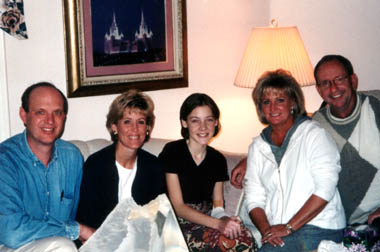
Jennifer, before her surgery, shown here with Jim and Becky
Davies and Debbie and Graham Bullick.
My day-to-day routine was not so bad, but some days the cumulative effect and discouragement of getting increasingly sick ? not being able to do anything for myself or help myself in any way ? would get me discouraged. I tried not to let my family see me cry, but late at night in my room when I was feeling discouraged, I would pour my heart out to my Savior to help me, to comfort me.
And I can tell you that the Lord does care, and that he does hear our prayers. The natural man would tell us to despair, which is a tool, along with fear, used by Satan to immobilize us. But President Hinckley has taught, “Let uncertainty and worry be pushed aside by an enduring feeling of hope.”
I have learned the key difference between adversity and tragedy is trust in the Lord. I was totally and completely at the mercy of the will of my Lord. Through the nights of seeking my Savior, I was comforted and blessed in many ways including my amazing family and friends, and my sustained health.
Mormon reminds us: “Know ye not that ye are in the hands of God? Know ye not that he hath all power?” Mormon. 5:23), and Isaiah says, “He giveth power to the faint; and to them that have no might he increaseth strength.they that wait upon the lord shall renew their strength, they shall mount up with wings as eagles.” (Isaiah 40: 29,31)
After I watched Justin’s decline and passing, I told myself that if I ever was on IVs for a long time and not improving, then I was dying. Yet when I saw the same thing happening to me, the whole idea was hard to accept. I simply didn’t think I could be so close to death when my mind felt so alive.
I was already listed for a cadaveric lung transplant (just in case) when my parents introduced me to the prospect of a living lobar transplant. They were very casual about it, proposing that we keep all our options open.” I felt fine about this proposal because I saw it as just a safety net and that it would never actually happen.
Miracles Begin to Happen
There have been many small and great miracles in my life. One of those miracles I believe happened at my appointment at Children’s Hospital in Los Angeles. While I was waiting for my blood work to be done, Mom and Dad went to tour the ICU. While there, the transplant coordinator pointed out Dr. Starnes, the surgeon who performs the lung transplants. The coordinator called it an “Elvis sighting” because he is rarely seen.
Later, my dad spotted Dr. Starnes again waiting for the elevator. The elevator happened to be right outside the lab, so Dad took the opportunity to introduce himself, my mom and me to Dr. Starnes. I later learned that without that providential meeting, I may never have had the transplant opportunity.
I was considered such a high-risk transplant patient that the medical team was not even going to bring my name up for transplant consideration. It was Dr. Starnes who said, “What about that nice girl I met?” and convinced the team to operate on me. In the many, many trips to Children’s Hospital L.A. that I have since taken, I have never again seen Dr. Starnes.
Another miracle paving the way for my life-saving procedure was the use of a new inhaled drug. Deadly bacteria called cepacia had infected my lungs, which caused my sudden decline in health and would make me ineligible for surgery.
My father, Gary Sabin, is a man constantly led by the spirit, and at this crucial point he remembered a drug casually mentioned by a research friend. A doctor in Australia had experimented with this already FDA-approved IV drug in aerosolized form and found that with many of his patients, the drug had worked against cepacia when nothing else had.
After some research, I began using this drug and after a few months I no longer tested positive for the deadly bacteria. Cepacia is so detrimental during surgery because when the lungs are removed, the bacteria can spill into the bloodstream, causing the infection to flare throughout the body. An immuno-suppressed person with new lungs could never survive with such an infection.
At that time, no hospital would ever transplant a person with cepacia. No known antibiotic kills cepacia and no one ever tests negative after consecutively testing positive for cepacia. So after inhaling this drug for some time, the medical team was baffled when I tested negative for cepacia. They declared it a mystery. This aerosolized drug is now in phase III trial for public use and has been used in many hospitals throughout the nation, allowing transplants to proceed that would otherwise be denied.
After Children’s L.A. accepted me, my dad brought my local doctor home after a fundraising event that had been held just ten minutes from my home. My parents had previously talked to me about a lung transplant, but I had resisted the idea. Dr. Light asked if he could hold my hand, and as I gave it to him I immediately started to sob. I knew something was coming. He held my hand as Mom cradled me.
In essence, he said that even if the cure for Cystic Fibrosis were to be here tomorrow, I was too sick for it to do any good; my lungs were already destroyed. I had been desperately clinging to a spark of hope that everything would work out without having to go through a transplant. Now, I knew what had to be done.
Once I had decided to undergo a transplant, I prayed that if this was the right course, I would continue to feel good about it. And I did. I remember our stake president, Wayne Hilbig, used to always say that, “If the Lord is trying to take you somewhere, let him. We don’t remember exactly who we are ? but He does. He knows everything that will help us become who we were before we came here and to accomplish what we were sent here to do.”
From the deciding point on, my whole body felt lighter. I no longer carried the burden of my questionable fate. I knew what was going to happen, and the thought excited me. I began thinking of breathing easy, having energy, not coughing, not having to do my hours of treatments. I thought of swimming, playing tennis, going out with friends and on and on. I began thinking of a whole new life, and I couldn’t wait!
There was still however one major hurdle ? the saving of my life was completely at the mercy of living donors, and no one in my family qualified. Would there be two people willing to risk their lives to save mine?
Tomorrow: The call goes out for living donors to save Jenny’s life, and more miracles occur.
2006 Meridian Magazine. All Rights Reserved.