


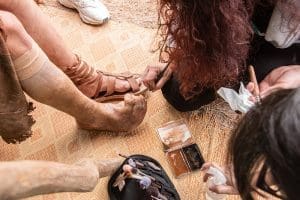





May I introduce you to four women, Linda, Shelley, Susan, and Lisa, who render loving service as they care for their elderly parents. Each has graciously consented to share her philosophies and tips with those of you who are likewise caregivers, or who anticipate becoming such in the future. We’ll hear from them in the order just mentioned with Linda leading out.
I
“It’s a gift,” was Linda’s immediate response to my question about caring for her eighty-eight-year-old mother. She went on to say, “It wasn’t that way at first, but it has truly become a gift to serve my mother and to help her to be happy in her later years. “
Linda added, “It was difficult to assume this role in the beginning for two reasons. First, it’s hard to accept the fact that someone you love is no longer as independent as they have been, and the likelihood that they will be again is slim. If they are your parent, you have to come to terms with the realization that you are losing the mentor you have looked to for help and advice and now you have to assume that role for them. You still want that person to be able, strong, competent, and independent. Second, it’s hard to put your own life on hold’ to help someone live theirs.
“Then, once you’ve decided to be of service, there are two options as I see the situation: either to do it willingly in the spirit of loving service or to do it unwillingly with resentment and self-pity. I decided to love it, and in so doing being of service to my mother became my gift.
“It has also been a gift of huge proportions to my teenage sons. She cared for them when they were young so I could work, and they are helping to care for her now. They have the same love and enthusiasm for her that she showed in caring for them. It is actually just priceless. They think she is adorable and cute, and they feel honored to be able to make her life as wonderful as it can be. Aren’t I just so lucky!!!”
As Linda spoke, I was reminded of a quote I had recently heard:
“There is no greater slavery than service without joy.” – C.S. Lewis
My next question to Linda was a request for a list of tips for caregivers. Again, Linda was quick to reply. These are her suggestions:
Be helpful, but not condescending.
Be patient and understanding.
Treat the person with respect and dignity.
Be loyal when you talk to others about your “patient.”
Be positive and of good cheer.
Make use of available products, equipment, and services to aid in the care of elderly/handicapped people.
Don’t ever discount medications that can help your loved one enjoy their life in spite of their weaknesses. Coming to the realization that, “This is as good as it’s going to get,” can be devastating for them, and medication for depression can give them back their spark and optimism. Don’t hesitate to convey this to their doctor.
Be aware of the fact that “quality of life” is relative. One’s perspective changes over the years. Don’t assume your loved one is unhappy just because he or she is extremely limited in abilities and activities. Old age can be a happy, contented time even for one who is failing in health.
Graciously accept offers from family members and others to assist you in your care or to relieve you of responsibility for a much-needed break. Realize that others may be reluctant to accept the fact that their loved one is failing. Also, they frequently feel inadequate to offer direct help. Define for them what assistance you need, and specifically what is involved, so they can feel capable of helping.
Communicate effectively. Discuss expectations, in particular – –yours and the one in your care.
Clearly and specifically express needs. Don’t expect one another to be mind readers. For example, don’t just hint by saying, “I’m so tired I can hardly put one foot in front of the other.” It’s much better to say, “I’m very tired, so I’m making arrangements for your care in order to take a break.” It would be preferable for the person in your care to say, “Please pick up a container of milk for me,” rather than complain by saying, “I’m low on milk,” (when you’ve already gone to the store). Furthermore, hinting often comes across as whining or complaining.
Take advantage of short-term respite care provided by professional facilities.
Continue to serve your loved one even if long-term respite care becomes necessary. You can still serve your loved one by visiting often, particularly at meal time and helping him or her eat. Elderly people usually love to eat with family members and friends, and most care facilities encourage this inasmuch as it helps the resident enjoy their meals and usually eat more.
Be prepared for a possible change in personality and disposition if some type of dementia begins to set in. The person often becomes confused, frustrated, and agitated. These feelings can manifest themselves as grumpiness or stubbornness. The person may become difficult to live with and refuse to cooperate. A common concern about the latter is the person’s refusal to get out of bed, to get dressed, or to bathe or shower. I’ve developed a “magic potion” (milkshake) that works wonders most of the time in nearly all situations. If I promise Grandma a milkshake as soon as she does what I’m asking her to do, she instantly complies. The milkshake recipe is as follows:
Energy boost for grumpiness, nutrition remedy for dehydration, and bribe for cooperation.
Works every time! (An additional milkshake is great for the caregiver as well.)
Blend:
1. one cup milk
2. one frozen banana (overripe ones have more flavor. Cut them and freeze in plastic bags.)
3. handful of mixed berries (available in the freezer case of the supermarket)
4. sweetener of your preference
II
My friend, Shelley, is responsible for the care of her ninety-year-old mother. She also spends time helping with the care of her in-laws, who are also in their nineties.
Shelley says, “My mother has her wits about her and is very sharp. She is not missing a beat as far as her cognitive skills are concerned, but her physical health is not great. I find that dealing with her many ‘voiding’ issues (both physical and mental) with a sense of humor is my best ally. She gets my humor and it dissipates some of the stress that is associated with her health challenges.
“I also find that avoiding the discussion of problems does not work with her. She knows what is going on and wants to be in the loop about decisions. I find this to be a respect issue.
“We have been able to manage her care in her home with an aide who comes in four hours a day to make sure pills are taken, breakfast and lunch are eaten, and the house is maintained. This is funded by my mom.
“My husband’s parents present an entirely different situation. First of all, their physical and mental states are more demanding. Secondly, they have exhausted Medicare coverage, and they don’t have the funds set aside to cover other in-home professional care services. Fortunately, there are six siblings and their spouses in the line-up to handle their daily care. We realize that this is just a stage of our lives where our priorities are our parents’ care and safe-keeping.
“My mother-in-law’s memory has failed. I find that I just talk about whatever, knowing she won’t really be in the conversation with me. I joke with her, she doesn’t get it, and I find myself just kind of needing a chocolate frozen custard on the way home!
“Sharing their care with other family members certainly makes this a more manageable situation. I hope we can continue on this path, at least for a while. We expect things to change, and they do – even overnight. Nothing is set in stone with elder care; it can change in a heartbeat. And you never have a very strong safety net when it comes to elder care.
“I believe that keeping elders in their own homes is the best situation, if one can take advantage of the many programs that are available”
(Note: Medicaid is only an option when all personal resources are used up.The only exception, according to our sources, is a person’s home, which does not have to be sold until the person dies, and then all monies that Medicaid has used toward their care must be repaid. It certainly is better for people to be able to stay in their home and “borrow” from their home equity than have to sell it and move to pay for a facility.)
Susan and her husband, Bob, moved in with his mother, who has Alzheimer Disease, to care for her.
Susan refers to a helpful book titled, The 36-Hour Day – A Family Guide to Caring for Persons with Alzheimer Disease, Related Dementing Illnesses, and Memory Loss in Later Life by Nancy L. Mace, M.A. and Peter V. Rabins, M.D., M.P.H.
One helpful concept from the book states, “It may be that damaged nerve cells, like a loose light bulb, connect sometimes and fail at other times.”
Susan says, “This visual helps me. I think it is important to understand that the loose connection behavior is not deliberate.”
From personal experience Susan explains, “I have learned that the time comes when complex instructions cannot be understood, let alone followed. Instructions need to be given one step at a time. An experienced nurse told me that someday even that one thing will have to be broken down for more simple understanding. I was surprised how soon she was proven right.
“One example: After helping with shower, dressing, and so on, I invited Grandma to put on her makeup. She has always liked to do that herself, but this day she seemed confused. So we broke it down: put on powder; put on lipstick, and did the other things. One task must be completed before another is mentioned.
“Grandma objects to being showered, but she loves to have her hair done – she wouldn’t miss her appointment for anything. So I say, Grandma, as soon as you’ve showered and taken care of your personal grooming, we’ll go get your hair done.’
“If we offer her food choices, she says no’ to almost everything. We can’t seem to please her. But if we present a plate of food in an appetizing manner, she’ll eat it.
“Whenever Grandma is agitated, we’ve learned to rub her feet with lotion to calm and soothe her.
“I’ve come to realize that it is not wise to make rash statements about what you will or will not do someday for your parents or for yourself. For instance, don’t say, I will never live ___________'(fill in the blank),” or I will never put Mother ____________'(fill in the blank).’ It is much better to say something to this effect to your family:, Let’s trust one another to make wise decisions that will be best for all concerned according to the circumstances at the time’.
“It is difficult to watch a body fail and memory fade, especially when they belong to someone you have long loved and admired. Humor seems to soften the pathway. President Boyd K. Packer’s emergency hymn strategy to conquer the stage of our minds works here, too. Every time I feel frustrated or annoyed by my innocent offender, I try to sing, As I Have Loved You.’ It works! It really works because it not only washes the irritation away, but it also reminds me of the purpose for my being: to become more Christ-like. This sweet little person gives me so much opportunity to practice – and she doesn’t even know it.”
Lisa agrees with the above-mentioned suggestions, especially those related to encouraging other family members to participate in the care of parents. She feels that sometimes others don’t share in the responsibilities because they either don’t know how to help or they fear they aren’t capable of doing so. These feelings can likely be overcome in two ways.
First, be specific about what help is needed. For example, Lisa adds, you might say to a sibling, “I would like to attend a class every Thursday morning for two hours. Would it be possible for you to be with Mother during that time?”
Second, allow others to help in ways they are most able. Lisa said that once she flew from Utah to California to assist her mother, and her brothers paid the airfare. On other occasions she uses her skills as a registered nurse while one sister aids in their mother’s hair care and personal grooming, and another sister takes care of the shopping and organizes their mother’s clothing for easier dressing.
It’s critical, Lisa emphasizes, that you don’t allow resentment to build up when you’re the primary caregiver. It’s important that you share the responsibility as much as possible. Not only do you need help for your emotional and physical well-being, it’s actually selfish if you try to keep all the blessings of service for yourself.
Conclusion
My father was a wonderfully righteous man who faithfully served the Lord in many positions of leadership and responsibility.
However, it was during the last five years of my mother’s life, when her declining health caused him to devote himself fully to her care, that he developed a gentleness and sweetness of spirit we children had never seen before. As we observed this sanctifying and purifying process take place in him, it was clearly evident that the greatest of all the service he had rendered throughout his 94 years was that of caring for our mother.
But charity is the pure love of Christ, and it endureth forever: and whoso is found possessed of it at the last day, it shall be well with him. Moroni 7:47
Excellent resources are provided by the “Division of Aging Services” that operates in most counties in the US*. Their services include:
Meals on Wheels Senior Centers
Transportation Caregiver support programs
Home health Employment information
Companion programs Information on care facilities for lower income seniors
55+ Directory of Services (complimentary book)
(*The Salt Lake County phone number is 801.468.2454)
Do You Need H.E.L.P.?
Home Executive Lessons and Principles
by Daryl Hoole
Daryl is answering questions from readers who contact her at [email protected]. Her response will be sent directly to the reader. Some responses may also be incorporated into her “At Home” column that appears every four weeks on Mondays on Meridian. This information will also be available on her personal website at www.theartofhomemaking.com.