





At a devotional address at BYU, on February 9, 1978, Sister Barbara Smith, General President of the Relief Society, mentioned an event that had been eagerly anticipated for four years – the completion and dedication of the Monument to Women in the garden outside the Nauvoo Visitors Center:
We were given approval by the First Presidency to ask the women of the Church to contribute funds to build a monument in Nauvoo as a memorial to the place where Relief Society was organized under the direction and the inspiration of the Prophet Joseph Smith. Here such a statement about faith in God and faith in self could be made.
We sought earnestly for an artist’s conception that would convey this important message, and we accepted the plan of Dennis Smith. In his plan he suggested thirteen sensitively sculpted figures, representing the gospel concept of women and their relationship to the world, to be placed in a lovely garden setting. People could come not only to enjoy the beauty of these statues but hopefully to take a few moments to contemplate the truths being expressed in artistic form.
There the centuries-old contributions that women have always made as individuals, wives, and mothers could be told. The magnitude of their responsibility throughout the years to give birth to and nurture new life could be recognized as a contribution to be honored, not to be tossed away in the name of progress when indeed no meaningful progress is possible without it.
No one was more excited about the dedication than Rosalie Smith Zufelt, Page, Arizona’s 1990 Citizen of the Year.
Rosalie, age 85, remembers the trip as if it were yesterday – thanks partly to her detailed journal, complete with dozens of photos, clippings and postcards. She was on Bus 7, bound for Nauvoo, on June 24 thirty years ago.
The strong diesel smell and the sound of the buses’ engines idling in the parking lot at 5:30 a.m. only added to the giddy excitement of the group of travelers. Rosalie says, “The getting acquainted, singing and chatter caused time to fly, making our first stop at Stuckey’s Rock Springs, Wyoming, a fast one.”
Happily, one of the women, Francis Langford (from the Phoenix East Stake in Arizona), brought her tape recorder. Because of that fortuitous decision, some of the lore that arose from the intimate swapping of stories on Bus 7 was captured whole, perfectly preserved.
Bus 7 transported Olive Brown, Spencer W. Kimball’s niece (she called Elder Kimball “Uncle President”), Mary Marble (monument designer Dennis Smith’s cousin), and Jackie Dunn, the group’s hostess (sister-in-law of Elder Loren C. Dunn, managing director of the church’s Missionary Department in 1974) . Riding along were women from Holbrook, St. David, Prescott, Globe, Page, Salt Lake City, Provo, Douglas, Phoenix and Idaho Falls.
The tour included Winter Quarters, Mormon Bridge, and Florence Mill, the oldest operating mill in Nebraska at that time.
The hill opposite Florence Mill was outside the city limits in the early days, and served as a hanging hill for horse thieves. Elder Jerry Carpenter, from Safford, was a Winter Quarters missionary, and helped to show the ladies around.
Passing through Council Bluffs, Iowa, the group saw the southernmost bluff, where Joseph Smith Jr. and Brigham Young held their councils.
The group was delayed in North Platte – an inconvenience that preserved them from a tornado a few hours down the road. When the storm had subsided, the trekking sisters entered McComb Illinois and found their beds in Tanner Hall, a sixteen-story men’s dorm.
Rosalie Zufelt found her accommodations remarkable indeed. There are no sixteen-story buildings in Page, Arizona. This was the first time she had slept in a skyscraper.
Hazel McRae, from St. David, Arizona, one of the new bus-buddies, confided that one of her ancestors took a baby boy to Carthage Jail to be blessed by the Prophet Joseph Smith Jr. According to her family history, the Prophet Joseph blessed the infant and named him “Joseph.” One of this baby’s direct descendents, named Jack, was then serving his mission near Liberty Jail.
As the mothers and grandmothers swapped missionary stories, it was recalled that Pete Shaw, from Snowflake, Arizona, was kidnapped on his mission to Chile, but safely returned. In 1978, he was a married man and the father of a baby.
Sharon Thomas, also from Page, Arizona, chimed in with a family tale of her own. Her son’s mission companion was shot four times at close range during a door approach and walked away unharmed.
Another traveler, Ila Asay added a story from her family lore: Her grandfather lived in Missouri when the Prophet was martyred. He testified to his children that he was out in the field as the tragedy was taking place, and even the plants wept. Many people believed Carthage had been cursed, and they were afraid to drink from the communal well.
Sharon Thomas added that her husband Milton’s great-grandfather had owned a blacksmith shop in Nauvoo. He took his eight sons into the shed when the Prophet Joseph was martyred and beat all his weapons into plowshares, then taught the boys how to plow with them.
As they shared tender stories, the sisters watched barges plying the Mississippi River. A local man told them they were probably carrying wheat or iron, and possibly coal. He explained it was much less expensive to ship by barge than by any other means, and bragged that the barges sink 9 feet into the water fully loaded, and each barge carries as much freight as 450 freight train cars.
The ladies of Bus 7 were told that Mark Twain’s allusion to the Widow Douglas’s “Light on Carter Hill,” was inspired by the lighthouse in Carthage. The turnaround bridge was dedicated in 1935 or 1936 by Franklin D. Roosevelt.
The women took a riverboat to Hannibal, Missouri, captained by Harold Eskew. Captain Eskew pointed out Glascox, rumored to be Mark Twain’s favorite island.
Once in Carthage, Priscilla Covey from Globe, Arizona, sang “A Poor Wayfaring Man of Grief,” commemorating the Prophet’s final hours in custody. The travelers learned that Carthage Jail was built in 1820, with window sills 30 inches wide. The jail included a debtor’s cell, a dungeon room, and an attic where the jailor’s little daughter slept.
Hazel McRae said 1974’s Miss Illinois used to live in the white house on the corner opposite the jail. Because she, Hazel, had served a mission in Carthage, she supplied some personal information about the town.
On June 27, 1978, the 134 th anniversary of the martyrdom, Bus 7 delivered its little band of sojourners to Nauvoo for the pageant, “Because of Elizabeth.”
When the audience heard President Spencer W. Kimball was in attendance, they spontaneously serenaded the prophet with “We Thank Thee Oh God for a Prophet,” as he took his seat.
The pageant portrayed the hardships of the Saints who immigrated from England; the organization of the Relief Society; the hardships of the early wives whose husbands served extended and repeated missions; the pennies donated to the Nauvoo Temple; the martyrdoms of the Prophet and his brother Hyrum; the mantle descending upon Brigham Young, and the hardship of leaving Nauvoo and trekking to Salt Lake City.
A moment was captured as the actors portrayed a banished family polishing their doorknob on the way out, and playing one last tune on the piano that had to be left behind.
The sisters sat on the bank of the Mississippi River, on a mild, heavenly night as they viewed the pageant. They realized how blessed they had been, when the pageant was rained out the following two nights.
On June 28, the visitors gathered under a large tent for the climactic dedication. Sister Smith explained that the area was subject to unexpected downpours. The tent turned out to have been an example of superior planning when the heavens opened for 20 minutes, dumping a gully-washer that would have drenched the ladies to the skin.
The dedication program rolled forward, with a choir and flagbearers from 70 countries.
The Visitors’ Center in Nauvoo now houses the ten volumes containing the names of all who donated to the Women’s Monument; but in 1978 this was still a work in progress.
Of note to the passengers on Bus 7: June 28 was also Hazel McRae’s birthday. She had the distinction of being the most senior member of the enthusiastic tour group.
Mary Marble told her bus buddies that Dennis Smith’s idea of creating the 13 separate statues was turned down at first. The original concept was one statue; not a baker’s dozen. But Smith showed the First Presidency a model in a garden settling, and the monument was born.
A highlight of the trip was the dedicatory message from General Relief Society President Barbara Smith. Also on the program were Belle Spafford of the Relief Society General Board; Elder L. Tom Perry; Janath Cannon, General Relief Society Education counselor; Marian Boyer, daughter of LeGrand Richards and General Homemaking Counselor; Dennis Smith, the sculptor; and Ilana Diamond Grodner, representing the governor of Illinois, James R. Thomason.
Mrs. Grodner said, “Rather than bringing the governor’s greetings, I ought to bring the governor’s apologies for what Illinois did 130 years ago. Illinois lost a great resource when the Saints left, and we want you to come back”
Governor Thomason proclaimed Wednesday, June 28, 1978, “Nauvoo Monument to Women Day.”
Elder L. Tom Perry called the monument a court of singular and striking beauty honoring womanhood.
Quoting from the first presidency, he said, “Because all human life began with her, the statues depict the special qualities women offer to the world.”
“The cookie jar is no longer the financial center of the ever-changing condition of the home,” he cautioned. “Remain on your pedestal in places of striking and singular beauty in a revered light, continuing to maintain the priorities the Lord has established.”
Belle Spafford remarked, “The statues will remind us of the unity of purpose and common goals of Relief Society, and the manner in which the prophet organized the Relief Society and ‘turned the key in our behalf.'”
Relief Society Education Counselor Janath Cannon said the monument garden reminded her of the Garden of Eden, and “the decision made there, for which we should be so grateful, and the garden of Gethsemane, where Jesus opened the gate back to God for all that would follow him.”
She advised, “As you walk through the garden here in Nauvoo and contemplate the bronze figures that portray the opportunities available to you as women, may Nauvoo be your Garden of Decision to follow the Savior on the way to perfection.”
Homemaking Counselor Marian Boyer spoke of the profit we may all gain from the talents of others. She cited the example of sculptor Dennis Smith, a family man who used his children and other relatives for models.
She quoted John Ruskin, the art critic, who said, “When we build, let us think that we build forever. Let us not build for the present delight, nor for the present peace alone. Let it be work such that our descendents will thank us. And let us think as we lay stone upon stone, that a time is to come when these stones shall be a blessing, that we might receive inspiration, and be guided as it were by this molding of the humble clay.”
She continued, “The Women’s Monument, which represents the womanhood of the Church, is such an inspired work. May this work be worthy of divine approval.”
She also quoted Florence Hansen, contemporary LDS sculptor, who said, of her “Figure of Joseph and Emma Smith,”

“May these figures represent a gift from LDS women to all women who look upon these figurines. May they realize the precious gift that we should all hold high and most sacred, the co-creation with God. Surely he must love his daughters; for creation is his divine gift.”
Barbara Smith declared:
The people of Nauvoo are blessed by the Spirit of God.
Nauvoo is a monument to the people, a testimony to their virtuous living, their faith and their courage. Nauvoo was a city of promise and vision; of industry, and finally a quiet, empty city.
The purpose of this structure is to commemorate the past; but it is more. The thirteen pieces of statuary in this lovely garden are designed to show what we know to be true about the essential role the irreplaceable contribution of women to life and to making life worth living. This monument will hopefully cause all people who come here to stop and to contemplate what they are learning.
The prophet Joseph Smith indicated that Nauvoo is the beginning era for women when light and knowledge will flow down from heaven. The women’s role is vital and each are of great worth and each will account ultimately for their decisions and their actions.
Each woman has a great legacy. If she responds to the invitation of the Lord, she can communicate with him.
Quoting Spencer W. Kimball, she continued, “We encourage all of you to be abreast of the times, to be familiar with current events, to be able to read the signs of the times, to be prepared to direct your children in proper paths, to guarantee them a purposeful and eventful life.”
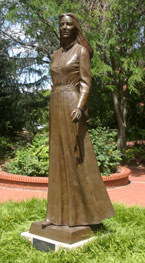
She went on to use each statue to describe a woman’s responsibilities to self, family and others.
“A woman is an essential part of the plan of salvation yesterday, today and forever. There is no way to complete that plan without woman.”
“This garden message can also help each one of us to understand the essential concepts of companionship of a man and a woman. “
She concluded by asking all to pledge themselves to commit to becoming the virtuous woman described in Proverbs 31:10-31:
Who can find a virtuous woman? for her price is far above rubies.
The heart of her husband doth safely trust in her, so that he shall have no need of spoil.
She will do him good and not evil all the days of her life. She seeketh wool, and flax, and worketh willingly with her hands.
She is like the merchants’ ships; she bringeth her food from afar. She riseth also while it is yet night, and giveth meat to her household, and a portion to her maidens.
She considereth a field, and buyeth it: with the fruit of her hands she planteth a vineyard.
She girdeth her loins with strength, and strengtheneth her arms. She perceiveth that her merchandise is good: her candle goeth not out by night. She layeth her hands to the spindle, and her hands hold the distaff.
She stretcheth out her hand to the poor; yea, she reacheth forth her hands to the needy. She is not afraid of the snow for her household: for all her household are clothed with scarlet. She maketh herself coverings of tapestry; her clothing is silk and purple. Her husband is known in the gates, when he sitteth among the elders of the land. She maketh fine linen, and selleth it; and delivereth girdles unto the merchant.
Strength and honour are her clothing; and she shall rejoice in time to come. She openeth her mouth with wisdom; and in her tongue is the law of kindness. She looketh well to the ways of her household, and eateth not the bread of idleness. Her children arise up, and call her blessed; her husband also, and he praiseth her. Many daughters have done virtuously, but thou excellest them all.
Favour is deceitful, and beauty is vain: but a woman that feareth the LORD, she shall be praised. Give her of the fruit of her hands; and let her own works praise her in the gates.
As Bus 7 pulled into Salt Lake City on June 31, 1978, at the conclusion of the trip, Rosalie Zufelt wrote, “We were glad to see home and family, and doubly sure our testimonies were much, much stronger.”
Thirty years later, she stands as a living monument to the Old Testament ideal of a virtuous woman and the Relief Society motto, “Charity Never Faileth.” Upon her return from the dedication, she and her husband spent 20 happy years collecting clothing and household necessities for needy families, and delivering them all over the United States, Canada and Mexico. She was featured on Phoenix Channel 12 TV in a special series, “Twelve who Care.”