





Human Rights: Brought Home from Japan
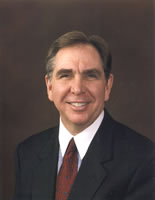
by Michael K. Young
It was a moment of extraordinary happiness. Kathryn, our daughter, was just walking down the terminal in the Salt Lake City airport to meet us after having completed her mission to Japan. The family was gathered and not a few tears were shed. So why in heavens name was I thinking of Sudan, one of the bleakest, most benighted places on earth? On that joyous occasion, why were my thoughts turning to a brutal war that was being conducted by an unspeakably vicious regime halfway around the world? The tragic deaths of two million Sudanese Christians, as well as the unimaginable suffering of over four million refugees displaced during that conflict, are extraordinary tragedies to be sure, but why, at the precise moment I threw my arms around Kathryn, did my thoughts turn there?
And why didn’t those thoughts leave me during the ensuing weeks? Our bishop had thoughtfully invited me to share my testimony during the sacrament meeting at which Kathryn was welcomed home. Again, as I contemplated my remarks, I could not get Sudan out of my mind. And other countries began to crowd my mind as well. North Korea, China, Nigeria, Bangladesh, Indonesia. I could not think about Kathryn’s mission without thinking about the millions of people in those countries who were dying or jailed or beaten simply because they professed a belief in God, a belief we were about to celebrate together as a church community.
Well, one might ask, why such morbid thoughts dominated my mind on what was such a wonderful day? I know I was asking. But the truth of the matter is that such thoughts are rarely far from my mind these days. And the reasons are both very simple and quite complicated.
Seeing the Face of Evil
The simple version is that three years ago I accepted an appointment to serve on the United States Commission on International Religious Freedom, and this year, at the urging of my fellow Commissioners agreed to chair the Commission. The Commission, comprised of nine individuals appointed by the President, the Senate and the House of Representatives, was created by the International Religious Freedom Act of 1998 in order to counsel the President, the Secretary of State and the Congress on what the United States might do to advance the cause of religious liberties around the world. Our assignment is to monitor the state of religious liberties all over the world, and then provide advice regarding ways in which our government leaders can structure and implement our foreign policy to encourage more countries to respect the right to believe and worship as one chooses.
As I have served on the Commission, I can say for the first time in my life that I have truly seen the face of evil. I have spoken with young Sudanese men and women who have been taken captive and forced to serve as slaves under the most horrific conditions simply because they wanted to worship their Savior. I have met gentle Chinese and Vietnamese ministers who have been imprisoned and beaten simply because they invited a few neighbors into their homes to worship God. I have met an elderly Chinese woman who was imprisoned and tortured because she owned a Bible. I met Nigerians and Indonesians whose arms or legs were literally hacked off their bodies with machetes because they wore crosses around their necks.
And I have met North Korean refugees who told of mothers, fathers, brothers, sisters, aunts and uncles who were recaptured as they attempted to flee that unbelievably brutal regime and were then, upon their return, asked only two questions. Were you contacted by South Korean intelligence officials? And, are you a Christian? An affirmative answer to either question earned you what these refugees described as a “short haircut.” When I asked what that meant, they said it meant a death sentence because the North Korean officials shaved the heads of those they are about to execute. They told me of the brutal oppression of all who profess Christianity. They told me of the children, perhaps as many as five million, who are systematically starved and who will surely grow up retarded and physically stunted for lack of nutrition.
Gratitude
The stories are legion. As I have stared into the anguished faces of these witnesses, there can be no doubt of the truth of their testimony. Nor can there be any doubt of Satan’s reign of blood and horror on this earth.
Having lived with these harrowing tales for the past three years and having spent considerable time offering feeble suggestions about what the U.S. might do to combat this reign of terror around the world, honestly speaking, I am never entirely surprised when these terrible thoughts surface, even at the inopportune moments. In fact, I am occasionally surprised when I notice I have gone a few hours without thinking about these things.
But that is the simple explanation. I think there is a more complex and perhaps even more important reason that these thoughts surfaced as I embraced Kathryn, and as I addressed our congregation on the occasion of her return. The longer I have worked on this Commission and the more stories of extraordinary brutality and inhumanity I have heard, the more grateful I have become for the extraordinary blessings of freedom that the Lord has bestowed on me and the more acutely aware I have become of my responsibility to do all within my power to help the millions of people so much less fortunate than I.
The Privilege of Teaching our Children
Among the most important blessings I enjoy is the privilege – indeed, the internationally protected right – to instruct my children in my moral and religious values and beliefs. The international human rights treaties to which the vast majority of the countries in the world, even most of the very worst offenders, belong guarantee me the “right to choose the kind of education that shall be given to their children.” (Article 26.3, Universal Declaration of Human Rights, Adopted and Proclaimed by the United Nations General Assembly on December 10, 1948) Even more explicitly, the government of the country in which I live “must have respect for the liberty of parents…to ensure the religious and moral education of their children in conformity with their own convictions.” (Article 13.3, International Covenant on Economic, Social and Cultural Rights, United Nations General Assembly, entered into force January 3, 1976; Article 18.4, International Covenant on Civil and Political Rights, United Nations General Assembly, entered into force March 23, 1976)
While this sounds like abstract legalese, the truth of the matter is that it guarantees something so fundamental, so important and so real that I thank the Lord for it at least once a day, every day! And as our entire family embraced Kathryn, this right and privilege leaped immediately to mind. How extraordinarily blessed to have been able to teach Kathryn and her brothers about the true and living God. What a remarkable privilege to have been able to hold family home evening, to share scriptures with my children, to send them to Sunday school, to seminary, to institute. How stunning my good fortune to have been able to freely raise my children in the Church without fear of persecution, arrest or death. What sublime good fortune to be able to profess and practice my faith freely and openly and to testify to those I love most the sacred truths and rituals of the gospel that I have come to hold so dear.
Extraordinary Privilege
Indeed, what I have come to learn so personally and intimately over the past three years – and the reason Sudan sprang to mind as I hugged my daughter – is that this extraordinary privilege that I have so long taken for granted is just that, a sadly much too rare privilege. Millions of people in far too many countries wake every morning, knowing that every time they kneel in prayer with their family, share a Bible story with their children or even whisper a testimony, they not only put their own lives at risk, but those of their children as well. Try as I might, I still cannot fully imagine that. And yet, for these millions, this is not only the only way of life they know, but they cannot even imagine the life I lead and the freedom I enjoy.
What a remarkable gift to be able to teach my daughter, and her brother, Stewart, before her, the inexplicable love of the true and living God and the atonement of his Son, all without fear that they might be imprisoned or worse for their devotion. What a blessing to send them out into the world to bear testimony of these extraordinary truths, again without fear they will suffer anything more than a bit of loneliness and perhaps discomfort because of their beliefs. And, even more to the point, as I hugged Kathryn at the airport, I realized even more acutely my obligation to do what little I can to help others around the world secure these same privileges and blessings.
As I stood on the pulpit to bear my testimony different thoughts overwhelmed me, but again the images of the Sudanese slaves and the North Korean refugees crowded my mind. I looked out over the audience and realized just how many people had contributed to the event we were celebrating that day. I saw Kathryn’s primary and Sunday school teachers. I saw perhaps the Church’s best young women’s leader, a leader who had befriended Kathryn and given her confidence in her testimony that rings out even today. I saw many of Kathryn’s good and kind friends in the audience, friends who had left Kathryn with an unshakable confidence that you could have fun and have deep and abiding friendships without ever compromising your principles. I saw bishops who had patiently and gently steered Kathryn through countless interviews, bishops who set such an example of priesthood leadership and love that Kathryn had truly glimpsed through them the love her Heavenly Father has for her. I realized that raising Kathryn in the Church had truly been a joint enterprise and that all those in the congregation were just as responsible for her testimony and her deep devotion as were Sue and I.
Then, the beauty of the other freedoms I enjoy struck with full force. Again, I recall the fundamental human rights to which I am entitled. I am entitled not only to believe and worship as I choose, but of even greater importance to my family, I am entitled to the right to “manifest my religion or belief in teaching, practice, worship or observance” either “alone or in community with others….” (Article 18, Universal Declaration of Human Rights; Article 18.1, International Covenant on Civil and Political Rights)
Again, the legalese, but again the simple and profoundly important guaranty. I can go to church! I can meet with the Saints! I can attend sacrament meeting, ward parties, general conference. I can worship in the privacy of my own home, of course, and frequently do. But I can join the Saints, partake of the rituals of the sacrament and the sacred temples. I can feed on the testimonies and the strength of my brothers and sisters in the gospel. And they can teach and nourish me and my children in the gospel.
As I looked out over that congregation that I have come to love so much and for which I feel such gratitude, I realized – yet again – what a rare and extraordinary blessing I have. I remembered – yet again – all those around the world who are not so blessed, all those who meet, if they meet at all, clandestinely, fearing imminent discovery and the terrible punishments that will ensue. And I thought – yet again – of the Savior’s injunction. Where much is given, much is expected.
2001 Meridian Magazine. All Rights Reserved.