









By L. William Lauro, MD
“Tanned is beautiful.” Do you remember that catchy slogan from the ’50’s? The folks who developed that slogan, namely the advertising gurus on Madison Avenue, were trying to sell the public tanning oils, coco butter, and UV lamps – all the necessary tools to get that rich, dark, healthy tan. People were lead to believe, through these advertising campaigns (and even some members of the medical community), that a bronzed body was a healthier body.
But then in the 1960’s the data started rolling in that showed the strong association between unprotected sun exposure and skin cancer. The evidence became overwhelming that good old sunshine was a known carcinogen.
At that point my mother started coating her kids with suntan lotion before we went to the beach (we were living in South Florida at the time). And ever since that time my family (and most likely your family, too) has been very vigilant about applying sunscreen before heading out for a day in the sun.
Unfortunately, for many of us who are now middle aged, the tanning excesses of the ’50s, 60’s, and ’70’s has created a near epidemic of skin cancer, both non-melanotic (the less serious type) as well as melanotic (the deadliest type of skin cancer).
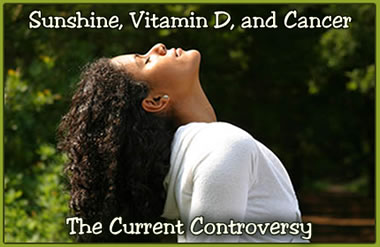
But now, despite the volumes of evidence against unprotected sun exposure, a new theory is receiving wide-spread exposure in the lay press: Sun-screens (and sun avoidance) might be eliminating too much sunlight from our skins and might therefore be reducing our vitamin D levels, a vitamin that has become popular of late because of its potential anti-cancer benefits.
Does this give us license to head back into the sun and throw our sun tan lotion bottles in the trash? What are we to do? Let’s look at the evidence.
A Brief Review of Vitamin D
Vitamin D was the fourth vitamin discovered and thus named “D” because A, B, and C were already taken (not very original, huh). We all remember from our basic health classes that vitamin D can only be manufactured in our bodies when our skin is exposed to sunshine. It can also be obtained from some of the foods we eat, but in much smaller quantities. This is the reason the food industry supplements many foods with vitamin D.
The creation of Vitamin D begins when our skin is exposed to sunshine, first producing an inactive previtamin (Vitamin D3) that must undergo further activation in the liver and the kidney. Vitamin D can also be produced by ingesting the inactive precursor Vitamin D2 which is found in small amounts in many foods. Both of these inactive pre-vitamins are partially activated by hydroxylation in the liver and then fully activated in the kidney.
And so, unless we eat foods that have been deliberately supplemented with vitamin D, such as dairy products, or unless we take a vitamin pill containing vitamin D each day, or unless we get occasional sun exposure, we may be getting less Vitamin D than is optimal for good health.
The Controversy
But here is the controversy, and it surrounds two points:
1) If we can get vitamin D by simply sun tanning, then why waste our time (and money) taking vitamin D supplements and eating vitamin D-enhanced foods – why not simply get more sun exposure?2) Is it possible that the vitamin D we consume via supplementation (mainly in the form of Vitamin D2) might not be as good as the vitamin D3 that our bodies make naturally when exposed to sunshine?
These questions become even more important when we consider the recent claims that vitamin D might help reduce the chances of getting some forms of cancer. And we already know that vitamin D can help prevent osteoporosis and reduce the risk of multiple sclerosis, type 1 diabetes, and imbalance in the elderly (but only when combined with extra calcium intake). Yes, vitamin D is a hot topic right now.
Two Big Questions
So, in light of these recent studies showing the vast benefits of vitamin D, two questions can be asked: should we be getting more vitamin D in our lives, and, if so, should we be getting it from the sun, rather than through supplements?
These are important questions because the last thing we want to do is unravel all the good that has been achieved these past 30 years through educating the public about the risk of unprotected sun exposure and its link to skin cancer and premature aging of the skin.
To answer the first question, let me tell you about the current recommendations for Vitamin D supplementation. For persons younger than age 50, the recommendation is an extra 200 units of vitamin D per day; ages 50-70, 400 units per day; older than age 70, 800 units per day. However, many experts believe these recommendations are too low (some feel that twice these amounts are needed, and I happen to agree with this).
By the way, a glass of fortified milk or orange juice (approximately 8 oz) has 100 units of Vitamin D in it; and most general multi-vitamin pills have 400 units.
Higher does of Vitamin D, when combined with calcium, have been shown in some studies to reduce colon cancer. We know that osteoporosis is benefited as well. We also know that for some reason an elderly person’s balance is helped by extra vitamin D/Calcium intake, and thus elderly people who take these supplements have fewer falls. And the exciting news is that Type 1 diabetes and multiple sclerosis may be reduced by extra Vitamin D and calcium.
Natural Vitamin D (Sunshine) versus Supplemented Vitamin D
Which is better? The studies I reviewed all pretty much conclude that naturally obtained vitamin D (via sunshine) is identical to that obtained by way of oral consumption (diet and vitamins). There is absolutely no reason to assume you are getting “better” vitamin D, or more vitamin D, by sun tanning. Both Vitamin D2 (dietary) and D3 (sunshine) are converted into the same chemical in the liver (partial hydroxylation) and then the kidney (full hydroxylation and activation).
And consider this: When our bodies are exposed to sunshine, Vitamin D3 is created, as we discussed above, but it occurs within just a few minutes of sun exposure; extra sun exposure does not create significantly more vitamin D. The body has a means by which it caps the production of natural vitamin D via sun exposure so that we do not get too much vitamin D (too much can be bad for you). So if you go out into the sun looking for vitamin D production, you will have maximized your skin’s ability to make its vitamin D long before you begin to get a pink coloration to the skin (usually about 7-8 minutes of exposure on a sunny day). Any extra sun exposure is a waste of time and exposes you to unnecessary skin cancer risk. As a matter of fact, only 5% of the surface area of the body needs to be exposed to the sun for a brief 7-8 minutes – this is usually accomplished by simply having your hands and face exposed to the sun on a bright day for this brief period of time.
Sun Tan Lotion and Vitamin D
Some scientists have worried that our penchant for using sun tan lotion to reduce the harmful effects of the sun on our skin can reduce our vitamin D production. These experts therefore have speculated that the population might benefit from 10-15 minutes of unprotected sun exposure each day. However, other studies have shown that sun tan lotion is not 100% perfect in eliminating sun penetration of the skin – enough rays still get through to produce significant amounts of vitamin D. So I would not recommend purposely sun tanning without sun tan lotion just to get vitamin D.
Vitamin D and Calcium
Vitamin D alone does not help prevent osteoporosis, nor does it seem to reduce cancer risk. You need calcium as well, something you cannot get from the sun. This argues for supplementation rather than sun tanning as our source of vitamin D. By the way, we should be getting an additional 1000-1500 mg of calcium per day along with our vitamin D supplementation.
Another thing to consider when taking Vitamin D, whether one gets it from sunshine or supplements – too much of it can be a problem. Yes, studies have shown that higher doses of Vitamin D (along with calcium) can reduce the risk of colon cancer, but this same higher dose increases the risk of prostate cancer! Nothing is ever as simple as it seems – one cannot not just open a vitamin pill bottle and gobble up the pills!
Summary
Additional vitamin D, along with calcium, seems to have many added benefits. Studies show a decrease in some cancers, as well as a decrease in Type 1 diabetes, multiple sclerosis, osteoporosis, and balance problems in the elderly. Exposing the skin to sunlight and/or ingesting foods supplemented with vitamin D (or taking vitamin pills with vitamin D added) can provide adequate amounts of Vitamin D. However, the amounts of vitamin D that can be produced by sun exposure are limited, it exposes the body to a known carcinogen (sunshine), and it ages our skin prematurely. Also, calcium, which is needed for vitamin D to work its wonders, cannot be obtained from the sun. Therefore, sun tanning cannot be recommended as a source of the additional vitamin D we seek.
But if you do want to have some sun-produced vitamin D, then know this: Vitamin D produced by exposure to the sun can be obtained in significant amounts by as little as a brief 7-8 minute sun exposure of just 5% of the surface area of the body three times a week.
Also, sunscreens do not appear to significantly reduce the amount of sun needed to convert vitamin D in the body – some sunshine still gets though.