






Savage Island, Part I
by Terry Bohle Montague
All Rights Reserved
Some portions of this article have been excerpted from Niue of Polynesia, Savage Island’s First Latter-day Saint Missionaries by Robert Maurice Goodman
I was led by the Spirit, not knowing beforehand the things which I should do. 1 Nephi 4:6
A PRAYER OF FAITH
“My missionary companion and I were preparing for a meeting in the village of Lakepa on the island of Niue when a woman rushed up to me. She was carrying a small boy who had been crying profusely. She asked if I would help comfort the child, and I said I would be happy to try. She extended her hand to give me something, and I opened my hand to receive it. Very gently, she placed in the palm of my hand the severed forefinger of the young boy – apparently the finger had been cut off in an accident. With simple faith, she asked if I would please put the finger back on her son’s hand and make it whole.
“Never in my life had I ever felt so totally humble, so completely inadequate, so absolutely helpless than at that moment. I stared down at the finger I was holding. Could this finger be restored onto the hand of this little boy?, I wondered. Do I have that much faith? And will the Lord grant that it should happen?
“The longer I paused, the smaller I became within myself. The mother was waiting for my answer, and I needed to say something.
“I quickly petitioned the Lord in silent prayer. A strong impression came that I should not attempt to restore the finger to its place on the child’s hand, but that I should bless him that he would never miss the finger and would live a long and useful life without it, never being hindered in his work because of its absence.
“I explained to the mother the impression I had received, and she accepted it as God’s will. Filled with faith, I proceeded to give her son the blessing, following the inspiration that had come to me.
“In many ways, that event is symbolic of my experiences as a missionary in Niue. I was young and inexperienced. At times, I wondered if I had enough faith to do what the Lord had called me to do. But my faith was strengthened by the simple yet profound faith of the Niuean people, whom I learned to love and cherish as my dear friends. And as my faith grew, I grew closer to the Lord and learned to trust in Him more fully.”
Robert M. Goodman
In 1744, when Captain James Cook attempted a landing on the island of Niue, the natives greeted him with spears, darts, and stones offered at such velocity, the Captain and his armed crew retreated in haste. Captain Cook declared the island peopled by “savages” and for more than 200 years, the name has stuck. Niue, Savage Island.
In 1952, when Elders Robert Goodman and Wallace Barrett alighted on Niue, they received a less dramatic greeting than Captain Cook’s. Yet, Elder Goodman’s next eighteen months on Savage Island proved a high adventure of strength and great faith as the Spirit led him, not knowing beforehand the things he should do.
NIUE
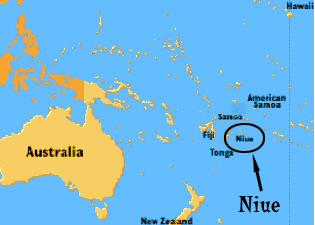
Niue (nee-oo-ay), on a map of the South Pacific, is about the center of all the Polynesian Islands, 500 miles west of Tahiti, 300 miles south of Samoa, 350 miles southeast of Fiji, 240 miles east of Tonga, and 1500 miles northeast of New Zealand. At 17 miles long and 10 miles wide at its widest point, Niue is one of the largest coral atolls in the world.
Unlike most Polynesian islands, Niue has no sandy beaches. Cave-pocked, 100- foot high cliffs of well-pounded coral form the shoreline and there are few places where one can find access to the open sea. Fishermen must make their way along narrow paths down steep cliffs, carrying their canoes on their backs. At the sea, they struggle to launch into the pounding surf. Since Niue has neither lakes nor rivers, the natives collect rainwater washed from their roofs and store it in barrels or cisterns. Although droughts are frequent, and cyclones damage the island every few years, coconut, banana, and papaya trees as well as many exotic hardwoods grow lush and plentifully.

Southern Shoreline
The first Niuean king came to power in about 1600 A.D. He established a government of councils that included a chief from each of the island’s 12 villages. In 1917, when the last king died, another did not succeed him.
In 1952, most of the 5,000 natives who lived on Niue Island did so without electricity, plumbing, or telephone service. Their only link with the outside world was a couple of short-wave radio sets and a freighter that made a once-a-month stop at the island.
CHRISTIANITY COMES TO NIUE
During pre-Christian times, Niueans worshiped nature. The sun, moon, large rocks, and fish. In the village of Mutulau, however, the chieftains taught that a man with a book would someday come to the island and teach of one God.
In the mid-1800s, when the first Christian missionaries arrived with the Bible, many Niueans accepted the teachings wholeheartedly. Later in that century, the London Missionary Society established itself on the island and became the only church functioning there. Because of the natives’ complete trust in the ministers of the London Missionary Society, the LMS positioned itself in island government and ultimately diminished the authority of the king and his councils.
Then, in 1900, when Niue was named a British protectorate and annexed as a territory of New Zealand, the Niuean king and his council became powerless. Governmental control shifted to the London Missionary Society and the head pastor ruled much as the former king had, placing native pastors in each of Niue’s 12 villages.
The LMS taught the Ten Commandments and basic precepts of the Bible and Christianity, laying a sure foundation for the gospel among the Niueans. The Society also taught that disobedience brought down God’s curses. Disobedience meant crop failure, disasters at sea, drought, and cataclysmic storms that would ravage the island. Disobedience could also mean illness, excommunication, community ostracism, stoning, and spiritual curses.
The otherwise fearless Niueans took the threats seriously and, because of that, the leaders of that church exercised great control over the islanders’ lives. The result was not only fear among the Niueans, but problems for the commissioners assigned by Great Britain to administer the affairs of the island. Without the backing or acquiescence of the LMS in Niue, the British government had its hands tied.
THE MISSIONARIES IN NIUE
In 1952, the New Zealand Mission was extended to the Cook and Fijian Islands and to the small coral island, Niue. Savage Island.
 Fritz Krueger, a German immigrant to New Zealand and member of the Church, had a great love of the gospel and a desire to share it with the people of the Polynesian Islands. He went to New Zealand Mission President, Sydney J. Ottley with a suggestion. He told President Ottley he was willing to move with his wife, Isabel, and their six young children to Niue. While he was there, he would earn his living showing movies, and baking and selling bread. He also hoped he would make friends among the islanders and initiate missionary work.
President Ottley liked the idea. Brother Krueger was set apart and the Kruegers moved to Niue.
Robert Goodman was 21 in 1951 when he received a call to serve in the New Zealand Mission. He spent a year in that country, overseeing the Sunday Schools and Mutual Improvement Associations. Then, in 1952, President Ottley reassigned him to Niue.

Elders Robert Goodman and Wallace L. Barrett
The British government readily issued a permit for Elders Robert Goodman and Wallace L. Barrett to enter Niue. The missionaries first flew to Fiji and then boarded a freighter that took them the remainder of the journey to Niue. After a week aboard the Tofua, and with Niue, at last, in sight, Elder Goodman went up on deck for his first look at the island.
One of the ship’s officers approached him and asked, “Elder Goodman, knowing that these people have had one single religion for more than 100 years and have lived in peace and harmony with it, why do you want to bring disunity and contention among them?”
Surprised and disconcerted by the question, Elder Goodman wasn’t sure, later, what he answered other than saying he had a message to deliver on Niue and he intended to do it.
Elders Goodman and Barrett arrived to a warm and earnest welcome from the Kruegers as well as the Resident Commissioner, Cecil Hector Larsen, who promised to do anything he could for the young Elders.

Cecil Hector Larsen
THE WORK BEGINS

The Blue Bell Congregation
The Elders’ living quarters proved to be a pair of lean-to sheds on the back of a little-used store. The missionaries slept on rope cots draped with mosquito netting. Their only water supply came from the rain that ran off their rusty metal roof into a cistern. With neither glass nor shutters in the windows, and doors that didn’t fit their frames, land crabs sometimes found their way into the Elder’ shoes and bedding. The missionaries dubbed their rooms, “the cave”.
Because the missionaries had no vehicle, not even bicycles, they had to limit their proselyting efforts to the area around Niue’s main village, Alofi. Elder Goodman had brought his guitar and taught the young natives “cowboy” songs, while they taught the missionaries “island” songs. Then, in a package sent by Elder Goodman’s family, he found a ball just the right size to play volleyball. Elder Goodman obtained enough fishing line to create a net, and in no time, teams formed to play the first volleyball game on Niue.
With Fritz Krueger’s assistance, a small congregation had already formed in Alofi. The Elders taught Sunday School classes for the youth and held Bible study classes in the evenings. Eventually, the classes led to lessons on the restored gospel of Jesus Christ, the First Vision, and the mission of the Prophet, Joseph Smith.
Soon, adults joined the classes and the little congregation blossomed to a hundred people. The Elders began looking for a building in which to hold their meetings. They found it in The Blue Bell, a former dance club with a concrete slab floor and roof and walls of rusty, corrugated iron panels. The Blue Bell was also without glass in the windows, doors for the entries, electricity, plumbing, or furniture. Natives and missionaries brought kerosene lamps to the night meetings and sat on woven palm leaf mats on the concrete floor.
THE ADVERSARY
With the establishment of the congregation at The Blue Bell, leaders from the other religion on the island began issuing threats and curses from their pulpits. Calamities, bodily harm, and death were promised to those who listened to the missionaries.
Using an old typewriter and a spirit duplicator, Elders Goodman and Barrett responded with a flyer that explained their objectives in coming to Niue and quoted the Apostle Paul’s teachings in Romans 12:14, to “bless and curse not.”
Tension within the community increased as Niueans, under the instruction of the other church’s leaders, began throwing rocks at the Elders, usually ambushing them at night and then disappearing into the jungle.
Elder Goodman recounted one nighttime incident in July 1952.
“There came a thunderous hail of stones and rocks upon our tin roof. The racket was so terrible we were sure our roof was going to cave in. We quickly pulled on some clothes and ran out into the night to hide in the bush. The attack quickly ceased, so we returned to our little home. We had not been hit or harmed in any way from the stones.
“However, Elder Barrett had failed to put on his shoes, and he suffered severe cuts on his feet. Some of the coral rock outcrops on Niue are poisonous and Elder Barrett’s wounded feet became badly infected. Over the next few days, his legs and body began swelling, and he was in serious pain.”
The doctor on Niue did what he could for Elder Barrett, but, a few days later, when the freighter came, making its monthly rounds, Elder Barrett left with it, leaving Elder Goodman without a companion.
Elder Goodman remedied the problem by asking one of the young native men, Wilson McMoore, also known as Moumou, to take Elder Barrett’s place. Though not a member, Moumou agreed.

Moumou and Elder Goodman
The freighter that took Elder Barrett away, brought a pair of bicycles for the missionaries and they extended their teaching to five neighboring villages. The missionaries had to ride over roads surfaced with crushed coral which were much like a gravel road, not easily navigated by bicycles, and hard on rubber tires.
The rock-throwing continued, but the missionaries escaped without injury.
In spite of the missionaries’ problems with the islanders, the Resident Commissioner, Cecil Larsen, befriended and encouraged the Elders by dropping in to see them and inviting them to his home every week. Sometimes they played golf together on the small course the British government had built.
THE AMANAU CAVE

Elder Goodman greets Elder Christensen.
In August 1952, the freighter’s return brought Elder Horace Thayne Christensen as Elder Goodman’s companion. With his arrival, the missionaries began planning their first baptismal service.
Twenty-six members of the Elders’ congregation had received testimonies of the restored gospel and were ready and eager for baptism. Though they had faced the curses of the other church and the ostracism of their families and community, they continued in faithfulness with a desire to be baptized.
 The intensity of abuse in the community escalated to the degree that the Elders worried for the safety of their investigators. They knew they had to be especially careful in planning and carrying out the baptisms. At last, they decided there would be less danger in holding the service at night, in one of the caves at the bottom of the shoreline cliffs.
The Elders rented a truck and, that night, picked-up those who committed to baptism. They left the truck alongside the road at the top of the cliffs and, with a few kerosene lanterns, the group descended, single-file, a 100-foot coral cliff. Elder Goodman wrote,
“The sea seemed quieter than usual. There wasn’t the normal pounding surf nor the rolling incoming waves that otherwise seemed to be endless.
“The pool inside the cave was calm and, as always, crystal clear. The light of the kerosene lanterns created beautiful cathedral-like patterns as they illuminated the walls and ceiling of the cave. Only the God of Heaven could have produced such beautiful patterns in that natural setting. I felt that there could not have been, in all the world, a more beautiful and peaceful setting than in that cave on that night. Some others wrote that there was more light present than that provided by our humble kerosene lanterns. I knew this was true.”

Amanau Cave
Of the natives baptized that night, Elder Goodman wrote, “Our hearts were greatly moved because we realized their faith was pure. I knew that because of their almost complete sacrifice of everything they had and their willingness to follow the Savior’s admonition to repent and be baptized. Surely, the light of the Spirit of the Lord did shine in the hearts and on the faces of each of those noble sons and daughters of God.”
MORE TRIALS
With the baptisms, rumors began that any government employee on Niue who joined the LDS Church would be fired. The Resident Commissioner, Cecil Larsen, wrote a letter countering the rumors and declaring them false.
After another 16 baptisms, the Elders found a threatening note left at their rooms, but the Elders shrugged it off. The incidents of rock-throwing increased so that new members and islanders sympathetic to the missionaries sometimes walked or biked alongside the Elders to protect them.
In September, the Krueger family, who had initiated and supported missionary work on the island, decided they must leave. Brother Krueger was unable to sufficiently support his growing family on the island, and, most worrisome, Sister Krueger had become ill and needed more medical attention than was available on Niue.
Their departure left a void in the missionaries’ lives.
Then, Elder Goodman developed a boil that grew to be larger than a silver dollar. Another followed and then another until the Elder suffered from ten to fifteen of them at a time. Blisters also appeared on his feet. The boils lasted several months and the extreme pain sometimes kept Elder Goodman from walking or riding a bike.
Commissioner Larsen continued to offer his friendship to the missionaries and they reported spending evenings at the Larsen’s home, playing board games and, in general, enjoying themselves. One entry in Elder Christensen’s journal says, “Mr. Larsen can surely do the hula. He is really fun to watch.”
Look for Part 2 soon
2001 Meridian Magazine. All Rights Reserved.