





Autumn colors and lack of crowds enhance the experience for visitors to some of the LDS Church’s most significant sites where the church was founded in western New York.
by Laurie Williams Sowby
PALMYRA, N.Y. — The name “Palmyra” is as well-known to Latter-day Saints as Nauvoo, and visited perhaps almost as much.
The quaint village, quietly situated on the banks of the Erie Canal in western New York state, is the place where the prophet Joseph Smith knelt to pray in a grove of trees on the family farm,
ushering in a new dispensation. Certain places around it hold equal importance to LDS members. In the fall, Palmyra holds a special allure, when humidity, heat and crowds are down and visits can be a nearly solitary experience.
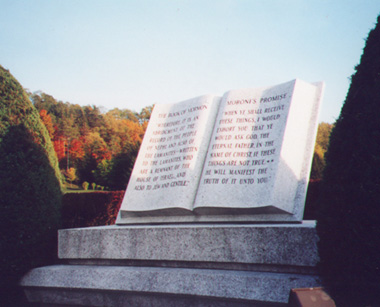
Latter-day Saints hold the area sacred as the place where the 14-year-old boy’s prayer about which church to join was answered by a vision of God the Father and his Son Jesus Christ, and where a heavenly messenger named Moroni delivered to Smith an ancient record whose gold leaves he translated and named the Book of Mormon.
The hill where the record was found — later named Cumorah — has been the site since 1928 of an annual summer pageant depicting events in the record of ancient inhabitants of the Americas. In
July, more than 100,000 people attend performances and line up to see nearby LDS sites.
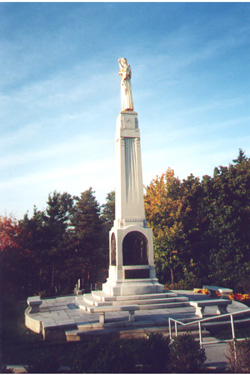
Other times of the year, visitors stop to admire the statue of Angel Moroni on top of the egg-shaped hill, catching a glimpse of the entire area — now cloaked in autumn colors of blazing reds and yellows. (You can hike up the path or take the road around the back of the hill to the parking lot on top.)
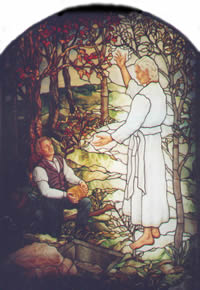
A new and larger visitors’ center at the base of the hill opened in the summer of 2002 — just one of several changes being made to accommodate the growing interest in the area. It features a stained glass window depicting Angel Moroni delivering the gold plates to Joseph Smith. The artist, Tom Holdman, earlier created stained glass windows and a scene of the First Vision for the Palmyra Temple.
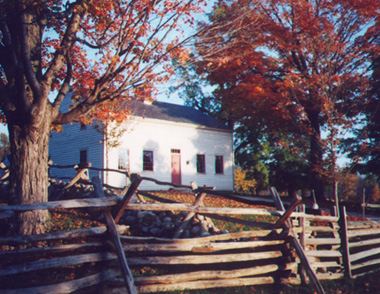
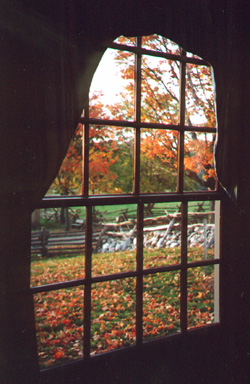
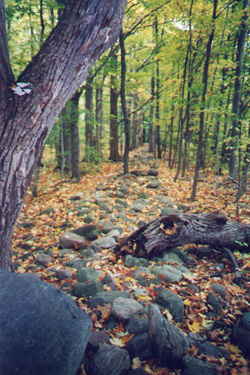
The Smith Farm about three miles away has seen some changes over the years as well. A small welcome center, opened in January 2000, offers maps and free guided tours of the replica log cabin and frame home a short walk down the unpaved lane. Joseph Smith received several visits from Moroni in the upstairs bedroom of the small cabin that was the Smiths’ first home in Palmyra. A look out the back door reveals the vast grove of hardwood trees now dropping their fall-tinted leaves along its paths.
The frame home, defined for years in the 20th century by its large front porch and second-floor portico, has been restored to its more rustic and authentic state, as the Smiths would have known it when they lived there in the 1820s. The interior has likewise been restored to a more authentic look, and a barn and shed have been rebuilt on the property.
The paved road that used to run in front of the frame home now runs behind it, dividing the home, cabin and Sacred Grove on the west from the small hill to the east where the Palmyra Temple
stands. The stained glass windows of the temple glow at night, their designs echoing the trees in the Sacred Grove.
More changes have come in recent years: A stake center has been constructed opposite the temple site, on Stafford Street; the old Palmyra chapel on Canandaigua Road is now Palmyra City Hall.

In town, the E. B. Grandin Print Shop where the first 5,000 copies of the Book of Mormon were made in March 1830 still stands at 217 E. Main. Missionary guides at the shop, which has been expanded into a visitors’ center, conduct free tours of the building, including the third floor press room where the equipment that printed the first pages can be seen. (You can buy an authentic-
looking copy of the early Book of Mormon — minus paragraphs or headings — at a book shop down the street.)
Just down the block at the intersection of Main and Canandaigua, the steeples of four different Protestant churches — Presbyterian, Episcopal, United Methodist and Baptist, all built in the 1800s –rise into the sky. They’re a reminder of the religious excitement and division that reigned here when young Joseph went into the grove in the spring of 1820.
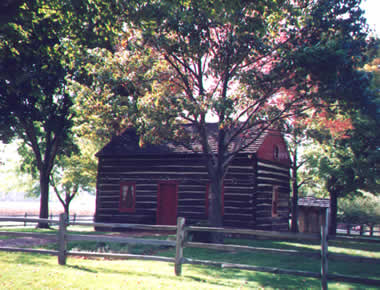
The official organization of The Church of Jesus Christ of Latter-day Saints happened about an hour’s drive southwest, in the log home of Peter Whitmer, whose Fayette farm lies about three miles south of Waterloo on a country road.
Reconstructed on the original foundation, the farmhouse where the church was organized on April 6, 1830, was the site of a special General Conference broadcast as part of the church’s
sesquicentennial celebration in 1980.

The place is also significant because Joseph Smith completed translation of the Book of Mormon in the upstairs room and received 20 sections of the Doctrine and Covenants here. In the woods not far from the home, three witnesses were shown the gold plates by the Angel Moroni.
As with all the LDS sites in the Palmyra area, the visitors center here is open daily from 9 a.
m. until 6 p.m., with free tours offered by missionary guides.
IF YOU GO: Palmyra is an easy, half-hour drive from Rochester, N.Y., along Highway 31. You won’t find motels in Palmyra, so look for accommodations in the southeast section of Rochester or the Brighton, Henrietta or Pittsford areas. (Several national hotel chains are represented.)
Maps for self-guided tours of all LDS sites in the area, including the Peter Whitmer Farm, are available at any visitors’ center, as are free guided tours. For more information on LDS Church
historical sites, log onto www.lds.org.
Consider flying into Buffalo, 70 miles west, for cheaper airfares and the opportunity to visit Niagara Falls, 20 miles north of Buffalo, while you’re in the area. Also consider flying into
Syracuse, about 90 miles east, as airfares to Rochester are typically high.