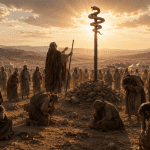






Was the Liahona, in Part, a Magnetic Compass? Can the Book of Mormon narrative and other scriptures support the idea that the Liahona contained a magnetic needle? Point #9: What about when Nephi consulted the Liahona in order to know exactly where to find game for food; doesn’t this imply a function of the Liahona completely different than a magnetic compass? If this is what the scripture really says, then I probably would agree, but let’s review the situation. In 1 Nephi 16:30 we read: “And it came to pass that I, Nephi, did go forth up into the top of the mountain, according to the directions which were given upon the ball.” The first thing that I must determine is how directions were given on the ball. According to my view it was the spindles that determined direction of travel and the writing on the ball that more or less reminded one of the spiritual requirements necessary in order to be successful. But a much larger question is whether or not the Liahona specifically pointed to where game was. I don’t think it specifically had to do so. I think there is room for a partially magnetic Liahona functioning as part of an overall orienteering process. Let me explain. From Nephi’s vantage point in the desert wilderness as he traveled southward, he probably viewed the mountains to the west rising high in the distance many miles away, and he knew that if he traveled there he could probably get game. But as I see it, it wasn’t the “getting game” that was the whole problem. It might have been just as difficult or more for Nephi to find his way back to where Lehi had camped. A magnetic compass would allow Nephi to chart a course toward the mountains that could be retraced on the return trip. Although while on top of the mountain Nephi could view everything below in a panoramic perspective, he still had to descend through tortuous paths. In such a descent one can very easily get disoriented and end up coming down the wrong ravine. Through the use of a magnetic compass Nephi would not only have been able to plot his course back to camp from the top of the mountain, but at various locations in his descent. To me the words “I, Nephi, did go forth up into the top of the mountain” implies a significant travel distance and an extended hike upward. [i] The words “according to the directions which were given upon the ball” might imply that he carried the Liahona with him. The fact that Nephi “did slay wild beasts” (plural) implies hiking and searching over much terrain to begin with, not to mention how much distance Nephi would have had to travel after hitting his target in order to find the animal. The word “beast” implies a larger mammal and thus a possibility of a lengthier distance after the initial arrow penetration before death. Additionally, for Nephi to focus on finding a wounded animal might have taken him further away from the memory of the trail he had taken to reach wherever he was at, and thus added to the need for the Liahona’s directional system (a part of which could have been magnetic) in order to guide him back to camp. Point #10: Why did the “compass” stop working when Nephi was tied up? While on the sea journey to the promised land, Nephi reproved his brethren and the sons of Ishmael and their wives for being “lifted up unto exceeding rudeness” insomuch that “they did forget by what power they had been brought thither” (1 Nephi 18:9-10). They became angry with Nephi and bound him with cords (1 Nephi 18:10-12). Nephi then writes:
The fact that the Liahona stopped working when Nephi was tied up certainly could be connected to a loss of spirituality as the text implies. But it also might imply that Laman and Lemuel had overestimated their skill in discerning directional orientation by means of the Liahona and that they had underestimated Nephi’s navigational skills in keeping them away from a storm. In other words, under ideal weather conditions it might have seemed to them that Nephi or anyone could always rely on the magnetized needle to give them proper directions, and that if one simply kept a straight course everything would be fine. But Laman & Lemuel very soon would have found out that steering the ship was not as simple as they thought. They apparently didn’t know how to navigate so as to keep the ship away from danger as much as possible; thus (or “insomuch that”), “there arose a great storm” (v. 13). When this stormy weather came up and the stars disappeared, the waves and winds swirled, and the spindles became erratic due to the tossing and turning of the ship and the electrically charged atmosphere, Laman and Lemuel knew they were in trouble. Upon being loosed, Nephi’s navigational training (both physical and spiritual) might have allowed him to make use of the erratic (but still “workable”-v. 21) Liahona, along with other possible navigational aids, in order to exit this stormy situation. Point #11: Why is the term “compass” only used by Nephi in relation to ocean navigation? Interestingly, while crossing the Arabian desert Nephi only referred to the Liahona as a “ball.” It is not until they set forth on the ocean that Nephi refers to the instrument as a “compass” (1 Ne 18:12). And it is many centuries later that Alma tells us that the real name of this instrument was “Liahona,” and that the word “Liahona” is, “being interpreted, a compass.” (Alma 37:38) In the ocean voyage Nephi refers to troubles with Laman & Lemuel in which the “compass” stopped working. He writes:
In reporting the affects of the storm at sea when the compass stopped working (but was later restored), Nephi mentions that they were “driven back upon the waters” (1 Ne 18:13,14,15). I asked myself, just how did he ascertain this knowledge? One interpretation of this phrase might simply mean that their forward progress had been halted. But how did they determine this? Another interpretation might be as simple as saying that Nephi sensed the storm coming from the direction which they were sailing towards and thus deduced that the winds drove them “back.” However, a storm can come from many directions, and in the midst of a storm the waves and winds can swirl. Thus the words of Nephi that they were driven “back” might also imply a knowledge of longitude (east-west position) as well as (or in addition to) latitude (north-south position). While latitude can be measured with a simple instrument while viewing Polaris (the North Star), longitude requires much more sophistication, especially in the middle or after a great storm in which stars are not visible and after which the position of the ship might have been severely altered (thus confusing the calculations of distance from any reference point). This knowledge of position in the aftermath of a storm was not able to be calculated by one single method. It would have required reference points and directional readings (of which a “compass” might play a part). While traveling through Arabia, for the most part Nephi and Lehi were on the Frankincense trail, which did not negate the use of a compass, but most probably diminished the need for such a use. Perhaps during those times the need for spiritual direction as reflected by the words of the Lord written on the “ball” was more important for their ultimate success. Point #12: If the Liahona was completely dependent on spirituality, or “faith, diligence and heed,” why did it apparently stop working or come into disuse shortly after the Nephite arrival in the promised land? Although Nephi took the Liahona with him when he departed from the land of first inheritance to go to the land of Nephi, he does not mention its use in guiding him through the wilderness to the land of Nephi (2 Ne 5:12). Nor does Amaleki specifically mention its use in describing the later Nephite migration from the land of Nephi to the land of Zarahemla (Omni 1:12-14), only that they were led “by preachings and prophesyings.” This makes me ask, If they were led by such spiritual manifestations, why did these not include the Liahona? And later on when Alma speaks of the function of the Liahona, he not only speaks of it in the past tense, he apparently fails to bring up any specific use of it beyond the travels of Lehi. (Alma 37:38-44) Once again I ask, Why would it not be of use to them in their travels if it was exclusively a spiritual instrument? Had their spiritual abilities diminished? One partial explanation of the situation might be found in the fact that the spindles could have lost their magnetism and nobody understood the process (or had the lodestone) to re-magnetize the spindles. Or perhaps the Lord saw no need for any continuing use for the Liahona. If such was the case and if Alma specifically tells the readers that, “there cannot any man work after the manner of so curious a workmanship,” (meaning that the Lord had not given any man since Nephi an understanding of how to interpret the Liahona), then no matter what the natural mechanisms involved, the Liahona would not “work.” On the other hand, while it might be a matter of conjecture, Alma’s statement many hundred years after the Lord had first given the Liahona to Lehi that “there cannot any man work after the manner of so curious a workmanship” might also be interpreted to mean that the art of magnetizing metals and constructing a magnetic compass had been lost. The destructive effects of time and moisture on iron spindles could have also complicated matters. [ii] Point #13: What about the use of the term “Liahona” or “compass” as a temporal metaphor? Many centuries after its actual use, Alma tells us that the real name of this instrument was “Liahona,” and that the word “Liahona” is, “being interpreted, a compass” (Alma 37:38). [iii] Alma then refers to the “Liahona” or “compass” in a metaphorical way. Alma writes:
Here a “temporal” Liahona or “compass” is contrasted with “things spiritual.” If by the word “temporal” we are to understand a worldly mechanism as contrasted to “things which are spiritual” then we might glean some insights. In other words, by following the directions of a “temporal” instrument – which functioned, in part, according to the “temporal” principle of magnetism, even though that principle was not fully understood – Nephi was guided to a hoped-for destination (the Americas-a land of promise) without getting lost or dying. In the same manner, by following “spiritual” things or by giving “heed to the work of Christ,” even though these principles might not be fully understood, one can be guided to “a far better land of promise.” This line of metaphorical thinking seems to fit the word “compass” used here for the Liahona, which word some have proposed to have been derived from the function of the magnetic compass. [iv] In reality, the original meaning is not so clear, with others stressing the idea that the word “compass” actually refers to something round. [v] However, if a metaphor is only a representation of something that is, or actually was, and if a “compass” functions according to a magical worldly phenomenon (magnetism), then, paraphrasing the words of Hugh Nibley, [vi] magic becomes religion when the power by which things operate is transferred from the things themselves to God. Conclusions: In concluding this point-by-point interrogation on the working principles of the Liahona, I must first note that in my research to come up with perspectives I have found that the idea of the Liahona having a magnetic spindle has been largely (although not completely) dismissed or ignored. [vii] However, in regards to the points covered in Part 1, I believe that I have established that the scriptures do not totally negate the idea that the Liahona may have been, at least in part, magnetic. Moreover, I feel that there is enough plausibility for at least a partially magnetic Liahona to warrant further investigation. (Continued with Part 2) Notes [i] . The extent of this distance might be affected by a number of factors: (1) whether or not Nephi was riding on a camel or donkey or traveling on foot; (2) how far away Lehi’s base camp was from the top of the mountain. Meat tends to spoil in heat unless proper precautions are taken in dressing the animal and returning to a place where the meat can be smoked. According to David Cope, a friend and longtime owner of a local meat processing plant, Nephi would only have had only about 6-8 hours to get the meat back to camp for smoking. (3) A possible third factor could have been associated with Nephi’s making a new bow after breaking his steel one. This is not necessarily apparent until a real-world scenario is in place. George Potter and Richard Wellington (Lehi in the Wilderness, Springville, 2003), whom I consider to be the most insightful authors on the geographical and cultural aspect of this part of Nephi’s narrative, give the following perspectives:
Since Nephi did not leave the group when he made the bow (1 Ne. 16:23) like he did when he went to hunt (1 Ne. 16:32), the bow appears to have been made from wood near the family’s camp. When Nephi went to hunt, he followed the directions he was given on the Liahona. He tells us “I, Nephi did go forth up into the top of the mountain” (1 Ne. 16:30). The Asir is a mountain range with hundreds of peaks, but Nephi seems to mention a specific one and so it may be that he was already on the upper slopes of the mountain … If this were the case and the family were already in the mountains, then olive becomes the even more likely possibility. … The bow he made seems to have worked well. With one arrow he was able to kill a number of animals, so it must have been accurate enough to kill small game (he couldn’t have carried a number of large animals [1 Ne. 16:32]). All of this points towards Atim (olive) as the most likely candidate. [p. 105] [ii] . Yet Laban’s sword of “steel” seemed to be preserved for centuries. [iii] . As for the meaning of the word “Liahona,” there have been a number of attempts to define it. For example, from the Editor’s Table of the 1907 Improvement Era we find the following:
Hyrum M. Smith and Janne M. Sjodahl write:
Paul R. Cheesman writes:
Hugh Nibley writes: And many people have dealt with the word Liahona. We had a teacher from Hebrew University here for a few years; in fact he bought a house in Provo. He was so fond of it he wanted to come and visit often. His name was Shunary. He never joined the church, but the first thing that fascinated him was this name Liahona. He traced it back to the queen bee, the leader of bees swarming in the desert. When bees swarm, that’s Liahona. I took it from a different one. Yah is, of course, God Jehovah. Liyah means the possessive, “To God is the guidance,” hona (Liyahhona). That’s just a guess; don’t put it down. But it’s a pretty good guess anyway. (Hugh Nibley, Teachings of the Book of Mormon – Semester 1 … Brigham Young University, 1988-1990. Provo: FARMS, p. 216.) [iv] . Amir Aczel is of that opinion. He writes: “But the magnetic compass was not only a celebrated technological and scientific invention. It also became a metaphor in poetry . . . (Amir D. Aczel, The Riddle of the Compass: the Invention That Changed the World. New York: Harcourt, Inc., 2001, p. xii) [v] . In a February, 1961 article by Hugh Nibley (“The Liahona’s Cousins,” in The Improvement Era, vol 64, num. 2, pp. 87-111), he writes the following:
In George Reynolds and Janne M. Sjodahl, Commentary on the Book of Mormon, we find the following:
[vi] . Hugh Nibley, “The Liahona’s Cousins,” in The Improvement Era, February, 1961, vol 64, num. 2, pp. 87-111. On page 109 he writes: “Religion becomes magic when the power by which things operate is transferred from God to the things themselves … When men lack revelation they commonly come to think of power as residing in things.” [vii] . In reviewing the literature, as far as I have been able to find, the earliest LDS article that speaks positively for the idea that the Liahona was magnetic comes from the 1883 book The Life of Nephi, the Son of Lehi. Cannon did preface this remark, however, with a disclaimer that the Liahona “differed in several respects from what are known as compasses.” (see Part 3 for this full quote) The next comment comes from a 1909 book by B. H. Roberts. Strangely enough, at the end of a whole page of comment by B. H. Roberts directed to prove that the Liahona was not a magnetic compass as anti-Mormon writers had charged, Roberts ends with the following:
In March of 1984 the FARMS organization sent out a 1-page Update entitled “Lodestone and the Liahona” (author not named) to those financially contributing members belonging to their Cornerstone Club. Each month the Update was sent out to all major contributors and active volunteers. They were “state-of-the-art short studies” reporting the organization’s most recent discoveries and works in progress. At the end of 1984 these articles were assembled into one report for distribution. In this article we find the following:
In 1992 the above Update “based on research by Robert F. Smith, March 1984” would be reprinted as “Lodestone and the Liahona,” in Reexploring the Book of Mormon: The F.A.R.M.S. Updates, edited by John W. Welch (Salt Lake City: Deseret Book Company and Provo: Foundation for Ancient Research and Mormon Studies, 1992, pp. 44-46). In 1993 an article written by Deanne Matheny appeared in the publication New Approaches to the Book of Mormon: Explorations in Critical Methodology in which she criticized John Sorenson’s writings on Book of Mormon culture and geography. One aspect had to do with Sorenson’s skewed directional system for Book of Mormon geography. Matheny argued for cardinal directions. Included among her reasonings was the fact that, “Additionally Lehi’s party had the Liahona, which is called a “compass” a number of times in the Book of Mormon … ” (New Approaches …, SLC: Signature Books, 1993, p. 278) However, In his 1994 rebuttal to Matheny, John Sorenson dismissed the idea of a magnetic compass. (Review of Deanne G. Matheny, “Does the Shoe Fit? a Critique of the Limited Tehuantepec Geography,” in FARMS Review of Books, vol. 6, no. 1 (1994), p. 310.) In the Fall 1994 Journal of Book of Mormon Studies (Vol. 3 No. 2, pp. 1-11) there appeared an excellent article by Robert L. Bunker (“The Design of the Liahona and the Purpose of the Second Spindle”) which has been discussed previously (see note 26). While the article broached the subject of the magnetic compass, no specific proposal was put forth. The focus of the article was on design not function, and the closest the author got to the principle of magnetism was in footnotes #2 and #3. In footnote #2 he writes on the description of a “spindle”: “Such a spindle-shaped pointer is often encountered in magnetic compasses (cf n. 3) where some type of marking designates one end as north.” But he follows that statement with the following: “The spindle in the Liahona used to designate direction would also have required differentiation between ends, either by color, texture, or shape. In note #3 Bunker comments on an analogous design to a magnetic compass and also hints at function but his ideas are not made clear. He seems to be making contrary statements regarding a magnetic Liahona. He writes: “Since the magnetic compass in Lehi’s time was still many centuries from discovery, the use of the word “compass” by Joseph Smith in translation to refer to the Liahona reinforces not only the analogy of directional function with the modern compass but also of design.” It is not clear to me what Bunker had in mind by saying that the word “compass” in the Book of Mormon reinforced “the analogy of directional function with the modern compass.” In a 1996 RLDS book by Glenn A. Scott, Jr. he writes:
No Comments | Post or read comments FEATURES |

May 19, 2026
May 19, 2026