







Last week, a “shaky leaf” that appeared on my online family tree blew a fresh breeze of insight into the life of my grandfather, John Andrew Kostakos. With curiosity, I clicked on the hint. What unfolded was a common document – the 1915 New York State Census. But what it revealed was a story untold.
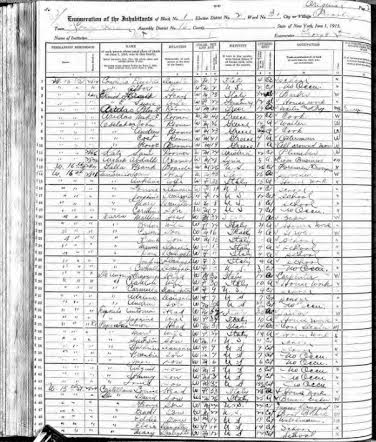 Lines 5-10, Aridas and Costakos
In the Senick home on West 15th Street in Brooklyn, there were six boarders – my grandfather, his three brothers, his soon-to-be brother-in-law and another family member. What is unremarkable is this snapshot of a typical early 20th century immigrant living situation. What is remarkable is that after 30+ years of family history research, I had no idea that these men had been roommates.
My father was my oral history source. It was upon his reminiscences that I based my earliest research. He lived in the family home until he married my mother at age 29. He knew all the relatives, as they frequently gathered in my grandparents’ home for Sunday afternoon dinners, card games, and lively discussions. He heard their stories and knew their histories, at least those that were shared. Dad was a remarkable resource, but his memories ended with his passing.
 Andrew John Kostakos, 1917-1999
As I studied this document, I pondered the statistics and their implications:
- On June 1, 1915, my godfather, Peter G. Aridas, had been in the U.S. for 19 years; still unmarried, still an “alien.”
- Mike E. Aridas (their exact relationship is one of my brickwalls) had immigrated two years earlier. Yet after 21 years of working as a cook, he was not married, not a citizen, and still living as a boarder.
- My grandfather, John, arrived next – just sixteen months before marrying my grandmother, Hariklia Aridas (sister of Peter G., above).
- It was more than ten years later that three of my granduncles uncles followed: Andrew, Konstandinos and George.
I have so many questions!
- What prompted Mike to leave family and our ancestral village to come to a big city in a foreign land? Was it discouraging to work for over 20 years as a cook, and still live as a boarder in someone else’s home?
- My grandfather, John, obviously knew the Aridas men prior to emigrating. Did my godfather, Peter, arrange the marriage between his sister and my grandfather? If so, why didn’t they marry in Sparta instead of Brooklyn?
- My granduncles were young when my grandfather left. What stories did they hear about his life in America, and how did those tales fuel their desire to follow?
There is so much I wish I knew about the lifestyles and experiences of these men. Their characters were shaped by their choices, and our family course was set by their decisions.
My own mortal life exists because of their actions.
These reflections cause me to wonder what stories you and I know that will be of worth to our descendants. It is up to us to ensure that some of their potential questions are answered. We don’t need to write a book; in fact, we can adapt the childhood game of “Twenty Questions” to:
“Twenty Answers for My Posterity”
1.My name is… I was given this name because, or I was named after (who and why).
2.I was born on: date, time, place.
3.My parents, brothers and sisters are: (list names, birth dates and birth places; consider using a Family Group sheet and attaching it).
4.My parents’ occupations, interests, talents were…
5.My most special memory of my childhood is…
6.I knew/did not know my grandparents. Their names and occupations? A special memory?
7.I spent time/did not often visit with cousins, aunts and uncles. They lived near/far away. My favorite memory of a family gathering is…
8.I went to the following schools: (list name and city of schools, years attended and degree earned).
9.As a child, I participated in: (list organizations such as Brownies, Scouts, sports teams, clubs, bands, etc.) My favorite was (and why).
10.I did/did not marry. (If married, list names, birth dates and birth places of spouse and children – consider using a Family Group sheet and attach it)
11.If married, how did I meet my spouse; what type of wedding did I have (religious/civil)?
12.I did/did not serve in the military: (if yes – dates, branch; did I serve in an armed conflict?)
13.What is my religious affiliation, and what meaning has it had in my life?
14.What is/was my profession, and why did I choose it?
15.As an adult, I am/was a member of: (list organizations, community service, hobbies).
16.What do I do to have fun?
17.What are my dreams and aspirations?
18.What was one of my happiest experiences?
19.What was one of my most difficult experiences, and what did I learn from it?
20.My message to my posterity is…
Will our stories end with our passing? What is of most worth to leave behind?
Let’s prevent our life histories from becoming forgotten histories.
Our posterity will be ever grateful.
Carol Kostakos Petranek is a Co-Director of the Washington DC Family History Center, a FamilySearch Volunteer Coordinator, and a Citizen Archivist at the National Archives in Washington, D.
C.


Christine ShawMay 23, 2014
Thank you for the 'Twenty Questions for my Posterity' article. I too have developed an immense appreciation for a 'vibrating leaf' in my family history site. This allows me to develop a greater appreciation of technology and the ability to find hidden knowledge and wealth of information. My late husband told us all countless stories yet in the last 6 months of life he lost the power of speech and our children were devastated. Instead of continuing with their woes I suggested that they write down their memories of 'dad's stories'. Every story will have commonalities and differences but I felt this was one way of remembrance. I will also use your 20 questions to fill in my remembrances and start on my life remembrances so that one day in the future a 'vibrating leaf' appears to a family member along with it will be our stories of remembrance and the blessings we have received in this life.
DianeMay 23, 2014
I love family history. My father never knew his father (who died when Dad was a baby) -- but by searching public records, newspapers, and asking, asking, asking...I finally learned why my grandfather suddenly moved from Paterson New Jersey to Tacoma Washington, how he met my grandmother (who also died many years before I was born) and why one uncle was born in a totally different town than the others. Keep on searching and you may find some of the answers you seek.