











The Salt Lake Tabernacle is a bold and daring building. The 132-foot wide open space of the interior (a North American record for its day) was completed before the railroad arrived in Utah. The building anticipated twentieth-century modernism in the way it eschewed traditional ornamentation and styles and clearly expressed its form on the exterior.
Early meetings in the LDS Church were held in private homes or outdoors. The first buildings constructed by the Church, the Kirtland and Nauvoo Temples, were multipurpose buildings that were woefully inadequate to accommodate the growing number of Saints. After arriving in the Salt Lake Valley, shade pavilions or boweries were built to provide comfort in summer months. Brigham Young then decided to build a 2,500 seat tabernacle (later known as the Old Tabernacle), which had a curved ceiling that became the prototype of the Great Tabernacle.
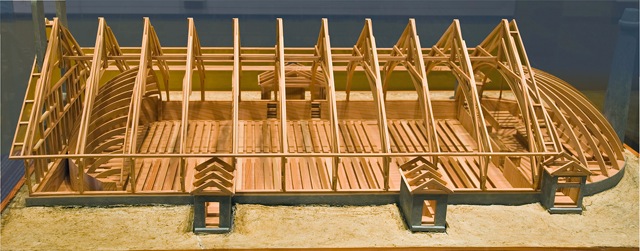 A model of the Old Tabernacle.
Brigham Young relied upon bridge builder Henry Grow and architects William Folsom and Truman O. Angell to realize his dream for a great hall. All of these men were relatively uneducated, at least in comparison to professional engineers and architects in North America and Europe at the time. However, what the Tabernacle designers lacked in formal schooling, they more than made up for with practical experience and a driving vision of what they wanted to create.
Henry Grow had learned to build lattice truss bridges in the East, and when he came to Utah he worked with Brigham Young to design and build a bridge over the Jordan River. The bridge spanned 130 feet with no supports. With this practical knowledge, Young and Grow adapted the lattice trusses into arches for the Tabernacle roof.
Young wanted a curved ceiling to provide good acoustics to help the audience hear the speakers. Designers worked out the complicated geometries of the roof, such as where the lattice trusses join at the curved ends.
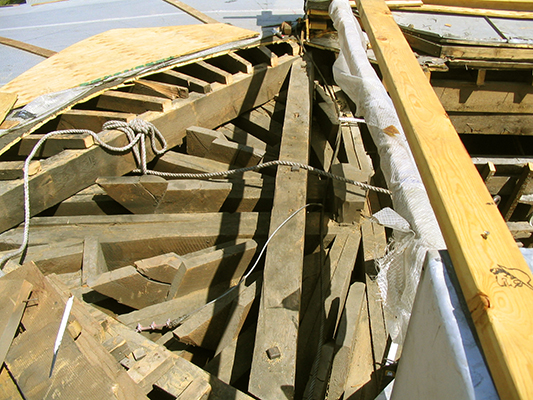 The roof with the sheathing removed and a temporary safety railing on the right. Here the beams of the rounded end of the roof (on the left, in a radial pattern) meet the beams of the long straight section.
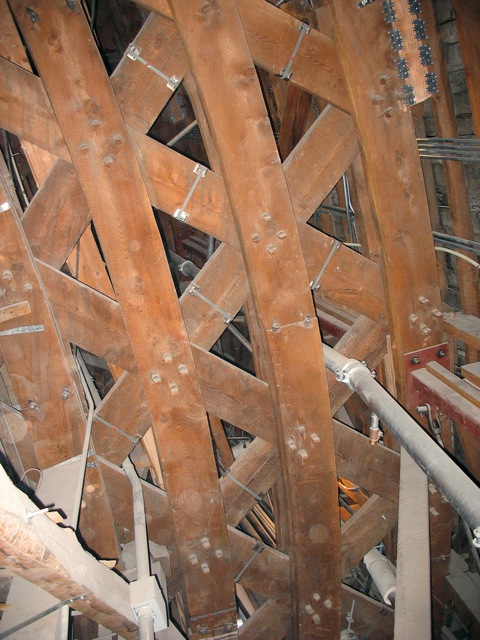 The timbers of the lattice truss arches. Notice the new steel straps supported planks that were splitting.
Built with volunteer labor, the Tabernacle stands as a witness to the collective sacrifice made by members of the Church. The structure was built in an environment relatively poor in timber, iron, and economic capital. Wooden pegs were used to connect the members of the arches.
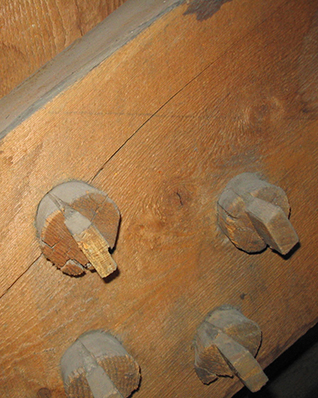
The claim that nails were not used to build the Tabernacle has been repeated often, but it’s not accurate. In reality, tens of thousands of nails were used in construction, although procuring iron for nails was challenging at the time.
Designing the inside was also a challenge. Truman Angell made room for 13,500 to be seated, and the building held as many as 15,000 with congregants standing in the aisles. The first conference was held in October 1867, and finishing touches on the building continued for a few more years. A magnificent organ was installed early on. Wood for the casings for the organ pipes was brought by wagon from southern Utah. Over the decades, more wood casings and pipes were added and the organ mechanics upgraded.
 The organ interior
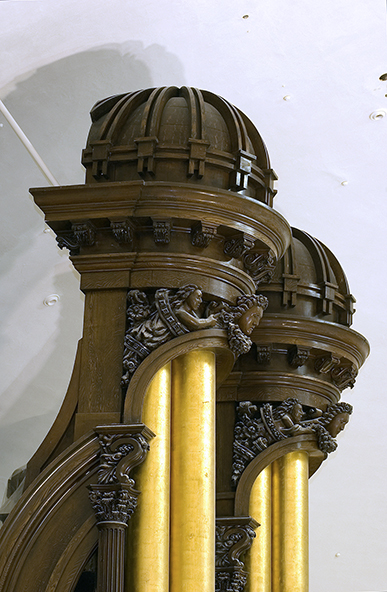 Notice the fine carving in the organ pipe caps.
The building was used for regular Sunday services and many public events in its early decades, but it is most famous now as the home of the Mormon Tabernacle Choir and the former home of LDS general conferences.
In 2006, the Church began a seismic upgrade and remodeling of the building. The foundation was secured by excavating the footings and installing micropiles around the footing of the stone pier to increase the seismic capacity. Then concrete was poured, joining the micropiles to the piers.
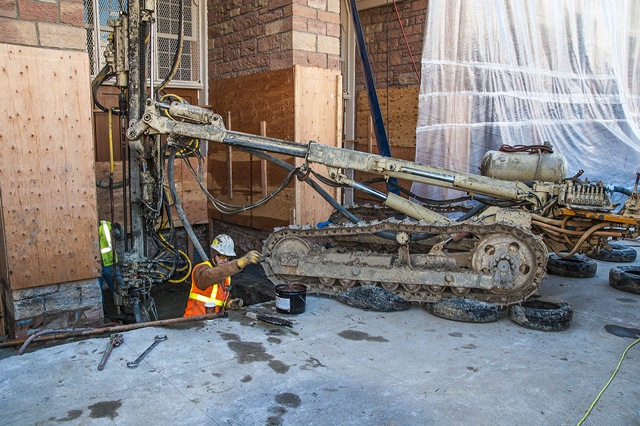 The drilling rig used to install the micropiles.
In the roof, the two wood trusses at the end of the straight section of the roof, supporting the radial rounded ends, had bowed a little over the years. So new steel trusses were installed to support them. To allow this work, jacking towers were built to transfer the loads to the steel trusses:

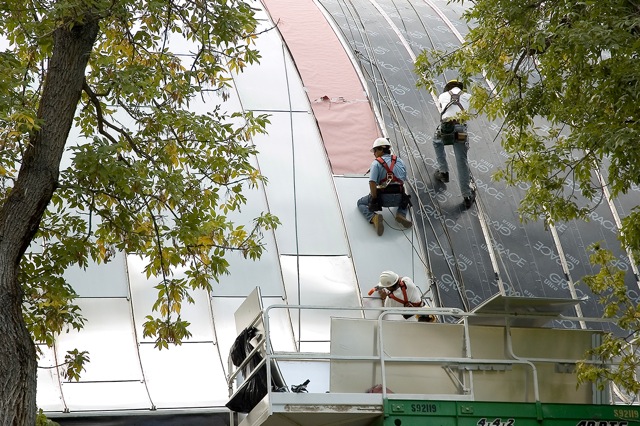
The roof was also upgraded with new plywood and layers of self-healing waterproof membrane.
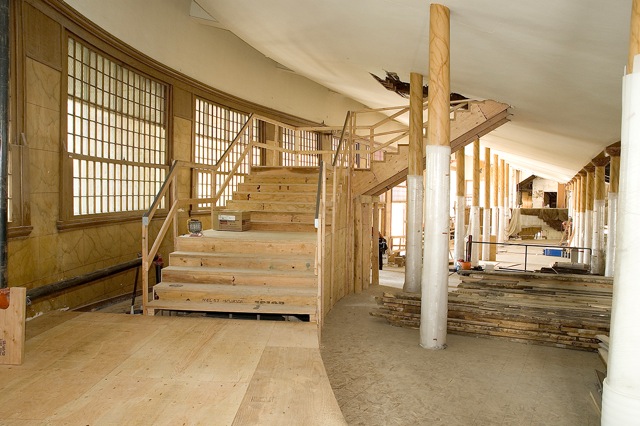
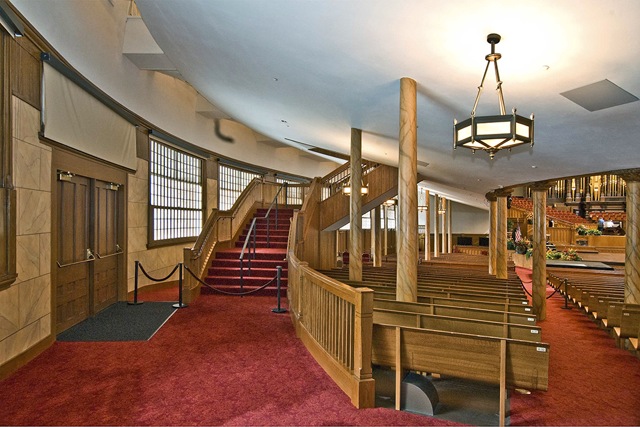
New stairways to the balcony were installed. The stand was upgraded with a lift system to permit overnight reconfiguration of the building from an orchestral concert to a church service
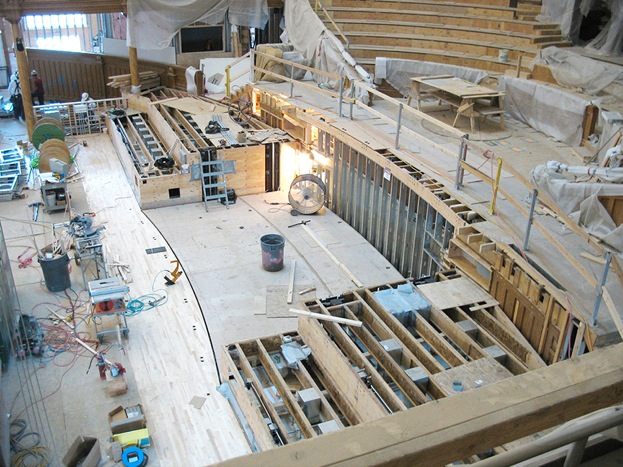
The upgrade allows the building to be of service continuing into the next century.
The Tabernacle’s unique shape, construction, and acoustics were critical in providing a place where a significant number of Church members could sit at the feet of a prophet and be instructed. Each step along the path of the Tabernacle planning, construction, and modification, when viewed in isolation, is seen as a logical move forward. However, when one views the entire history of the development of the Tabernacle, one can see more clearly the challenges, risks, and key decisions which led to its success.
In short, the journey from a simple shade pavilion to the largest audience hall in North America is both breathtaking and extraordinary.
Elwin C. Robison, professor of architecture at Kent State University, was commissioned by the Office of the Presiding Bishop to create a report about the Tabernacle to assist the architects hired to do the seismic upgrade. That report was the basis for his new book about the architectural history of the Tabernacle, with hundreds of photos telling the story. The book is now available from BYU Press here.
Photos in this article are courtesy of Arnold Angle and Elwin Robison.






Wayne MangumOctober 1, 2016
In August 1966 I to was Baptized in the Font which now I'm guessing was under the Tabernacle Choir seating area, several others were also Baptized that day, wonderful memories of that day are still vivid in my mind, I to am saddened reading here it is no longer there, are there any pictures of the Font before it's removal out there somewhere, where do go to find pictures of it?
SuzanneApril 2, 2014
I was also baptized in this glorious font. What happened to the font and why is it not there?