




After a fairly mild January of 1846, February brought below-normal, bone-chilling temperatures to Nauvoo, Illinois, just as the mass exodus from Nauvoo, Illinois, to the Rocky Mountains began. On February 4, the first wave of covered wagons ferried across the freezing Mississippi River. For three weeks, temperatures dropped, and ferries carrying wagons often dodged ice until the mile-wide river froze solid.
“We could have remained sheltered in our homes had it not been for the threats and hostile demonstrations of our enemies,” Brigham Young said. “Our only means of avoiding a rupture was by starting in midwinter. Our homes, gardens, orchards, farms, streets, bridges, mills, public halls, magnificent Temple . . . we leave as a monument of our patriotism, industry, economy, uprightness of purpose and integrity of heart” (History of the Church, 7:603).
To mark the sesquicentennial of the original exodus from Nauvoo, approximately 1,800 Latter-day Saints gathered beside the frozen Mississippi River on February 4, 1996. The weather was a sunny -12 degrees, and eight hundred people sat or stood inside a large tent around muffle furnaces to keep warm. To enable 1,000 people outside the tent to attend the commemoration, the tent side was rolled up. This caused the temperature inside the tent to decrease enough that “Pitts Brass Band,” music students from Quincy, could no longer play their instruments.
Every year since the 1996 commemoration, missionaries in the Illinois Nauvoo Mission have hosted a Mormon Exodus re-enactment. This year on February 2, 2013, approximately 300 people joined the exodus walk. Several temple missionaries–Elder and Sister Memmott, Elder and Sister Jensen, and Sister Ritchie–reflected on their first exodus re-enactment experience.
In the Family Living Center
At 8:00 a.m., participants met at the Family Living Center for a continental breakfast prepared by missionaries from the Illinois Nauvoo Mission. An opening prayer, hymn “They the Builders of the Nation,” and a pioneer reading launched the exodus re-enactment.
Participants selected name tags of ancestors or other Latter-day Saints who left from Nauvoo and wore the tags around their necks as they walked. Elder Memmott represented his Hatch ancestors, and the Jensens carried names of Allred ancestors.
“The Family Living Center was warm and full of modern-day pioneers anxious to be on their way,” Sister Ritchie said. “The crowd included babies and children who probably had no idea what was ahead. However, several loudly let their lack of normal comforts be known.”
To prepare for the exodus walk, Sister Ritchie said, “We were sure our modern-day cold-weather clothes were adequate: thermals, coats, boots, and scarves.”
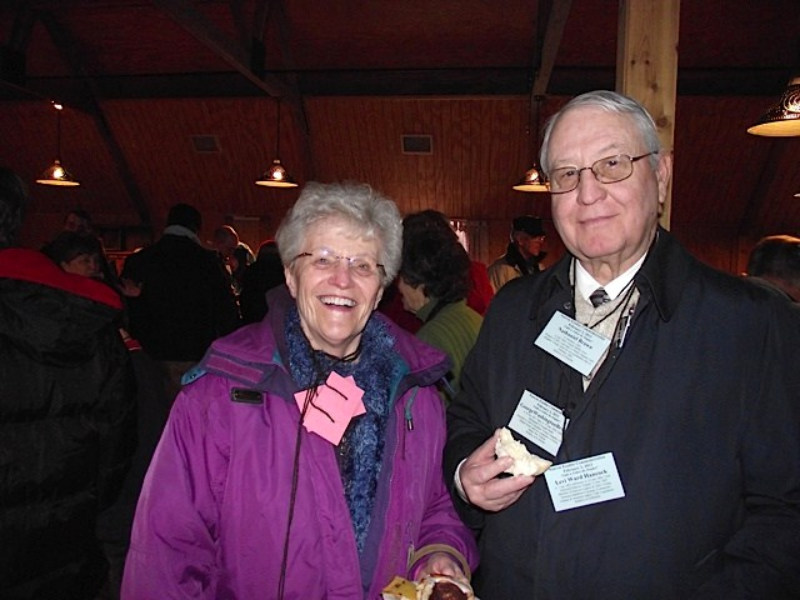 Elder and Sister Ritchie
However, “a sharp biting breeze began to blow across Nauvoo from the northwest as we left our gathering place,” Elder Memmott said. “Quickly we covered our necks and hands to protect our extremities.”
The Walk down Parley Street
At 9:00 a.m., Illinois Nauvoo Mission and Nauvoo Temple missionaries, community members, visitors from such states as Wyoming and California, a Young Women group from Indiana, and others lined up outside the Cultural Hall to march down Main and Parley streets behind the American flag which led the procession. With a powerful wind blowing, Elder Memmott helped the site missionary holding the lead flag “find a piece of yarn to tie down the U.S. flag. The bottom anchor of the flag was bound fast to the pole.”
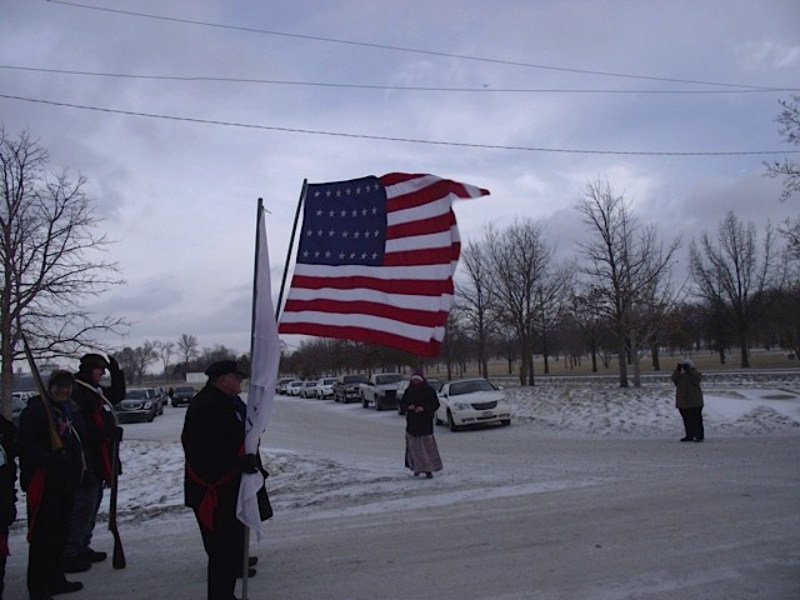
Men portraying the Nauvoo Legion fell into line, and behind them flag bearers carried flags from the home countries of those who settled in Nauvoo.
 Tom Simpson photo
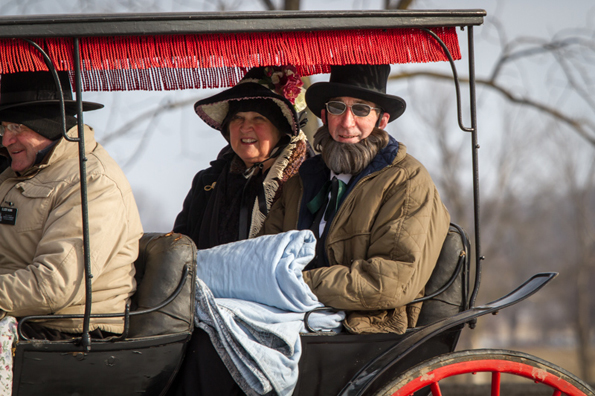
Next came the walkers, with some dressed in 1840s clothing. “Bringing up the rear were 1840s carriages, covered wagons, and the medical van,” Sister Ritchie said. “Riding in a carriage were Elder and Sister Christensen, dressed in costumes portraying Brigham and Mary Ann Young.”
 Tom Simpson photo
According to Elder Jensen, “Elder Christensen learned that he had a terminal disease, and he decided he wanted to go on a mission. When he got here, he worked like every other missionary. He even finished cement. He was part of Rendezvous’ and worked in the sites. He regularly attended the temple. On the exodus walk we met his family. . . . His son had come to take them home.”
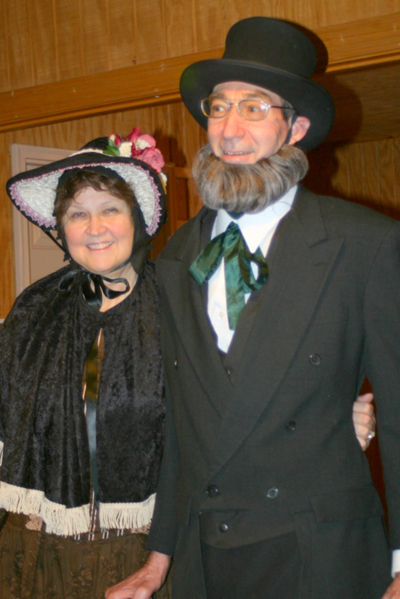
The 2013 exodus re-enactment linked courage from past and present together. Elder and Sister Christensen served as examples of courage with present-day trials, and Sister Memmott reflected on the past. “As we walked on the snowy road following the same path our forefathers walked, I was filled with wonder at their courage . . . mothers and fathers and babies leaving their lovely homes behind. Today I heard a child in our group cry and the tender feelings were made real to me.”
Elder Memmott, a retired temple recorder, noted that “as the temple grew smaller, the power of their covenants received in that holy edifice infused the early Saints with strength and hope.
The power of the temple was in their hearts and souls to bear them up in their trials westward.” This same power will bear us up in our trials today.
On the 2013 exodus re-enactment day, each of the temple missionaries noted the cold weather and biting wind. Sister Ritchie said, “As the parade turned right from Main to Parley Street, the cold wind blowing off the Mississippi River let us feel its strength. We tightened our coats and scarves and pushed ahead.”
“I covered my ears with my gloves, trying to protect my ears from the penetrating wind,” Elder Memmott said. “As we walked past the Seventies Hall, the full force of the wind cut across our path. The flags were blowing, whipping in the breeze.”
Sister Memmott added, “Oh, it was cold! How glad I was for hooded coat, gloves, warm scarf, and tall boots to shield me from feeling the bitter cold! But it did, indeed, penetrate nonetheless. That wind was the catalyst causing chill to blow right through me, and my stinging gloved fingers never did get warm.”
“As we marched in the cold,” Sister Jensen said, “I offered deep thanks for ancestors who went to Utah and braved trials to establish homes where the gospel was taught so that I could enjoy the blessings of the gospel.”
At the End of Parley Street
The participants reached the Mississippi River and huddled together at the Pioneer Memorial Kiosk for a short memorial service prepared by site missionaries.
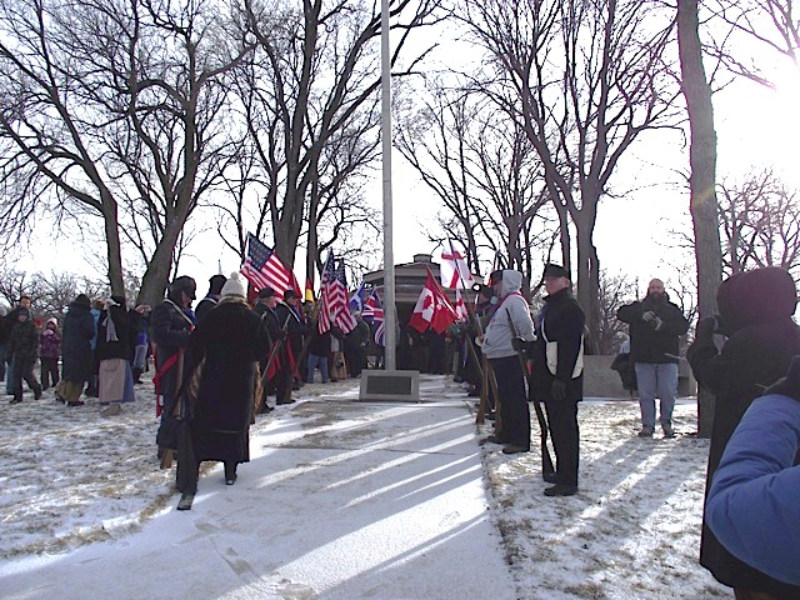
Elder Germer played “Call to Colors” on his trumpet after “struggling to get the mouthpiece warm enough to blow,” Elder Memmott said. “We hoisted the flag to the top of the flag pole, and it waved wildly in the wind’s grasp.”

Participants recited the Pledge of Allegiance and sang the last two verses of “Come, Come, Ye Saints,” accompanied by Elder Ward on the harmonica. Sister Skidmore presented a pioneer reading, and names of those whose journey ended on the trail were read. After a moment of silence, Elder Germer played “Taps,” and a closing prayer concluded the program.

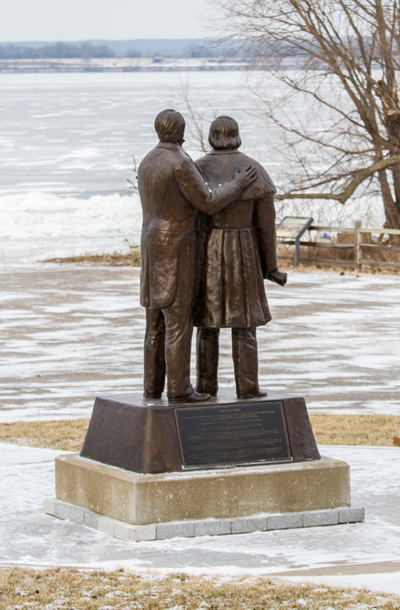
This was a memorable occasion, made poignant by our seeing the sheet of ice on the Mississippi and huge shards of ice that looked like ice waves near the shore,” Sister Jensen said. “It was easy to know how cold the saints must have been and awe-inspiring to know of their faith to follow a prophet.”
 Tom Simpson photo
Untold Nauvoo Stories Symposium
On February 1 and 2, 2013, the City of Nauvoo, Nauvoo Tourism Office, Joseph Smith Historic Site, and Historic Nauvoo hosted the 3rd Annual Untold Nauvoo Stories Symposium in conjunction with the Mormon Exodus re-enactment. Attendees expanded their understanding of Nauvoo’s historical past through presentations about less-known topics of people, conditions, and events that make Nauvoo unique and significant to American history. Symposium speakers voluntarily gave their time and expertise to expand the vision of Nauvoo’s diverse history.
Symposium sessions began with Father Tony Trosley discussing the intersection of Mormon and Catholic faiths in Nauvoo through the lives of Julia Murdock Smith, Joseph Smith, Brigham Young and Catholic priests Henry Reimbold, Leonard Tholen, and John Alleman.
Mary Jo Scheetz, long-time resident of the Nauvoo area, talked about the life of her ancestor Joseph Kirschbaum. Using his talents as artist, musician, and horticulturist, Joseph Kirschbaum documented post-Mormon Nauvoo. Mary Jo shared original paintings, photos, and artifacts of her talented ancestor who kept post-1846 Nauvoo alive.
Kim Orth and Lachlan Mackay discussed the 2012 Nauvoo Journey Stories project that brought the Smithsonian traveling exhibit to Nauvoo. Kim, co-chair of the Journey Stories project, presented “treasures” uncovered by the committee’s research. Lachlan, historic sites coordinator for the Community of Christ, described topics from Nauvoo Journey Stories that warrant further research. Grant Palmer and Tom Kimball presented their perceptions of William and Jane Law leaving the LDS Church. Wayne May, publisher of Ancient American Magazine, gave a PowerPoint presentation about the Hopewell people who resided in West Central Illinois over 2,000 years ago.
Jim Moffitt presented memories of the Moffitt family, early pioneers of Nauvoo. Bob Baxter provided insights about interesting “characters” of old Nauvoo. Bob Hopp discussed the life of Rear Admiral Edwin T. Layton, who fought in the Battle of Midway during World War II. Mary Logan informed attendees about Nauvoo’s 23 stone-arched wine cellars built in the late 1800s.
Rosemary Palmer presented stories from 58 first-hand accounts of children who lived in 1840s Nauvoo, and Linda Nelson talked about her family and childhood in Nauvoo during the 1950s and 1960s. Joseph Johnstun discussed Freemasons in Mormon Nauvoo, and his wife Shalisee told stories about Estel Neff, a current long-time resident of Nauvoo.
Rosemary Pollock, a former Nauvoo Temple missionary, shared her research about Dr. John Weld, an early resident who lived in Nauvoo from 1839 to 1892. Durell Nelson told about the life of another early Nauvoo citizen, Heinrich Lienhard, who worked at Sutter’s Mill when gold was discovered and later purchased and lived in Heber C. Kimball’s home in Nauvoo for 47 years.
On Friday evening, Hotel Nauvoo opened its doors for a buffet dinner, and four string members of the Nauvoo Community Orchestra provided entertainment. The keynote speaker was Brother Bill Myers, who told stories of Methodists in Nauvoo since 1846, including tales of German-speaking and English-speaking Methodists with two congregations until 1904. On Saturday evening, a closing social was held at the Nauvoo Tourism Office, where attendees visited and listened to harp and autoharp music.
“We learned lots and admire so much how all the groups of citizens work together to showcase the history of Nauvoo,” temple missionary Sister Jensen said.
Next year’s Mormon Exodus re-enactment will take place on Saturday, February 8, 2014, and the Untold Nauvoo Stories Symposium will be held on February 7 and 8. Nauvoo welcomes visitors to next year’s re-enactment and symposium. To submit proposals for the 2014 Untold Nauvoo Stories Symposium, e-mail [email protected]“ with name and contact information, bio-sketch, and brief description of the presentation. Keep in touch with symposium details by visiting www.untoldnauvoostories.com as presenters, presentations, and schedule are placed on the web site. February is a peaceful month to come to Nauvoo, commemorate the 1846 exodus, and delve into Nauvoo’s diverse history.
Rosemary Palmer is Nauvoo correspondent for Meridian Magazine.