








Something about parenting lends itself to analogies. Just recently I’ve seen or heard parenting compared to gardening, running a blender without a lid, and being pecked to death by ducks, as well as several aspects of sports from refereeing to zone defense. Whatever analogy seems to fit at the time, parenting is one of the most challenging and rewarding experiences of my life, and certainly one of the hardest and most important jobs anyone can have. Parenting books run the gamut of philosophies and suggestions. Here are two I found informative and eye-opening:
“Quietly and en masse, French parents are achieving outcomes that create a whole different atmosphere for family life.”
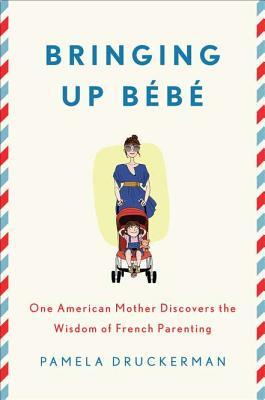 Bringing Up Bebe: One American Mother Discovers the Wisdom of French Parenting
By Pamela Druckerman
Ms. Druckerman’s self-deprecating exploration of French parenting techniques is charming to read and I was gratified to see that, at least in some respects, I could be considered “French!”
If I could take only one concept away from this book, it would be that of l’equilibre – “not letting any one part of life–including parenting–overwhelm the rest.” French parenting assumes that there should be a certain balance in family life and that one must “give real weight to the parents’ own quality of life, not just to the child’s welfare” and that balance is absolutely vital, in my mind. I also like the idea of “healthy separation” and that French parents “allow themselves to mentally detach from their kids” including some serious time away from them at a pretty young age (like a week or more at age four), far better than the thought that some “American stay-at-home mothers…never use babysitters because they consider all child care to be their job.” I mean, I love my children more than life itself, but I certainly crave – no, need– some “me” time, too.
Interestingly, there are also some echoes from Battle Hymn of the Tiger Mother (which I reviewed on Meridian here) as well. Ms. Druckerman notes that French parents (and teachers), like the “Chinese mothers” in Battle Hymn of the Tiger Mother, are less forthcoming with praise than American parents generally are: “Perhaps they realize that those little zaps of pleasure kids get each time a grown-up says ‘good job’ could–if they arrive too often–simply make kids addicted to positive feedback. After a while, they’ll need someone else’s approval to feel good about themselves. And if kids are assured of praise for whatever they do, then they won’t need to try very hard. They’ll be praised anyway.” (Actually, this is borne out in quite a bit of research, including in NutureShock, another great parenting book.) Likewise, the French “don’t think that a bit of frustration will crush kids. To the contrary, they believe it will make children more secure.” It can be hard as a parent to watch your child not reach a goal they set or to see their hopes disappointed, but being able to deal with disappointment and setbacks is an important life skill. And we can’t learn or practice resilience if we don’t have the chance to fail and the space to process our emotions ourselves.
“Self-esteem comes from actual competence.”
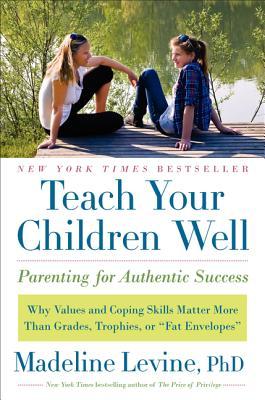 Teach Your Children Well: Parenting for Authentic Success
By Madeline Levine
Dr. Levine provides a good summation of positive parenting techniques, mostly focused on the definition of “success” and “failure.” Instead of the relentless focus on academic success that drives some kids to stressed, sleep-deficient, self-harming states, Dr. Levine encourages parents to recognize that “in the real world, success has all kinds of different faces.” And instead of seeing our work as parents as “crisis intervention,” she advocates a paradigm shift to refocus on “our most important job–to provide a calm, secure, and loving haven for our children as they go about the challenging business of growing up.”
As soft and fuzzy as this sounds, it doesn’t mean coddling or “helicopter parenting” or building your entire world around your children; rather it means finding the right balance of oversight and freedom at each stage of your child’s development. It means seeing your child for who s/he is, with his/her attendant strengths and weaknesses, rather than those you project on them because of your past experiences, current desires or future dreams. It means developing “warm, supportive relationships” with them so they are more “open to advice and guidance” from you.
The book separates kids into three categories by age, roughly equivalent to elementary, middle and high school. I’ll admit that with a 10-, 6-, and 3-year-old, I read the elementary section most intently, though some of the pointers for middle-school-aged kids are already starting to be pertinent with my 10-year-old.
Dr. Levine breaks each section down into important skills or qualities for children to develop and ends each section with “How Parents Can Help,” providing several specific, actionable points. Don’t trivialize difficulties. Help your child find and develop ‘islands of competence.’ Stay curious with your child. Encourage questions. Value academic risk taking. Point out the effects of your child’s behavior on others. None of the advice is really new – I’ve read lots of parenting books and I’ve encountered most of these ideas multiple times – but I appreciate how Dr. Levine packages and presents the information.
Frankly, the middle-school section scared me a bit. Statements like this one: “Our system of education for this age group is largely a misery and the middle schoolers’ well-documented needs for adequate sleep, flexible study time, multiple breaks, and quiet, restorative time are ignored. Add to this a stew of hormonal and brain changes. Mix in difficult issues like sex, drugs, and academic pressure, issues that were previously reserved for high school students with more coping skills. And don’t forget that researchers have documented a host of negative effects simply from the transition into middle school, including lowered achievement, destabilized social relationships, and reduced self-esteem.” Eeek. Or “It is actually parents, rather than teens, whose mental health is most negatively affected during the early adolescent years. Moms in particular bear the brunt of their teens’ irritability.” Lovely…
In the third part of the book, Dr. Levine discusses what she calls the “resilience factor” which includes seven essential coping skills kids should learn in order to be successful in life: resourcefulness, enthusiasm, creativity, a good work ethic, self-control, self-esteem, and self-efficacy. I found this section to be particularly helpful and full of practical suggestions, both “do”s and “don’t”s.
The final section contains some exercises to help you and your family identify your core values and guiding principles, and to create a family action plan.
It ends with the encouragement that “We are never ‘finished’ products” and that with self-reflection, we can identify and choose to change behaviors that are not helpful for us or our children.
**************************
On My Bedside Table…
Just finished: Like Me: Confessions of a Heartland Country Singer by Chely Wright
Now reading: Jesus Wars: How Four Patriarchs, Three Queens, and Two Emperors Decided What Christians Would Believe for the Next 1500 Years by Philip Jenkins
On deck: Before I Go to Sleep by S.J. Watson
**************************
A few more books on parenting next time. Have you dropped by my new blog Build Enough Bookshelves yet? Come find me on goodreads.com or email suggestions, comments, and feedback to egeddesbooks (at) gmail (dot) com.