








In the last installment of “self-help” books, we have one that promises to teach you the skills you need to change any habit and one that promises to improve your ability to “sell to” or move others. Is there anyone out there that couldn’t use some help in either or both of those categories? I didn’t think so. Read on!
“What idiot would refuse a crutch when his leg is broken?”
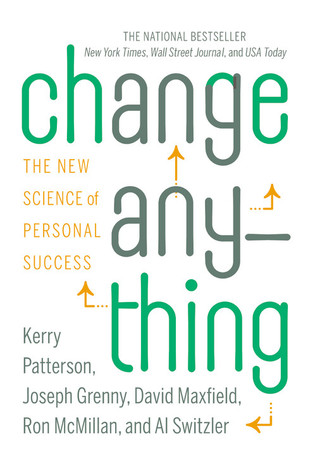
Change Anything: The New Science of Personal Success
By Kerry Patterson, Joseph Grenny, David Maxfield, Ron McMillan, and Al Switzler
How many times have you tried to change a habit and failed miserably? (I know I’m not the only one whose New Year’s Resolutions are forgotten long before Valentine’s Day…) And then you feel like a failure, you curse yourself for your lack of willpower or stamina, you beat yourself up for not being able to stick with that diet or pay off that debt or swallow those snarky words that hurt your partner or children. Well, according to the team of authors who wrote Change Anything: The New Science of Personal Success, it’s not about a lack of willpower, it’s about changing the whole process of how you change. And changing is a skill anyone can learn.
Patterson, et al., identify Six Sources of Influence that work together to motivate our behaviors and, therefore, need to be adjusted when we want to make a change. They arrange their Six Sources in a matrix with three categories (Personal, Social, and Structural) with two facets each (Motivation and Ability). Using all six of the sources, rather than just one or two, greatly improves your chance of success. And the authors go in to great detail on specific tactics for each. For example, under Source 1: Personal Motivation, they recommend five tactics to increase your personal desire to change and keep it strong:
* Visit your default future. Figure out what your future will look like if you don’t change.
* Tell the whole vivid story. Describe that future as vividly as possible to make it seem more “real.”
* Use value words. Articulate the “why” for your change in positive terms.
* Make it a game. Set a time frame and smaller goals to help you reach the big one.
* Create a personal motivation statement. This will help you stay on track when you hit those crucial moments when you are more likely to fail.
And that’s just one of the Six Sources.
One thought I found particularly insightful was regarding willpower. “Will is a skill, not a character trait. Willpower can be learned and strengthened like anything else, and…it is best learned through deliberate practice.” This makes sense. If we view willpower as a static character trait, we’re more likely to think that because we’ve failed once, there’s no use in trying again; we just can’t do it, it’s hopeless. If instead, we view will as a skill that can be improved, there’s always hope for that improvement and the encouragement to keep trying.
The authors recommend looking at this process of change as a scientist would. (This was actually my favorite idea in the entire book.)
Don’t expect to be able to identify all of your crucial moments and vital behaviors at the beginning. Your progress won’t follow a straight line. You’ll hit binges and setbacks, but treat these challenges the way any scientist would. Examine your failures with curiosity and concern, not self-condemnation. You’ll quickly discover that you learn more from your failures than from your successes…Learn, adjust; learn more, adjust again. Make even your bad days become good data.
I love the idea of “examin[ing] your failures with curiosity and concern, not self-condemnation.” We all fall short of our ideal, despite all our efforts, and treating those moments as opportunities to improve our method of improving instead of opportunities to belittle ourselves is a much healthier approach.
At times it was difficult to differentiate between some of the categories the author present, in particular the two facets of Social Sources seemed to work in tandem, but I appreciated the well-rounded and forward-thinking approach they demonstrate to making and maintaining positive changes, and the concrete tactics they describe. The book has a related website, www.changeanything.com, where you can register your own plan for personal change and access additional helpful tools and tips.
 “We’re all in sales now.”
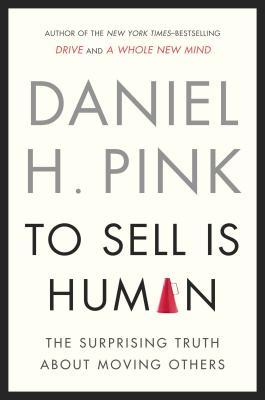
To Sell Is Human: The Surprising Truth About Moving Others
By Daniel H. Pink
For me, Daniel H. Pink’s book Drive: The Surprising Truth About What Motivates Us was one of those mind-blowing, look-at-the-whole-world-differently kind of books that only comes along every so often. In fact, I named it as one of my “Top Twelve of 2010” right here on Meridian Magazine. The very day that column was published, I got a nice little note from the author himself.
Emily —
Thanks for including DRIVE on your list of favorite 2010 books. Much appreciated.
Cheers,
Dan Pink
If you were listening very closely, you might have heard an embarrassing little fan-girl squeal when I opened that email. Maybe.
So I admit that I was predisposed to like his newest offering: To Sell Is Human: The Surprising Truth about Moving Others. But I was also a bit skeptical. You see, I’m one of those who shies away from the very idea of “selling something” or anything like unto it. As a newlywed finishing up my undergraduate degree in Provo, Utah, I took a job where my primary responsibility was cold calling people and trying to get them to answer various questions about different products and companies. I got assigned to the Viagra survey.
Precisely two hours, dozens of phone calls and one partially completed survey later (the person put me on hold halfway through the survey and never came back), I was done. Totally and completely done. And I wasn’t even “selling” anything.
It’s quite a triumph for Daniel Pink, then, to have so convincingly reframed the entire practice of “selling” as something that not only “everyone” does, but as something I personally do, too. It’s no longer an activity limited to greasy-haired, slick-talking used car salesmen. It’s now “the ability to move others to exchange what they have for what we have” and, Mr. Pink claims, it “is crucial to our survival and our happiness…It is part of who we are.”
Mr. Pink lauds the rise of small entrepreneurs, the elasticity demanded of employees by their employers, and the enormous growth of the “Ed-Med” sector (i.
e., education and medical services) as major drivers behind the universality of selling. He notes that the information asymmetry that used to govern the buying/selling process no longer exists, in large part due to the internet providing easy access to data. With that, the advantages of the sellers have all but disappeared and the act of selling, or “moving”, has become much more democratized.
In this brave new world where selling is the norm for just about everyone, a different mindset is required. Rather than the old maxim Always Be Closing, the qualities of Attunement, Buoyancy, and Clarity have charged to the forefront. To sum up, in order to be successful, one must cultivate the empathy to be “in tune” with others and see from their perspective; the resilience to bounce back from rejection; and the ability to define the right problems and ask the right questions.
Mr. Pink grounds his suggestions in hard science. For example, in the section on buoyancy, he quotes a fascinating social science study done in Brazil that calculated the optimum ratio of positive to negative emotions. The study showed that three positive emotions for every negative emotion was the lowest ratio that demonstrated an improved well-being. Interestingly, experiencing more than about ten positive emotions to each negative emotion “does more harm than good” as “life become a festival of Panglossian cluelessness, where self-delusion suffocates self-improvement.”
Above all, this book is practical. Mr. Pink provides concrete actions to take that will improve job performance, personal well-being, even the quality of our relationships, as we consciously work to refine our ability to move others.
**************************
On My Bedside Table…
Just finished: The Ordinary Princess by M.M. Kaye
Now reading: The Casual Vacancy by J.K. Rowling
On deck: If Not, Winter: Fragments of Sappho by Sappho
**************************
Have you checked out my new blog yet? I’d love to see you over at Build Enough Bookshelves for extended versions of these and other book reviews. Come find me on goodreads.com or email suggestions, comments, and feedback to egeddesbooks (at) gmail (dot) com.