






Last time we looked at the process of science, the curiosity and experimentation at the heart of the quest for more knowledge, and how to evaluate scientific findings that we encounter in our daily lives. Today we’ll look at some specific facets of science including kissing (biology), the periodic table of the elements (chemistry) and superheroes (physics). Science is not so intimidating, after all!
“A kiss is one of the most significant exchanges two people can have.”
The Science of Kissing: What Our Lips Are Telling Us
By Sheril Kirshenbaum
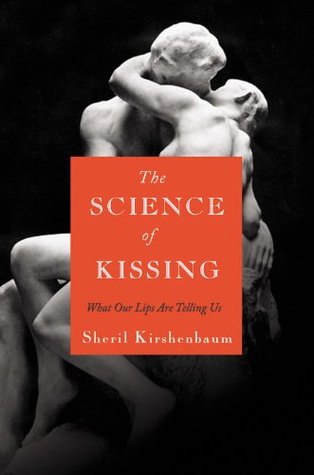 The Science of Kissing: What Our Lips Are Telling Us is a brief but interesting look at the history, cultural and social practices, and science of kissing/smooching/bussing/osculating. Ms. Kirshbaum includes many memorable tidbits throughout the book. Several nuggets that stuck out to me included descriptions of affectionate, kiss-like practices of non-European cultures, such as rubbing noses or biting off eyelashes. (Yes, you read that right!) Did you know that one study shows that men who kiss their wives before leaving for work live on average five years longer and earn 20-30% more than their un-kissed counterparts? (Don’t know if that works the other way – the study didn’t look at the effect of a goodbye kiss on the lifespan of working women.) And why in my four years of high school German classes and three years of college German classes did I never learn that German has thirty different words for kissing?
Ms. Kirshenbaum gives a short survey of the historical evidence for kissing across multiple cultures, as well as kiss-like behaviors in animals. She touches on gender differences in kissing expectations, attitudes and preferences and then moves on to the biochemical, physiological and neurological effects of kissing. She covers cutting-edge MEG (magnetoencephalography) studies currently being done by New York University neuroscientists in relation to the neuroprocesses that occur before, during, and after kissing.
I was astonished by one statistic she shared: 59% of men and 66% of women reported breaking things off with a prospective partner because of their first kiss. With that in mind, we can probably all stand to improve a bit. Luckily, Ms. Kirshenbaum closes with ten “tips” for being a good kisser based on the scientific evidence presented earlier in the book, including “improve your taste and scent,” “foster anticipation,” and “kiss regularly and often.” My husband has greatly appreciated that last bit of advice.
“Life is built solely, if mysteriously, from the elements on the periodic table.”
By Sam Kean
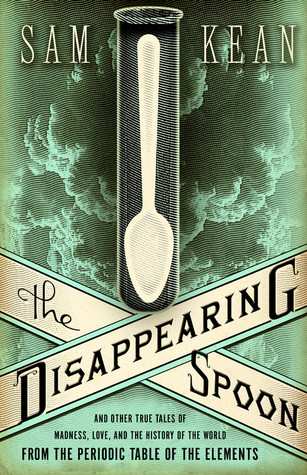 So, outside of those who went into chemical engineering, how many of us have given any thought at all to the periodic table of the elements since our high school chemistry class? And have you ever taken the time to really look at that big poster on the wall that looked like a medieval castle made of building blocks? Mr. Kean uses the structure of the periodic table of elements to delve into its history, chemical attributes, and the very nature of the elements that make up this world and everything in it. And he puts the elements in their proper perspective, too. “As we know, 90 percent of particles in the universe are hydrogen, and the other 10 percent are helium. Everything else, including six million billion billion kilos of earth, is a cosmic rounding error.”
While all the elements in the universe besides hydrogen and helium are “a cosmic rounding error,” many of them are absolutely vital to life on earth, but it took scientists many years to identify, much less understand each element’s place on the periodic table and in the processes of life. Arranged generally chronologically, The Disappearing Spoon guides the reader through history as new discoveries were made. Elements weren’t even recognized as such – “substance[s] that cannot be broken down or altered by normal, chemical means” – until the early 1800s, and often discoveries of new elements were painstakingly slow in coming.
Mr. Kean paints portraits of many interesting individuals related to the periodic table in The Disappearing Spoon. Maria Goeppert-Mayer, born in Germany in 1906, overcame the limitations placed upon women scientists – most PhD programs at the time refused to admit women and certainly wouldn’t hire one – to eventually be invited to participate in the Manhattan Project. In a vital contribution to understanding how atoms are put together, she discovered the fundamental facts of how nuclei shells function. Her nuclear shell model was “brilliant physics” and she eventually won the Nobel Prize for Physics in 1963. Another scientist, Clair Patterson, initially focused on using rates of uranium decay to estimate the age of the universe. Realizing that the element lead omnipresent in human hair, skin, and nails, was ruining his ability to get results, he resorted to drastic measures to maintain an uncontaminated field for his experiments. “This scrupulousness soon morphed into obsession” and Patterson became an activist against lead in paint, gasoline, and other substances, almost single-handedly responsible for raising public awareness of the dangers of lead.
The influence of the elements shows up in everything from popular culture to global socio-political situations. Mark Twain’s science fiction short story “Sold to Satan” incorporates Marie Curie’s astonishing discoveries about radium made only six years before its 1904 publication – the devil is made entirely of the radioactive material and wears a protective coat of polonium to prevent the instant incineration of the people he meets. For many years, the elements tantalum and niobium used in cell phones was mined in the Democratic Republic of Congo and sold to fund a brutal war; now the demand has shifted to the element tin, also plentiful in the Congolese ground.
The Disappearing Spoon presents an accessible pathway to comprehending more about the building blocks that make up our world. Mr. Kean rounds out the science with the human interest stories that surrounded the myriad and still ongoing discoveries.
“The real world is a complicated place.”
By James Kakalios
 Dr. Kakalios teaches a popular freshman seminar at the University of Minnesota entitled “Everything I Needed to Know about Physics I Learned from Reading Comic Books.” The Physics of Superheroes is his attempt to convince a wider audience of the excitement to be found in the laws of physics. His imaginative teaching style incorporates examples across the comic book universe from The Flash’s kinetic energy to Iron Man’s technologically advanced suit, and his “punny” and sometimes dry wit translates well into the written word.
Promising in his preface that even readers who are averse to math can follow along with his explanations, he declares “for this book, all that is required is that one recognizes that + = 1.” While a bit more familiarity with algebra would be helpful, Dr. Kakalios mostly delivers on that promise. His descriptions of physics equations and processes are thorough without being overwhelming. And he covers the gamut from Newton’s Law of Gravity to Special Relativity and the Three Laws of Thermodynamics to Quantum Mechanics.
Dr. Kakalios starts out with the universally known character Superman and his ability to “leap tall buildings in a single bound” – due, of course, to the fact that Earth’s gravity was so much weaker than that of his home planet Krypton. Pointing to Superman’s origin story which mentions that Superman can jump 660 feet (1/8th of a mile) straight up in the air, Dr. Kakalios sets out to calculate just how much greater Krypton’s gravity is than Earth’s. Explaining the equations F(orce) = m(ass) x a(cceleration) and v(elocity)2 = 2g(ravity) x h(eight) as well as the principles behind the equations, Dr. Kakalios calculates that “Superman’s legs must provide a force of 5600 pounds” in order to allow him to make the 660 foot leap. A bit more extrapolation yields the gratifying figure: “the gravity on Krypton must have been 15 times greater than on Earth.” Isn’t your life more complete now?
A seamless combination of entertaining and educational, The Physics of Superheroes is a fun read.
**************************
On My Bedside Table…
Just finished: Wonder by R.J. Palacio
Now reading: The Secret Tree by Natalie Standiford
On deck: Roger Williams and the Creation of the American Soul: Church, State, and the Birth of Liberty by John Barry
**************************
New topic next time! I love to hear from you with suggestions, comments or feedback. Track me down on goodreads.com or email me at egeddesbooks (at) gmail (dot) com.