








My first selection in this column on books about science may seem rather odd. Ray Bradbury, a renowned science fiction writer, once said, “The best scientist is open to experience and begins with romance – the idea that anything is possible.” In that spirit of curiosity and desire to know, I think you’ll find A.J. Jacobs’ experiences fascinating. The books look at the deluge of scientific information in modern society – how to rationally evaluate scientific claims without getting swept away by sensational misrepresentations or overwhelmed by jargon.
“The culture of distraction is changing the way we think”
My Life as an Experiment: One Man’s Humble Quest to Improve Himself
By A.J. Jacobs
 A.J. Jacobs has found his niche. In previous books, he documented his experiences reading through the entire Encyclopedia Britannica or living for a year according to strict Biblical laws or even improving his physical health. A.J. – I can’t bring myself to call him Mr. Jacobs, his books give off far too intimately friendly a vibe for that – describes himself straightforwardly in this book’s introduction as “addicted to these experiments” adding that as a writer he was “cursed with a relatively uneventful upbringing” and since “my ordinary life doesn’t merit a book” he inserts himself into these sometimes ridiculous situations to “see what happens.” You can call it “immersion” or “participatory journalism,” but the key, A.J. claims, is to be “interested in the topic” and to “keep the good parts and not descend into insanity.”
In My Life as an Experiment, Mr. Jacobs explores the dangers of multi-tasking, the benefits of outsourcing, the perils and perqs of fame, and the vulnerability of nudity, often with the starting point of a recent scientific study. He emulates George Washington for a month by adhering to his 110 “Rules of Civility and Decent Behaviour in Company and conversation,” spending time with several professional George Washington interpreters. He poses as a woman – his nanny, actually, and with her permission – on an online dating site. And he spends a month responding to his wife’s every whim. Which she totally deserved after all the other experiments she’s put up with over the years.
His experiments also included a trial of “Radical Honesty” where you not only tell the absolute truth, but you also completely remove the filter between your brain and your mouth, saying everything you’re thinking. While the constant confrontations which Radical Honesty prompts can be cathartic, A.J. also admits that they are relentless. By the end of the month, he’s decided to maintain what he calls “Sustainable Radical Honesty,” particularly about his own flaws and mistakes and in relationships, while mostly ditching the aspects concerning other people’s flaws. He also states “I’ve come to appreciate the filter between the brain and mouth. Words can be dangerous. Once they’re out in the atmosphere, they can become self-fulfilling prophecies.”
I was fascinated by the chapter on the brain’s many biases against rationality. He starts out: “My brain is deeply flawed. And no offense, but so is yours. Your brain is not rational. It’s packed with dozens of misleading biases. It’s home to an alarming number of false assumptions and warped memories. It processes data all wrong and makes terrible decisions.” Whew! Tell me how you really feel! But seriously, statements like “Probably 90 percent of our life decisions are powered by the twin engines of inertia and laziness” catch my attention. He highlights several of the most common biases, such as the Lake Wobegon Effect (where all the children are above average), the Availability Fallacy, Unit Bias, Source Amnesia, the Halo Effect, Confirmation Bias, the Mere Exposure Effect, and a half dozen others and then goes about consciously trying to work against them. He states in his conclusion that, outside of his year of living biblically, this month of “the Rationality Project has had the most dramatic, long-lasting effect of all my experiments.” It certainly made me think about how I think, gather, and process information.
The curiosity and enthusiasm A.J. Jacobs demonstrates in this book, as well as his other works, exemplifies the soul of science: recognizing what we don’t know, and driving to expand our knowledge, to experience the foreign, and to keep searching for additional truth.
“Science is not conducted in a vacuum.”
By Sherry Seethaler
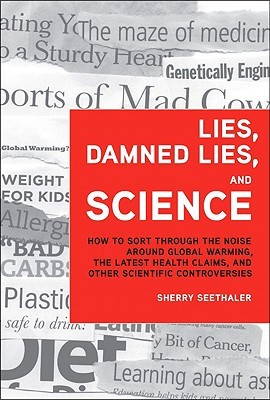 Lies, Damned Lies, and Science is a thorough, step-by-step handbook on how to interpret scientific claims, particularly those made in the mainstream media. This is not a book to read quickly – the best application is probably to read a chapter or even just a section within the chapter and take some time to digest the processes and examples described. Dr. Seethaler gives her readers the tools to get past the oversimplified perspectives that we as a general public are all-too-often fed, the better to understand the nuances involved in the scientific process and studies’ findings. She emphasizes that science is not the black-or-white choice it is often perceived to be, and that critical thinking skills are more important than an in-depth encyclopedic scientific knowledge in deciphering scientific claims.
Dr. Seethaler provides specific, actionable tools to use in evaluating the overwhelming myriad of scientific claims we wade through on a daily basis. For example, her first chapter focuses on explaining the scientific process – which is much messier than the scientific method we all learned in high school might lead one to believe – as well as how science progresses, and why scientists can disagree, sometimes vehemently. She boils this informative chapter down into three basic applications for her readers: “Legitimate criticism can be distinguished from science bashing,” “Claims about scientific disputes or consensus should not be taken at face value” and “Beware of the self-declared revolutionary who claims to be unappreciated by the scientific community.” Subsequent chapters elucidate the importance of identifying stakeholders and recognizing bias, evaluating pros and cons as well as risks and benefits, considering the “bigger picture” in an appropriate context, and distinguishing between cause and coincidence, among other topics.
Occasionally the text is a bit dry, but Dr. Seethaler throws in enough off-the-cuff humor and pop culture references (Harry Potter’s Potions class is mentioned right off the bat) to keep you awake and reading.
Her examples are particularly compelling – she draws from a wide range of fields including medical, agricultural, archaeological, sociological, and economic – and transmits a confidence to her readers that they can understand and evaluate scientific claims. “You are…perfectly capable of learning to see through the hype and hogwash that come your way,” she affirms. Lies, Damned Lies, and Science is an incredibly useful and empowering book.
**************************
On My Bedside Table…
Just finished: God Is Not a Christian: And Other Provocations by Desmond Tutu
Now reading: In Heaven as It Is on Earth: Joseph Smith and the Early Mormon Conquest of Death by Samuel Morris Brown
On deck: A Book of Silence by Sara Maitland
**************************
More science in two weeks! Come find me on goodreads.com or email suggestions, comments, and feedback to egeddesbooks (at) gmail (dot) com.