







Yes, I know this is the “Non-fiction Nook,” but I’ve been rediscovering my love of historical fiction lately, as well as being reminded of just how much knowledge of history one can absorb from good, well-researched works of fiction. So I thought I’d share with you a couple of books – series, actually – that I’ve both learned from and enjoyed recently. What are your favorite works of historical fiction?
“All the packing was done and we was pulling out down the road and I couldn’t take my eyes off the little house sitting there lonesome looking with that window open like a mouth calling us back.”
These Is My Words: The Diary of Sarah Agnes Prine, 1881-1901, Arizona Territories, A Novel
By Nancy E. Turner
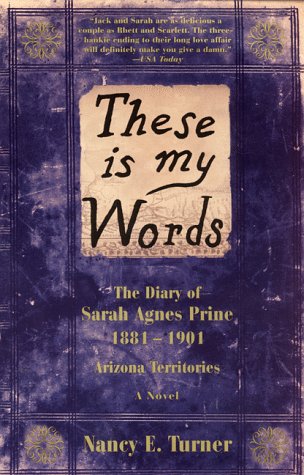 Ms. Turner grew up hearing stories about her great-grandmother, the real Sarah Agnes Prine. Upon discovering her love of writing when she returned to college at age 40, Ms. Turner decided to fictionalize some of those stories in a diary format. Ms. Turner’s Sarah is strong, independent, decisive, entrepreneurial, resilient, and honest. She judged people on their actions, not the color of their skin or their clothes or connections. Her diary chronicles her struggles to make a good life in a wild, empty place, to “be good” and to gain as much of an education as she can without the opportunity to go to school. Her love of books and learning, her deep desire to be truly loved and not settle for less, her ability to simply do what needs to be done, whether managing a ranch, nursing the wounded, or protecting her family, have made her one of my heroes.
I fell in love with Sarah and with These Is My Words from almost the first page. (Anyone who states “A nice girl should never go anywhere without a loaded gun and a big knife” has definitely piqued my interest!) I was completely taken in by this woman’s story; the first person, diary format really worked for me. Some characters mentioned in the book can come across as less than three-dimensional, but that again is true to the diary format. And don’t let the grammatically incorrect title put you off; it just shows where she started so you can see how far she came by the end of the book. As you read along, her spelling, punctuation and grammar all improve as she educates herself with the resources she has available.
Ms. Turner has Sarah describe her life in plain, no-nonsense language which by its starkness serves to highlight the unpredictability and harshness of life in the Territories. And boy, was it harsh. Sarah lived through some incredibly difficult times and losses over and over again, with moments of sublime happiness and over-the-top hilarity, too. These Is My Words draws an interesting perspective on life in the 1880s and 1890s, particularly for women. From These Is My Words we also learn about what it takes to run a ranch, make soap, and be self-reliant in a hundred other ways. Sarah could shoot, ride, and work as well, if not better, than most of the men in the book. She called a doctor on a nonsense diagnosis (“acute inflammation” – “of what?”). She refused to allow a bank clerk to talk down to her and took her money elsewhere when told she should let her husband worry about finances. When her second husband began to take her for granted, she told him off, handed him the baby and went to bed, letting him deal with the house, dinner and the children for the evening.
Sarah’s story continues in two sequels: Sarah’s Quilt: A Novel of Sarah Agnes Prine and the Arizona Territories, 1906 and The Star Garden: A Novel of Sarah Agnes Prine. While I enjoyed the first the most, all three are worthy of your time and will expand your understanding of life on the Frontier.
“Since her time in France, Maisie had preferred an army-issued tin mug for her private teatimes, for the warmth that radiated from the mug to her hands and to the rest of her body.”
By Jacqueline Winspear
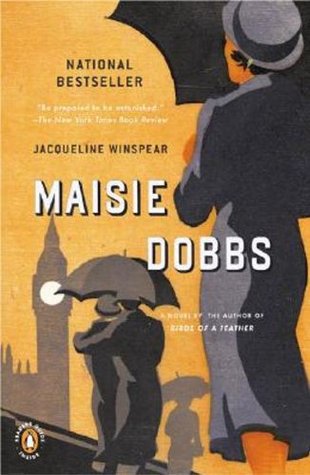 Maisie Dobbs was born the daughter of a costermonger, a street seller of fruits and vegetables, in London, England. In 1910, at the age of 14 and after the death of her mother, she became a maid in the home of Lady Rowan Compton in order to supplement the family’s income. Always intellectually curious despite her disadvantaged roots, Maisie was discovered one night in Lady Compton’s library, reading from the wealth of literature on the shelves. Fortunately, Lady Compton felt that such a thirst for knowledge should be encouraged and arranged for Maisie’s education with a good friend, Maurice Blanche. A few years later, World War I broke out, and Maisie volunteered as a nurse at the front in France. After the war, Maisie apprenticed to Maurice in his psychology and investigation business and learned from him how to uncover secrets, solve mysteries, and help bring closure to others in distress, all the while trying to heal from the trauma the war caused her.
Maisie Dobbs is the first in a series of nine books and counting, and picks up in 1929. Maisie has recently hung out her shingle doing “Trade and Personal Investigations” and accepts her first clients as a solo investigator.
Ms. Winspear deftly creates the feel of the late 1920s and early 1930s, incorporating thoroughly researched period details without it seeming forced. (For example, did you know that the word “hiking” came from a contraction of the words “hill walking” and was encouraged by the British government after World War I as a way to get British citizens to improve their health by exercising and getting fresh air? Neither did I!) Maisie’s unique position, coming from a lower working-class background, but being a well-educated professional and living among the privileged, provides the opportunity to learn about British life across the entire socio-economic spectrum. Because of the nature of Maisie’s work, she interacts frequently with the British police force and Scotland Yard, providing us a glimpse into that world as well. It’s obvious that Ms. Winspear holds a special place in her heart for the fashions of the day, as she describes each character’s clothing and accessories in great detail.
Having read the entire series so far, I’m most impressed with the realistic depiction of the after-effects of war. Maisie deals with flashbacks to her time in France, in the thick of the fighting. She experiences continuing trauma and difficulty dealing with certain situations or memories.
Over the course of the nine books, we see Maisie healing, occasionally back-sliding, and slowly moving forward. I’m also intrigued with the way Ms. Winspear presents the growing threat of the Nazi Germany in the later installments of the series. Of course, we as readers know that the Second World War is just around the corner, but it’s fascinating to watch the characters struggle to make sense of the disparate threads of information regarding Hitler and his goals.
If you would like to learn more about life in Great Britain during the Interwar Period, the Maisie Dobbs series is an enjoyable way to dip your toes in.
**************************
On My Bedside Table…
Just finished: The Righteous Mind: Why Good People Are Divided by Politics and Religion by Jonathan Haidt
Now reading: Dandelion Wine by Ray Bradbury
On deck: Something Wicked This Way Comes by Ray Bradbury
**************************
A few more of my favorite historical fictions next time, with a focus on World War II. Come find me on goodreads.com or email suggestions, comments, and feedback to egeddesbooks (at) gmail (dot) com.