








Mistakes. We all make them. And most of us really don’t like making mistakes…much less admitting it. But making mistakes can have some surprising benefits as these two books show.
“Expertise is simply the wisdom that emerges from cellular error.”
Better By Mistake: The Unexpected Benefits of Being Wrong
By Alina Tugend
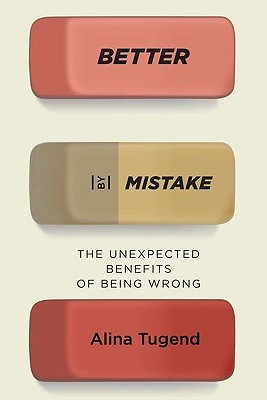 We’ve all heard the advice to learn from our mistakes and we’ve probably all paid lip service to the idea that mistakes are “learning experiences” rather than “failures”, but do we really believe it? In the beginning of Better By Mistake, Ms. Tugend explains that “In writing this book, I often emphasize the ‘good’ part of mistakes. That doesn’t necessarily mean that the mistakes themselves are good, but their aftermath-tracing back why we made them and what we learned from them-can be very helpful in avoiding mistakes in the future.” Of course, getting any benefit from our errors means we must be willing to acknowledge them, and study them in order to learn from them and improve. “While success may be a bad teacher, failure isn’t a very good one either if we don’t recognize the lessons being taught.” So why do we sometimes stress the appearance of perfection so much? Or expend so much energy justifying bad decisions? “If we spent half that much energy owning up to our responsibilities rather than hiding from them, we might actually get things done much more effectively and with a great deal less angst.” Ms. Tugend delves into the psychological reasons behind perfectionism and the serious disadvantages to “maladaptive perfectionists” who are unwilling to try new things out of fear of failure.
Ms. Tugend points out that this is particularly evident in our society’s work environment. “Most companies-like most people-don’t see themselves as promoting a work environment where mistakes are feared and avoided. They say they encourage risk taking and innovation, but in reality, they don’t.” She goes on: “All too often, mistakes are treated as something shameful that should be flung aside as quickly as possible, rather than as something to be examined and learned from. And because of this, companies-and employees-fail to uncover systemic problems that may be leading to the errors.” It’s difficult to create an environment that truly encourages creativity and innovation – both qualities that will require individuals to try new things and make some errors along the way – if mistakes are frowned upon or punished.
Another benefit of making mistakes is learning about differences. “When we’re small children, we tend to think that how we live is how everyone lives…When we discover these differences, we have to slightly rearrange our way of thinking-not everybody is like us.” This can help us learn to accept not only the different ways of life but to accept our own mistakes by viewing them as other cultures view them. For example, “the Japanese emphasis on effort…can remind us that making mistakes while trying something new is to be commended, not disparaged, and…we shouldn’t revere results while diminishing the value of the process.” Results-oriented cultures, such as in many Western countries, are generally much less tolerant of mistakes than process-oriented societies.
Since we were little, we’ve been taught that if you make a mistake that hurts another person, you should say sorry, so Ms. Tugend also addresses the art of the apology. Occasional double-speak, non-apologetic apologies by politicians, celebrities or other public figures aside, “A proper apology has three elements: an acknowledgment of the fault or offense, regret for it, and responsibility for it-and, if possible, a way to fix the problem.” Justifications or excuses only weaken a sincere apology.
Ms. Tugend encourages a simple shift in how we handle mistakes, starting with young children: “Emphasize effort and deemphasize results.” In addition, we should strive for “clear communication” in all our interactions, including observation and feedback, and to be wary of the assumptions we make. If you’d like to learn more about leveraging your mistakes into improvements – which hopefully, most of us would – Better By Mistake is an excellent step toward that end.
“Today, almost any physicist understands relativity better than Einstein did…”
Einstein’s Mistakes: The Human Failings of Genius
By Hans C. Ohanian
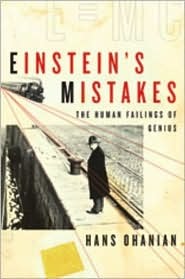 Albert Einstein was a genius. Time after time, he made theoretical leaps and discoveries that were decades ahead of the work his contemporaries were doing. He also made some colossal, amazingly bone-headed errors. In fact, according to Dr. Ohanian, a physicist himself, out of 180 scientific papers published by Einstein over his lifetime, a full 40 of them had mistakes, some of which were trifling, but many of which were significant. 40 out of 180 – that’s almost a quarter of his output! Not only that, but his doctoral dissertation alone had over thirty math errors. If the greatest physicist of the 20th-century (and the second-greatest of all time, after only Sir Isaac Newton) can mess up that frequently and still be lauded as a genius, I figure a few mistakes here and there aren’t going to kill me, either.
Interestingly, Einstein didn’t consider intelligence or hard work to be his most important asset. His stubborness got top billing, instead. “He felt that the task of a scientist is to find the most important question, and then to pursue it relentlessly.” But Einstein also had what Dr. Ohanian calls “a remarkable talent for making fruitful mistakes.” His intuition frequently, but not always, guided him to correct conclusions, in spite of his “botched” mathematical reasoning. Some of these mistakes led directly to the discoveries Einstein is best known for: his theories of special and of general relativity. (One quick note: in physics, as in most scientific fields, the word “theory” doesn’t mean “opinion” or “conjecture” as it does in everyday usage. Rather, in this setting, the word “theory” is equivalent to “explanation.”)
I was most surprised to discover that Einstein was not very comfortable using math as a basis or proof of his proposed theories; and he made many errors in the mathematical portions of his papers. Whenever he could, he’d partner with another physicist or a mathematician whose job it was to write the part of his papers that involved calculations – and in his later years, he employed assistants for the sole purpose of performing the complex mathematics his work required. Unfortunately, these partners or assistants often were denied the credit due to them, either by deliberate omission, or simply because the name “Einstein” overshadowed any other attached to a project.
Dr. Ohanian has a talent, too, of explaining complex scientific theories in a way that is understandable for the layperson. I appreciated his analogy comparing mass and energy to ice and water. First, in relation to possibly the most famous equation associated with Einstein, E = mc2, he explains that “mass is a congealed form of energy, or an inactive form of energy” or, in other words, “mass and energy are two facets of the same thing.” Then he provides this image: “We can think of the congealed energy hidden in the mass of a body as analogous to the congealed water locked in the Antarctic ice sheet, and we can think of the liquid water on the Earth as analogous to the ordinary energy.
” He goes on to provide more detail about, for example, the “dramatic and violent” effects we would see if a great deal of congealed energy – mass – was released at once; similar to the “disastrous flooding of all the coasts” that would happen if all the congealed water – ice – in the Antarctic were released simultaneously. Great visual, isn’t it?
Einstein once said, “We all must from time to time make a sacrifice at the altar of stupidity, for the entertainment of the deity and mankind.” It’s affirming to know that a stubborn, arrogant genius like Einstein recognized the inevitably and necessity of the occasional error. Perhaps I can be a bit more welcoming and gentle with my own mistakes, too.
**************************
On My Bedside Table…
Just finished: Calling on Dragons by Patricia Wrede
Now reading: The Red Tent by Anita Diamant
On deck: Goodbye, I Love You by Carol Lynn Pearson
**************************
New topic next time… Come find me on goodreads.com or email suggestions, comments, and feedback to egeddesbooks (at) gmail (dot) com.