





Click to Buy
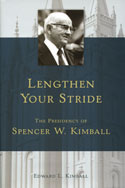 In 1977 a biography of President Spencer W. Kimball appeared and was immediately a best seller, particularly for its candid insights into the man. But between that time and his death in 1985, a great many important events occurred. First in significance was the 1978 revelation authorizing conferring priesthood on all worthy men.
In addition there was organization of the First Quorum of the Seventy, a burst of new and smaller temples, growth in missionary service, conducting of sixty area conferences throughout the world, and opposition to the Equal Rights Amendment and installation of the MX missile system in Utah.
The new book, Lengthen Your Stride, tells of the twelve years, 1973 to 1985, both about the man and the institution. The book is full of anecdotes. Here are some examples:In March 1972, Spencer’s heart had deteriorated, and he suffered breathlessness and bone-weary fatigue. He bluntly described his condition to the First Presidency (Joseph Fielding Smith, Harold B. Lee, and N. Eldon Tanner): “I am a dying man. I can feel my life slipping away. I believe it only a matter of months.”
The Presidency asked Dr. Russell Nelson, “What can surgery offer?”
Dr. Nelson suggested an aortic valve replacement and a graft to bypass a blocked artery.
Harold B. Lee asked the crucial question, “What is the risk?”
“I don’t know,” Dr. Nelson replied. We have no experience doing both procedures on patients this old.”
Spencer did not fear death, only disability. He began to respond wearily, “I am an old man and ready to die to make room for someone else in the Quorum.”
But President Lee interrupted, rose to his feet, and pounded his fist on the desk, saying with power, “Spencer, you have been called! You are not to die! You are to do everything you need to do to continue to live!”
“Then I will have the operation.”
*
In December 1973, President Lee, who had been in apparent good health, checked into the hospital for tests – but without any sense of urgency. However, a few hours later he went into cardiac arrest. As resuscitation efforts continued, his secretary Arthur Haycock telephoned President Lee’s counselors, Marion G. Romney and N. Eldon Tanner. He also called Spencer, who as president of the Quorum of Twelve would become leader of the Church should President Lee die.Upon arriving at the hospital, Spencer asked, “President Romney, what would you like me to do?”
“I guess all we can do is pray and wait.”
About nine o’clock, after an hour of desperate effort, a doctor came in to the waiting room, shaking his head, “The Lord has spoken. We’ve done all we can. President Lee is gone.”
Elder Romney, acknowledging the implicit dissolution of the First Presidency, turned to Spencer: “President Kimball, what would you like me to do?”
*
W. Grant Bangerter recalled the low expectations many had of the period Spencer Kimball would lead the Church: “‘O Lord,’ we prayed, ‘please bless President Kimball. He needs all the help you can give him.'”Spencer shared the feelings. He said, “I am such a little man for such a big responsibility.
He later said, “I still wonder what the Lord was thinking about, making a little country boy like me President of his Church, unless he knew that I didn’t have any sense and would just keep on working.”
*
Some threats on his life proved genuine. In November 1975, when Spencer went to rededicate the remodeled St. George temple, a young man who had felt humiliated when he was sent home early from a mission and hospitalized for mental problems was arrested in the parking lot near the temple with a rifle and scope. He was returned to the state hospital, but later released. When a few years later Spencer returned to St. George for a youth conference, the man was again discovered, lying down in the back seat of a car in the parking lot with a shotgun.*The Reverend Norman Vincent Peale took the opportunity to meet the first Presidency. He was struggling with a personal challenge and asked President Kimball to bless him.“You mean you want me to give you a blessing such as I give our people?” Spencer queried.
“Yes.”
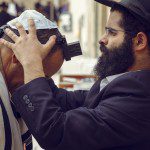
Willingly President Kimball and his counselors put their hands on Dr. Peale’s head and, as Dr. Peale related:
President Kimball in his quiet, sincere, loving manner prayed for me by name and asked the Lord to be near to me and love me and to take care of me and to guide me, and as he talked I began to be very broken up and touched, and then all of a sudden I had a wondrous feeling of the presence and I said to him, “Sir, He is here; I feel His presence.”
We said goodbye; I walked out into that crisp, sun-kissed morning and … as I walked along, I
suddenly felt the burden lift, and I saw the answer to the difficulty and I felt the victory.
*All the four children were much loved by their parents, but Spencer had a strained relationship with his eldest son and namesake. When in 1943 Spencer had been called to the Quorum of the Twelve Spencer wrote to his children about his feelings of inadequacy and told them that he could succeed in the calling only with their support, including faithfulness in the Church to which he was committing his life. But support in that sense was something the son felt he could not give with integrity, because he simply did not believe Mormonism’s truth claims.Over the years Spencer’s repeated, anguished efforts to call his son to repentance only widened the gap between them. The son believed he should not be expected to profess faith and live his life in a way inconsistent with his convictions. The father kept hoping that perhaps one more appeal would make the difference.Spencer once told his son, “I would rather you be a day laborer and president of an elders quorum than be inactive in the Church and get all the recognition the secular world can offer.”
*
Camilla provided Spencer unshaken support. She recounted, “One morning as I was dressing to go serve as a guide on Temple Square, I was struck by a shattering question: “How do I know that Joseph Smith actually saw the Savior and the Father? How could I know such a thing?” I wondered how I had the temerity to say that this thing actually happened. I was terribly disturbed. I knelt and prayed about it, but left the house still troubled. I can still feel the sensation I had when I stood up to tell the Joseph Smith story that day, as I had told it so many times before.
Suddenly I had a manifestation – a burning in my bosom – that was so assuring, so reassuring, that I had no question in myself that this was actually the testimony that is promised if we seek and really want to know. What is amazing to me is that I’d never thought of that question before. My testimony was just such a fact of my existence. And then the question and the answer came in that same day! I was not a youngster; I was a mature woman.”
*
In 1977, President Kimball and Marion G. Romney were attending a stake conference in Filmore, Utah. The White House telephone operator tracked President Kimball down and said that President Jimmy Carter wished to speak to him. Spencer was at the pulpit speaking, so President Romney took the call. President Carter was preparing to speak at a Baptist convention about missionary work and asked many questions about the Mormon program: How many missionaries? What salary do they receive? How long do they serve? Where do they come from? Where are they sent? He complimented the Church on an inspired program and asked that he be sent additional information.
*
In January 1976 Spencer spoke in the Cleveland Coliseum as part of a special program on the Word of Wisdom called “What Makes Mormons Run?” During this visit to Cleveland, Donald Kimball, a distant non-Mormon cousin with whom Spencer had corresponded, tagged along through the whole visit. As he accompanied Spencer and his secretary Arthur Haycock to the airport, Donald offered his highest praise, “Arthur, you Mormons should make my cousin Spencer a saint.” Spencer, sitting in the front seat, turned and responded, “Nobody can make you a saint. You have to make yourself one!”
*
At the Stockholm area conference in August 1974, President Kimball asked David Kennedy, the Church’s “ambassador,” “Where are you going when you are through here?”“Home.”
Spencer asked casually, “Could you go by way of Portugal and establish the Church there?” Although it was hardly on the way home, Kennedy went to Portugal, recently the subject of a military coup.
Kennedy learned from an American diplomat that most of the people Kennedy knew from the former Portuguese government were jailed, except Mario Soares, who was foreign minister. The diplomat happened to have business with Minister Soares that afternoon, and Kennedy went along. Soares also said that the Department of Justice under Salgado Zenha had responsibility for religion and, by chance, he and Zenha were having dinner together that evening. When Zenha learned about Kennedy, he granted him an appointment the next day. In discussing Church recognition, Zenha noted that the large
number of “private cults” in the United States tended to dilute the excessive influence of a dominant church. However, he explained, under existing law a church had to have 500 members to obtain official recognition, and Kennedy knew of only three members in the country.
“But,” said Kennedy, “you’re a military government, still governing by decree. You have the authority to recognize the Church simply by order, haven’t you?”Zenha agreed and ordered recognition of the Church. Kennedy then urged that all churches should be extended the same recognition, and the minister agreed. In November the first LDS missionaries arrived.
*
On their flight to a 1976 area conference in New Zealand, Spencer and Camilla were both ill, with high fevers. The conference was to open with a cultural program. Spencer asked President Tanner to take his place in attending the program, because he felt a need to preserve his strength for the Sunday meetings. He slept feverishly, Dr. Nelson beside him. After a few hours, Spencer broke into a heavy perspiration and woke with a start, pajamas soaked. “What time was the cultural program to begin?” he asked.“At seven o’clock, President Kimball,” Dr. Nelson responded.
“What time is it now?”
“Almost seven.” Dr. Nelson checked Spencer’s temperature. It was normal.
“Tell Sister Kimball we’re going!” Spencer announced.
Dr. Nelson swallowed his impulse to give medical advice and notified Camilla. They hurriedly dressed and drove to the stadium, where the cultural evening had just begun. As their car entered the stadium;. Before they arrived a young man offered a lengthy opening prayer and pleaded,”We three thousand New Zealand youth have gathered here to sing and dance for thy prophet. Wilt thou heal him and deliver him here!” As if on cue, Spencer’s car entered the stadium and the crowd of 16,000 erupted in a deafening
shout.*
In attending a 1977 area conference in Bolivia, the visitors flew to La Paz, the highest major city in the world, new arrivals often feel ill from the effects of the altitude. A reporter related his experience:
No sooner did we land than I got a headache. When we arrived at the hotel, I thought I was going to die. I could visualize my epitaph, “Died in La Paz.”
While lying on my bed I heard a knock on my door. I was a little put out that someone was disturbing my dying. I strode to the door and flung it open. There stood President Kimball and his personal physician. He asked how I felt. Talk about fast repentance. Here was a man twice my age, a man who had undergone open heart surgery, and he was inquiring about my health. I insisted I was fine and, as I turned from the door I heard him knock on the next door and ask, “How are you feeling?”
*
In 1981, President Kimball was sometimes confused and discouraged. His counselors also were sick and old. But on July 14 he called Arthur Haycock, his personal secretary, into his office. As Haycock described it, “The fog lifted … He was clear in his decision.” He acted in a definite and controlled manner, as if the clock had turned back years.Spencer told Arthur that after prayerful consideration he felt impressed to call a third counselor in the First Presidency, and he asked Arthur to locate Gordon B. Hinckley.
Minutes later, with Elder Hinckley sitting across the desk, Spencer got right to the point: He had decided to call another counselor in the First Presidency. What did Elder Hinckley think of that? The first reaction was curiosity. Why, he wondered, was the President of the Church confiding something of this nature in him? He responded that there was precedent for such action by Joseph Smith, Brigham Young, and David O. McKay. In any
case, the Church president was free to do as he wished in such matters.Spencer smiled, expressed appreciation, and then said simply, “I would like you to serve as my counselor.” From that time on President Hinckley was the only fully active member of the Kimball First Presidency.
*
After his death there was an outpouring of condolences, some from children:“Dear Mrs.
Kimball, I am sorry your hussbund died. But that’s life. He was a good man. Matthew”“Sister Kimball, I am really sorry about President Kimball, but I guess it was about time for him. I went to see his viewing he did not look pretty but he looked good. Steve”
“Dear Sister Kimball, I would like to help you if you need me call 967-0266. I’m 9 years old. I have seen Spencer W. Kimball but you probably don’t remeber. I danced with my cosin Tony. She’s a girl. If you are filling blue call me or just remember familys are forever. Margarita”
*
When Spencer was out in his yard, his neighbor “Sam” Parker liked to visit with him. Sam’s wife, Saundra, once said, “You shouldn’t impose on President Kimball to have to visit with you all the time. He deserves a little privacy.” So Sam stopped going out. After about ten days, Spencer appeared at the door with a plate of cookies. “I’m here to apologize,” he said.A shocked Sam exclaimed, “What for?”
“I don’t know,” replied President Kimball. “It is for whatever I did that made you mad at me. You used to come out to visit me, but now you seem to be avoiding me.”
*
Click to Buy
 The book is accompanied by a compact disc, which includes a longer manuscript of the book that contains all the footnotes and text for which there was not room in the printed book. The book text and the additional text are supported by 3,500 footnotes in the CD. On the CD are also additional photographs, text of other books and articles about President Kimball, and some audio clips demonstrating his voice before and after surgery for throat cancer.
The book has much in common with the 1977 biography in its tone and candor. It provides insight into the events of a momentous twelve-year period in the Church’s history.