




“They must needs be chastened and tried, even as Abraham, who was commanded to offer up his only son.”
Doctrine and Covenants 101:4
God’s Request and Abraham’s Obedience
The temple site for which Abraham is most remembered is not at Beersheba, but a place some fifty miles north, the destination of an unexpected journey he was called to make while living at Beersheba. It is the startling story of his supreme sacrifice, the crowning event of his life. And it involves his beloved son Isaac, who according to the earliest sources was about twenty-five at the time. 1
Genesis announces the event as a test for Abraham (Gen. 22:1), 2 but the Zohar insists that Isaac “was also included in the trial.” 3
It began with a surprise conversation initiated by God, apparently at night. 4 Orson Hyde states that “the Spirit of the Lord came upon [Abraham],” 5 while Josephus tells that God actually appeared to him. 6
God addressed him by the name he had given him, the name meaning “Father of a multitude”: “Abraham” (Gen. 22:1), or, according to the Septuagint, God called his name twice: “Abraham, Abraham.” 7 To which Abraham responded in deep humility, “Here am I, Lord what willest Thou of Thy servant?” 8
According to Genesis, the Lord answered: “Take now thy son, thine only son Isaac, whom thou lovest, and get thee into the land of Moriah; and offer him there for a burnt offering upon one of the mountains which I will tell thee of” (Gen. 22:2).
In the words of a nineteenth-century writer,
God bids him sacrifice the son for whom he had waited so many years, and over whose birth he had so rejoiced: He bids him sacrifice his only son, the one link which there was between himself and the promise that his posterity should be as the dust of the ground and the stars of heaven in number: He bids him sacrifice Isaac whom he loved, towards whom his heart yearned with infinite tenderness, who had made his home bright and joyous, and to lose whom would be the darkening of all the days he had yet to live. 9
Josephus insists that this was not a command but a request, 10 a fact not apparent in the King James Translation “Take now thy son …” (Gen. 22:2). But this word “now” translates the Hebrew na, a particle of entreaty, 11 which translators of the stature of Robert Alter and Everett Fox say should be rendered in this verse as a request: “Take, pray, your son.” 12 So also the preeminent medieval Jewish scholar Rashi held that the meaning of this Genesis passage is not a command, but God was saying: “I request of you … ” 13
Jewish tradition similarly records the Lord as saying “please” 14 or “I have come to ask of thee something.” 15 Standing face to face with His beloved friend Abraham, and looking him in the eye, God gently requests the sacrifice of Abraham’s own beloved son, and then “keeps silent about his reasons.” 16
Many had been the commands that Abraham had received from the Lord, but never a request. It seemed to leave the door open for questions or discussion about the nearly unbelievable task the Lord had asked for. But the man who had pled with such fervor with the Almighty over the fate of Sodom now offered no dissent or discussion, no hedging or hesitation. He did not “stop to reason or argue with the Almighty,” noted Joseph F. Smith, but simply “went … without complaining or murmuring” to fulfill what God had asked. 17
Abraham could well have offered “a justifiable excuse,” pointing out that what God had asked contradicted the prior promises, says Yosef Albo, “but he refrained from doing so, suppressing his paternal feelings out of love of God.” 18 God had expressly recognized Abraham’s love for Isaac in asking for his sacrifice, and it was indeed Abraham’s love that was being tested: whom did he love the most, Isaac or God? 19
Such was Abraham’s love for and trust in the Almighty that even in the face of this horrendous deed, and even when it had been put to Abraham as a mere request, apparently all he needed to know was what God desired.
God’s wish was truly Abraham’s command, no matter how hard.
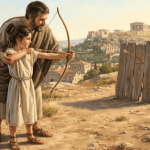
Abraham is the focus, but what about Sarah? “Has he told her where he is going? Has he said anything to her about what he is about to do? … The story does not tell us.” 20 At least directly, it doesn’t. But the lack of any protest makes it clear, as observed by one Latter-day Saint mother and leader, that “out of kindness to her,” Abraham did not disclose what he had been asked to do. 21 He simply, as Genesis tells, “rose early in the morning and saddled his donkey” – he did it himself, although he had many servants 22 – “and took his two lads with him, and Isaac his son, and he split wood for the offering, and rose and went to the place that God had said to him.” 23
Before they left that morning, according to rabbinic texts, Abraham and Isaac said their morning prayers, as was always their practice. 24
With the donkey carrying the wood and provisions, the party of four began the long walk northward and gradually upward to the hill country of Moriah, the destination designated by God. “The severity of the trial,” notes Henry Blunt, “was unspeakably increased by the three days’ journey.” 25 The deed was not to be done upon sudden impulse, but only after due deliberation as he walked beside his beloved son carrying the weight of a terrible secret. “
The secret was his alone,” says Elie Wiesel; indeed, “he alone knew there was a secret – and he refused to share it.” 26 He would keep his beloved son safe from pain or anxiety as long as possible, shouldering the entire painful burden as long as he could.
It might, of course, have been different. God might, as Origen pointed out, have commanded Abraham simply to take Isaac to the appointed place, and there asked for the sacrifice. But once Abraham is asked to make the sacrifice, the painful journey “is prolonged for three days, and during the whole three days the parent’s heart is tormented with recurring anxieties, so that the father might consider the son in this whole lengthy period, that he might partake of food with him, that the child might weigh in his father’s embraces for so many nights, might cling to his breast, might lie in his bosom. Behold to what an extent the test is heaped up.” 27
And what did Abraham tell Isaac as they walked along for three days together? Surely he had expected some day to impart to his beloved son his final testimony and blessing, but never under circumstances like these! And what was Abraham thinking as he walked along? “Notice the old gentleman,” said John Taylor, “tottering along with his son, brooding over the promises of God and the peculiar demand now made upon him.” 28 “We cannot conceive of anything that could be more trying and more perplexing than the position in which he was placed.29
Indeed, it would have been difficult enough to have even been apprised of Isaac’s impending death, but Abraham was asked to do the deed by his own hand. Did God not abhor human sacrifice? Was it not a perversion of that true order of sacrifice intended to signify the future sacrifice of the Beloved Son? Had not Abraham himself courageously opposed human sacrifice in Ur? Had not God rescued Abraham when he was about to be offered up in a sacrificial rite?
This new request was the ultimate of ironies. Nor was there anything in all the patriarchal records like it, for among the righteous, “nothing of the kind had ever transpired before as a precedent,” noted John Taylor. 30
And how could the divine promises through Isaac now be fulfilled? For “had not God promised great blessings through this very son? ” 31Thus Abraham was asked “to destroy the very thing that God had promised to protect and enhance: his posterity.” 32
In the words of John Taylor, “It was not only his parental feelings that were touched,” 33 for “through the spirit of prophecy, [he] had gazed upon his posterity as they should exist through the various ages of time. And among other things he saw the days of Jesus [and] … was glad. And after all this, God told him to take the life of his son. What, and thus prevent your posterity from coming upon the earth as you beheld it in vision? Yes, and in one stroke of the knife blast all these glorious, … blessed hopes.” 34
With Isaac, then, rested the future salvation of the entire world, the future of Zion, as Abraham well knew.
And what of the salvation of those already living in Abraham’s Zion? As pointed out by Jewish scholars,
What would happen to his followers and those who admired him if he slaughtered Isaac and the world learned that Abraham’s teachings had been violated in the grossest manner by the teacher himself? His entire lifetime of achievement would have been nullified. He would have been despised, vilified, ridiculed. 35
Well did one writer observe that what Abraham was asked to do “threatened to empty all the meaning from the story of his life.” 36 And yet he also knew, noted President Spencer W. Kimball, “that God would require nothing of him which was not for his ultimate good. How that good could be accomplished he did not understand,” 37 for this sacrifice seemed “so contradictory! … It was irreconcilable, impossible!” 38 It was, says Jacques Derrida, simply the “most cruel, impossible, and untenable” thing imaginable. 39
Joseph Smith even indicated that “if God had known any other way whereby he could have touched Abraham’s feelings more acutely and more deeply he would have done so.” 40 All of which is of more than historical interest to Latter-day Saints, of whom the Lord has said that they must be “tried, even as Abraham” (D&C 101:4).
No wonder that Abraham went, in the words of Spencer W. Kimball, “with breaking heart” 41 as he walked along with his beloved but condemned son, each step bringing them closer to the slaughter. In the Genesis account the journey is one of silence; we are not privy to Abraham’s words, much less his thoughts or feelings that he could share these with no one. His alone was the agony.
“On the third day,” says Genesis, “Abraham looked up and saw the place far away” (NRSV Gen. 22:4). How did he recognize it? Jewish tradition says he saw a pillar of fire or a cloud of glory resting on the mountain. 42 Then, continues Genesis, “Abraham said to his lads: “You stay here with the donkey, I and the lad will go yonder” 43 and “we will worship, and then we will come back to you” (NRSV Gen. 22:5).
Why did Abraham expressly say that he and Isaac would both return? Was he perhaps confused, not really knowing what he was saying? Was he carefully hiding the truth, knowing that he and Isaac would not really be returning? Or, as some of the Jewish sages believed, had the Holy Spirit suddenly prompted Abraham to utter these words, which were actually a prophecy? 44 Or, as another Jewish interpreter thought, did Abraham intend to bring Isaac’s bones back with him? 45 Or did Abraham believe that God would resurrect Isaac on the spot, so that Abraham and Isaac would indeed walk back together? 46
Once again we are not privy to Abraham’s inner thoughts as we witness his unstinting obedience.
Then “Abraham took the wood of the burnt offering and laid it on his son Isaac” (NRSV Gen. 22:6). The rabbis commented that Isaac’s carrying the wood for his own sacrifice “is like one who carries his own cross on his shoulder.” 47
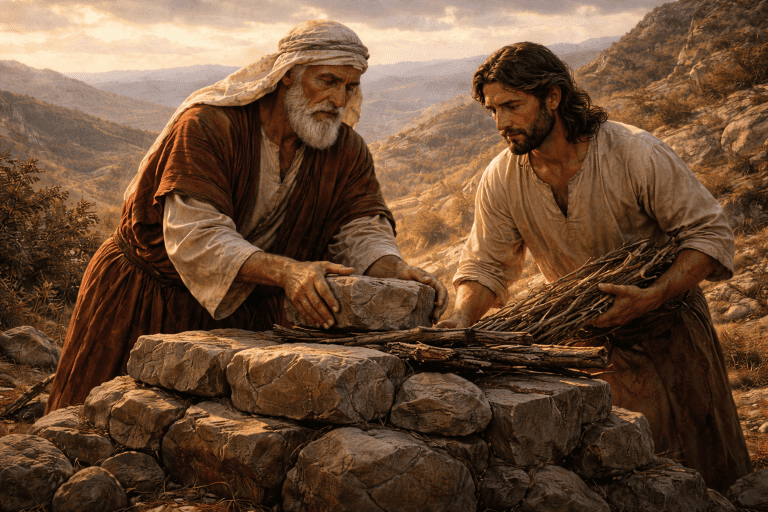
Then, taking “the firestone and the cleaver … in his own hand,” Abraham set out with Isaac, “and the two walked off together” 48 – hand in hand, says one midrash. 49 “Isaac broke the silence” 50 and “said to his father Abraham, Father!’ And he said, Here I am, my son.’ He said, The fire[stone 51] and the wood are here, but where is the lamb for a burnt offering?’ Abraham said, God himself will provide the lamb for a burnt offering, my son.’ So the two of them walked on together” (NRSV Gen. 22:7-8).
In the Hebrew text, the words “offering” and “my son” can be read in apposition, making Abraham’s answer ambiguous: was he merely addressing his son, or had he told him that he, Isaac, would in fact be the offering? Rashi insisted that Isaac now “understood that he was going to be slaughtered,” 52 yet he went willingly, “with equal heart.” 53
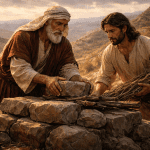
In the words of Elie Wiesel, “The two of them [were] alone in the world, encircled by God’s unfathomable design. But they were together … Together they reached the top of the mountain; together they erected the altar; together they prepared the wood and the fire.” 54
Notes 1 Josephus says Isaac was twenty-five or in his twenty-fifth year (Judean Antiquities 1.227). Jubilees says he was twenty-three (Jubilees 17:15). One rabbinic tradition says he was twenty-six or twenty-seven (see Feldman’s discussion in Josephus, 88-89 n. 702). The rabbinic tradition making Isaac thirty-six or thirty-seven appears to be a later embellishment connecting the sacrifice of Isaac with the death of Sarah, a connection absent in and seemingly contradicted by earlier sources. The King James depiction of Isaac as a “lad” (Gen. 22:5) tends to be misleading to our modern ear. The word “lad” in that verse translates the Hebrew naar -the same Hebrew word used in the very same verse to describe Abraham’s two servants. The word is used throughout the Old Testament with a wide range of age variation, including soldiers. See Brown, Driver, and Briggs, Hebrew and English Lexicon, 654-55. Referring to a number of Jewish texts, Louis Ginzberg notes, “Great emphasis is laid in the sources on the fact that although Isaac, at the time of the Akedah, was no longer a lad, but a grown-up man (different views are given as to his exact age . . .), yet he willingly submitted to his father’s wish.” Ginzberg, Legends of the Jews, 5:249 n. 229
2 Most modern translations translate the Hebrew verb as “tried” or “proved.”
3 Zohar 1:119b, in Sperling and Simon, Zohar, 1:372.
4After receiving the command, Abraham “rose up early in the morning.” Genesis 22:3. In the Qur’an, Abraham saw it in a dream. Surah 37:102, in Khatib, Bounteous Koran, 593.
5Journal of Discourses, 11:152.
6Judean Antiquities 1.223-24, in Feldman, Josephus, 85-87.
7Septuagint of Genesis 22:1, in Brenton, Septuagint, 25.
8Baring-Gould , Legends of the Patriarchs, 189; see Genesis 22:1-2.
9Goldman, In the Beginning, 792, quoting J. H. Blunt.
10Judean Antiquities 1.223-24, in Feldman, Josephus, 85-87.
11See Brown, Driver, and Briggs, Hebrew and English Lexicon, 609.
12Genesis 22:2, in Alter, Genesis, 103. Similarly, see other translations of this verse: “Pray take … ” in Fox, Five Books of Moses, 93; “Take, I pray thee … ” in Young, Young’s Literal Translation, 13 of Old Testament; and “Take, I beg of you … ” in Hirsch, T’rumath Tzvi, 105.
13Rashi on Genesis 22:2, in Rashi, Commentary, 199. So also Hershon , Rabbinical Commentary on Genesis, 121, including n. 2: “Take, I pray thee . . . “
14Tuchman and Rapoport, Passions of the Matriarchs, 68.
15Baring-Gould , Legends of the Patriarchs, 189; see Genesis 22:1-2.
17Stuy, Collected Discourses , 2:279.
18Yosef Albo in The Fundamentals of Judaism , quoted in Leibowitz, Studies in Bereshit, 202.
19Levenson, Death and Resurrection of the Beloved Son, 221-22, noting the emphasis in the Genesis text on Abraham’s love for Isaac, and noting Jubilees 17:16, 18.
21Carol B. Thomas, “Sacrifice: An Eternal Investment,” Ensign, May 2001, 63.
22As pointed out in Baring-Gould , Legends of the Patriarchs, 190.
23Genesis 22:3, in Alter, Genesis, 104.
24Kasher, Encyclopedia of Biblical Interpretation, 3:136, citing several sources.
25Blunt, Twelve Lectures , 220.
26Wiesel, Messengers of God, 97.
27Origen, Homilies on Genesis 8.3-4, in Oden, Ancient Christian Commentary, 2:103, omitting a question mark because only a portion of the first sentence is quoted.
28Journal of Discourses, 14:360.
31Oxenden, Portraits from the Bible, 45.
32Denny, An Introduction to Islam, 21.
33Journal of Discourses, 24:264.
34Journal of Discourses, 22:318.
35Scherman and Zlotowitz, Bereishis: Genesis, 1(a):599.
36Klinghoffer, Discovery of God, 61.
37Kimball, Teachings of Spencer W. Kimball, 59.
38Kimball, Faith Precedes the Miracle, 6.
40As reported by John Taylor in Journal of Discourses, 24:264. Similarly on another occasion John Taylor reported Joseph Smith’s statement that if God “could have invented anything that would have been more keen, acute, and trying than that which he required of Abraham he would have done it.” Journal of Discourses, 14:360.
41Kimball, Faith Precedes the Miracle, 6.
42Ginzberg, Legends of the Jews, 1:278-79.
43Fox, Five Books of Moses, 94. As faithfully reflected in this translation, the same Hebrew word is used in this verse to designate Abraham’s two young men (“lads”) and Isaac (“lad”). See also translations in Alter, Genesis, 104, and Wenham, Genesis 16-50, 97.
44See Ginzberg, Legends of the Jews, 1:279; and Rashi on Genesis 22:5, in Rashi, Commentary, 202.
45See Bachya ben Asher, quoted in Levenson, Death and Resurrection of the Beloved Son, 131.
46See Hebrews 11:17-19, and discussion in Levenson, Death and Resurrection of the Beloved Son, 130-31. Hebrews clearly says that Abraham was expecting that God would resurrect Isaac and thereby fulfill the promises, but whether Abraham thought this would happen immediately remains unclear.
47Genesis Rabbah 56:3:1, in Neusner, Genesis Rabbah, 2:280.
48Genesis 22:6, in Speiser, Genesis, 161.
49Midrash Hagadol, in Miller , Abraham Friend of God, 167.
50Genesis 22:7, in Speiser, Genesis, 161.
52Rashi on Genesis 22:8, in Rashi, Commentary, 203.
53Leibowitz, Studies in Bereshit, 200, quoting Rashi.
54Wiesel, Messengers of God, 96 (emphasis in original).