



When you read well written stories dubbed “Historic Fiction,” it is easy to get so wrapped up in the writing you forget where the history stops and the fiction begins. Much goes into writing a quality book in this genre, perhaps more so than any other style of fiction.
With historically based novels, careful research is a must to give readers a true sense of the time in which the story takes place. Artistic license is encouraged, to be sure, but the writer must be careful not to create something inauthentic. From speech patterns, to dress, to daily living, the writer has to make his “spin” on what may be a familiar story utterly believable. Notable primary characters have to be true to what is known about them, yet interestingly developed to make the reader willing to see beyond the dry history they may remember from high school text books. Lesser known lead characters, real people whose stories are not-so-well-known by the general public, have got to pull the reader in quickly to make him care about a historical “nobody.” In deed, it would be quite easy for historical fiction to “go bad.”
My Picks
My main selections this month occur in 33 – 36 A.D., 1856, 1847, and 1946. The places in which the events happen range from The Roman Empire to post-war Britain. I believe each of the authors adroitly takes you to another place and time and are great examples of historic fiction done well.
On the High Seas
The Captain’s Wife, Douglas Kelley
“Carry on, Mr. Hare,” she said to her new first mate. “I’ll be below.”
She was struck by the thought: her first mate. Her first mate.
Hare was grinning. “Aye, aye, ma’am.”
She gathered her skirts to descend the steps…and the men went back to work.1
 Telling the little known story of a nineteen year old Boston woman named Mary Patten and her twenty-nine year old husband, clipper ship sea captain, Joshua Patten, first time author Douglas Kelly deftly takes the reader back to 1856, describing all of the romance and peril of life on the sea one needs to imagine being there himself.
Shortly after their marriage, Joshua takes Mary on a year long voyage around the world. During the trip, the intelligent young woman is instructed by her spouse on navigating both via the stars and with the use of a sextant. Near the journey’s end, she has her character tested when a sudden storm damages the ship, injuring a number of the sailors. Mary hardly hesitates before she sets to work as a triage nurse helping the wounded men. Her heroism in the face of such adversity made quite an impression on the men who might have otherwise dismissed her based on her gender.
A year later, Joshua is commissioned to leave New York on a dangerous, though routine supply trip to San Francisco on the ship Neptune’s Car by way of South America’s treacherous Cape Horn. Time, however, is fleeting and Joshua is forced to leave with a first mate he hardly knows and about whose character he is uncertain.
Shortly after the ship leaves harbor, William Keeler, the first mate begins to show evidence he is a rogue and worthy of suspicion. As the journey continues, the man’s behavior grows steadily more difficult, as he ignores orders and pushes the crew towards mutiny. In the mean time, Joshua is overcome by a mysterious illness, leaving only Mr. Hare, the loyal second mate, in charge of sailing Neptune’s Car. Unfortunately, he is illiterate and unlearned in the intricacies of navigation. Mary is therefore called upon to use her slight knowledge to bring the ship to port. In concert, she and the second mate manage to sail the ship, but the journey is not without considerable strife for all aboard.
At nineteen with only minimal experience and an ill husband to nurse, Mary Patten gains the trust and allegiance of the ship’s contingent of rough and tumble sailors. Her story is a true heroine’s tale, with some of the descriptive eloquence of a Tom Clancy and the romance of Nancy Turner’s These is My Words.
Though the narrative of The Captain’s Wife can sometimes be plodding, like trying to sail through the windless doldrums, it rights itself and makes for an inspiring read. Kelley does get just a little descriptive on the “young marriage” side of things. Though, I don’t recall language being an issue.
If you like this book, you’d probably really enjoy Erik Larsen’s Isaac’s Storm. I was pleasantly surprised by this one a few years back!
Imprisoned in New South Wales
Coldwater, Mardi Mc Connochie
My sisters and I had long since learned to close our ears to the vile suggestions that were made whenever we came into the convicts’ view […] I was in no doubt about what my likely fate would be should I ever find myself alone and unprotected with any one of these men […]. I entertained no fond illusions; I lived in a lion’s den, and I had no desire to put my heard in his mouth. 2
A riveting offering from Australian author Mardi Mc Connochie, Coldwater takes the literary Bront sisters, Charlotte, Anne, and Emily, transports them to a harsh Australian island penal colony, and dares them to escape.
Set in the New South Wales of 1847, Charlotte, Anne, and Emily Wolf are the daughters of one Captain Wolf, the cruel prison governor of Coldwater, from where no prisoner has ever managed to break free. The three sisters and their father take turns telling this intriguing story of love, murder, and mayhem that begins with Captain Wolf being shot by a prisoner. Although he recovers swiftly, the shooting makes the girls pensive about their futures should anything ever happen to their father. Charlotte, the oldest at thirty-one, is most loyal to the captain, but realizes their prospects for marriage or proper employment are very limited on both the prison island and the mainland. Without the protection of Captain Wolfe, the girls are vulnerable to ruin in a number of ways – from being surrounded by treacherous criminals and questionable officers to being completely isolated from polite English society in remote, frontier-like Australia. These are not things considered lightly by the aging, friendless Charlottle. Emily and Anne are the best of friends and seem to feel the seclusion slightly less than Charlotte, though their desire for romance and excitement is greater than hers. In their isolation, the sisters decide to put their creativity to the test to see if any one of them could make a viable living as authors.
Trouble starts to build on the fractious island when the young, impetuous Emily falls in love with Irish inmate, Finn O’Connell. The blossoming love between Finn and Emily is abruptly interrupted as Captain Wolf discovers the affair and moves to tighten his control on all the island’s ill-fated prisoners. The increase of Wolf’s dominance brings forth a prisoner revolt. What follows shocks all involved on Coldwater and changes life for the girls forever.
I am not a huge Bront fan, though Jane Eyre is one of my favorite novels, but I found Ms. Mc Connochie’s relocation of the three literary sisters and their odd father into the world of New South Wales’ brutal penal colonies very effectively done and utterly engaging.
Recovering from Nazi Germany
<a href="https://www.
<hr class=’system-pagebreak’ />readinggroupguides.com/guides_G/guernsey_literary_pie_society1.asp” target=”_blank”>The Guernsey Literary and Potato Peel Pie Society, Mary Ann Shaffer and Annie Barrows
Will Thisbee was responsible for the inclusion of Potato Peel Pie in our society’s name. Germans or no, he wasn’t going to any meetings unless there were eats! So refreshments became part of our program. Since there was scant butter, lessflour, and no sugar to spare on Guernsey then, Will concocted a potato peel pie: mashed potatoes for filling, strained beets for sweetness, and potato peelings for crust. Will’s recipes are usually dubious, but this one became a favorite. 3
 Like Alexander Mc Call Smith’s No. 1 Ladies’ Detective Agency series, The Guernsey Literary and Potato Peel Pie Society is another book I have to gush over; I loved this book from page one. Told in the first person using letters between characters as the vehicle for driving the plot, Guernsey is a witty tale replete with vibrant, engaging personalities that more often than not made me laugh out loud.
Using the post World War II period in England as their setting, authors Shaffer and Burrows set out to explore the invasion and occupation of the British held Channel Islands by German forces during the war. What they created out of that research is one of the most delightful books I have had the pleasure of reading in a while.
The Channel Islands, of which Guernsey is the largest, are just off the coast of Normandy. Guernsey was held by the Nazis from 1940 to 1945, with hopes that it would be an ideal launch site for an attack against the British mainland. However, that plan never came to fruition and the islands were fated to be just another outpost for German brutality.
Juliet Ashton, a writer in her early thirties provides the main voice in Guernsey. It is through letters to her publisher and childhood friend, Sidney Stark, that we first get to meet this spunky young woman; and it is through a letter penned by Guernsey native, Dawsey Adams to Juliet that we are first introduced to the Channel Islanders. By a chance occurrence, Dawsey comes to possess a copy of the Selected Essays of Elia by Charles Lamb that once belonged to Juliet. As her name and address are written inside the cover, he decides to write her, seeking information on a good London book store where he might purchase more of Lamb’s works. In his initial letter, Dawsey discloses a bit about the Guernsey occupation and how he came to cherish Mr. Lamb’s Essays.
Having achieved some fame during the war for a humorous newspaper column she wrote, Juliet is hungry for new writing material. The letter she receives from Mr. Adams stirs her curiosity and shortly thereafter her creative juices start flowing. As they engage each other through frequent correspondence, Juliet and Dawsey begin to explore what life was like in their respective spheres during the war, providing for some much needed catharsis on both sides. They also develop a friendship that opens doors for Juliet on the island, allowing her to expand both her research and her circle of friends exponentially. In fact, the pursuit of this great story drives Juliet across the English Channel and into the middle of life on Guernsey in a humorous and unexpected way.
The Guernsey Literary and Potato Peel Pie Society gets ten stars from me. It is terrific history and enchanting fiction. I even mentioned retiring on Guernsey to my husband as ex-pats; too bad Juliet and Dawsey won’t be there by the time we arrive!
Revisiting Rome
The Robe, Lloyd C. Douglas
This faith…is not like a deed to a house in which one may live with full rights of possession. It is more like a kit of tools with which a man may build him a house. The tools will be worth just what he does with them. When he lays them down, they will have no value until he takes them up again. 4
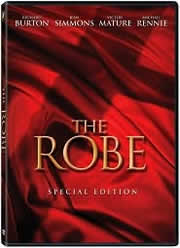 Until a friend recommended The Robe to me last year I had never heard of it. I have since learned that it was a huge success when it was first published in 1942, and subsequently made into a movie in 1953 starring Richard Burton. Once I got to investigating, it was one of those books I started feeling like everyone else had read (or at least heard of) but me!
Rather slow to start, The Robe sets the stage for the early spread of Christianity, in Rome, where we are introduced to the family of Senator Marcus Lucan Gallio and his household of slaves. The primary characters are his daughter, Lucia; Lucia’s friend, Diana; son, Tribune Marcellus Gallio; and Marcellus’ Greek slave, Demetrius. It happens that Senator Gallio has recently offended the Prince Regent, Gaius, and shortly thereafter, Marcellus imprudently did the same. For his efforts, Gaius sends Marcellus away from his gentle life in Rome and off to command a post at the cesspool in Minoa, also known as Gaza. It is typically considered a place of exile for the Roman military, a place one is sent only as punishment.
Though he is not required to, Demetrius accompanies his master on his new assignment; the two are quite close friends, despite his standing as a slave. However, once in Minoa, Demetrius is pushed aside as Marcellus’ command takes much of his time. Shortly after his arrival at Minoa, the Roman fort is required to send a contingent to Jerusalem to help keep the peace during Passover week. It so happens the Roman legion arrives shortly before Jesus is lead through the city on a white donkey, a sight Demetrius gets to observe first hand. The sadness and dejection in Christ’s eyes makes an impression on him and he spends much of his newly acquired free time learning more about this strange man with the haunting eyes.
As it turns out Marcellus and Demetrius get to witness much of what occurs over the next week, from Palm Sunday to the thrashing of the money changers at the Temple to the execution order by Pilate. Since the Minoan soldiers are furthest removed from Jerusalem, it is decided they will be the ones to crucify Christ and Marcellus is forced to carry out the execution of the Savior.
In the scriptures we read of the Roman soldiers casting lots for His robe, and in The Robe, Lloyd Douglas draws upon that scene to surmise what may have become of the soldier that won it on that fateful night. Unluckily, Marcellus “wins” the robe, but almost loses his mind as a result.
The ensuing story focuses on faith, conversion, forgiveness, healing, and the pure love of Christ, as the reader is drawn into back rooms in Capernaum, inns in Athens, and an emperor’s private home at Capri, as well as a dozen more sites throughout the Roman Empire, circa 33 A.D. Artfully done, the author allows the modern reader to meet Jesus through the eyes of his apostles and a number of those whom he healed, those whose lives he touched forever, people whose stories we only glimpse snippets of in the New Testament.
Despite being a grand undertaking for me this month, I’m glad I did read this nearly 500 page book. Mr. Douglas is an articulate story teller, recreating the events surrounding the death of Christ and the spreading of Christianity throughout the Holy Land, Greece, and Rome in the years following the Crucifixion with warmth and believability.
The characters and events are well developed, though it is a long story covering approximately three years… in often painstaking detail. Douglas is a descriptive writer and I greatly enjoyed this faith promoting book.
The Robe contains no language, no gory depictions of violence, just a few over used words and phrases which act as a small detractor to the otherwise superlative writing.
Honorable Mentions
A Stolen Tongue, Sheri Holman
An odd and yet interesting tale that created a multi-faceted sensory tapestry for me while reading, A Stolen Tongue brought together the visual imagery of what I consider “that awful Christian art” from the early middle ages, the painting The Cheat with the Ace of Clubs by Georges de la Tour and Caravaggio’s The Cardsharps, the smell of a garbage dump, and Peter Ustinov’s portrayal of Hercule Poirot. I know, bizarre, isn’t it?
Spinning a tale that is part pilgrimage part murder mystery, Holman tells the story of 15th century German monk Friar Felix Fabri on journey to the Holy Land in 1483. Felix is accompanied by his patron and the patron’s son, Ursus, who is hoping to become a knight once in Palestine. In addition to visiting the important areas in Palestine, Friar Felix plans to visit several places along the way to pay homage to Saint Katherine, his “spiritual wife.” Unfortunately, it seems someone is always one step ahead of him, stealing the pieces of his beloved right out of their reliquaries! Will he be able to recover the pieces and solve the mystery surrounding a strange young woman who calls herself “the tongue of Saint Katherine” before his party is all destroyed by the journey itself? Hold on to your bonnets for this book, it is a wild ride through Eastern and Western Christianity, with some fascinating twists in the Middle east, too!
I vacillated much on the recommendation of this book. The period described is quite absorbing and Felix’s story is so different from what I typically read. However, there is one secondary character, a particularly rough man, that frequently uses some harsher language. Sensitive readers: beware!
Freedom Bound, Rosalie T. Turner
Beginning in May of 1806, Ms. Turner tells the story of thirteen year old Anta Majigeen Ndiaye whose village is destroyed by invading tyeddo warriors seeking captives to sell into the flourishing slave trade on the coast of Senegal. She describes in detail the horrors of Anta’s capture and subsequent journey to Cuba for sale to Zephaniah Kingsley, a wealthy white plantation owner in Spanish East Florida.
From shortly after her purchase by Kingsley to her death in 1871, Anta, later renamed Anna, lives with him as a plural common law wife. However, Anta is more than a common house slave on the plantation. Very early in their relationship, it becomes clear to Kingsley, who is thirty years her senior, that Anta is bright, high-spirited, and deeply intelligent. She proves her worth as a human being and help-meet to Kingsley over and over through out their years together, and after bearing his third child, he grants her her freedom.
An interesting story of a powerful man and an amazing young woman, I found the history surrounding Anta’s life quite engrossing, even if the writing didn’t always measure up to the life it was describing.
Mormon Memories: The Path to Mountain Meadows, Beth Shumway Moore
One thing I appreciate about people telling difficult stories is truthfulness and intellectual honesty; the same two traits are required of readers of such stories. Mountain Meadows is indeed the epitome of a “difficult story.” Beth Moore seeks to do nothing more than to bring this mark on Church history out of the shadows and into daylight, to show the troubles of the Saints which helped create the conditions for this egregious lapse in judgement on the part of a small group of our beloved pioneers, and she does so with compassion.
In telling this story, Moore creates a fictional family for us to follow from their arrival in the Salt Lake Valley, shortly after Brigham Young in 1847, until just after the tragedy in the Meadows in 1857. A family that lived through the Missouri years, Nauvoo, the Martyrdom of Joseph Smith, and the driving of the Saints out of the United Sates into the Indian territory of Mexico provides the ideal vehicle through which to express the justifiable fear and anger the pioneers felt at the time of Mountain Meadows. After the conclusion of the massacre, the characters must deal with the enormity of their actions and the reverberating effects throughout Southern Utah and the church in general.
Moore also provides a window on polygamy and the difficulty of life for our trailblazing sisters that made an indelible impression on my mind.
September 2007 Ensign article on The Mountain Meadows Massacre
Next Month:
Earthly Visions of Heaven and more readers’ suggestions
I’d love to know what books you’re reading and whether or not you’ve enjoyed my recommendations. Please, add me to your friends’ list at GoodReads.com or contact me via email at [email protected]“>[email protected]
End Notes
1. Douglas Kelley, The Captain’s Wife, (Plume: U.S.A, 2001) 185.
2. Mardi McConnochie, Coldwater, (Ballantine Books: New York, 2001) 145.
3. Mary Ann Shaffer and Annie Barrows, The Guernsey Literary and Potato Peel Pie
Society, (The Dial Press: New York, 2008) 51.
4. Lloyd C. Douglas, The Robe, (Houghton Mifflin Company: Boston, 1942) 320.
I’d love to know what books you’re reading and whether or not you’ve enjoyed my recommendations. Please, add me to your friends’ list at GoodReads.com or contact me via email at [email protected]“>[email protected]