





By Phil Lowry
In early 1999, President Gordon B. Hinckley appeared at a rehearsal of the Mormon Youth Symphony and informed that ensemble that it was soon to be disbanded. To soften the blow, he also stated with a twinkle in his eye that “something better” was coming along.
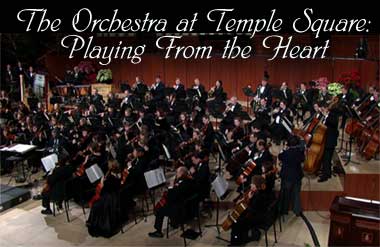
That “something better” was created later that year. It was to be a new orchestra, drawn from the finest LDS musicians on Utah’s Wasatch Front (and some from farther away). This new orchestra wouldn’t have the age limits imposed on the Mormon Youth Symphony (age 30 or lower), and would be a sister organization to the Mormon Tabernacle Choir. It would be called the Orchestra at Temple Square.
Recruitment began in earnest in the summer of 1999. It wasn’t easy starting a full-blown orchestra from scratch. The choir’s associate conductor Dr. Barlow Bradford used all of his skill and considerable enthusiasm to extend audition invitations to instrumentalists from around the Wasatch Front, whose skills and character were known to the community. It took a while for them to find me, a lawyer buried n the middle of Utah County and not at all a part of the local music scene. After some doubt and spiritual prodding, I auditioned and became a charter member of the orchestra in October of 1999.
Being a member of the orchestra is one of the Church’s most unusual, and most satisfying, callings. The Orchestra, like the Choir, is composed of temple-worthy Latter-day Saints who are called as general service missionaries for the Church. The orchestra is our primary calling, just as the choir is for choir members. Unlike the choir, the orchestra has no mandatory minimum retirement age, nor is there a specific term maximum for one’s calling (unlike the choir’s 20-year maximum). Auditions are required, as they are for the choir, but unlike the choir there is no “training school” for the orchestra. One day you may be at the audition, and the next week you may be on TV for Music and the Spoken Word. Performance expectations are high. On more than one occasion the orchestra has been handed the music for a broadcast 90 minutes before the red “on air” light goes on.

The Church has invested a tremendous amount of time and money in the OTS with a long-term view to its role as both a complement to the choir and a stand-alone ensemble. In the original apostolic blessing given to the orchestra by President James E. Faust, the orchestra was blessed to be regarded as one of the fine orchestras of the world and to take its message of the spirit through music to all the world. Its purpose and mission is thus the same as the choir’s: to spread the gospel of Jesus Christ through music.
The orchestra membership is wide and varied. Many local music professors from BYU or other local universities are members, as are a host of local secondary school music teachers. There are also a number of full-time professional musicians who dedicate their spare time to the OTS. Students fill many of the orchestra slots, some being drawn from some of the fine local programs that prepare students for professional music careers, while others come from professional programs (one member is getting his Ph.D, in biomolecular engineering). And, of course, like the choir there are other occupations represented, including social workers, accountants, etc. The OTS, like the choir, is an all-volunteer ensemble.
Leading the orchestra in these efforts is Dr. Bradford. Before Dr. Bradford joined the choir staff he had already established himself as an accomplished orchestra conductor, and thus he perfectly complements Drs. Craig Jessop and Mack Wilberg in ensuring consistent quality in the orchestra’s important role.
The OTS is often recognized for its role in accompanying the choir in many broadcast events, including the weekly Music and the Spoken Word and First Presidency Devotionals. These primarily feature arrangements of LDS hymns and other sacred works that complement the spirit of what is being presented and do not draw overmuch attention to themselves.

Often, however, the OTS, like the choir, will tackle challenging classical pieces in stand-alone concerts, where the music itself it designed to be the primary source for carrying the Spirit. The OTS has collaborated with the choir in The Planets by Holst, Polovtsian Dances by Borodin, and Robert Cundick’s The Redeemer. Other works to the OTS’ credit include Prokofiev’s Symphony No. 5, Richard Strauss’ Death and Transfiguration, Gustav Mahler’s Symphony No. 4, and Beethoven’s Symphony No. 7, all to local critical acclaim. Soon the choir and the OTS will join forces in presenting Mahler’s Symphony No. 3, the longest symphony in the classical repertoire, and then shortly after will present Johannes Brahms’ Eine Deutsches Requiem for Easter.
Perhaps most recognized is the orchestra’s recordings with the choir. Two CDs under the Telarc label have already been released, with an album under the new Church-owned Resound! label coming out some time before Easter. These most visible efforts are complemented by other projects, including the soundtrack to Testaments (the film currently being shown in the Joseph Smith Memorial Building adjacent to Temple Square), the soundtrack to the video at the Nauvoo visitors’ center, and the soundtrack to Light of the World (the gala celebration shown at the Conference Center during the 2002 Olympic Games).
Recording with 450 people on stage can be a true challenge. The most recent project for the Resound! label was focused on music about the Savior and his ministry. The project took 12 hours, including an all-day session on a Saturday. Each piece required multiple takes, usually starting with a “shake-down” take to get the willies out. Often Dr. Jessop would say some words to get the choir and orchestra in the right mood for the piece being recorded. Before one take he suggested we picture ourselves in The Shire (the quaint and blissful home of the Hobbits in The Lord of the Rings). After that take, which was particularly bad, someone suggested that perhaps we Hobbits had gotten lost in a daisy-filled meadow somewhere.
Humor like that is required in a marathon recording session. Backstage in the Tabernacle the recording engineers, along with Drs. Bradford and Wilberg, listen intently to the recording as it unfolds. If there is a mistake, a page rustle or a watch beeping (or, worse yet, a cell phone going off-yes, it happens), they phone it in to Dr. Jessop, who has a phone at the podium. Every time that phone would ring we would jump. Bad news or good? Sometimes facts beyond our control ruin a good take. The Tabernacle is not sound proof, and at the end of one very soft piece it sounded like the entire Salt Lake City fire department went racing down South Temple Street.
Even in these days of digital magic, there was no way to filter out that mess, so we did the take again (and it was even better).
Perhaps most remarkable about recording an album like the one we just finished is both the spiritual highs and lows it generates. We had been warned repeatedly about the importance of our project, and that Satan would do his best to disrupt us in our efforts. All of us felt the challenges, but also the elation of overcoming them with the help of the Spirit. Sort of like being carried through a very nasty marathon on a great runner’s back.
A new album will be recorded in May on a patriotic theme, so we get to do it all over again. These projects bring together some of the Church’s greatest singers and instrumentalists in a wonderful collaboration. As the OTS grows and matures, we hope to emulate our “big brother,” the Mormon Tabernacle Choir, in being a tremendous missionary tool worldwide. Meantime, we will continue to enjoy our frequent “family home evenings” with our singing brethren and sisters, and look forward to working with them for years to come.