

 By Robb Cundick
Pictures by Debra Gehris
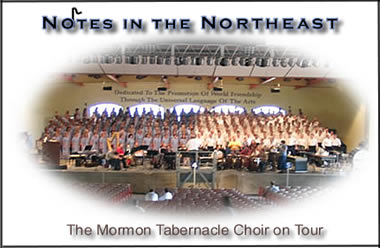
About every two years the Mormon Tabernacle Choir leaves Salt Lake City for a major tour. Two years ago I wrote about our travels throughout the Southern United States. It seems such a short time ago, but here we are on the road again – this time balancing things out with a visit to the Northeast. This tour marks the beginning of the 75th year since the first broadcast of “Music and the Spoken Word;” and is thus being billed as our 75th Anniversary Tour. Just a few weeks ago we were focused on recording an album. When we finally turned to extra rehearsals for the tour, I wondered if we had allowed enough time to prepare. But things came together surprisingly quickly, which indicates how much the Choir has progressed: what used to take months is now taking weeks. It’s a good thing because our schedule just gets busier every year. (Have I said that before?)
It took three charter planes to transport the 335 Choir members able to get away, a 25-piece woodwind, brass and percussion ensemble from the Orchestra at Temple Square, two conductors, two Tabernacle Organists and an entourage of spouses and guests from Utah to Grand Rapids, Michigan, site of our second concert. Our second concert? Yes, the first was to be at Interlochen Center for the Arts, 135 miles to the north, which made for an unusually hectic first day. The flights left Salt Lake City at 4:30, 5:30, and 6:30 AM …well that’s when they were supposed to leave, but each was delayed an hour or so, creating immediate headaches for those trying to keep things on schedule. Choir Administrative Manager Barry Anderson said this was the day he had feared the most. He said if we could make it through this one, everything else would be “a piece of cake.” (That might be a dangerous thing to say – hopefully he won’t later regret that statement!).
Upon arrival at Grand Rapids we were bussed to the Amway Grand Hotel, where a Choir of local Latter-day Saints greeted us with a sign reading, “Welcome to the Center of Zion” whilst singing the hymn, “Beautiful Zion.” The warm, spiritual welcome was touching and we wished we could have lingered to visit but were hurried on to lunch, made a brief visit to our rooms and then headed to the buses for a 2 hour ride to Interlochen.
 |
|
Local LDS Choir welcomes us at Grand Rapids.
|
Interlochen is one of the nation’s most prestigious arts camps. Founded in 1928, it has provided summer training for generations of young musicians, actors, artists and writers. Set amidst forests and lakes in beautiful northern Michigan, Brother Anderson described it as a kind of “Camp Steiner for Music” (Camp Steiner is a Boy Scout camp in Utah’s Uintah Mountains). When we stepped from the buses and walked to the performance pavilion, we passed cabins that were indeed rustic but did have electricity.
As we waited for rehearsal, the wind blew from a lake behind the pavilion. Called Green Lake, it made for a scenic backdrop, and the breeze was a welcome relief from the heavy, humid air we westerners are so unaccustomed to. But within the shelter of the pavilion the air became stagnant and heat from the bright lights added further discomfort. So we were very happy when Director Craig Jessop said we could take off our coats for the performance. (I don’t remember that ever happening before).
|
click to enlarge
 |
|
Catching a snooze during the long first day.
|
As I took a first look at the stage I was struck by a saying written in large letters on the back wall: “Dedicated To The Promotion Of World Friendship Through The Universal Language Of The Arts.” Surely few groups better embody the spirit of that saying than the Mormon Tabernacle Choir; I knew immediately that we would feel at home here. The shell of the stage focused sound like the center of a loudspeaker, slanting outwards into the open-sided pavilion where large orange-painted steel beams supported a wooden ceiling, excellent for reflecting sound. Windows behind our risers looked out upon Green Lake; an idyllic setting in which to perform and listen. When we later reentered for the performance we were delighted to see the seats almost completely filled; nearly 4,000 were in attendance.
Opening Night
Some feelings of uncertainty seem inevitable before the first concert of a tour. Prior to leaving Utah there was only one opportunity to run through the complete program. We were to memorize everything and now came the moment of truth. Faulty memory can play amusing tricks on the choir. For example, at the beginning of “Shenandoah” the words are, “O Shenandoah, I love to hear you.” But many forget and sing, “I love to see you.” What comes out, then, is “I love to sear you.” Another test is, “America, the Beautiful” where the first verse goes, “God shed His grace on thee” while the second is “God mend thine every flaw.” If everyone isn’t on their toes some will repeat that first phrase the second time round so it sounds like, “God shmend thine every flaw.” My all-time favorite, though, is “All People That On Earth Do Dwell,” which we memorized for our European tour in 1991. There is a phrase, “we are His flock” which is followed shortly by “and for His sheep He doth us take.” If you lose focus one little bit, it is just too tempting to sing, “we are his sheep” for the first phrase. What comes out? “We are his schlock(!)”
Fortunately, this time our memories performed pretty well and I don’t think any slip-ups were glaring. But what became immediately apparent was what a fast-paced, dynamic program Drs. Jessop and Wilberg had brought to bear. Craig and Mack had commented earlier that they felt the outdoor venues made it necessary to include a greater number of vigorous and rousing pieces than usual. Each set ended with a piece that might normally be a concert closer, such as Mack’s arrangements of “Come Thou Fount of Every Blessing,” and “Cindy,” Rimsky-Korsakov’s “Glory,” and a rousing medley of George M. Cohan pieces including, “I’m a Yankee Doodle Dandy,” “Give My Regards to Broadway,” and “You’re a Grand Old Flag.” Even “Battle Hymn of the Republic” was shifted from its usual place as the first encore into the body of the program.
The crowd warmed quickly and were obviously having a terrific time. Performing outdoors brought along a few uninvited guests: birds chirping throughout the concert and bugs flying around below the bright stage lights. At one point one landed on Mack Wilberg’s nose and refused to respond to a quick swat. When he began to sting, Mack was forced to reach up and take more forceful action, but he did it without missing a beat and everything proceeded smoothly.
 |
|
Stage at Interlochen (note the saying on the back wall).
|
For me, the most fun piece of the concert was an African carol Mack first introduced in his days with the BYU Men’s Chorus, “Betelehemu.” Like “Cindy,” it generates additional excitement with clapping, but also employs a variety of percussion instruments played by members of the Orchestra. Much to our delight, even Tabernacle Organist Rick Elliott joins in, shaking a huge gourd. But most unexpected to the audience is a gentle two-step left/right sway by the Choir. A Choir member’s spouse commented that even though she knew it was coming, when the Choir suddenly broke into that unified sway the effect was breathtaking – it almost made one dizzy as the whole stage seemed to move.
Early attempts at this piece were sometimes comical. An observer at a rehearsal said one person in front just couldn’t seem to get it right. When the Choir swayed right, they swayed left; when our clapping motions moved up, theirs went down. Clapping in threes while swaying in twos was indeed really hard it first – like trying to simultaneously rub your tummy and pat your head. At one point, Mack even took a few people aside and gave individualized lessons, but the effort needed to get it right really paid off in this sure-fire crowd pleaser. I only wish I could sit out front once and see it myself!
There were numerous standing ovations at the end, but most gratifying was to hear random comments and talk to people as we headed back to the buses. I chatted with a family who had enjoyed our recordings for years but couldn’t get over how much more exciting it was to hear us live. One man told a Choir member he had been attending concerts at Interlochen for years and had never enjoyed anything that much. An elderly woman exclaimed that it had been the greatest experience of her life. An executive for a northern Michigan radio station told Craig Jessop he had not seen anything so powerful in 25 years of broadcasting and attending concerts.
Grand Rapids
We couldn’t have asked for a better start, but after the return bus ride to Grand Rapids (arriving after 1 AM) we were very glad there was nothing scheduled the next day until 3:30 in the afternoon, allowing an opportunity to sleep in and do a bit of sightseeing. My roommate Dave Jackman and I joined many Choir members on an excursion to the Frederick Meijer Botanical Garden, which featured large tropical and desert greenhouses, a display of carnivorous plants, and an outdoor sculpture garden. A highlight was a 24-foot-high figure of a horse after a design originated (but never completed) by Leonardo Da Vinci. (Mr. Meijer, a wealthy retailer, financed the project, a duplicate of which resides in Milan, Italy.) At the conclusion many of us gathered in an atrium to sing “God Be With You Til We Meet Again” for a group of women from a horticulture club who had been befriended members of our group. They smiled and snapped pictures as we sang and some became misty-eyed. Such encounters occur regularly on tour; opportunities to sing and make new friends are not limited to concerts.
The original plan in Grand Rapids was to sing in DeVos Hall, which seats 2400, but a construction project necessitated a move to Van Andel Arena. While the arena didn’t have the acoustics of the concert hall, the change turned out to be fortuitous because 6,000 more people were able to come (for a total of 7,800). Seated in the hall were Rich DeVos and Jay Van Andel, founders of the Amway Corporation. They have contributed generously to the community (which explains why many things are named after them}. Fred Meijer, who I mentioned above, attended as well. In fact, local Stake President Charles Stoddard, who was instrumental in bringing the Choir to Grand Rapids, said Mr. Meijer contributed $10,000 to help sponsor the concert because he grew up on a farm listening to us on radio. What a matchless opportunity to gain greater respect for the Church in an area the Choir has never visited before.
Again, the response was very enthusiastic. The review in the Grand Rapids Press the next day was entitled, “Nothing Quite Like It: Visit by Mormon Tabernacle Choir will live in memory.” It went on to say, “Awesome. There’s no other way to describe the Mormon Tabernacle Choir’s performance in Van Andel Arena.” Brother Jessop said Mr. De Vos was nearly overcome with emotion after the performance.
On to Kirtland
Next morning called for an early breakfast (5:30 AM) and originally would have continued with travel to Toronto, Canada for an evening concert. Unfortunately, due to lingering concerns about the SARS outbreak, this concert was cancelled just before the tour. (We hope we’ll be able to return to Toronto in the not-too-distant future.) But this turn of events also brought a fabulous opportunity for the Choir: a stopover in Kirtland, Ohio, site of the Kirtland Temple and the newly-rebuilt historic buildings we have been hearing so much about.
|
click to enlarge
 |
|
Listening to a presentation at the N. K. Whitney store.
|
We arrived to find the couple and sister missionaries well-organized and prepared for us as we divided into smaller groups and toured the visitors center, the Newel K. Whitney store, and the rebuilt saw mill and ashery. However nothing could compare with our experience in the Kirtland Temple, which we visited in two groups. Each group had the opportunity enter the temple, sit within the enclosed pews and listen to a presentation by a smiling and very gracious host from the Community of Christ (which now owns it), Lauchlan McKay. I asked him what had happened to the temple between the time the Saints left for Missouri and 1870, when the Community of Christ (formerly RLDS) took possession it. I learned that for a number of years it fell into disrepair. Only the generosity of a wealthy gentleman, who paid for installation of a new roof, saved it from succumbing to the elements. How grateful I felt that this historic gem has been preserved. While it may not serve as a temple as we know them today, it is still a very sacred place.
|
click to enlarge
 |
|
Choir members wait in front of the Kirtland Temple.
|
While the interior was smaller than I expected, its resemblance to the assembly room of the Nauvoo Temple was remarkable. One could sense that it was built by people who did not possess great means, but who did their best to make it special. Seeing it in person made me appreciate their sacrifice all the more; and I also realized how intimate those extraordinary experiences such as the temple’s dedication must have been. To think of the Prophet Joseph, his father, and other early leaders sitting so near that you could look up into their eyes, and then to reflect on the occasions when heavenly visitors (including the Savior himself) appeared, was intensely moving.
And then came an experience of the present that we’ll remember all our lives: just one day short of a year from singing at the dedication of the Nauvoo Temple, the Choir, under the direction of Brother Jessop and with Brother Wilberg at the piano, sang Mack’s stirring arrangement of “The Spirit of God Like a Fire Is Burning,” the incomparable hymn composed especially for the Kirtland Temple’s dedication.
Choir member Jim Shumway sang the solo first verse for our group. He sang with great feeling yet somehow managed to maintain his composure; and we are indebted to him, for eyes were moist and noses sniffling and emotions flowing freely. The rest of us would surely have found it difficult to sing had Jim not been so stalwart. Like the Nauvoo dedication, this experience just grows sweeter as we have more opportunity to reflect upon it. Our Community of Christ friends also seemed very moved by it.
We were reluctant to leave but still had to make it to Buffalo, New York that day. Friday was one of the few days with nothing scheduled. Choir members scattered for visits to nearby Niagara Falls, movies, plays, a AAA-league baseball game …you name it. (Some of the “golf fiends” seem to find time for 18 holes no matter where we go!) Saturday we were up early and “back to work,” heading 75 miles south to sing at Chautauqua.
Welcome to Chautauqua!
Imagine BYU Education Week, but including a number of religious denominations and set in a village of Victorian homes that have been kept in immaculate condition since the 1800’s. The area is wooded and borders a picturesque lake. Early visitors arrived by steamboat where there is now a beautiful bell tower that sits on a little peninsula. The religious commitment of the its founders is illustrated by a little park along the edge of the lake that models the holy land; from the Dead Sea in the south, following the Jordan river northward to the Sea of Galilee and continuing all the way to the heights of Mount Hebron (Lake Chautauqua represents the Mediterranean Sea). Such is the setting of Chautauqua, a peaceful place where we found ourselves frequently exclaiming, “I’d love to come back here with my wife/family!”
Each summer Chautauqua sponsors a “festival for the mind and body.” People come from far and wide to spend days to weeks enjoying the beautiful surroundings and being enlightened by classes and lectures by day and concerts, theatre, ballet and opera at night. Prominent ministers, rabbis, politicians, entertainers and ensembles of all sorts are scheduled throughout the summer.
|
click to enlarge
 |
|
Choir member Carol Leishman visits with friendly Chautauquans.
|
Here was an audience of seekers, inviting the best that civilized society has to offer, and thrilled to have the Mormon Tabernacle Choir join them. From the moment we emerged from the buses we received warm greetings and smiles wherever we went. Many of the homes are owned by religious organizations, and some had signs that read, “Welcome, Mormon Tabernacle Choir. Restrooms available here!” (That’s always a welcome sight when you’re with the Choir!). As we neared the performance site, an enterprising 11-year old boy named Tom shouted, “Get your copies of The Chautauquan Daily’ here! Help send me to college!” As soon as we saw the headline, “Mormon Tabernacle Choir returns to Chautauqua” below a half-page picture of the Choir, we mobbed him! He had to send an associate for more papers.
|
click to enlarge
 |
|
Alto Carol Weibel points out Chautauquan hospitality.
|
This was the only venue where both an afternoon matinee and evening concert were scheduled. The institute had insisted upon it; and when we saw lines of people forming as we rehearsed we began to understand why. Again we sang in a covered pavilion with open-air sides, this one a little larger than Interlochen’s hall. Once more there were great acoustics; and also the terrific bonus of a well-maintained pipe organ, which meant we didn’t need to set up the electronic one that travels with us. One of the ushers said with pride that a new set of 32-foot reeds had been installed recently. Tabernacle Organist Rick Elliott told me the man who financed the new reeds flew with his entire family from California just to hear our concert. We taped the weekly “Music and the Spoken Word” as part of the matinee and Rick played a rousing rendition of the “Washington Post March” for the organ solo and featured the new pipes.
For the matinee, the weather was perfect: probably somewhere in the 70’s with a nice breeze. The pavilion was filled, with some even sitting in the sun on outside bleachers. As the newspaper stated, this was not the Choir’s first visit to Chautauqua; our predecessors had come in 1967. In fact, there are two current members who sang then (they joined at a young age and left for several years before returning), and a number in the audience were there, too.
The response of yet another enthusiastic audience had to be muted for a while during the portion of the program where we recorded the weekly broadcast, and you could tell it was difficult for them to sit on their hands. When the segment ended they erupted at once in a great outpouring of shouts and applause. At the close of the concert someone yelled, “Don’t wait 30 years to come again!”
Between concerts we were free to wander the grounds, where we ate dinner in a tent by the lake. As if we didn’t feel welcome enough already, during dinner a woman in the bell tower surprised us by playing, “Come, Come, Ye Saints.” Rick Elliott told me he and John Longhurst had run into her when they were making preparations the previous day. She asked if there was something she could play that would be of special significance to us. They replied almost in unison, “Come, Come, Ye Saints!” Unfortunately they didn’t have a hymnal and Rick ended up hastily writing it out for her, hand-lining the music staffs on a piece of plain paper.
Before the evening concert, the lines reached back for 3 blocks. The weather was again delightful, with birds chirping in the background. Every seat was filled, including the outdoor bleachers. As we entered the stage, ushers smiled and said, “Chautauqua loves you!” At the close of the concert people couldn’t seem to applaud enough so they started stomping on the floor. We later learned that both the 3 block lines and foot stomping were unprecedented. Attendance at the two concerts totaled over 11,500 people, and many others listened from the balconies of surrounding homes. President Mac Christensen said that already we have sung for nearly as many people as we did for the entire Southern States tour. As we walked back to the busses, people called from the balconies, “You were fantastic! We loved it!”
Next morning we headed for New Jersey, with stopovers in Palmyra and Fayette, but I’ll save that for part two!
To Be Continued…