








Tantara Records puts all BYU music groups under one umbrella — and all over the world — with high-quality recordings. BYU’s Tantara Records has produced more than 50 titles featuring BYU performing groups and composers
by Laurie Williams Sowby
You may have seen them — selling like hotcakes from tables in the lobby after performances, lining racks in the music section at the BYU Bookstore, or displayed in LDS music outlets. You may even own a couple of recordings by BYU’s choirs, faculty or instrumental ensembles.
But if you’re like most people, you have little idea where they came from. Hint: Don’t think Deseret Book or Covenant, both known for LDS music recordings. Instead, meet Tantara.
Tantara Records is a company which sees to it that the products of BYU’s School of Music are heard all over the world. The Italian word, suggested as the name by former music department head K. Newell Dayley, denotes a trumpet fanfare.
With offices located in the Knight Mangum Building, the label which oversees recording and distribution of BYU music-related CDs and videos is growing.
“It’s been around for 25 years, but it’s been organized into a company with more visibility now,” said Ron Simpson, whose role as general manager is just one of many hats he wears, including working with the Young Ambassadors and Living Legends and serving as division coordinator of media music. Simpson joined the BYU music department in 1984, bringing with him his business expertise as co-founder of Sound Column.
Tantara Comes Into Its Own
Tantara gradually came into being between 1993 and 1994, he said, but hit its stride in the late 1990’s. More than 50 titles are currently available, in four categories: classical, jazz, contemporary and inspirational (see www.tantararecords.com to order). Operations manager Ben Fales says the goal is seven new recordings each year.
Having its own label means BYU has put all of the performing arts organizations — which used to produce their own recordings individually — under one umbrella. Tantara encompasses a surprisingly broad variety in what it offers— including Synthesis jazz, Barlow Endowment composers’ new works, hymns by the BYU Singers, a cappella jazz by Vocal Point, the Caribbean rhythms of Panoramic Steel, and classical favorites by the BYU Chamber Orchestra.
The Young Ambassadors’ recordings have long been top sellers because of what Simpson called “a well-oiled mechanism that worked for years” as albums have been sold in lobbies following concerts. Now their music is also available in music stores — “thanks to Tantara,” said Simpson.
So is new music written by contemporary composers, performed by BYU music faculty members such as the Roger Drinkall-Dian Baker cello/piano duo, with the late cellist’s “Late Conversations” recently re-released.
In addition to the general public, Tantara’s customers include libraries and industry colleagues. The Heritage Series, whose purpose is to preserve LDS music, includes “Leroy Robertson: A Treasury of Chamber Music,” Robert Cundick’s oratorio, “The Redeemer,” and “JoAnn Ottley: Retrospective.”
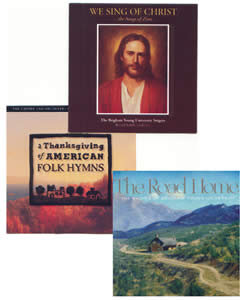
The best seller in Tantara’s repertoire? “Unquestionably, it’s `A Thanksgiving of American Folk Hymns,'” said Simpson, who cites “a synergy between the music makers and the directors” that makes it a hit. The concert by several BYU choirs and orchestra has been shown on 130 PBS television stations. The popularity of the video necessitated production of a compact disc and cassette to follow it. They’ve sold by the tens of thousands. A DVD is in the works for the album’s 10th anniversary this year, Fales notes.
“We’re trying to get LDS music out to a wide variety of stations,” said Simpson. Those include public radio stations in Minnesota, Philadelphia and Boston, as well as KZION.com on the internet.
Where It All Happens
The actual recording of Tantara products may take place in commercial studios around Utah, on the BYU Motion Picture Studios’ sound stage, or on campus in the de Jong Concert Hall in the Harris Fine Arts Center. Tantara doesn’t actually record in the building where the phone rings and the small staff keeps up with orders and shipping. But it often teams up to produce a master recording, which is then made available for air play and reviews before more CDs are copied.
Such was the case with Synthesis, whose “Live at Montreaux” was recorded at the international jazz festival in Switzerland. The reverse happened with the BYU Singers’ “We Sing of Christ.” The locally-owned Sanctus company made the master, and Tantara took over from there. Excel entertainment distributes Tantara’s product to music outlets across the country.
Fales says the biggest challenge is “being a two-man operation, trying to get everything done” to supply the market. Whereas classical and inspirational music sales may have fallen in other areas, he says, “We’ve done all right because of our LDS audience.”
Some of Tantara’s inspirational CDs which may appeal to those LDS listeners include:
— “Echoes of the Sabbath,” sort of a sampler of BYU choral groups, originally intended as a public relations gift for those contemplating enrollment at BYU. It contains some excellent sacred selections, some with lush orchestral accompaniment of BYU’s Philharmonic Orchestra.
— From the University Singers under Ron Staheli, “We Sing of Christ…the Songs of Zion” (familiar hymns and religious folk songs), “Songs of the Soul” (some lesser-known pieces featuring the Singers’ impeccable harmonies), and “I Believe This is Jesus” (African-American spirituals whose rhythms would probably render them inappropriate for sacrament meeting but are otherwise good listening).
— “The Road Home,” a collection of music about heart and home, performed by the University Singers, Concert Choir, Women’s Chorus and Men’s Chorus.
— “All Creatures of Our God and King,” featuring the BYU Concert Choir under the direction of Mack Wilberg, along with some of his trademark arrangements of familiar hymns and sacred works.
See the entire selection and hear samples at www.tantararecords.com.