

with pictures by Deb Gehris
Life is filled with challenges; new ones arise all the time. Each test provides opportunity for growth as we learn new things and reach within to gather strength. Our faith grows as we seek and receive help from our Heavenly Father. But not all challenges are equal. From time to time, something comes along that requires unusual effort; a special resolve; a stretch of our talents and abilities.
Imagine that you coach a college football team. Every two years, all the coaches in the country hold a convention where they attend classes taught by experts, compare notes, and learn from one another. The convention also offers the opportunity to watch football games played by the best teams in the country – teams that had to win a competition just for the privilege of playing before this distinguished audience. Your team, however, is so highly regarded that it did not have to follow the usual route. Based solely upon a reputation built over decades it has been specially invited to play in the biggest game of the convention.
Do you think you might be little nervous? Sure, you know your team is great; but if you don’t bring your best game, what will the other coaches think? They’ll likely return home and tell everybody you’re a has-been. Your stellar reputation will suffer, your fans will feel let down and it is unlikely that you will ever receive such an invitation again. Perhaps you would be better off not taking that chance; you might be tempted just to turn the invitation down in the first place.
A Special Invitation
Such was the choice facing Drs. Craig Jessop and Mack Wilberg, when they were invited to bring the Mormon Tabernacle Choir to perform for the February, 2005, convention of the American Choral Directors Association (ACDA). This edition of the biennial gathering was to be held in Los Angeles, California. As always, top choral directors from the United States and throughout the world would be in attendance. Craig and Mack didn’t hesitate about what their decision would be. Choirs are not invited to sing for this convention; they must audition for the privilege. This was a high honor they didn’t want to pass up.
Choir President Mac Christensen favored accepting the invitation and scheduled a meeting with the First Presidency of the Church. When President Hinckley and his counselors learned of the invitation and of what it would mean for the Choir and the Church, they did not hesitate. President Hinckley said, “Let’s do it!”
Preparing for the Tour
Following the busy Christmas season, the Choir would normally be ready for an easier schedule. But this year, without missing a beat we jumped straight to preparations for ACDA. January saw extra rehearsals scheduled for each Tuesday night and each Sunday following Music and the Spoken Word. The repertoire for ACDA was also incorporated into several broadcasts to help eliminate the need for any effort not focused on the upcoming convention.
While Craig and Mack are always intent upon refining every detail of our performances, this was a time when the level of expectation elevated to unprecedented heights. Sometimes we divided into separate groups so both conductors could work with us. They were unrelenting, stopping every time there was the slightest problem with pitch, notes, rhythm or diction. Passages were repeated seemingly without end, pausing each time to analyze problems and try again until they were done perfectly. But even more than this, Craig emphasized the importance of sharing our spiritual feelings. We needed to transcend music, keeping a prayer in our hearts that we might radiate the real motivation that underlies our singing. I have heard Craig say more than once, “If we put music on the altar and worship it, we fail. That’s not what we’re about. If music becomes the medium – the way we express our faith – then it succeeds.”
Featuring Our Famous Arranger
Craig also felt this would be a wonderful occasion to feature the arranging talents of Mack Wilberg. While many members of The Church of Jesus Christ of Latter-day Saints are aware of Mack’s musical gifts, some may be surprised to learn of his renown in the choral world at large. For the past two years he has been the top selling composer/arranger at Oxford University Press, a major publisher of choral music in the United States and Great Britain. The world is clamoring for his arrangements and we in the Mormon Tabernacle Choir are blessed to be able to perform new works before they even reach the publisher.
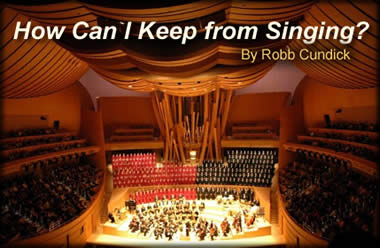
And so, in addition to favorite Wilberg arrangements that have become staples of our repertoire (such as “Praise to the Lord, the Almighty,” “Cindy,” and “Come Thou Fount of Every Blessing”), we learned two new ones: a Sephardic Jewish wedding song called, “A El Novio No Quere Dinero,” and the hymn, “How Can I Keep from Singing?” which, as you can tell from its title, couldn’t be more appropriate for expressing our feelings about music.
Each of these pieces presented special challenges. The text for “A El Novio” is in an obscure Spanish dialect. As with all music for the program, it would need to be memorized. Though the text is repetitious, there are slight variations, unusual rhythms, and a rapid tempo that made it very difficult to learn. There are also sections of clapping, but Mack didn’t want your normal everyday slap-your-hands-together kind of clap. Rather it was more restrained and refined: the left arm was held vertically with the hand flat and parallel to the side of the face. The right hand was also held flat and the upper portion of the fingers patted against the palm of the left hand. Only the right hand was to move; the left arm and hand were to remain stationary. It’s hard enough to describe but even more difficult to execute in a uniform fashion with 360 singers. Our efforts were rather pathetic at first and Mack finally told us we’d better go home and practice in front of a mirror or next time he’d call attention to those who couldn’t get the hang of keeping their left hand still.
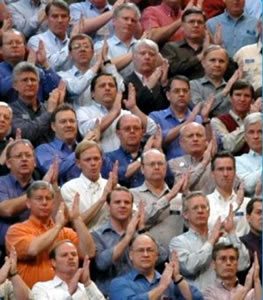
Though our initial efforts were pretty disjointed,
we finally got the hang of the “Spanish clap.”
A Trial Run
It took a couple of weeks to come together, but we finally learned it well enough to perform on a broadcast before the tour. Two remarkable coincidences made that performance especially memorable. The Sundance Film Festival was held that week, and as a result, two couples happened to be in attendance that had a special interest in the piece.
After the performance both came forward to address the Choir.
The husband of the first couple happened to be a Sephardic Jew. He related how he had met a former LDS missionary two years previously on a train. They had a common interest in humanitarian efforts and were now engaged in a project to raise money for the education of young girls in Ethiopia. He was grateful for the generosity of Latter-day Saints who had contributed to the fund. He had studied Church history and was fascinated by the parallels between the LDS exodus from Nauvoo and the experience of Sephardic Jews, who were driven out of Spain and Portugal in the Middle Ages. “Now don’t get excited. I’m not going to convert!” he joked. However, he was delighted to have been present to hear this piece.
The other couple represented an Arab television network. “A El Novio” has a very Middle Eastern flavor. We have probably never sung a piece having harmonies and rhythms that would identify so closely with the music of the Arab world. They happened to be filming the Choir as part of their experience in America and they said they would be showing us on Arab television. It seemed beyond coincidence to cross paths with the Arab world on the day we performed a piece of such appeal to them.
The hymn, “How Can I Keep from Singing?” pays tribute to the encouragement and calming influence that music brings to our lives. It extols singing as our ineluctable expression of joy and gratitude for the gifts that music brings. Cutting to the heart of what the Mormon Tabernacle Choir is about, Craig and Mack knew that its message is one with which our audiences would intimately identify. Mack’s beautiful new arrangement would surely bring tears to their eyes. But to make this delicate piece the spiritual high point of the concert would require complete unity of sound and perfection of pitch. Thus, in its own way, “How Can I Keep from Singing?” required as much concentration and effort as “A El Novio No Quere Dinero.”
One more treat awaited our California audiences: when we tour we are usually only able to take a small ensemble of brass and percussion from the Orchestra at Temple Square. But for this special occasion we brought along the string section! It was not possible to bring the full orchestra, but 65 players came and we were so happy to have them. What depth and richness they added! And that’s not to mention their energy and cheerfulness.
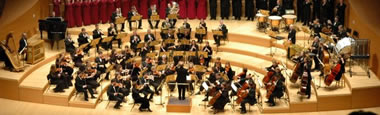 For the first time, strings from the Orchestra at Temple Square joined us on tour.
Off to California
So far this has been a rather long buildup to a very short tour. We left Salt Lake City on a Thursday and returned Sunday evening. But experiences to cherish for a lifetime were packed into those four days. Besides, I wanted to convey how diligently we prepared and how anxious we were to make this a performance that would not merely impress, but deeply inspire the distinguished members of the ACDA. It was the kind of opportunity that could open many future doors, not only for the Choir, but for the Church.
We took commercial flights to LA, arriving in several groups throughout the day. Things were quiet until late Friday morning, when we boarded buses for San Diego. Since the ACDA concerts would be closed to the general public, we wanted to add a concert that would be open to everyone. The Choir hadn’t appeared in San Diego since 1969, and so we scheduled a performance for Friday, February 4th at Cox Arena, on the campus of San Diego State University.
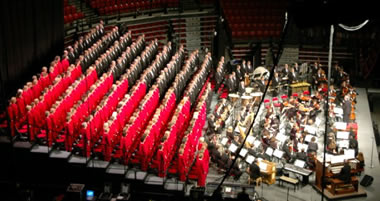
On Friday night, the Choir performed a concert for the general public at San Diego State University’s Cox Arena.
The weather was beautiful and such a nice change from the cold weather in Utah. It was fun to see a blimp paralleling our course as we drove down the coast; and giant two-rotor helicopters were on maneuvers as we passed through Camp Pendleton. After an afternoon rehearsal and sound check, we ate dinner and returned for the concert. We were glad for this opportunity to sing for such a friendly audience the night before facing the choral cognoscenti of the ACDA. The concert was a delight from beginning to end. The first half consisted of music we would sing for ACDA, while the second filled with familiar favorites we often sing on tour. Unfortunately, the transit back from San Diego made for a late night return. The next day would surely be ranked among the most demanding the Mormon Tabernacle Choir will ever face.
The Big Day
We were scheduled for three performances at ACDA: two in the beautiful new Disney Hall and one at the three-year-old Cathedral of Our Lady of Angels. The convention consists of several tracks designed to emphasize different areas of special interest. The concerts were scheduled such that all convention attendees would have an opportunity to hear us. As a result, all three performances were placed back-to-back at the end of the conference. For the Choir and Orchestra this presented both an opportunity and a challenge: an opportunity in that our performance would be the grand finale of the conference and a challenge since our audiences would have listened to dozens of wonderful choirs by the end of the convention. After four days, they could be tiring and thus even harder to please. And although these concerts were only 45 minutes in length, they were filled with vocally demanding works. We knew that by the third concert our voices would be wearing thin.
We stayed at the Los Angeles Downtown Marriott, which was a twenty minute walk from Disney Hall. Unfortunately it was uphill and our rehearsal and performance schedule required us to traverse it three times that Saturday – in the morning to rehearse at Disney, again for the afternoon rehearsal at the Cathedral of Our Lady of Angels, and a third time for the evening performances. Anyone who would have difficulty with such a trek was asked to not participate in this tour. Fortunately our Church Security contingent had mapped a route they were confident would be safe for a late-night return. It led through a building with an escalator that eased the climb a bit.
Walt Disney Concert Hall
Walt Disney Concert Hall was dedicated in October of 2003 as the newest venue of the Los Angeles County Music Center. Designed by architect Frank Gehry, it features a wavy, steel exterior that was conceived to look like a ship with its sail at full mast. Maybe it was the power of suggestion lent by its namesake, but when I first saw it I thought of Mickey Mouse.
I don’t mean that in a derisive way. It’s just that all those steel structures felt rather “Disneyesque.” I somehow had an impression of giant, misshapen mouse ears sticking out at odd angles. It is imaginative and creative, and I am sure Walt Disney would have approved.
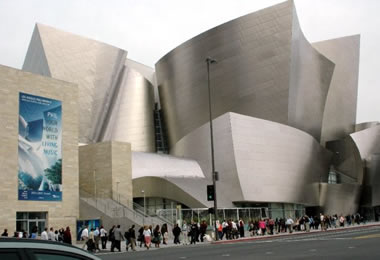 Disney Hall has a very imaginative architectural design.
Walt Disney would surely have approved!
The 2,265-seat auditorium was designed to look and feel like a ship’s hull, its curved wood ceiling reminiscent of billowing sails. Central to the auditorium is a magnificent 6,134-pipe organ with a most unusual faade, whose square wooden pipes protrude at such random and unusual angles that they have been compared to pick-up sticks or super-sized French fries.
 The beautiful faade of the pipe organ in Disney Hall is undoubtedly one of the most unusual ever conceived.
Disney Hall was the equal or better of any concert hall in which we have ever performed. From the first notes, we could tell we were going to love it. As we entered for the first evening performance it was thrilling to see the auditorium filled with eager concert-goers. Earlier I used the term, “cognoscenti,” which refers to a person who is especially knowledgeable about a subject. However it can take on an aristocratic connotation – a bit highbrow and stuffy. To tell the truth, the prior buildup we had received left me expecting an audience that would be reserved and critical. But here were people who were clearly upbeat and excited to see us.
Most of the Choir was placed in what would normally be audience seats above the orchestra platform. But an additional two rows of singers were to stand on the stage behind the orchestra. Those of us in the upper seats entered first and there was a slight wait before the remaining two rows entered the stage. As they entered there was a stir among the crowd. It was as if they were saying, “Whoa! You mean there are more of them?”
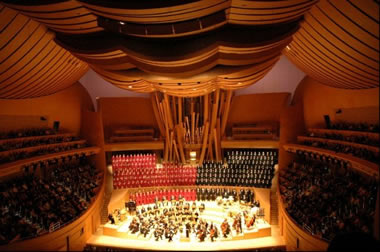
A site to rival our home in the Tabernacle: the Mormon Tabernacle Choir and Orchestra at Temple Square perform in Walt Disney Concert Hall, Los Angeles, California.
Appreciation for Mack
It was fun to see the reaction whenever Mack Wilberg made an entry. Some in the audience cheered! He is so obviously beloved in the choral world. One Choir member, upon telling a concertgoer that Mack had written special arrangements for us, was amused at the reply: “You mean Mack Wilberg is a Mormon?” Before the third concert I suggested to Mack that afterwards he should dive – like a rock star – into the audience. He laughed, but he is not one who seeks such acclaim. He was somewhat embarrassed to have so many of his arrangements featured in the program. He is a gentle and humble man who is ever self-effacing. How we love him!
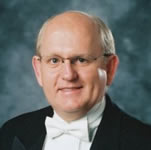 Dr. Mack Wilberg
“Reserved” and “critical” are words that had no place in Disney Hall that night. Had our performances not lived up to the Mormon Tabernacle Choir’s reputation, I have no doubt the audience would have cooled quickly. However, our careful musical and spiritual preparation made for a performance that was – as had been hoped – transcendent. We sang with a single voice and with great power. As we intoned the soft, sweet pieces, such as “Glory to God in the Highest” from Rachmaninoff’s All Night Vigil and our carefully prepared “How Can I Keep from Singing?”, I was reminded of feelings I had when we sang at the dedication of the Nauvoo Temple. If we were feeling such things, would the audience feel them, too?
Excited Response
The responses at all three concerts were no less than fully ecstatic; each performance surely being up to the highest standards the Choir has ever achieved. The giant chamber of the Cathedral was a challenging place to sing but the pews were packed, with many having to stand. Throughout the concert and afterwards we saw many tears and knew that we had touched many hearts. As we exited, I smiled to see a little boy – no more than four or five – standing nearby, dressed in a handsome suit. His parents had brought him up front for a closer view. How heartwarming to see a child look to choral singers as his heroes! How wonderful that he is being encouraged to appreciate things with deeper meaning than that commonly found in our pop culture-dominated world!

The middle of the three concerts was at the Cathedral of Our Lady of Angels, just a short walk down the street from Disney Hall.
By the third performance we were indeed exhausted. Mack Wilberg put it well: “After the first concert I thought, Gosh that went so well! Where do we go from here?’ And it seemed like the third concert was even better than the first…I think everyone’s adrenaline was pumping by that point!” Indeed it was, but as I’m sure Mack would agree, it was more than mere adrenaline. We know that the credit for our energy and endurance that night goes to Him whose Spirit we sought to emanate. Were we successful? Let some of the feedback we have received tell the story.
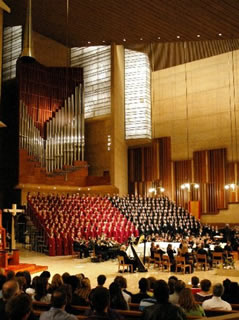
The huge space of the Cathedral made for difficult singing conditions, but we once again received a warm and enthusiastic response from a standing-room-only audience.
Inspiring Feedback
These comments were overheard by photographer Alan Gibby, who covered the concerts for the LDS Church News:
“The night definitely finished off with the big leagues, that was the Mother of all Choirs.”
“This Cathedral has never sounded like that before.”
“This Music Hall was perfectly designed for the Mormon Tabernacle Choir.”
A man who walked up to a Choir member on the way back to the hotel remarked, “Thank you. I don’t have to go to Church tomorrow now …because of you I attended Church tonight.”
David Batter, Choirmaster at Saint Cecilia Schola Cantorum and Conductor of the Omaha Singers, wrote the following to Brother Jessop:
“What a wonderful concert last night in Disney Hall.
It was the perfect way to end the ACDA Conference. I knew you’d all do so well and had been looking forward to hearing you live. I sat by my friend Jeff Daniel [Jeff sings in the Atlanta Symphony Chorus; he sang with Robert Shaw for many years]. He gave a huge smile of approval with the opening measures of the Choir. The massive wall of beautifully unified sound was so very impressive and heartwarming. I appreciated the dynamic text phrase shaping as well as the programmatic contrast of tempos, style, and excellent pacing. A woman sitting to the other side of me whom I’d never met before the concert kept making pleasing sighs throughout the whole performance. She physically shook with excitement. I hope you know the impact you made with the audience. Congratulations!”
Keith Atkinson, Director of Public Affairs for the Church, provided the following:
Dr. Manuja Hinduja of India: “This Choir transcends culture and connects directly to that universal yearning in everyone’s heart to draw closer to God.”
Dr. Theo Schramm, Pastor of Immanuel Baptist Church: “This performance is the highlight of my life!”
Michael Moody of the Church Music Department gathered these quotes:
“When the Choir began singing the City stood still.” (Greg Whitely)
“Every number was a standing ovation.” (Gay Smith, LA Trumpeter)
“During the quiet passages you could hear a pin drop.” (Betty Ann Marshall)
“They were ‘spot-on.’ It was thrilling, dramatic – just powerful stuff. They were really connecting with their audience. It was a proud moment! (Director Ron Staheli, whose BYU Singers also appeared at ACDA).
Michael himself added:
“From the West Balcony I could observe the prominent musicians – critics who had refused to join in the standing ovations for the previous choirs. The Mormon Tabernacle Choir melted the hearts of all – virtually everyone spontaneously rose to their feet. The Choir’s performance was technically and spiritually unsurpassed. It was an exhilarating, once-in-a-lifetime experience. What a privilege for us to have been there.”
From Ed Thompson, President of the Utah Chapter of the ACDA (and a former member of the Choir):
“For what I can only describe as the most amazing choral/orchestral performance I have ever heard, I can only say that through my own tear-filled eyes I saw and heard the reaction of everyone around me as not just appreciation and love, but also the reaffirmation of the high worth of musical performance – and that what all of us do or have done is, after all, worth the effort and sacrifice.”
“…Legend has it that upon completing his Hallelujah Chorus,’ Georg Frideric Handel exclaimed, I did think I did see all Heaven before me …” I think we all believe that the heavens were opened to him in some way, inspiring him to complete this and the rest of his magnificent Messiah.’ I happen to believe that on Saturday evening, February 5, 2005 the heavens were opened again for music – not only to support, sustain and inspire you but also, this time, to listen.”
And finally, the words of dear Brother Jessop as he spoke to us upon our return:
“I’ve been crying for three days …something swept over me on Sunday. I was fine Saturday. In my professional life – in my entire musical life – it will be one of the highlights spiritually and musically that I’ve ever known or experienced. I cannot tell you the effect that you had and the effect that your music making had on the people. It was more than music; it transcended music. I want thank you from the bottom of my heart for your devotion, your faith, your patience, your dedication, your trust.”
Final Thoughts
I mentioned that there was a twenty-minute walk from the Marriott hotel to Disney Hall. As I think back on our experiences in California, I am struck by the memory of the long line of singers and instrumentalists strung out along that path as they made their way from the hotel, through the buildings, and up the escalators and steeply-sloped streets. I think as well of the nave of the Cathedral of Our Lady of Angels, where long murals on each side depict a column of the faithful saints beloved to the Catholic Church. Such is the pathway of the generations of singers that have made up the Mormon Tabernacle Choir. So begins the pathway – now approaching its sixth year – of the Orchestra at Temple Square. There are those who are just beginning their service and those for whom the journey is nearly at an end.
I can imagine a line extending beyond my vision of those who have finished the journey and continued on with life, and then into eternity. In California we represented them all. Without self-congratulation, but with heartfelt humility and sincerity, I think we who presently tread the path can say that we have represented them well. We have done everything possible to live up to the names that mean so much to us: the Mormon Tabernacle Choir, the Orchestra at Temple Square, and The Church of Jesus Christ of Latter-day Saints.
I would like to end by quoting the words of, “How Can I Keep from Singing?” There have been different versions through the years, but they are originally attributed to Robert Lowry (1826-1899), a Baptist Minister from Pennsylvania. However rather than phrasing them as poetry, I feel their meaning is clearer as prose:
“My life goes on in endless song; above Earth’s lamentation I hear the sweet though far-off hymn that hails a new creation. Through all the tumult and the strife, I hear the music ringing; it sounds an echo in my soul. How can I keep from singing? What though the tempest loudly roar? I hear the truth; it’s living! What though the darkness ’round me close? Songs in the night it’s giving. I lift my eyes; the cloud grows thin; I see the blue above it; and day by day this pathway smoothes, since first I learned to love it. No storm can shake my inmost calm while to that rock I’m clinging. Since Love (or in Lowry’s original, “since Christ“) is Lord of heaven and earth, how can I keep from singing?”
These words, too, speak of a pathway – the one that leads through life. How blessed we are to be anxiously engaged in making music – the gift of heaven that calms the troubled soul and encourages all people as they make their way up the road of life.
How, indeed, can we keep from singing?