










This article includes excerpts from The Heart of Our Covenants: Temple Principles that Draw Us unto Christ by Valiant K. Jones. Used by permission. See www.valiantjones.com or www.cedarfort.com.
In the Church publication Preparing to Enter the Holy Temple, President Boyd K. Packer taught that the endowment and the marriage sealing are connected. He said that in preparation for the sealing ceremony, a temple officiator might say to a bride and groom, “Each of you has received your endowment. In that endowment you received an investment of eternal potential. But all of these things, in one sense, were preliminary and preparatory to your coming to the altar to be sealed as husband and wife for time and for all eternity.”[1] Later he added, “When sealed at the altar a person is the recipient of glorious blessings, powers, and honors as part of his or her endowment.”[2]
We should not think of the endowment ceremony and the marriage sealing ceremony as two distinct and unrelated ordinances. They are connected. The endowment can be seen as the first part of a ritually elaborate wedding ceremony where the bride and groom each make covenants with God in preparation for being sealed together eternally. Indeed, the covenants of the endowment can be seen as the primary covenants of an eternal marriage.
Eternal marriage is a three-way covenant between a man, a woman, and God. One Latter-day Saint institute manual presents the marriage covenant with a triangle diagram like the following:[3]
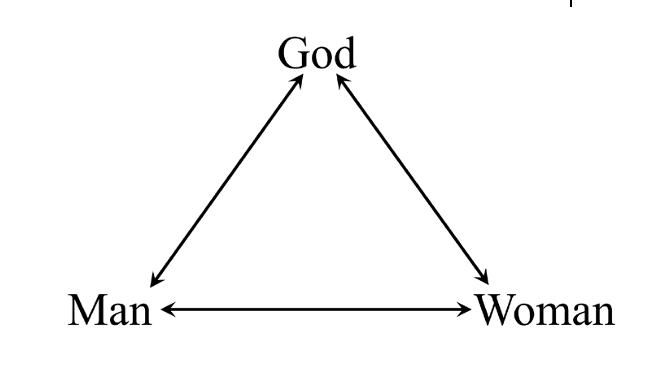
This triangle model can be carried a little further: The two sides of the triangle, which form covenant links to God, are established when a man and a woman, individually, receive their endowments. And the base of the triangle, connecting the man and the woman together, is formed during the marriage sealing ceremony. So the triangle becomes this:

With this perspective, the endowment is seen as the first half of the marriage ceremony. Many aspects of the endowment point toward this conclusion: the seating of men and women on separate sides of the room before they pass through the veil; the covenants themselves, each of which helps ensure a successful marriage; the manner of progression through the veil for couples who are about to be sealed; and the fact that in older temples, the sealing rooms lie beyond the celestial room, sometimes at a higher level, implying that eternal marriage is the next step in progression toward exaltation.
President James A. Faust affirmed a connection between the endowment and eternal marriage, saying, “The crowning blessings of life come through obedience to the covenants and honoring of the ordinances received in the holy temples, including the new and everlasting covenant of marriage, which is the capstone of the holy endowment.”[4] If eternal marriage is the capstone of the endowment, then we should not think of the two as independent ordinances but as progressive ordinances, with marriage built upon the foundation of the endowment. Those who have been present at a temple marriage ceremony know that there is no exchange of vows in the traditional language often used by other churches. For example, the bride and groom do not promise to take one another “for better, for worse, for richer, for poorer, in sickness and in health, to love and to cherish.”[5] In fact, historically, the eternal marriage ceremony has included very little language describing the marriage vows.
In spite of the lack of traditional vows, Elder Orson Pratt explained that the eternal marriage ceremony includes “a covenant and promise . . . [to] fulfill all the laws, rites, and ordinances, pertaining to this holy matrimony.”[6] His spelling of rites is not r-i-g-h-t-s, as in entitlements or privileges, but rather r-i-t-e-s, as in rituals. Also, Elder Pratt did not specify what these “laws, rites, and ordinances” are. As I contemplated what they might refer to, the first thought that came to my mind was that they would have to be “laws, rites, and ordinances” administered by the priesthood. Then I realized that they are perfectly encompassed in the covenants of the endowment.
The endowment covenants are presented as laws, they are administered in temple rites, and they are part of a priesthood ordinance. I believe they are the laws, rites, and ordinances we promise to abide by when we are married in the temple. Thus, the covenants of the endowment double as the primary covenants of eternal marriage.
When we see the covenants of the endowment in this light, we recognize that everyone who has received his or her endowment has received the foundational covenants upon which eternal marriage is built. Even if an endowed person is not sealed to a spouse during mortal life, the covenant bond to God has been formed with nothing held back in that leg of the three-way relationship of marriage. Only the final sealing to a spouse, with its majestic, crowning promises, has yet to occur. This is a beautiful concept that affirms the love and mercy of God for all of His children, married or single. God’s covenant ways are marvelous. They include blessings and promises that are certain for all who desire to follow His covenant path, regardless of their marital status.
Many priesthood ordinances have two parts. Baptism is not complete without confirmation, and when the sick are anointed with consecrated oil, a separate ordinance seals that anointing. The same is true for temple washings and anointings—each is followed by a separate sealing or confirmation. These paired ordinances have one part that includes a physical action and another part that focuses more on the spiritual. They can remind us that Christ’s Atonement was also completed in two parts: in Gethsemane and on Golgotha. This two-part pattern shows us that whenever we see a priesthood ordinance called a sealing or a confirmation, there is a preceding ordinance associated with it. So what is the antecedent, companion ordinance for the sealing we call an eternal marriage? It is the endowment. The two go together. The first prepares for the second. The covenants of the endowment are the covenants of an eternal marriage. The sealing that occurs with an eternal marriage not only seals the couple together, but it also seals the ordinance of the endowment for each participant, confirming one of the primary purposes for which they were endowed: to form an eternal family.
When we see the endowment as the first half of the marriage ceremony, new insights can come. As we review the Creation story in this context, we can remember that the whole purpose of the earth is to provide a place where families can be established for growth and learning. As we view the story of Adam and Eve played out, we can see that first marriage as a model for us, teaching the purpose of opposition and the temptations that will come to every marriage and family. And when we see the Apostles Peter, James, and John come on the scene, we can recognize the importance of following the counsel of modern-day prophets and apostles in our families.
Those who have been married in the temple will remember that before going into the sealing room, they were taken to an endowment room to participate in a special veil ceremony as a couple. This alone should be sufficient witness that the endowment and eternal marriage are linked. I once taught a Sunday School lesson on eternal marriage as part of a class for new members. The class included a newly baptized couple who were looking forward to their temple sealing. When they learned that they would first need to receive their endowments, the wife asked, “What is the endowment?” I replied, “I like to think of the endowment as the first half of the wedding ceremony—the part where we make covenants with God before we are sealed together as a couple.” The sister responded with a simple and contented “Oh!” and a look of satisfaction on her face. The explanation fit her understanding of the whole reason she wanted to go to the temple—to be sealed to her husband forever. The endowment truly does prepare us for our marriage sealing. The covenants of the endowment are antecedent covenants that we must agree to as part of the new and everlasting covenant of marriage.
In the Church’s General Handbook, the instructions for performing a civil marriage ceremony state, “Before performing a civil marriage, a Church officer may counsel the couple on the sacred nature of the marriage vows. He may add other counsel as the Spirit directs.”[7] I expect that similar instructions are given to those who perform temple marriages. At the temple marriage of one of my children, I was thrilled when the temple sealer reviewed the covenants of the endowment as part of his counsel to the bride and groom.
During the height of the COVID-19 pandemic, about a year after Elder David A. Bednar empowered us to “discuss the basic purposes of and the doctrine and principles associated with temple ordinances and covenants,”[8] I had occasion to perform two civil marriages for members of the Church. The following reflects the marriage counsel I gave, putting Elder Bednar’s guidance into practice.
“Today you will be married in a union that will last for the remainder of your mortal lives together. This ceremony is a foreshadowing of an even higher ceremony which we hope you will choose to receive at a future time: marriage for time and all eternity in a holy temple of God. A temple marriage makes it possible for you to live eternally as husband and wife—not only in this life but also in the next. I encourage you two to set eternal marriage as a goal and work toward it.
“Those who enter into eternal marriage must first make covenant promises to follow five specific laws of God. These promises are made individually by the man and the woman to secure their relationship with God, but they also form the foundation of a strong and happy marriage. These covenantal laws, along with my commentary, are as follows:
- “The Law of Obedience: God’s commandments are not meant to be restrictions to control us but rather guideposts to keep us on the path of happiness. If you will always keep God’s commandments, your marriage will be on a sure foundation, and you will avoid a lot of pain and sadness.
- “The Law of Sacrifice: If you will always remember the sacrifice of our Lord, Jesus Christ, and then sacrifice for one another and for the future children the Lord might send you, then you will find a level of joy that is not available to those who are self-centered and only seek after their own comforts.
- “The Law of the Gospel of Jesus Christ: If you will come unto Christ and always remember Him, repenting when needed as you strive to be a better person, then you will have the guidance of the Holy Ghost in your marriage. That guidance is critical.
- “The Law of Chastity: Physical desires for one another are God-given, for they have the potential to bring you children and draw you closer as a couple. However, their use outside of marriage, either through real or virtual means, can destroy a marriage. Make sure you always remain faithful to one another in your marriage.
- “The Law of Consecration: If you will consecrate your lives to God and serve others, your family will grow in an atmosphere of benevolence and love. Remember that “whosoever will lose his life for [Christ’s] sake shall find it” (Matthew 16:25).
“Following this five-step covenant path will put Christ at the center of your marriage and give you a strong foundation for a happy family life.”[9]
In the world today, many people enter into prenuptial agreements before marriage. These are legal covenants between the two betrothed parties. Engaged Latter-day Saint couples also enter into prenuptial covenants—these are called the covenants of the endowment. However, there are significant differences between the world’s ways and God’s ways. The prenuptial covenants of the world are entered into to assure the rights of the individuals and to establish the ownership of assets in case the marriage fails. The prenuptial covenants of God, received through the endowment, are entered into to ensure that the marriage will last for eternity.
Oh, what beauty, glory, and magnificence we see in the ordinances established by our loving Father in Heaven! The blessings He provides through the endowment and sealing ordinances in His holy temples are powerful and eternal. No wonder He declared, “And this greater [Melchizedek] priesthood administereth the gospel and holdeth the key of the mysteries of the kingdom, even the key of the knowledge of God. Therefore, in the ordinances thereof, the power of godliness is manifest” (D&C 84:19–20). As President Russell M. Nelson declared, “The supreme benefits of membership in the Church can only be realized only through the exalting ordinances of the temple. These blessings qualify us for ‘thrones, kingdoms, principalities, and powers’ in the celestial kingdom.”[10]
Valiant K. Jones is the author of The Heart of Our Covenants: Temple Principles that Draw Us unto Christ. For more information, see www.valiantjones.com or www.cedarfort.com.
[1] Boyd K. Packer, Preparing to Enter the Holy Temple (2012), 15; emphasis added.
[2] Boyd K. Packer, Preparing to Enter the Holy Temple, 31; emphasis added.
[3] “Keeping the Sacred Covenant of Marriage,” Building an Eternal Marriage Teacher Manual (2003), 14.
[4] James E. Faust, “Keeping Covenants and Honoring the Priesthood,” Ensign, Nov. 1993, 39.
[5] Wikipedia, “Wedding Vows,” last modified Nov. 6, 2024, 15:10 (UTC), https://en.wikipedia.org/wiki/Marriage_vows.
[6] Orson Pratt, “Celestial Marriage,” The Seer 1, no. 2 (Feb. 1853): 31.
[7] General Handbook, 38.3.6.
[8] David A. Bednar, “Prepared to Obtain Every Needful Thing,” 103.
[9] Valiant K. Jones, “Wedding Ceremony,” personal notes, Aug. 2020.
[10] Russell M. Nelson, “Endure and Be Lifted Up,” Ensign, May 1997, 72.








ShaunaMarch 5, 2025
Fantastic! thank you so much. These insights will enhance my temple attendance
Jenny Madsen SvendsenMarch 4, 2025
Thank you for such an enlightning article, I never realized that temple endowments and marriage are related, I wonder why I didn't catch on to that, after being sealed to my husband in the temple in 1971, but we learn ine upon line, precept upon precept for sure.