




Rejoicing in Christ: Sunday General Conference Talk Excerpts

Sunday Morning

Alive in Christ
By President Dallin H. Oaks
President of the Church
Living worthy to meet Christ is no easy task. Many current writers characterize the time in which we live as “toxic,” a time of “contempt” or “hostility” toward adversaries. This hostility affects many different relationships in society, involving many whose Christian beliefs should orient them otherwise.
Our Savior Jesus Christ taught us how to relate to one another. The great commandments in the law, He taught, were to love—God and neighbor (Matthew 22:37-39).
Asked who is my neighbor? Jesus answered with a parable that praised the merciful action of the Samaritan, a group the Jews isolated and held in contempt. But Jesus’ teachings about the circle of love went far beyond Samaritans. In the Sermon on the Mount, He declared:
“Ye have heard that it hath been said, Thou shalt love thy neighbour, and hate
thine enemy.
“But I say unto you, Love your enemies, bless them that curse you, do good
to them that hate you, and pray for them which despitefully use you, and persecute
you” (Matthew 5:43-44).
What a revolutionary teaching for personal relationships! Love even your enemies! But who are our enemies? Its full meaning, in the sources from which King James’ translators chose the word enemies, include military foes and even extends to any who actively oppose one another. Today we might say that we are commanded to love our adversaries. All mortals are beloved children of God. As President David O. McKay taught, “There is no better way to manifest love for God than to show an unselfish love for one’s fellowmen.”1

Encounter at the Empty Tomb
By President Dieter F. Uchtdorf
Acting President of the Quorum of the Twelve Apostles
What Mary and those with her discovered on that Sunday morning changed the world
forever. “They found the stone rolled away from the tomb, but when they went in they did not find the body of the Lord Jesus. While they were perplexed about this, behold, two men stood by them in dazzling apparel … [and] said to them, ‘Why do you seek the living among the dead? He is nothere, but has risen.’”
This encounter at the empty tomb changed them forever.
It changed the world.
Many might picture Jesus as a carpenter from Nazareth or a traveling preacher from Galilee. They might note the significant influence He had on the world’s religious history. But the bold message of the empty tomb is that Jesus Christ is not merely a historical figure.
We do not seek Him among the dead. He is risen!
We understand He is not confined to the pages of a book any more than He was confined to that grave of stone. The scriptures teach us not only who Jesus was but who He is.
Because of what happened on that Sunday morning, we can speak of Jesus Christ in thepresent tense.
He lives!
Today.
At this moment.

Best Days and Worst Days
By President Emily Belle Freeman
Young Women General President
Isn’t it amazing how you can go from best day to worst day in a matter of minutes?
This is mortality. A proving ground. A place designed for growth. I have learned that
God allows mortality to do its work in us—and that includes both best days and worst days.
I don’t know what your story looks like right now, if today is a best day or a worst day.
But here is my advice for you. On that worst day with Greg several weeks ago, I opened my Forthe Strength of Youth guide wondering if the eternal truths, invitations, and promised blessingsfrom the guide could really help Greg and I find strength in Christ.
Here is what I read. Maybe these words will help you.
“God’s plan is for you. … He has all power and knows all things. You can trust Him, even when life is hard.”
“God wants to communicate with you.” He knows you. He knows your name. “Pour out your heart to Him. … Be still and listen for His answers.”
“Jesus Christ will help you. … When you are worried, afraid, or struggle in any way, He
will comfort you.”

I Feel My Savior’s Love
By Elder Pedro X. Larreal
Of the Seventy
The sacrament represents the Atonement of Jesus Christ. During that sacred moment, when we give our full attention to Him and focus on His Atoning sacrifice, How can we not feel His great love for us? How can we not feel important when we remember that He willingly volunteered to be the advocate between us and the Father? not feel His In Luke 22:19 and 20, we read:
“And he took bread, and gave thanks, and brake it, and gave it unto them, saying: This is my body, which is given for you; do this in remembrance of me.
“Likewise, also the cup after supper, saying, This cup is the new testament in my blood,which is shed for you.”
When Christ spoke, these words found in Luke, He was focused on us; the sacrament wasgiven for our benefit. Notice again what He says: “This is my body, which is given for you”; and in the following verse, He says, “This cup is the new testament in my blood, which is shed for you.”

Choose Jesus Christ as Your Guide
By Elder Edward B. Rowe
Of the Seventy
While the Savior’s Atonement is infinite, His invitation is individual. He invites you andme to accept Him as our personal guide. He suffered not just for humanity—He suffered for each of us individually. As President Russell M. Nelson taught: “Jesus Christ took upon Himself your sins, your pains, your heartaches, and your infirmities.”10 In short, He knows you personally and thus how to guide you based on your distinct strengths, weaknesses, and circumstances.
Though our paths in life are unique, each is to be within the covenant path. For that is Christ’s path. We enter that path and connect ourselves to Jesus Christ as our guide through exercising faith in Him, repenting, and making sacred promises, or covenants, with Him. We follow in His footsteps within the covenant path by being in holy places, like the temple, and by having sacred experiences through partaking of the sacrament, praying, studying the scriptures, and ministering to others. The more time we spend with our guide in this way—and strive to follow His example—the more we will develop a deep bond and special relationship with Him.

“He Is Risen”
By Elder Ronald A. Rasband
Of the Quorum of the Twelve Apostles
Accounts in The Book of Mormon, Another Testament of Jesus Christ, also bear witness of Him Resurrected. A gathering at a temple in the new world in the land Bountiful21 heard a voice from the heavens saying, “Behold my Beloved Son in who I am well pleased, in whom I have glorified my name—hear ye him.”
Then, they beheld a “Man descending out of heaven; and he was clothed in a white robe;
and he came down and stood in the midst of them.” And “he stretched forth his hand.” I love that image of Him stretching forth His hand. He said, “Behold, I am Jesus Christ, whom the prophets testified shall come into the world.”
That outstretched hand was well-known in His earthly ministry. His hand rescued Peter as he began to sink in the choppy waves of the Sea of Galilee.26 His hand motioned for the crippled man at the Pool of Bethesda “to rise. . . and walk.”27 His hands washed the feet of his disciples28 and His hands “took bread, and gave thanks, and brake it” initiating the sacrament in “remembrance” of Him.”29 He promised the prophet Isaiah “Fear thou not; for I am with thee. . .for I am thy God; . . .I will uphold thee with the right hand of my righteousness.” That promise is for us all.

Because of Jesus Christ
By Elder Dale G. Renlund
Of the Quorum of the Twelve Apostles
I cannot add more time to your days or eliminate the many concerns modern life brings.
But I can offer this counsel: Not all matters are of equal value, and maintaining an eternal perspective helps us prioritize the things that are of greatest value. On this Easter Sunday, let us consider why focusing on Jesus Christ and the “infinite virtue of His great atoning sacrifice” is of greatest value and helps us no matter how many other concerns we must manage. His life, mission, and the fruits of His Atonement bless us infinitely and daily.
Focusing on the Savior, His infinite Atonement, and what He has done for us will bring
joy and clarity into our lives,31 no matter how many other concerns we have. This is why ancient and modern prophets have always and will always direct us to Christ.32 You may remember that President Russell M. Nelson taught, “Whatever questions or problems you have, the answer is always found in the life and teachings of Jesus Christ.”33 And President Dallin H. Oaks, the Lord’s living prophet today, counseled, “Jesus Christ is the way.”
You need not be like our little dog, Lady—confused, discouraged, and overwhelmed—when facing too many balls; you do not need to crawl back to bed and cower. Instead, keep your eye on the ball. Focus on the Savior.

The Joy of a Covenant Relationship with God
By Elder Thierry K. Mutombo
Of the Seventy
Our Heavenly Father has a special love for each person who makes the covenant with Him in the waters of baptism. That divine love deepens as additional covenants are made in the house of the Lord and are faithfully kept.
Nathalie and I have experienced this divine love during a very difficult time in our lives as husband and wife and eternal companions. We have been blessed with ten children…
We have experienced the death of four of our children at the beginning of our marriage. After the passing of three of our children, Nathalie and I wondered and asked ourselves so many questions, like the Prophet Joseph Smith asked in Liberty Jail: “Heavenly Father, where art Thou? Do You hear our cries and prayers? What are You trying to teach us through this hardship?”
We soon learned that this was not the end of our trials when Allan Mutombo, our nine-month-old baby, passed away. I found him in his crib. Holding his body in my arms, I cried, begging for a miracle that day. However, as you know, God’s plan for us is perfect, and that day He decided to take Allan back to Him. My prayers did not change His mind and will.
To add to this challenge, after the funeral, our extended families gathered and decided, without consulting us, that Nathalie and I should separate. They told me that tradition required us to separate, and they asked me to take my wife’s belongings outside the house because we had lost many children. I went into the bedroom and prayed to my Heavenly Father, asking for strength to face this adversity…
I remembered the words of our temple sealing and the promises made to God and to each other. I felt great peace and reassurance that Nathalie and I are a daughter and a son of a loving and caring Heavenly Father. I felt the Savior’s love and His hand lifting me up. Understanding our divine identify and potential helped me to know and do what God expected of me.
I came out of the bedroom with empty hands and told the people who were there: “I’m sorry, but Nathalie is my eternal companion. We are striving together to build an eternal family, and the Savior is helping us achieve it.”
They were unhappy and opposed my decision, but exercising my faith in Jesus Christ made me stronger.
A Peculiar Treasure
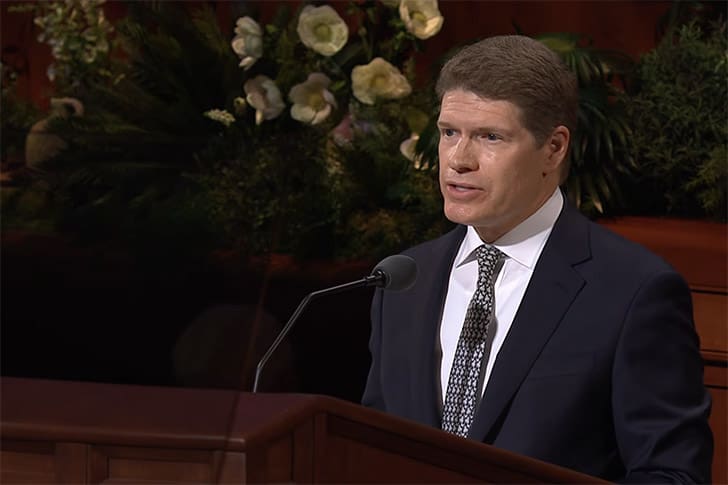
By Elder Alan R. Walker
Of the Seventy
As we study the scriptures, we encounter the word “treasure” dozens of times—most often as a warning not to set our hearts upon riches or upon the fleeting things of the world. Yet among all those warnings about earthly treasure, there is one passage that reveals something astonishing: the Lord Himself speaks of us as His treasure. I speak of the moment when the Lord addressed the prophet Moses upon Mount Sinai and declared that His people would be a peculiar treasure unto Him, if they would obey His voice and keep His covenant.
Our Heavenly Father’s greatest desire is for us to live with Him again and enjoy eternal life by His side. His work and glory is “to bring to pass the immortality and eternal life of man.” In order to make this possible, He designed the plan of salvation. He sent His Beloved Son, Jesus Christ, to break the bands of death and atone for the sins of the world. This sacrifice is the greatest expression of our Father’s infinite love for all His children…
In His benevolent teaching to Moses, the Lord established a pattern of application not only to the ancient children of Israel, but to all those who desire to become His treasure—the Lord’s covenant people. That pattern includes two simple but powerful conditions: to obey His voice, and to keep our covenants with Him. Then we will be a peculiar, or special, treasure; and as such we will be blessed, strengthened, and favored through the Savior’s atoning sacrifice.
Sunday Afternoon
The Character of Christ
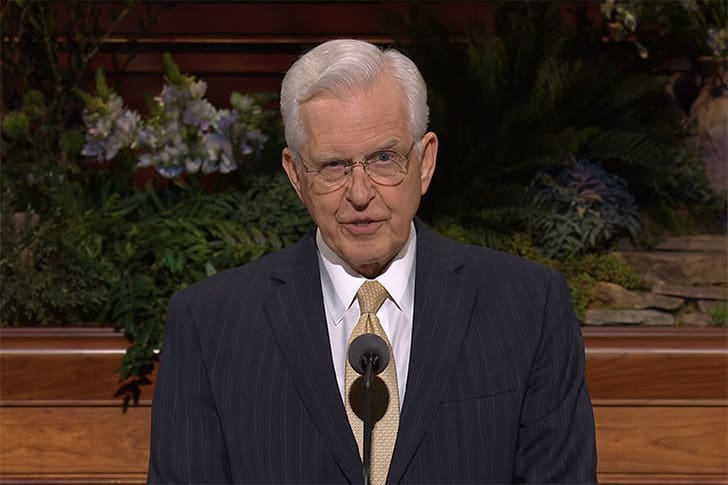
By President D. Todd Christofferson
Second Counselor in the First Presidency
Since we know that the Lord will come and establish a new earth where righteousness prevails, Peter asks, “What manner of persons ought ye to be?” He counsels that we should be preparing diligently now so that when the Lord comes, He will find us “in peace, without spot, and blameless,” leading lives of holiness.
As I have pondered Peter’s question, “What manner of persons ought ye to be?,” I have decided to speak today about the character of Jesus Christ. It is in emulating the character of Christ that we become the “manner of persons” we ought to be. Acquiring the character of Christ is one of the most important ways we take His name upon us.
When we consider the character of the Savior we tend to focus immediately on His attributes, such as virtue, integrity, humility, compassion, and courage, but we should also consider, what is it in Jesus that gives rise to such character traits? I believe they are the natural fruit of the thoughts, desires, and intents of His heart. Christlike character grows out of a Christlike heart. Thus, if we are to succeed in developing a Christlike character, we must possess His motivations—His thoughts, desires, and intents of the heart. For us, it will require what the scriptures call a “mighty change of heart”…
In the case of King Benjamin’s people, and some others, this spiritual rebirth with a changed heart was almost instantaneous. For most of us, our “mighty change of heart” occurs incrementally over time. In either case, the outcome is the same and equally valid. And in all cases, it requires faith in Christ, repentance, a baptismal covenant of obedience, and the grace of Jesus Christ through the Holy Spirit.1
Yes, it requires a consistent and sustained effort on our part, but remember, it is not
simply a matter of our striving. The good news of the gospel of Jesus Christ is that we, each of us, can call on the grace of Jesus Christ to help us.

Remember “Remember, remember”
By Elder Chi Hong (Sam) Wong
Of the Quorum of the Seventy
Do you still remember the five sets of “Remember, remember” verses in the Book of Mormon?
They are:
- We can dwell with God in a state of never-ending happiness if we keep His
commandments.
- We will be cut off from God’s presence if we do not keep His commandments.
- We can only be saved through the atoning blood of Jesus Christ.
- We will not fall if we build our foundation upon Jesus Christ.
- We were given knowledge and agency to choose and act wisely.

“I Glory in My Jesus”
By Elder Aaron T. Hall
Of the Quorum of the Seventy
As the Book of Mormon prophet Nephi concludes his teaching, he shares this powerful
witness, “I glory in plainness; I glory in truth; I glory in my Jesus, for he hath redeemed my soul from hell.”
That short phrase, “I glory in my Jesus,” beautifully captures Nephi’s loving relationship with the Son of God, the Messiah, the Redeemer. In the books of 1st and 2nd Nephi, there are over 60 different names for Jesus Christ. Each name reveals something of His majesty, character, and His mission as the Savior of the World. Yet, in this expression of love, Nephi refers to Him in a very endearing way: My Jesus.
To Nephi, Jesus Christ was not someone distant or merely known by name. No, to Nephi, the name of Jesus was his salvation. As Nephi experienced trials, and the joy of deliverance, the name of Jesus Christ became even more personal to him.
Nephi came to know that “there was none other way, nor name given under heaven whereby men can be saved in the Kingdom of God…” The name of Jesus Christ was Nephi’s redemption, and he gloried in it.

“Here Am I, Send Me”
By President Susan H. Porter
Primary General President
Wake up each day with purpose and confidence, knowing that Jesus will walk with you. Follow His example and say in prayer to Heavenly Father, “Here am I, send me.” Then listen for thoughts and ideas. What will He send you to do? Through His Spirit He may send you to comfort someone who is lonely, help your family, learn important lessons at school, or teach someone to pray. He can help you stand for truth so you can bring His light to others.
Do you remember learning about Jesus feeding more than 5,000 people? Jesus had been teaching all day, and the people were hungry. Somewhere in this large group there was a youngboy who had five loaves of bread and two small fishes. He knew that this food could not feed very many people, but he decided to give Jesus what he had. Jesus took the food and thanked Heavenly Father for it. That food fed thousands of people!
Eternal Marriage Is an Eternal Journey
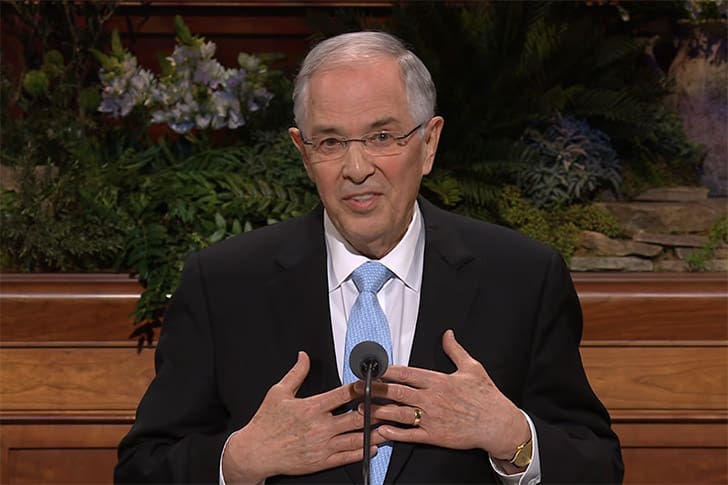
By Elder Neil L. Andersen
Of the Quorum of the Twelve Apostles
In my 74 years, there are only a few experiences where nearly every emotion and feeling
are solidly cemented in my conscious mind. One of the most poignant is as I knelt across the altar from Kathy in a holy temple of God. The hopes, the dreams, the love we shared, all burst in a kaleidoscope of anticipation as we heard those unforgettable words, “for time and for all eternity.”
To you in this vast worldwide congregation who lovingly remember that day in your life, I speak especially to you. At that moment, kneeling across the altar, we have a growing realization of the depth of our commitment to God and each other. The sacred ordinance binds us together with our eternal companion and with God. We solemnly vow to keep the covenants, and the Lord promises us as we are faithful, unspeakable blessings in mortality and beyond; including thrones, powers, and dominions in the eternal world.
Our even greater hope, however, is a desire to refine our very nature, to become more like our Savior, allowing us one day to live with Him. Within our sacred marriage, bound to God and to each other, we find ourselves in a crucible of spiritual development where vital qualities: sacrifice, charity, patience, and oneness; the very character of Christ can become a greater part of us.
As we increase our love for the Savior, our love for each other grows. Like our own discipleship, our eternal marriage is not a short-term experiment but a journey, an eternal journey of becoming who God desires us to become.

Keys, Covenants, and Easter
By Elder Quentin L. Cook
Of the Quorum of the Twelve Apostles
Elijah was a remarkable prophet who held sacred priesthood keys and through whom mighty miracles were performed. Christians, Muslims,12 and Jews the world over accept Elijah as a prophet. Muslims believe that Elijah was a prophet sent by God (Allah) to call people away from idol worship – especially the worship of Baal – and back to the worship of the one true God.
The Jews have been waiting for Elijah’s return for over twenty-nine hundred years, as a forerunner to the coming of the Messiah. Prior to Jesus Christ’s mortal ministry, the prophet Elijah exercised the sealing power of the Melchizedek Priesthood.
It is noteworthy to me that Elijah also appeared, with Moses, at the time of the transfiguration of Christ. Elijah conferred priesthood keys of the sealing power upon Peter, James, and John. It is also significant that when Christ visited the people on the American continent, He specifically recited to them the Old Testament account in Malachi concerning Elijah and his role in uniting families eternally prior to the Second Coming of Christ.
Because of the Restoration, we understand the important and pivotal role Elijah has playedin the salvation of mankind. Elijah “committed” to Joseph Smith the priesthood keys pertaining to the sealing power to bind sacred ordinances and covenants on earth and in heaven. This includes the vicarious ordinances of salvation and exaltation that must be performed here on earth in the temples of the Lord.
The sealing ordinances are effective after this life and in the eternities – to seal husbands and wives, parents and children. Without these keys, there are no eternal families and the “whole earth would be utterly wasted.”

Come Unto Christ—Together
By Elder Taniela B. Wakolo
Of the Seventy
“The doctrine of The Church of Jesus Christ of Latter-day Saints centers on the family.Essential to our doctrine on the family is the temple. The ordinances received there enable us to return as eternal families to the presence of our Heavenly Father. …The gospel plan…is implemented through our mortal families, and its intended destiny is to exalt the children of Godin eternal families.”
The Lord has also declared that “marriage is ordained of God…that the earth might
answer the end of its creation,” and without the sealing authority needed to enter these eternal covenants that unite families forever, “the whole earth would be utterly wasted at his coming.”
The temple stands as a symbol of hope, not pressure. The crowning ordinance of temple sealings invite us into the divine order of God. The gospel of Jesus Christ is not a wedge to divide families but a bridge to unite them, eternally. We must ensure that our discipleship reflects the Savior’s patience, His gentleness, and His perfect love.
My dear brothers and sisters, some of you are from families yet to be sealed in the temple. Some of you who are listening are not members of the Church. Others of you who are members of the Church may have spouses not of our faith. Today, I say to each of you: You are essential to God’s plan.

Abide with Me; ‘Tis Eastertide
By Elder Gerrit W. Gong
Of the Quorum of the Twelve Apostles
Jesus Christ walking with His disciples on the road to Emmaus reveals a covenant
pattern. Sometimes, on our dusty roads to Emmaus, we feel alone, misunderstood, burdened, unseen. But as He “talk[s] with us by the way,” His words in scripture can cause our hearts to burn. As He breaks and blesses the sacramental bread, His ordinances and covenants can help us know Him.
As we walk by faith with Him, abiding in Him, and Him in us, we come to know He lives. His Easter promises are real.
Just as the disciples on the road to Emmaus ask Jesus to abide with them, Jesus Christ
promises to abide with us. In the gospel of John chapters 14 and 15, Jesus teaches His disciples and us how He can remain, belong, walk with us. His faithfulness is stronger than the cords of death.
When we have a question, problem, or joy, Jesus Christ says, I am your answer – your way, your truth, your life. To abide with us in our darkest days, in John 14 Jesus promises us the First and Second Comforters.
The First Comforter Jesus speaks of is the Holy Ghost. “And I will pray unto the Father, and he shall give you another Comforter, that he may abide with you for ever.” “The Comforter, which is the Holy Ghost, whom the Father [shall] send in my name, he shall teach you all things, and bring all things to your remembrance.”
The Second Comforter Jesus speaks of is Himself. Jesus promises, “I will not leave youcomfortless: I will come to you.”“For “he that loveth me shall be loved of my Father, and I will love him, and will manifest myself to him.” Indeed, “if a man love me, he will keep my words: and my Father will love him, and we will come unto him, and make our abode with him.”

Closing Remarks
President Dallin H. Oaks
President of the Church
Truly, Jesus Christ is the way to peace in this world, and eternal life in the world to come. He knows and loves each of us perfectly, and invites us to walk with Him, abide in Him, and follow His example of ministering to others one by one in charity and love. We have been reminded of the central role of marriage and families in our Heavenly Father’s plan for the eternal destiny of His children. May we demonstrate the pure love of Christ in our families, in our communities, and in all of our interactions with God’s children.
As the messages from this conference are published, I invite all to study and ponder them prayerfully, and to act in faith on the principles they explain. The Lord has promised: “unto him that receiveth I will give more.”1 As we treasure up and act upon the teachings of this conference, the Lord will continue to teach and inspire us with personal revelation and guidance.
Angels with Noses: A Theology of Toast

The Envy of Angels
The Catholic writer Thomas Howard—whose liturgical prose is a master class in finding the holy in the humdrum—once made a disarming observation. In Chance or the Dance? 1 he notes, quite simply, that angels have no noses.
He was not, of course, offering an anatomical diagram but a theological contrast. In traditional Christian thought, angels are pure spirits—“ministering spirits,” beings of wind and fire who cry glory before the throne of God but do not dwell in the heavy, humid world of taste and touch. They behold the Beatific Vision; they are dazzled by the unveiled glory of God. But they cannot do what you did this morning. They cannot smell hot chocolate. They cannot taste the sharp, cold shock of orange juice or the warmth of buttered toast. They cannot feel the scratch of wool, the stubborn resistance of a garden stone, or the sticky warmth of a child’s hand—that small, gummy sacrament of trust.
Historic Christianity, at its best, is far more friendly to the body than the caricatures admit. It affirms the goodness of creation and the resurrection of the body. Yet even so, it has often imagined the highest forms of life—God, angels, and our most exalted experiences—as “spiritual” in a way that leaves our senses behind, as though God preferred ghosts to gardeners. By that logic, Samwise Gamgee—with his love of food, rakes, and potatoes—would seem distressingly unspiritual. (Which, of course, is why most of us trust him.)
God Himself has a nose—and, one might say, a taste for worlds.
Here the Restoration quietly but firmly parts ways with much of that tradition and offers something far more scandalous. It declares that God Himself has a nose—and, one might say, a taste for worlds.
Latter-day Saints confess that the Creator of galaxies is not an abstract mind floating in a void, but a Man of Holiness with a glorified body of flesh and bone—a being who can touch and hold, and, presumably, smell the franks on a grill and the frankincense in a temple with equal delight and in perfect order. We are taught that many “angels” are resurrected beings—men and women who have reclaimed their clay, glorified and quickened, but still tangibly, wonderfully real. The Restoration also acknowledges other messengers—premortal spirits, disembodied spirits—but even the bare possibility that many angels are resurrected neighbors changes the picture dramatically. It turns the hereafter from a rumor of mist into a city with streets and kitchens.
Doctrine and Covenants 137 gives that city a surprisingly concrete feel. Joseph sees the celestial world, and how is it described? Not as a vague brightness, but as a place with “streets…paved with gold.” Heaven, in other words, has pavement. It has architecture. It has somewhere to walk. The gold is not there to impress Wall Street; it is there to say, in the most ancient biblical shorthand, “This place is solid, radiant, and real.” In John’s Apocalypse, the New Jerusalem descends with foundations and measured walls and gates that swing on hinges. The seer does not come back stammering about an idea; he comes back talking about a city grid.
Taken together, Joseph’s vision and John’s revelation suggest that exaltation is not a promotion into abstraction but an entrance into the most real neighborhood you have ever known—only transfigured. Imagine, if you will, a celestial cul-de-sac with lawns that never quite die in August and porches where resurrected grandparents are forever “just about to take the bread out of the oven.” Gold streets are not an excuse to escape the material; they are a divine joke at the expense of our suspicions. The Lord seems to be saying, “You were afraid matter was too shabby for Me, so I paved the sidewalks with it.”
If God is embodied, and if the destiny of the human soul is not to escape the body but to be eternally welded to it—then the physical world is not a distraction from the spiritual life.
If this is true—if God is embodied, and if the destiny of the human soul is not to escape the body but to be eternally welded to it—then the physical world is not a distraction from the spiritual life. It is the very terrain on which the spiritual life is lived. Re-enchantment does not mean floating above the world to find God; it means pressing deeper into the grain of reality until we taste the glory hidden there—discovering that the ladder to heaven is built, inconveniently, out of ordinary days.
The Doctrine: Radical Materialism
To understand why a grilled cheese sandwich can be holy—aside from the obvious—we have to dismantle what S. Brett Savage calls “unwitting dualism.” This is the vague, Neo-Platonic suspicion that haunts even the most faithful Latter-day Saints: the idea that our bodies are heavy, clumsy cages trapping our bright, shiny spirits. We assume the “real us” is the ghost inside, and the body is just the mere carapace—a rental car we have to fuel and repair until we can finally trade it in for a cloud. It is a poor bargain if you happen to like strawberries.
This dualism is the factory setting of Western culture. It urges us to divide life into sealed compartments: Sunday is for the spirit; Monday is for the body. Prayer is spiritual; doing the dishes is physical. Studying scripture is holy; eating lunch is merely biological—as though God made mouths only for speaking hymns and never for tasting soup.
Joseph Smith shattered that partition in 1843 with a single, thunderous sentence:
“There is no such thing as immaterial matter. All spirit is matter, but it is more fine or pure.” (D&C 131:7)
By “Radical Materialism,” then, I do not mean the flat materialism of some modern philosophies, where everything is just particles and laws and nothing more. I mean Joseph’s claim that even what we call “spirit” is a kind of matter—finer, purer, and capable of relation, covenant, and glory. On that view, matter is not the enemy of spirit; it is the medium of spirit—the score on which God writes His music.
The spirit and the body are not enemies; they are distinct forms of the same holy stuff.
We are not ghosts trapped in machines; we are beings of integrated matter. The spirit and the body are not enemies; they are distinct forms of the same holy stuff. As the Doctrine and Covenants reminds us, “the spirit and the body are the soul of man” (D&C 88:15). You do not simply have a soul that resides in a body; you are a soul constituted by a body—a truth which makes the resurrection less an afterthought and more the punchline.
The implications are staggering. If spirit is matter, then matter matters. The physical world is not a disposable wrapper around the “real” spiritual gift; it is part of the gift itself. The sensation of hot water in a shower, the crunch of an apple, the ache of tired muscles—these are not interruptions to eternity; they are the texture of it, time’s way of teaching us what permanence will feel like.
The disenchanted believer tries to look past the physical to find the divine. The re-enchanted Saint looks at the physical and sees God’s fingerprints. We believe in a God who didn’t just create the abstract concept of “nourishment,” but invented the specific, crunching, tasting reality of a honeycomb. We believe in a Savior who, in His resurrected glory, did not ask for a hymn or a philosophy lecture, but for a piece of broiled fish (Luke 24:42). And in 3 Nephi, as a resurrected Being, He breaks bread and blesses wine among the Nephites, binding His glorified life once again to eating and drinking with His people. Heaven, it seems, keeps opening its doors at mealtime.
The Sacrament of the Mundane
Once we accept that matter is holy, the “ordinary” parts of our week begin to glow with a strange new light. We begin to see that God is constantly using the physical to communicate the infinite. C. S. Lewis called this principle “Transposition” 2 — the way a richer medium (the spiritual) descends into and expresses itself through a poorer medium (the physical). Grace, one might say, speaks with a local accent.
The supreme example of this is the Sacrament.
Every Sabbath, we witness a miracle so routine we often sleep through it. We take a piece of bread—usually cheap, mass-produced white bread from a grocery store shelf—and a plastic cup of tap water. These are the most banal, utilitarian objects imaginable. To the “factory worker” view of the world, they are carbohydrates and H₂O—fuel for a bipedal mammal on a spinning rock.
But under priesthood authority, these common elements are sanctified. They are pressed into service to hold the weight of the Atonement of Jesus Christ. The bread becomes the body of the Redeeming God. The water becomes the blood of the New Covenant. We eat and drink, and for a moment, the barrier between heaven and earth is as thin as a dove’s feather and just as easily overlooked.
The Sacrament is unique—covenantal, priesthood-administered, explicitly focused on Christ. Yet it is not an exception to the rule of nature; it is a revelation of the rule. It shows us what all matter is meant to do. Bread is meant to mediate love. Water is meant to carry life. The world is not only habitable; it is hospitable.
We are often eloquent about sunsets and mountains and strangely tongue-tied about cheese and bread. We write odes to oceans and constellations, but ignore the “submerged sunrise” in a block of cheddar or a loaf of sourdough. The very ordinariness of these things makes them easy to overlook.
A re-enchanted imagination sees the grocery store not as a depot of commodities, but as a cornucopia of God’s largesse. He knew we needed fuel, so He gave us strawberries, avocados, and steak. He could have made us photosynthetic, soaking up light in silence. Instead, He made us masticating, digesting, tasting creatures who must kill and eat to live—a daily reminder that our life is sustained by sacrifice, by life given for life. Between the beefsteak tomatoes and the bakery, the shelves preach a quiet commentary on Calvary.
In that sense, every meal is a small, echoing sacrament of the Atonement of Jesus Christ—not in the formal, ordinance sense, but as a living parable enacted in our bodies. We live because something else is broken and offered, taken in and transformed. The table quietly preaches what the altar proclaims; grace, like bread, is meant to be broken and shared.
The Altar of the Kitchen Table
If the chapel Sacrament table is the center of the ward, the kitchen table is the center of the home. In a re-enchanted world, they are, in a deep way, two ends of the same altar—one in polished wood, the other in peanut butter fingerprints.
We often view family dinner as a logistical nightmare—a chaotic friction of picky eaters, spilled milk, and weary parents trying to extract details about the school day from reluctant teenagers. We rush through it to get to the “real” spiritual work of Family Home Evening or scripture study.
But what if the eating is the lesson?
When a family sits down to break bread, they are enacting the central drama of the Gospel: fellowship. They are saying, “We are distinct individuals, yet we draw life from the same source.” When a mother or father spends an hour cooking a meal that is consumed in fifteen minutes, they are teaching the doctrine of sacrifice—“This is my time, given for you.” When we pass the steaming potatoes, we are acting out a small oblation—practicing the law of consecration in miniature. The gravy boat becomes, absurdly and truly, a kind of chalice.
These aren’t just “automatic family triggers” playing out a biological script; they are real choices of offering, receiving, and bearing one another’s burdens—the kind of agency that makes us more than machines.
Modern culture has largely mechanized eating. We “refuel.” We eat in our cars. We drink “energy” from cans. We treat our bodies like engines that need gas. In doing so, we strip the act of its holiness. We become “angels with no noses,” trying to bypass the sensory joy of creation and then wondering why the universe smells of nothing in particular.
Our language betrays us. When we call a meal “fuel” or a home a “busy machine,” we are not just being efficient; we are hiding. Those metaphors let us pretend that nothing sacred is at stake—that we are merely organisms optimizing inputs and outputs, not souls choosing to love.
The laundry, the dishes, the sweeping—these are not enemies of our spiritual life. They are the liturgy of care.
To re-enchant the home, we must recover the table. We must refuse to apologize for the physical needs of our families. The laundry, the dishes, the sweeping—these are not enemies of our spiritual life. They are the liturgy of care. The Restoration collapses the false distance between “sacred” and “secular”; it brings the temple into the kitchen—and, mercifully, does not ask us to vacuum on streets of gold.
Think of Christ in the New Testament. How often is He eating? He turns water into wine at a wedding feast. He feeds the five thousand on the grass. He institutes the memorial of His death at a Passover supper. After His Resurrection, He cooks breakfast for Peter on the shore of Galilee. The God of the Universe seems incredibly interested in dinner—as though the menu itself were a minor prophet.
Why? Because He knows that we are not brains on sticks. He knows that the way to the human heart is often through the human stomach. He knows that when we eat together, we drop our defenses. We become, literally, companions—from the Latin com panis, “with bread”—friends defined not only by what they believe, but by what they pass across the table.
This, Too, Is Holy
There is a story of a young missionary who, overwhelmed by the humidity and smell of a foreign city, prayed to be delivered from his physical discomfort so he could focus on the Spirit. His mission president, a wise and weathered man, corrected him: “Elder, you weren’t sent here to float above the people. You were sent here to sweat with them.”
That is the call of the re-enchanted life. It is the call to stop trying to be an angel and start trying to be a Saint.
That is the call of the re-enchanted life. It is the call to stop trying to be an angel and start trying to be a Saint—which is a much earthier thing. Sainthood, in the end, is holiness with dust on its shoes.
It means we stop resenting our bodies for being tired and start honoring them as temples where the Holy Ghost is pleased to dwell. It means we stop rushing through our meals and start savoring them as gifts from a Father who loves us. It means we look at the mess of a family dinner—the noise, the spills, the chaos—and say with a shock of recognition: This, too, is holy.
Pure spirits cannot taste the bread. Devils cannot enjoy it. But we, with bodies and agency, can receive the world as a gift and return thanks through it. For now, we stand in a unique posture—poised between the dust of the earth and the fire of heaven, able to lift a fork to our mouths and taste the goodness of the Lord.
So let us eat. Let us feast. And in the very act of tasting the world, let us remember the God who gave us noses to smell the rain, tongues to taste the cheese, and bodies to rise in the morning of the First Resurrection, ready to live—and eat—forever. Salvation may be less an escape from supper than an invitation to stay for dessert.
1. Thomas Howard, Chance or the Dance? A Critique of Modern Secularism, 2nd ed. (San Francisco: Ignatius Press, 2018).
2. C. S. Lewis, The Weight of Glory and Other Addresses, rev. and expanded ed. (New York: HarperOne, 2001).
3 Things to Do When the Sacrament Has Become Rote

Sign up for Meridian’s Free Newsletter, please CLICK HERE
The following comes from LDS Daily. To see the full article, click here.
Each week, members of The Church of Jesus Christ of Latter-day Saints partake of the sacrament, a sacred ordinance where bread and water are consumed as a symbol of Jesus Christ’s atoning sacrifice. The sacrament is also a time for those who have been baptized to renew their covenants, or promises, to follow Christ.
While it is a wonderful blessing to be able to partake of the sacrament each week, such consistency also means the sacred can quickly become rote if we’re not careful. If you find your mind wandering or the sacrament spiritually unfulfilling, here are three simple things you can do to reconnect with the Savior through the sacrament.
Use the Sacrament Prayer as Personal Inventory
We hear the sacrament prayers every week. The words may be simple, but when we take a closer look we find some very deep questions. Applying these questions to our hearts or even to the past week can keep our minds focused on Christ. For example:
- Are you willing to take the name of Christ upon yourself?
- How can you better keep the commandments?
- Did you remember Christ in the past week? If not, how can he become part of your life?
- How has the spirit been influencing your life?
As we reflect deeply on our covenants as found in the sacrament prayer, we invite a more powerful spirit of inspiration and reverence into our lives.
To see the full article on LDS Daily, click here.
Why Are Ordinances So Important?

Sign up for Meridian’s Free Newsletter, please CLICK HERE
Visit Book of Mormon Central’s Website
Follow Us on Facebook
Now these ordinances were given … that they might look forward to [Christ] for a remission of their sins, that they might enter into the rest of the Lord.
Alma 13:16
Principle
References to ordinances, as well as meaningful examples of them, can be found in numerous Book of Mormon passages. These passages help demonstrate how essential ordinances are to Christ’s Gospel and Heavenly Father’s Plan of Salvation.
Webster’s 1828 dictionary, published just before the Book of Mormon was translated, defines an ordinance as “a law” or a “rule established by authority.”[1] For example, in American law, a resolution passed by a city council is often called an “ordinance.” The word “ordinance” or “ordinances” appears 11 times in the Book of Mormon, and these verses show that an ordinance is indeed something firmly established by God, like a law.[2] It is related to the word “order” and suggests the idea of making things orderly, like how laws make society “orderly.”[3] The word can also be used to refer to actions, ceremonies, or religious rituals that solemnize vows or agreements.[4]
Pahoran, for example, “was appointed chief judge and governor over the people, with an oath and sacred ordinance to judge righteously” (Alma 50:39). In this case it seems that “ordinance” refers to a sacred law, laid down by God, which stated that Pahoran had to judge righteously, a law that Pahoran likely covenanted to obey.[5] Sometimes, the Book of Mormon uses the phrase “a law of performances and ordinances” to talk about the Law of Moses.[6] This phrase describes the sort of “outward performances” (Alma 25:15) that would eventually become unnecessary because of the Atonement (4 Nephi 1:12).[7] These examples show that the word “ordinance” can be understood as a law “ordered” or decreed by God, laws that people covenant to obey.[8]
Because the Book of Mormon was originally written in a language related to Hebrew, a careful look at two possible Hebrew words translated as “ordinance” can help to make sense of the concept. The Hebrew words huqqah and ḥoq have basically the same meanings: “custom, manner, decree, portion, order, prescription, or limit,” and are often translated as “statute” or “ordinance.”[9] The words seem to be similarly used in the Book of Mormon.[10]
King David told Solomon to keep God’s “statutes [ḥuqqot], and his commandments [mitzvot], and his judgments [mishpatim], and his testimonies [edot], as it is written in the law [torah] of Moses” (1 Kings 2:3).[11] Similarly, in the Book of Mormon after Jesus came to give the higher law it says: “And they did not walk any more after the performances and ordinances of the law of Moses; but they did walk after the commandments which they had received from their Lord” (4 Nephi 1:12, emphasis added). This example suggests that, when the word ordinance is used in the Book of Mormon, it is talking about more than priesthood rituals. It is referring, in addition, to a wide range of rules that pertain to the making and keeping of the laws of God by way of covenant.[12]
Throughout the Book of Mormon, the Nephites performed many of the priesthood ordinances present in the church today. For example, they performed baptisms (Mosiah 18:10), gave the gift of the Holy Ghost (3 Nephi 18:37), administered the sacrament (Moroni 4–5), and ordained men to priesthood offices (Alma 6:1).[13] It is even likely that something like the endowment was performed among the Nephites (2 Nephi 32:4).[14] Although these rituals are rarely referred to as “ordinances” in the Book of Mormon, the Book of Mormon still teaches that ordinances are indispensable to God’s plan. Priesthood ordinances are performed to bind people to God’s laws or to each other as a covenant community.[15]
Application
The Book of Mormon’s uses of the word “ordinance” can help to explain the importance of ordinances today. Ordinances are sacred acts performed by the authority of the priesthood.[16] According to the Book of Mormon, God has firmly decreed that these ordinances should be performed, and so it would make sense that they would need to be performed in the prescribed manner, by God’s authorized representatives who hold the priesthood.
The Book of Mormon shows that God’s laws are connected with ordinances and that ordinances are performed according to laws established by God. As such, they need to be performed in the exact manner decreed by God.[17] This is likely because they are designed by God to teach spiritual truths, often through symbolism.[18] Therefore, in order for them to teach what God wants them to teach, they need to be done in precisely the way He has spelled out.
Certain ordinances are essential to exaltation, and today these are called saving ordinances.[19] The Book of Mormon’s depiction of ordinances as immutable laws from God reminds the reader of the essential nature of these ordinances.[20] They are not simply optional rituals a person can perform if they wish. They are an essential part of God’s divine order.[21] Without receiving these saving ordinances as instructed, and without accepting the laws of order and organization connected with those ordinances, no one can become like Heavenly Father or return to live in His presence.[22]
Elder Dennis B. Neuenschwander stated, “The sacred ordinances of the gospel as requirements for salvation and exaltation were ‘instituted from before the foundation of the world.’ They have always been an immutable part of the gospel.” Ultimately, “Through the sacred ordinances of the gospel, we learn of His kingdom and learn of Him, we enter into holy and eternal covenants, and we receive an endowment of divine power in our lives. All of these things bring us to Christ that we may be perfected in Him.”[23]
Further Reading
Elder Peter F. Meurs, “The Sacrament Can Help Us Become Holy,” Ensign, November 2016, 85–87, online at lds.org.
Elder Dennis B. Neuenschwander, “Ordinances and Covenants,” Ensign, October 2000, online at lds.org.
Elder Dallin H. Oaks, “The Aaronic Priesthood and the Sacrament,” Ensign, January 1999, online at lds.org.
[1] Noah Webster, American Dictionary of the English Language (1828), s.v., “ordinance.” Online at webstersdictionary1828.com.
[2] Eldin Ricks’s Thorough Concordance of the LDS Standard Works (Provo, UT: FARMS, 1995), 553–554.
[3] See “ordinance,” at Wiktionary: The Free Online Dictionary, online at Wiktionary.org.
[4] Noah Webster, American Dictionary of the English Language (1828), s.v., “ordinance.” Online at webstersdictionary1828.com.
[5] The Dead Sea Scrolls contain this usage as well. See Hugh Nibley, Teachings of the Book of Mormon, 4 vols. (Provo, UT: FARMS, 1993), 1:151. 2 Kings 23:3 is one good example of someone covenanting to keep a law, showing the connection between ordinances and covenants.
[6] See 2 Nephi 25:30; Mosiah 13:30; Alma 30:23; 4 Nephi 1:12.
[7] John W. Welch, “The Temple in the Book of Mormon: The Temples at the Cities of Nephi, Zarahemla, and Bountiful,” in Temples of the Ancient World: Ritual and Symbolism, ed. Donald W. Parry (Salt Lake City and Provo, UT: Deseret Book and FARMS, 1994), 305–306.
[8] Alma 30:3 and 3 Nephi 24:7, 14 directly or indirectly connect the word “ordinance” to “law” as well.
[9] See John W. Welch and J. Gregory Welch, Charting the Book of Mormon: Visual Aids for Personal Study and Teaching (Provo, UT: FARMS, 1999), chart 119.
[10] Because these Hebrew words are basically the same, they don’t appear next to each other in lists. The same is true of the words “ordinance” and “statute” in the Book of Mormon. This suggests that these words are probably very close to the words translated as “ordinance” and “statute” in the Book of Mormon. See John W. Welch, “Statutes, Judgements, Ordinances, and Commandments,” in Reexploring the Book of Mormon: A Decade of New Research, ed. John W. Welch (Salt Lake City and Provo, UT: Deseret Book and FARMS, 1992), 64–65.
[11] Welch, “Statutes, Judgements, Ordinances, and Commandments,” 64.
[12] Welch, “Statutes, Judgements, Ordinances, and Commandments,” 63.
[13] For more on these ordinances, see Book of Mormon Central, “What Is The Purpose of Baptism in the Book of Mormon? (2 Nephi 31:6–7),” KnoWhy 59 (March 22, 2016); Book of Mormon Central, “Why Did Moroni Keep Writing? (Moroni 2:3),” KnoWhy 249 (December 9, 2016); Book of Mormon Central, “Where Did Moroni Get the Sacramental Prayers from? (Moroni 4:1),” KnoWhy 250 (December 12, 2016).
[14] Welch, “The Temple in the Book of Mormon,” 305.
[15] Even Christ had to receive all essential ordinances. See Joseph F. McConkie, “The Promise of Eternal Life (2 Nephi 31–33),” in Book of Mormon, Part 1: 1 Nephi to Alma 29, Studies in Scripture, Volume 7, ed. Kent P. Jackson (Salt Lake City, UT: Deseret Book, 1987), 165.
[16] See “Ordinances and Covenants,” in Doctrinal Mastery: Core Document (Salt Lake City, UT: The Church of Jesus Christ of Latter-day Saints, 2016), 9–10, online at lds.org.
[17] Consider, for example, the rigidly fixed way in which baptism is to be performed. See Larry E. Dahl, “The Doctrine of Christ: 2 Nephi 31–32,” in Second Nephi, The Doctrinal Structure, ed. Monte S. Nyman and Charles D. Tate Jr., The Book of Mormon Symposium Series, Volume 3 (Provo, UT: Religious Studies Center, Brigham Young University, 1989), 361.
[18] “Ordinances and Covenants,” online at lds.org.
[19] “Ordinances and Covenants,” online at lds.org.
[20] Even the exact wording is important. See Brant A. Gardner, Second Witness: Analytical and Contextual Commentary on the Book of Mormon, 6 vols. (Salt Lake City, UT: Greg Kofford Books, 2007), 6:336.
[21] Joseph Fielding McConkie, Robert L. Millet, and Brent L. Top, Doctrinal Commentary on the Book of Mormon, 4 vols. (Salt Lake City, UT: Deseret Book, 1987–1992), 4:319.
[22] “Ordinances and Covenants,” online at lds.org. See also Noel Reynolds, “Understanding Christian Baptism through the Book of Mormon,” BYU Studies 51, no. 2 (2012): 5–6.
[23] Elder Dennis B. Neuenschwander, “Ordinances and Covenants,” Ensign, October 2000, online at lds.org.
The Last Supper

This week Meridian is running a series of articles on the last week of Jesus’ life taken from ‘Source of the Light: A Witness and Testimony of Jesus Christ, the Savior and Redeemer of All.’ To see the previous installment, click here.
It was Thursday of the Lord’s final week, and that day He and His apostles would share the Passover, their last supper together. Some confusion has arisen because John wrote that the next day, Friday, as Jesus stood in mortifying trial before Pilate, “it was the preparation of the passover,” the day when the Jews would search their houses and destroy anything containing leaven, the day they would take their yearling lambs to the gleaming white and gold temple for sacrifice, bearing them home again on their shoulders for the feast that night.
How could the Lord and His apostles have eaten their Passover meal instead on Thursday? Best evidence suggests that the Lord and His apostles, being Galileans, followed a calendar that began at sunrise. Thus 14 Nissan, the day of Passover preparation, began Thursday morning, and their meal was eaten that night. However, on the Judean calendar, 14 Nissan began Thursday at sunset, and the killing of the sacrificial lambs occurred on Friday afternoon before 14 Nissan had ended.
Therefore, at that same hour when the bleating of thousands of sacrificial lambs went silent, the Lamb of God, who “was lifted up upon the cross and slain for the sins of the world,” 18 would also cease to breathe. The last symbolic sacrifices were offered at the very moment of the ultimate sacrifice. All things bore record of Christ and His mission for those who had eyes to see.
The Passover Meal
For their paschal meal, the last supper, the Lord sent Peter and John ahead to make preparations, saying with seeric vision that they were to go into the city where they would meet a man bearing a pitcher of water, an unusual sight in Palestine, where carrying water was women’s work. They were to follow him into a house where the master, probably a loving disciple, would have prepared a large upper room, already furnished for the feast.
It may have been just at sunset as Jesus and the other ten apostles descended the Mount of Olives and entered the Holy City in all its festive attire. The evening lamps were lit; the lamb had been roasted on a pomegranate spit; the bitter herbs, the vinegar, the unleavened cakes were ready as Jesus reclined at the table over which He would preside.
Their mood was somber, their hearts burdened as Jesus and His friends took the several hours to eat the Passover meal and perform its accompanying rituals.
“Why is this night different from all others? Why do we eat only unleavened bread, bitter herbs, and roasted lamb?” they would have asked and answered. Whatever the traditional answers, for them this night was different because the Lord would soon leave them, and they bore a love for Him that made the thought unbearable. I
In just hours, they would look for Him and find Him not. He would say, “Whither I go, ye cannot come.” Then, “supper being ended,” Jesus arose, “laid aside his garments; and took a towel, and girded himself,”i poured water into a basin, and began to wash the disciples’ feet. The feet of those in Palestine, clad only in sandals as they trod the filthy streets strewn with dirt and dung, were distasteful by day’s end. Washing another’s feet was the lowest of jobs, fit only for the utterly servile, fit not just for a servant but for a slave.

Washing the Feet of the Apostles
Thinking His Master too noble for such a task, Peter demurred, “Thou shalt never wash my feet,” to which Jesus answered, “If I wash thee not, thou hast no part with me.” Then the impulsive, exuberant Peter, fired with love for the Lord, said, “Lord, not my feet only, but also my hands and my head.”
As He poured the water over their feet, He wanted the memory borne deeply into conscience. “If I then, your Lord and Master, have washed your feet; ye also ought to wash one another’s feet.”ii The greatest was not the one with the most acclaim or honor, doing work of power and distinction, but the quiet servant, meeting the unspoken need.
Then Jesus told them something that shocked their sensibilities: “One of you which eateth with me shall betray me.” They all asked sorrowfully, “Is it I?” iii
John, lying on Jesus’ breast, asked who it was, and Jesus answered, perhaps to him alone, “He it is, to whom I shall give a sop.”iv Then dipping the sop, He gave it to Judas, who asked with mock dismay, “Master, is it I?” “Thou hast said,” 23 answered Jesus. “That thou doest, do quickly.”v And Judas hurried out alone into eternal darkness.
“Little children, yet a little while I am with you,” said Jesus in that upper room, and as His death approached, love was foremost on His mind. It was love that undergirded His life and His final sacrifice, love that never sought its own, love that didn’t waiver before those who were wretchedly unlovable.
Now He asked of those who would follow Him, “A new commandment I give unto you, That ye love one another; as I have loved you, that ye also love one another.”vi This love would be a distinguishing mark of their discipleship.
The Institution of the Sacrament
Nothing communicated love more clearly than the Lord’s institution of the sacrament: “As they were eating, Jesus took bread and brake it, and blessed it, and gave to his disciples, and said, Take, eat; this is in remembrance of my body which I gave a ransom for you. And he took the cup, and gave thanks, and gave it to them, saying, Drink ye all of it. For this is in remembrance of my blood of the new testament, which is shed for as many as shall believe on my name, for the remission of their sins.” vii
The Passover had been a symbolic looking forward to the blood of the Lamb, which would be shed as a ransom for the sins of all those who would believe on His name. The sacrament was in remembrance of Him with a dual pledge that all those who partook would take upon themselves His glorious name and He would send His Spirit to be with them. They could not save themselves from sin and death, but, through His sinless life, He could. For this reason He had come. What inexpressible comfort for these disciples in this awful hour.
Then Jesus, with the absolute knowledge of the events of that night, gave them news to make the heart shudder: “All ye shall be offended because of me this night: for it is written, I will smite the shepherd, and the sheep shall be scattered”—scattered by fear, and the sword, and the trembling of the spirit. Could this be true for every one of His closest friends? But Peter with a rush of heartfelt emotion said, “Although all shall be offended, yet will not I.” viii “I am ready to go with thee, both into prison, and to death,” to which Christ sadly replied, “I tell thee, Peter, the cock shall not crow this day, before that thou shalt thrice deny that thou knowest me.” ix
Peace, I Leave with You
“Peace” was a greeting given among the Jews. Shalom. On this night as the lights began to burn low in the upper room, the Lord offered the deepest peace: “Peace I leave with you, my peace I give unto you: not as the world giveth, give I unto you.”
When armies clash, when neighbors look at each other with enmity, when the ambitious are relentlessly self-seeking, when fear and worry clutch the soul and cloud all good intentions, when one can never get enough, this is not peace. Peace, in fact, can never be the gift of the world and its inclinations. It is the natural gift of knowing God, of living radically different from the world.
Submissive instead of willful, forgiving instead of revengeful, willing to suffer instead of seeing another suffer, loving not just friends but also enemies. With these principles Christ’s true followers would be utterly set apart, and He could say to them just minutes before He faced all the torment that Satan could unleash upon Him, “Let not your heart be troubled, neither let it be afraid.” x
Preparing His Apostles
It was a night for Him to reveal hidden mysteries of the kingdom. They would soon be persecuted as the devotees of an executed criminal, and He needed to prepare them. While He was with them, He could comfort and bless them, give them courage when they faltered. And now He promised, “I will not leave you comfortless: I will come to you.” If they loved Him and kept His commandments, He would send them another Comforter that would abide with them forever—”Even the Spirit of truth; . . . for he dwelleth with you, and shall be in you.” xi
What extraordinary and powerful comfort this was can be seen in the later lives of those who listened intently to His words. Peter, that very night, would retreat in fear and deny that he knew the Lord, but only days later at Pentecost, when he received the Holy Ghost—this Comforter—he became mighty and unshakable.
Then Thomas, thinking of his Lord’s imminent departure, asked, “Lord, we know not whither thou goest.” How will we find you when you are gone? Jesus answered, “I am the way, the truth, and the life.” “In my Father’s house are many mansions. . . . I go to prepare a place for you.” xii
They sang together with the last cup of their Passover meal, sang perhaps in a circle, as if offering a prayer. Then with whispered conversation they came out of the gate of the city, down the steep hill, and through the Kidron Valley, the sound of running water from a swift brook filling the air. Behind them were the oil lights of a celebrating city, ahead just a few hundred feet the dark specter of the Mount of Olives, where olive trees still grow in healthy abundance, the very image He needed for further teaching about their relationship to Him.
“I am the Vine”
“I am the vine,” He said, “ye are the branches: He that abideth in me, and I in him, the same bringeth forth much fruit: for without me ye can do nothing.” xiii What, nothing? Despite our pretended self-sufficiency, without Christ we are as worthless as a branch broken from a tree, withered, dry, and utterly useless. And who were these eleven without Him “but unschooled Galileans, some of them fishermen, one a publican, the rest of undistinguished attainments, and all of them weak mortals?” xiv
Therefore, if, like us all, they were wandering, unsure, and helpless without Him, He implored, “Ask.” “If ye abide in me, and my words abide in you, ye shall ask
what ye will, and it shall be done unto you.” xv Again, “Whatsoever ye shall ask the Father in my name, he will give it you.” xvi
Ask the Father in my name. “For the Father himself loveth you, because ye have loved me.” xvii For them as for us all, He would be their intercessor with the Father, plead their cause, advocate their case. Because they had believed on Him, and therefore on the Father who had sent Him, He would no longer call them His servants but His friends. “I have loved you,” He said. “I have loved you.” xviii
“Greater Love Hath No Man than This”
Then He explained what He would do because of this love. He would give His very life: “Greater love hath no man than this, that a man lay down his life for his friends.” xix For their love for Him they would weep and lament in the next days, weep while the world rejoiced, but He who has the power to promise said, “Your sorrow shall be turned into joy. A woman when she is in travail hath sorrow, because her hour is come: but as soon as she is delivered of the child, she remembereth no more the anguish, for joy that a man is born into the world.” xx
Still, discipleship for them would not be without its terrible costs. The world would hate them as it had hated Him. They would be excommunicated, turned out of the synagogues, and become social outcasts. He said, “Whosoever killeth you will think that he doeth God service. And these things will they do unto you, because they have not known the Father, nor me.” He told them of this shadowed future not to dismay or unnerve them, not to make them shiver in the night, but to strengthen them, that when these things “shall come, ye may remember that I told you of them.” xxi
Then Jesus lifted up His eyes to heaven to pray, pleading with His Father not for Himself but for His loyal followers who would in the next cruel hours lose His sustaining presence. “I pray for them . . . which thou hast given me. . . . I pray not that thou shouldest take them out of the world, but that thou shouldest keep them from the evil.” xxii In that long night and the years to come, they would need this prayer.
Notes
i John 13:4
ii John 13:8,9
iii Matt. 26:22
iv John 13:26
v John 13:27
vi John 13:34
vii JST Matt. 26:22-24
viii Mark 14: 27,29
ix Luke 22: 33-34
x John 14:27
xi John 14: 18, 17
xii John 14: 5,6,2
xiii John 15:5
xiv James Talmage, Jesus the Christ, p. 561
xv John 15:7
xvi John 16:23
xvii John 16:27
xviii See John 15:9
xix John 15:13
xx John 16:20-21
xxi John 16:4
xxii John 17: 9, 15
FEATURES