



Come Follow Me Doctrine & Covenants Podcast #14: “Lift Up Your Voices … to Declare My Gospel,” Doctrine and Covenants 30-36

Scot
Parley Parker Pratt was 16 months younger than the Prophet Joseph and he was born about 140 miles east of Palmyra, New York. Parley was born curious about religion. He said to his father one day when he was 18 years old and they were laboring together in the forest:
“Father, how is it there is so manifest a difference between the ancient and modern disciples of Jesus Christ and their doctrines? If, for instance, I had lived in the days of the Apostles, and believed in Jesus Christ, and had manifested a wish to become his disciple, Peter or his brethren would have said to me, ‘Repent and be baptized in the name of Jesus Christ for REMISSION OF SINS, and you SHALL receive the gift of the Holy Ghost.’ I should then have known definitely and precisely what to do to be saved.
“Now, father…I believe in Jesus; I wish to serve him and keep his commandments… How…can I observe the ordinances of God and keep his commandments?”
“To these inquiries my father could give no satisfactory answer…I still continued to ponder upon these things, and to search the Scriptures to learn how to be saved.” (Pratt, Parley P. Autobiography of Parley P. Pratt, Revised and Enhanced Edition, edited by Scot Facer Proctor and Maurine Jensen Proctor, Deseret Book Company, Salt Lake City, 2000, pp 10-11.)
Parley would not rest until he could discover the right path to the Lord Jesus Christ.
Maurine
Welcome to Meridian Magazine’s Come Follow Me Podcast. We are Scot and Maurine Proctor and this week’s lesson includes Doctrine and Covenants, sections 30-36 and is entitled: “You are called to preach my gospel.” We’re excited to be with you again this week and to help you understand these early days of the Kingdom of God on the earth. If you want to check scripture references or quotes, you can find the transcripts to these podcasts at latterdaysaintmag.com/podcast that’s latterdaysaintmag.com/podcast.
So, Scot, do you remember years ago, when we were on an anniversary getaway in Old Town, Alexandria, Virginia and we noticed a film crew right there in the town square? The director came up to us and said, “We’re from CSpan2 and we’re doing a series of short sequences, asking people what books they have read lately and something they would like to say about that book. Would you like to go on camera and tell us what you’ve been reading?” Scot, you jumped right in and said, “Well, we’ve just finished a book that we edited and published that’s called The Autobiography of Parley P. Pratt. He was an early Mormon preacher in frontier America and we’d be glad to tell you about that.”
Scot
That’s right and the director said, “That would be fantastic!” And he hooked up a couple of lapel mics and within a minute they were filming this sequence on the stories and background of Parley P. Pratt. And we didn’t mince any words that he was a follower of Joseph Smith and the restored gospel of Jesus Christ. We talked for maybe three to five minutes and then we were done. They thanked us and we went on our way to celebrate our anniversary in Alexandria. We never gave that interview one more thought and we never saw the interview on CSpan.
Many years later we were in an exercise equipment store in Tysons Corner just off the beltway. We were looking at treadmills or exercise bikes and the salesman said, “May I help you?” And before I could say “Yes,” he said, “Wait a minute. I know you. You’ve been on TV.” And I said, “No, I think I just have one of those familiar faces.” He said, “No, I recognize you—you talked about a book you and your wife did on some Mormon preacher in frontier America.” We couldn’t believe it, except that Parley P. Pratt is someone who is not easy to forget. He was one of the greatest missionaries the Church has ever had.
Maurine
Parley joined the Church in 1830 and in the 27 years he was in the Church before his martyrdom, he served about 25 1/2 years in some sort of mission or missionary capacity. He was constantly preaching the gospel either without purse or scrip in the United States, Canada, England or South America. He was indefatigable. He was full of energy and full of light. And when he first heard anything about this new religion he was immediately interested.
Parley and his wife, Thankful, had established a beautiful forest home and 50-acre farm in rural Northern Ohio, with a fine orchard, a beautiful garden, meadow land, grain and flowers accentuating the beauty of the setting. But then one day he had a distinct impression that he must leave it all and they must head east.
When they arrived in Rochester, Parley informed Thankful that “nothwithstanding our passage being paid through the whole distance, yet I must leave the boat and her to pursue her passage to our friends; while I would stop awhile in this region. Why, I did not know; but so it was plainly manifest the Spirit to me. I said to her, “we part for a season, go and visit our friends in our native place; I will come soon, but how soon I know not; for I have a work to do in this region of country, and what it is, or how long it will take to perform it, I know not; but I will come when it is performed.” (Ibid, pp 27-29)
Scot
“It was early in the morning, just at the dawn of day,” Parley wrote, “I walked ten miles into the country, and stopped to breakfast with a Mr. Wells. I proposed to preach in the evening. Mr. Wells readily accompanied me through the neighborhood to visit the people, and circulate the appointment.
“We visited an old Baptist deacon by the name of Hamlin. After hearing of our appointment for evening, he began to tell of a book, a STRANGE BOOK, a VERY STRANGE BOOK! in his possession, which had been just published. This book, he said, purported to have been originally written on plates either of gold or brass, by a branch of the tribes of Israel; and to have been discovered and translated by a young man near Palmyra, in the State of New York, by the aid of visions, or the ministry of angels. I inquired of him how or where the book was to be obtained. He promised me the perusal of it, at his house the next day, if I would call. I felt a strange interest in the book. I preached that evening to a small audience, who appeared to be interested in the truths which I endeavored to unfold to them in a clear and lucid manner from the Scriptures. Next morning I called at his house, where, for the first time, my eyes beheld the “BOOK OF MORMON”—that book of books—that record which reveals the antiquities of the “New World” back to the remotest ages, and which unfolds the destiny of its people and the world for all time to come;—that Book which contains the fulness of the gospel of a crucified and risen Redeemer;—that Book which reveals a lost remnant of Joseph, and which was the principal means, in the hands of God, of directing the entire course of my future life.”
Maurine
Parley recorded: “I opened it with eagerness, and read its title page. I then read the testimony of several witnesses in relation to the manner of its being found and translated. After this I commenced its contents by course. I read all day; eating was a burden, I had no desire for food; sleep was a burden when the night came, for I preferred reading to sleep.
“As I read, the spirit of the Lord was upon me, and I knew and comprehended that the book was true, as plainly and manifestly as a man comprehends and knows that he exists. My joy was now full, as it were, and I rejoiced sufficiently to more than pay me for all the sorrows, sacrifices and toils of my life. I soon determined to see the young man who had been the instrument of its discovery and translation.” (See Ibid, pp 30-33)
Parley had his sure witness of the work and would be baptized within a few days. He was given the gift of the Holy Ghost and ordained an elder under the hands of Oliver Cowdery.
Now, his mission of leaving his wife and the boat on the Erie Canal was complete. He headed to the east 235 miles to reunite with his wife and family.
Scot
Within a short time, he preached in Canaan, New York to his family and friends. His wife believed him and so did his younger brother, nineteen-year-old Orson Pratt. These two amazing brothers would, in less than five years, be ordained to the office of apostles in that first quorum organized in Kirtland, Ohio.
Parley wanted to meet the Prophet Joseph as soon as possible. He did so and I’m so glad he recorded his description and first impressions of the prophet:
“President Joseph Smith was in person tall and well built, strong and active; of a light complexion, light hair, blue eyes, very little beard, and of an expression peculiar to himself, on which the eye naturally rested with interest, and was never weary of beholding. His countenance was ever mild, affable, beaming with intelligence and benevolence; mingled with a look of interest and an unconscious smile, or cheerfulness, and entirely free from all restraint or affectation of gravity; and there was something connected with the serene and steady penetrating glance of his eye, as if he would penetrate the deepest abyss of the human heart, gaze into eternity, penetrate the heavens, and comprehend all worlds.
“He possessed a noble boldness and independence of character; his manner was easy and familiar; his rebuke terrible as the lion; his benevolence unbounded as the ocean; his intelligence universal, and his language abounding in original eloquence peculiar to himself—not polished—not studied—not smoothed and softened by education and refined by art; but flowing forth in its own native simplicity, and profusely abounding in variety of subject and manner.
Maurine
“He interested and edified, while, at the same time, he amused and entertained his audience; and none listened to him that were ever weary with his discourse. I have even known him to retain a congregation of willing and anxious listeners for many hours together, in the midst of cold or sunshine, rain or wind, while they were laughing at one moment and weeping the next. Even his most bitter enemies were generally overcome, if he could once get their ears.
“I have known him when chained and surrounded with armed murderers and assassins who were heaping upon him every possible insult and abuse, rise up in the majesty of a son of God and rebuke them, in the name of Jesus Christ, till they quailed before him, dropped their weapons, and, on their knees, begged his pardon, and ceased their abuse.
“In short, in him the characters of a Daniel and a Cyrus were wonderfully blended. The gifts, wisdom and devotion of a Daniel were united with the boldness, courage, temperance, perseverance and generosity of a Cyrus. And had he been spared a martyr’s fate till mature manhood and age, he was certainly endued with powers and ability to have revolutionized the world in many respects, and to have transmitted to posterity a name associated with more brilliant and glorious acts than has yet fallen to the lot of mortal. As it is, his works will live to endless ages, and unnumbered millions yet unborn will mention his name with honor, as a noble instrument in the hands of God, who, during his short and youthful career, laid the foundation of that kingdom spoken of by Daniel, the prophet, which should break in pieces all other kingdoms and stand forever.” (Ibid, pp. 45-46)
Scot
Maurine, I love that description of Joseph. Of the scores of eyewitnesses who gave descriptions that we have of him, this one is my favorite. Parley doesn’t hold back. Parley was with Joseph in every kind of situation. He was in chains with him in the Richmond Jail. He served in the quorum of the twelve under direction of the prophet Joseph. He was in his presence many times as he witnessed Joseph receiving revelation from God. He had many personal conversations with Joseph who explained to Parley some of the deepest doctrines of the Kingdom of God. Parley knew Joseph and loved him like a brother.
And soon after that first meeting in September 1830 the Lord revealed to Joseph that Parley and Oliver Cowdery and Ziba Peterson and Peter Whitmer, Jr. were to be called on a mission to the west to teach the native American population on the far borders of the United States.
Together with Ezra Thayre and Northrop Sweet and one or two others who were called, this little group of missionaries represented about ten percent of the baptized members of the Church at that time! Imagine now if we had ten percent of the membership of the Church serving full-time missions—that would be 1.7 million missionaries!
I love the promise the Lord gives to these first four missionaries in Section 32, verse 3:
“…and I myself will go with them and be in their midst; and I am their advocate with the Father, and nothing shall prevail against them.” (D&C 32:3)
How would it be if every missionary today in these difficult times understood, believed and accepted this promise? That is so powerful.
Maurine
Now, we explained to you a few podcasts ago that Parley and his brethren stopped on their way west at Mentor and Kirtland, Ohio to meet with Parley’s old friend and associate Sidney Rigdon. Sidney and many of his congregation believed in the restored gospel of Jesus Christ and were baptized—in fact, within a short time, according to Parley, 127 were baptized in this area, doubling the membership of the Church. And that number would quickly grow.
But there were some sincere investigators in the area of Kirtland and Mentor who did not yet believe in a living prophet and they wanted one of their own people to go see this man for himself and report back his findings. This person had to be honest and trustworthy and full of discernment by the Spirit of God. They chose one Edward Partridge to go on this mission to meet Joseph Smith. Edward would accompany Sidney Rigdon on the nearly 300-mile journey.
Scot
Dean Jessee wrote: “Well-educated Edward Partridge was a successful hatter in Painesville, Ohio, with significant property holdings, and his community’s respect. He and his wife, Lydia, enjoyed their comfortable home, five children, and the teachings of Alexander Campbell, which gave them “much happiness.” Hence, when four strangers came to his door in the autumn of 1830 claiming that the true gospel had been restored, he dismissed them as imposters. But something—their message? the remark of one who said he was thankful there was a God in heaven who knew the hearts of all men?—motivated Edward to send an employee after a copy of their new scripture.
“From that day his life would never be the same…
Jessee continues: “What kind of a person was Edward Partridge? Early revelations refer to him as a man without guile “like Nathanael of old,” and commend him for the “integrity” of his heart (D&C 41:11; History of the Church, 2:302). Local townsmen trusted Edward’s inquiry at the New York scene of Mormon beginnings because of his reputation as “‘a man who would not lie.’” And Joseph Smith described him as “a pattern of piety, and one of the Lord’s great men known by his steadfastness and patient endurance to the end” (“History of Joseph Smith,” Times and Seasons, 15 Sept. 1843, vol. 4, p. 320). That same steadfastness and patience were also characteristic of his wife and their children.” (Jessee, Dean, “Steadfastness and Patient Endurance,” Ensign, June 1979)
Maurine
Sidney and Edward went on the cold 300-mile journey to meet the Prophet Joseph. They first went to Manchester, New York but the Smith family had moved. Edward took the time to enquire of all the neighbors in the area where the Smiths had lived for 14 years about their reputation.
Edward “located Joseph preaching at a meeting in his father’s house in Waterloo. When the Prophet invited comments from listeners, Edward arose and stated that he had been to Manchester, had observed the “good order and industry” exhibited at the Smith farm, noticed the sacrifices they had made for the sake of their faith, and having discovered that the Smith character was questioned upon no other point than that of their religion, he requested immediate baptism.” He was so desirous to make the covenant that he wanted to go to the cold Seneca River that very night. Joseph put his arm around Edward and said that they should get a good night’s rest and perform the ordinance in the morning. The following day, Saturday, December 11, 1830, Joseph baptized Edward in the Seneca River. Edward was overjoyed to join the Church and receive baptism at the hands of the Prophet. He would soon be ordained as the first bishop of the Church.
Scot
Let’s put some of this in perspective, Maurine. This trip to meet Joseph Smith was also Sidney Rigdon’s first meeting with the Prophet—in December 1830. The Book of Mormon had been available for sale at the Palmyra Bookstore in the Grandin Building since March 26, 1830. Some critics of the Church claim that Joseph Smith was not learned enough to write the Book of Mormon (and that is true—save he was given the gift and power of God) and that the learned and powerful preacher, Sidney Rigdon must have written this book of scripture. Nothing could be further from the truth.
From this meeting in December 1830, Joseph and Sidney became fast friends and Sidney was called to the work. Listen to the word of the Lord in section 35 of the Doctrine and Covenants:
3 Behold, verily, verily, I say unto my servant Sidney, I have looked upon thee and thy works. I have heard thy prayers, and prepared thee for a greater work.
4 Thou art blessed, for thou shalt do great things. Behold thou wast sent forth, even as John, to prepare the way before me, and before Elijah which should come, and thou knewest it not.
5 Thou didst baptize by water unto repentance, but they received not the Holy Ghost;
6 But now I give unto thee a commandment, that thou shalt baptize by water, and they shall receive the Holy Ghost by the laying on of the hands, even as the apostles of old. (D&C 35:3-6)
Maurine
One of Sidney Rigdon’s congregation, who was moved upon by the Spirit and baptized by those four missionaries who arrived in Kirtland, was Frederick Granger Williams. He was filled with the Spirit and immediately had the desire to join the four missionaries on their trek to the western boundaries of the United States a thousand miles from Kirtland. The five of them left just as winter was beginning in late November and early December of 1830. They had only gotten 50 miles west of Cleveland and Parley was arrested on a frivolous charge.
Parley records:
“I was soon ordered to prison, or to pay a sum of money which I had not in the world. It was now a late hour, and I was still retained in court, tantalized, abused and urged to settle the matter, to all of which I made no reply for some time. This greatly exhausted their patience. It was near midnight. I now called on brother [Ziba] Petersen to sing a hymn in the court. We sung, “O how happy are they.” This exasperated them still more, and they pressed us greatly to settle the business, by paying the money.
“I then observed as follows: “May it please the court, I have one proposal to make for a final settlement of the things that seem to trouble you. It is this: if the witnesses who have given testimony in the case will repent of their false swearing, and the magistrate of his unjust and wicked judgment and of his persecution, blackguardism and abuse, and all kneel down together, we will pray for you, that God might forgive you in these matters.”
“My big bull dog pray for me,” says that Judge.
“The devil help us,” exclaimed another.
“They now urged me for some time to pay the money; but got no further answer.
“The court adjourned, and I was conducted to a public house over the way, and locked in till morning; the prison being some miles distant.”
Scot
Parley continues:
“In the morning the officer appeared and took me to breakfast; this over, we sat waiting in the inn for all things to be ready to conduct me to prison. In the meantime, my fellow travelers came past on their journey, and called to see me. I told them in an undertone to pursue their journey and leave me to manage my own affairs, promising to overtake them soon. They did so.
“After sitting awhile by the fire in charge of the officer, I requested to step out. I walked out into the public square accompanied by him. Said I, “Mr. Peabody, are you good at a race?” “No,” said he, “but my big bull dog is, and he has been trained to assist me in my office these several years; he will take any man down at my bidding.” “Well, Mr. Peabody, you compelled me to go a mile, I have gone with you two miles. You have given me an opportunity to preach, sing, and have also entertained me with lodging and breakfast. I must now go on my journey; if you are good at a race you can accompany me. I thank you for all your kindness—good day, sir.”
“I then started on my journey, while he stood amazed and not able to step one foot before the other. Seeing this, I halted, turned to him and again invited him to a race. He still stood amazed. I then renewed my exertions, and soon increased my speed to something like that of a deer. He did not awake from his astonishment sufficiently to start in pursuit till I had gained, perhaps, two hundred yards. I had already leaped a fence, and was making my way through a field to the forest on the right of the road. He now came hallooing after me, and shouting to his dog to seize me. The dog, being one of the largest I ever saw, came close on my footsteps with all his fury; the officer behind still in pursuit, clapping his hands and hallooing, “stu-boy, stu-boy—take him—watch—lay hold of him, I say—down with him,” and pointing his finger in the direction I was running. The dog was fast overtaking me, and in the act of leaping upon me, when, quick as lightning, the thought struck me, to assist the officer, in sending the dog with all fury to the forest a little distance before me. I pointed my finger in that direction, clapped my hands, and shouted in imitation of the officer. The dog hastened past me with redoubled speed towards the forest; being urged by the officer and myself, and both of us running in the same direction.
Maurine
Parley concludes:
“Gaining the forest, I soon lost sight of the officer and dog, and have not seen them since. I took a back course, crossed the road, took round into the wilderness, on the left, and made the road again in time to cross a bridge over Vermilion River, where I was hailed by half a dozen men, who had been anxiously waiting our arrival to that part of the country, and who urged me very earnestly to stop and preach. I told them that I could not then do it, for an officer was on my track…
And here’s the rest of the story:
“The Book of Mormon, which I dropped at the house of Simeon Carter, when taken by the officer, was by these circumstances left with him. He read it with attention. It wrought deeply upon his mind, and he went fifty miles to the church we had left in Kirtland, and was there baptized and ordained an Elder. He then returned to his home and commenced to preach and baptize. A church of about sixty members was soon organized in the place where I had played such a trick of deception on the dog.” (Autobiography of Parley P. Pratt, Revised and Enhanced Edition, pp 53-55)
And Scot, I think it’s interesting that the Lord called these missionaries to take the gospel to the native tribes all along the way, but specifically to those in what we now call Kansas, outside the then border of the United States. They had no success at all with the Indian tribes. They did create much interest among them, but because of the government agents who controlled who could interact with the Indians, the missionaries were ordered to leave.
Here’s the point: this 3,000-mile round-trip mission of these five missionaries was successful and because of a brief stopover in Kirtland and Mentor, Ohio, would change the entire history of the Church. The Saints would soon be commanded to gather to Kirtland in Northern Ohio.
Scot
Maurine, I was moved in this week’s readings by verse 3 of Section 31:
3 Lift up your heart and rejoice, for the hour of your mission is come; and your tongue shall be loosed, and you shall declare glad tidings of great joy unto this generation.
You know we can apply all these scriptures to us personally in our time and in our day.
I remember so well when I put in my own papers for my mission. I always wanted to serve a mission and I was thrilled to finally put things in motion to get my call. I was at Ricks College and I met with the Stake President on Friday, February 27 for my final interview. I had all the physical papers together, my medical and dental reports and all the various things I had to fill out. Our meeting was after school in the evening and it was full of the Spirit.
I had a secret desire as I left his office: My parents wedding anniversary was coming that very next Friday, March 5 and I so wanted to have my call so that I could tell them on their anniversary as a present. President Ricks, my Stake President, said he would try to get the papers in the mail by Monday. I knew it was virtually impossible, just logistically, to get my call back, in the regular mail by that next Friday. Still, it was my great desire and I humbly prayed that this might be the case.
Friday was a very busy day for me. I had a full load of classes including the famous anatomy and physiology class taught by Dr. Lyle J. Lowder. Some of you listening may have also had this amazing professor. I loved the class and never missed a lecture or a lab. I knew when the mail came at the Norseman Apartment where I was living and it would be right during this class. I could hardly bear it. But reality said that the call wouldn’t be coming anyway.
Then a friend of mine came to me right before class and he said that he thought he saw an envelope from Salt Lake in our mail drop at the apartments. He thought it might be my call. I sat down in class and I could hardly contain myself. I was sitting by my good friend, Connie, and she said, “Are you okay? You look so anxious!” I said, “I think I might have my mission call at the apartment.” She said emphatically, “Scot. GO! I’ll take notes for you!” I immediately got up and left the Romney Building. I started down the sidewalk and then onto the street that headed straight north to the apartment. The snow was banked so high on the side of the streets I had to walk in the street to get home.
Just as I was walking down the street, one of the other guys from the apartment building was driving south to campus. He slowed down and rolled his window down. “Hey Scot, I think there’s a letter to you from Salt Lake. It might be your mission call. It had a big red stamp on it that said, “REJECT!” I knew he was kidding but why would he even say that there was a letter there from Salt Lake?
I started running down the icy street. I made the ten minute distance in about four minutes. As I came in the door of my apartment, my brother, Kirk, was there and he had that look on his face. We always put the mail on the kitchen table so everyone could get their letters. I quickly picked up the large stack and carefully went through each one. The call wasn’t there! I thought the hour of my mission had come!
Kirk said, “What’s wrong?” I said, “I thought that maybe my mission call had come. I guess not.” He said, “Did you look under your pillow?” He had taken the call and hidden it there for me.
I quickly ran into the bedroom and picked up the pillow. There was the large white envelope from Salt Lake. I went to open it, but I wanted to be careful about it so I went in the kitchen and got a big, sharp kitchen knife to do it.
I went in the bedroom again and started to slit the letter open but then I stopped. I set the knife on the end table and held the call against my chest and knelt down by my bed. I said, “Heavenly Father. I know that thou knowest where I have been called and hast always known. At this moment I do not know where it is but I give thee my all for this call and will serve thee with all my heart, might, mind and strength. This is my promise to thee in the name of Jesus Christ, Amen.”
At that point I quickly opened the letter and the first thing I saw was “Language Training Mission.” I thought WHERE IS THAT?!
I then saw the real letter from President Spencer W. Kimball: Dear Elder Proctor, You are hereby called to serve a mission to the Germany Frankfurt Mission. I read every word of the letter but GERMANY FRANKFURT MISSION just was ringing in my ears the whole time. Tears filled my eyes.
I told my brother and he put his arms around me and said, “I’m really proud of you, Scot.” Within minutes I called my Mom at home and then my Dad at the University to tell them of my call and give them this anniversary gift. The miracle had happened, I received my call in exactly one week.
The hour of my mission had come!
Maurine
I love that story, Scot. And it reminds me of all the promises the Lord gives to His servants that carry His gospel to the world–just in our reading this week alone:
First in Section 30, verse 11:
…you shall ever open your mouth in my cause, not fearing what man can do, for I am with you.
The Lord assures His servants in these latter days that He is with them. How could anything be more comforting?
Now in Section 31, verse 5:
5 Therefore, thrust in your sickle with all your soul, and your sins are forgiven you, and you shall be laden with sheaves upon your back, for the laborer is worthy of his hire.
As His servants work with all their soul and heed His voice, their sins are forgiven and they will be a given an abundant harvest.
And in verse 11 of that same section:
11 Go your way whithersoever I will, and it shall be given you by the Comforter what you shall do and whither you shall go.
The promise of the Holy Ghost giving directions to His servants has been fulfilled millions of times in this dispensation.
Scot
I remember, Maurine, that my mother had written me one letter in Germany saying that I should listen to the tiniest promptings of the Holy Ghost and follow those promptings immediately. I decided to heed her counsel. That very next day after receiving her letter we were tracting in the “Treppenhäuser”—the multi-unit, tall apartment buildings that had no elevators. And we came to a rare door that opened for us. I was about to give a standard approach, Guten Tag, wir sind Representanten die Kirche Jesu Christi der Heiligen der Letzten Tage und wir haben eine ganz wichtige Botschaft fur Sie und ihre Familie, but right as I opened my mouth, like a flash of lightning, the Spirit said, “Ask her about her dog.” I said, “Guten Tag, was für einen Hund haben Sie?” What kind of dog do you have? The woman brightened up immediately and said, “Kommen Sie herrein!” Come on in! We were able to talk about her dog for ten minutes and then she allowed us to teach her the gospel for the other half an hour. I tried to follow that counsel as often as possible.
Maurine
We’ve talked about the promise in Section 32, verse 3:
and I myself will go with them and be in their midst; and I am their advocate with the Father, and nothing shall prevail against them.
He will go with His servants. He is the advocate with the Father. And I do love that last promise, “nothing shall prevail against them.” We had a writer on Meridian years ago, Richard Halverson, who, talking about the missionary force, laughingly asked “what CEO would hire 19-year-olds to represent the company to the world with little training and no product manual? It’s brilliant and could only come from the mind of God.”
Those last promises cover for the weaknesses of those who will turn to Him in all things.
And I love this promise in Section 33, verse 8:
8 Open your mouths and they shall be filled, and you shall become even as Nephi of old, who journeyed from Jerusalem in the wilderness.
Who doesn’t want to become like Nephi of old and be led by the Spirit, “not knowing beforehand, the things which I should do”? (See 1 Nephi 4:6)
Scot
And we can’t miss the promises in Section 35, verses 13 and 14:
13 Wherefore, I call upon the weak things of the world, those who are unlearned and despised, to thresh the nations by the power of my Spirit;
14 And their arm shall be my arm, and I will be their shield and their buckler; and I will gird up their loins, and they shall fight manfully for me; and their enemies shall be under their feet; and I will let fall the sword in their behalf, and by the fire of mine indignation will I preserve them.
Those are quite the promises. And he calls people like you and me, “the weak things of the world” to thresh the nations by the power of His Spirit. That should be encouraging to any missionary today, even those who have had to sit in their apartments and figure out ways to get the gospel to people without physically seeing them.
Maurine
And how is all this possible? A key of understanding is in Section 36, verse 2:
2 And I will lay my hand upon you by the hand of my servant Sidney Rigdon, and you shall receive my Spirit, the Holy Ghost, even the Comforter, which shall teach you the peaceable things of the kingdom;
Did you catch that? I, meaning God, will lay His hand upon His servants by those who have been given authority. So, when a young sister or elder goes in to be set apart as a full-time missionary, whether it be by President Henderson, or President Deere, or President Wood, or President Wunderli—you can remember that verse: And I will lay my hand upon you by the hand of my servant…fill in the name—and you shall receive my Spirit.
That is a promise to remember.
Scot
That’s all for this week. We love you and we cherish these times being with you. Next week’s lesson will be a special Easter podcast. Thanks to Paul Cardall for the beautiful music that accompanies this podcast and to Michaela Proctor Hutchins, our producer. Have a great week and see you next time.
Come Follow Me, Podcast #3: “The Hearts of Their Children Shall Turn to Their Fathers”, Doctrine and Covenants 2, Joseph Smith History 1: 27-65
Maurine
Do we know every scripture that Moroni told Joseph Smith on his September 21 visit in 1823? Our first answer is, “They are listed right here in Joseph Smith’s history.” Yet Oliver Cowdery told us there are many more. And here’s another surprise—all but two are from the Old Testament.
Scot
Hello, we are Scot and Maurine Proctor and this is Meridian Magazine’s Come Follow Me podcast. Today we will be studying Doctrine and Covenants Section 2 and Joseph Smith-History 1, verses 27-65 for a lesson titled, “The Hearts of the Children Shall Turn to Their Fathers.” Would you tell your family and friends about this podcast or put it on Facebook? We would love that. The podcasts and the transcripts can be found at latterdaysaintmag.com/podcast. That mag is m-a-g as in magazine. So that’s latterdaysaintmag.com/podcast.
Maurine
Hugh Nibley asks a searching question:
After his First Vision, why were people so furiously angry with Joseph Smith? It was not for being a reformer or rebuking a naughty world. In his day, the most popular preacher was the one who could denounce the manners of the times most fiercely and paint the most lurid pictures of wrath to come. Nobody led militant campaigns against even the most rabid preachers of hellfire or swore to drink their blood…the country was full of strange separatist cults with strange social programs and strange moral practices such as the Mormons were falsely accused of, but no one thought it virtuous to burn their settlements or shoot them on sight. In what did the modern prophet’s deadly offense consist?”
Scot
Nibley said, “Joseph, as so many of the Prophets of old, said, “I had seen a light, and in that light I saw two personages who did in reality speak to me.” As soon as he said this to the world, all hell broke loose. That changed everything. And so he testified throughout his life. And so it was for him. “Though I was hated and persecuted for saying that I had seen a vision, yet it was true; and while they were persecuting me, reviling me, and speaking all manner of evil against me falsely for so saying, I was led to say in my heart: Why persecute me for telling the truth? I have actually seen a vision; and who am I that I can withstand God, or why does the world think to make me deny what I have actually seen? For I had seen a vision; I knew it, and I knew that God knew it, and I could not deny it.” (Joseph Smith History, 1: 25)
Maurine
You would think a boy of 14 who said he had a vision would be ignored in his youth, dismissed as inconsequential. That his experience should cause such a ruckus reminds us that Satan knew who this young Joseph really was and would never let him rest. From the First Vision, through those tender growing up times of adolescence, he was “all the time suffering severe persecution at the hands of all classes of men, both religious and irreligious, because I continued to affirm that I had seen a vision” and then there is this poignant phrase, “persecuted by those who ought to have been my friends and to have treated me kindly” (Joseph Smith History-1: 27,28).
So, he comes to the night of Sept. 21, 1823, and he has on his mind, the same thing he did when he had the First Vision, which is the state of his soul. Could his sins be forgiven him? He says that he had been “led…into divers temptations, offensive in the sight of God” Joseph Smith History-1: 28), and by this he meant nothing serious but the levity and the foolish errors of youth.
Scot
As he is seeking the assurance that he is still acceptable in the eyes of the Lord, he makes a striking statement. “I had full bconfidence in obtaining a divine manifestation, as I previously had one.” (Joseph Smith History 1:29). Now, this is from a young man who was just three months shy of 18 years old.
Our experiences with God grow our faith and prepare us for more. When you have seen a prayer answered or felt His stirrings in your soul, you have a growing evidence that God responds to you. That is why opening your eyes to see the Lord’s hand in your life and then writing down those moments, large or small is so important. These prepare you to move forward into an even deeper relationship with God.
We have a friend whose sister is in critical condition in the hospital, who wrote this week on Facebook, “Sometimes we find ourselves praying for a Parting-of-the-Red-Sea kind of miracle and fail to see a multitude of other tender mercies if that’s not the miracle we get.”
Maurine
God’s manifestations to us are all around if we have the eyes to see, and seeing prepares us with faith for more. Joseph Smith had full confidence he would receive a divine manifestation this night.
Oliver Cowdery describes what Joseph’s prayer that night that Moroni first came. Oliver writes, “On the evening of the 21st of September, 1823, previous to retiring to rest, our brother’s mind was unusually wrought up on the subject which had so long agitated his mind—his heart was drawn out in fervent prayer, and his whole soul was so lost to everything of a temporal nature that earth to him had lost its charms, and all he desired was to be prepared in heart to commune with some kind messenger who could communicate to him the desired information of his acceptance with God.
Scot
“At length,” he says, “the family retired, and he, as usual, bent his way, though in silence, where others might have rested their weary frames ‘locked fast in sleep’s embrace,’ but repose had fled, and accustomed slumber had spread her refreshing hand over others beside him—he continued still to pray—his heart, though once hard and obdurate, was softened, and that mind which had often flitted, like the ‘wild bird of passage,’ had settled upon a determined basis not to be decoyed or driven from its purpose.” Citation in original: “Oliver Cowdery, ‘A Remarkable Vision,’ Latter-day Saints’ Millennial Star 1, no. 2 (May 1840–April 1841): 42.” Originally published in Latter Day Saints’ Messenger and Advocate 1, no. 5 (Feb. 1835): 78–79.
Maurine
I love that image of our thoughts as a “wild bird of passage.” How often they are! And how often we wish they were not that way.
When I think of a wild bird of passage, I remember the day that a bird flew into our office through an open window. It could not find its way out, and in its panic it flew from one side of the room to the other in useless flutterings. We watched it swoop from corner to corner, dashing about and making no progress. That sort of panic is in great contrast to Joseph’s determined prayer that would not be decoyed or driven from its purpose.
Scot
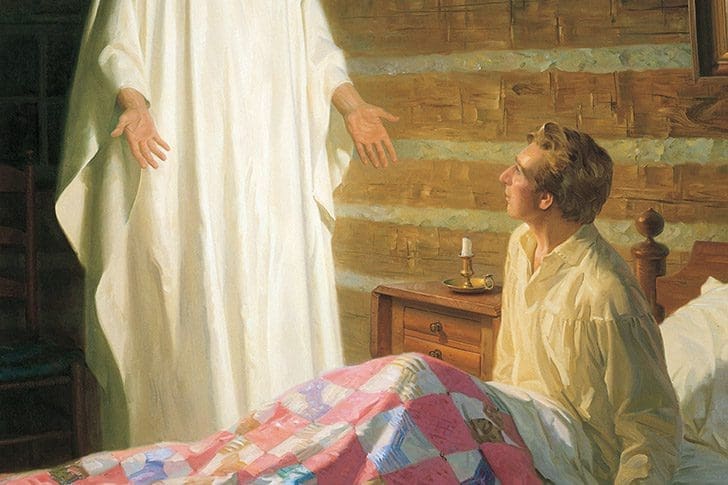
Then a light began to appear in Joseph’s room which continued to increase until the room was lighter than at noonday. We have sometimes seen paintings of Joseph being alone in this room, but remember, this is a pioneer cabin, and his brothers are also there packed into the beds. They did not see what Joseph saw, because this message was not for them.
Joseph’s attempts to describe Moroni are inadequate because we don’t have the mortal words for heavenly things. Joseph said the whiteness of his robe “was beyond anything earthly I had ever seen; nor do I believe that any earthly thing could be made to appear so exceedingly white and brilliant…His whole person was glorious beyond description, and his countenance truly like lightening” (Joseph Smith—History 1: 31,32).
Maurine
Our language here on earth is wholly unable to describe the heavenly. Joseph was, at first, afraid, but as in the First Vision, the first word he heard was a comforting one—his own name. He was known in the heavens and one had come from the presence of God to deliver a message that was particularly for him.
He was told that God had a work for him to do, but he was also warned as he says, that my name should be had for good and evil among all nations, kindreds, and tongues, or that it should be both good and evil spoken of among all people.
This is a prophecy that continues to be fulfilled.
Scot
Let’s get a picture of Joseph in our minds. Parley P. Pratt described him: “There was something connected with the serene and steady penetrating glance of his eye, as if he would penetrate the deepest abyss of the human heart, gaze into eternity, penetrate the heavens, and comprehend all worlds.
“He possessed a noble boldness and independence of character; his manner was easy and familiar; his rebuke terrible as the lion; his benevolence unbounded as the ocean; his intelligence universal, and his language abounding in original eloquence peculiar to himself—not polished—not studied—not smoothed and softened by education and refined by art; but flowing forth in its own native simplicity, and profusely abounding in variety of subject and manner. He interested and edified, while, at the same time, he amused and entertained his audience; and none listened to him that were ever weary with his discourse. I have even known him to retain a congregation of willing and anxious listeners for many hours together, in the midst of cold or sunshine, rain or wind, while they were laughing at one moment and weeping the next. Even his most bitter enemies were generally overcome, if he could once get their ears.” (from The Autobiogrqphy of Parley P. Pratt)
Maurine
Believers and those whose attention he could capture loved Joseph Smith and do so to this day, but detractors have during his life and to this day reviled him, accused him, traduced him, disdained him, belittled him, mocked him and beat him up in the court of public opinion. Many who leave the church will say, “It is that Joseph Smith that I just can’t handle.”
Who was this angel who had entered his room? Of course, Moroni, who had cared meticulously for the plates through 36 years of wandering, until he could bury them in a hill in Manchester New York, not very far from where a young prophet would come to live 1400 years later.
The Lord tells us what Moroni’s specific mission is in Doctrine and Covenants 27:5, “I have sent [Moroni] unto you to reveal the Book of Mormon, containing the fulness of my everlasting gospel, to whom I have committed the keys of the stick of Ephraim.”
Scot
That really is an exciting thing to know that Moroni actually holds the priesthood keys of the stick of Ephraim (which includes what has been published and what will yet be published some day from the sealed portion). Moroni gave a lengthy and profound message to Joseph, and when he was finished, Joseph “saw the light in the room begin to gather immediately around the person of him who had been speaking to me, and it continued to do so until the room was again left dark, except just around him; when, instantly I saw, as it were, a conduit open right up into heaven, and he aascended till he entirely disappeared, and the room was left as it had been before this heavenly light had made its appearance.”
He said, “I lay musing on the singularity of the scene, and marveling greatly at what had been told to me by this extraordinary messenger; when, in the midst of my meditation, I suddenly discovered that my room was again beginning to get lighted, and in an instant, as it were, the same heavenly messenger was again by my bedside” (Joseph Smith—History 1: 43,44).
Maurine
Moroni came three times, repeating without variation what he said, and then adding words of warning. These visits took the entire night, until the cock crowed, indicating morning. We will look at what Moroni taught in two parts, first about obtaining the plates.
Moroni told him that not far away, a record containing the fulness of the everlasting gospel, was buried in a hill on the west side, not far from the top. The plates were deposited in a stone box and “this stone was thick and rounding in the middle on the upper side, and thinner towards the edges, so that the middle part of it was visible above the ground, but the edge all around was covered with earth.” In the box was also the urim and thummim, and the breastplate, so the record could be translated.
Scot
This was clearly not just described to Joseph, but shown in vision, because he recognized the place as soon as he saw it. In addition to what the Joseph Smith’s History tells us about what happened next, here is Lucy Mack Smith’s description of the events of the next day.
“The next day Joseph, his father, and his brother Alvin were reaping in the field together. Suddenly, Joseph stopped and seemed to be in a deep study for some time. Alvin hurried him, saying, “Joseph, you must keep to work or we shall not get our task done.” Joseph worked again diligently, then stopped in the same way a second time. When his father saw that Joseph was very pale, he urged him to go to the house and tell his mother that he was sick. He went a short distance till he came to a beautiful green under an apple tree. Here he lay down on his face, for he was so weak he could go no farther.
“He was here but a short time, when the messenger whom he had seen the night before came to him again and said, ‘Why did you not tell your father what I told you?’ Joseph said he was afraid his father would not believe him. ‘He will believe every word you say to him,’ said the angel.”
Maurine
This is an important point. We’ve said how Joseph had been persecuted since his First Vision, and now he will be adding translating ancient gold plates to the reasons for disdain. What he did have was a loyal, supportive, unwavering family, who would believe him, who would stand by him in every hardship, who would buoy and sustain him, and would take this project as their own.
Lucy continued, “Joseph then promised to do as he was told by the angel and rose up and returned to the field, where he had left my husband and Alvin; but when he got there, his father had just gone to the house, as he was somewhat unwell. Joseph then requested Alvin to go to the house and ask his father to the field, for, said he, I have something to tell him.’ When his father came to him, Joseph rehearsed all that had passed between him and the angel the previous night. Having heard this account, his father charged him not to fail in attending strictly to the instruction which he had received from this heavenly messenger.”
Scot
Moroni had told Joseph “that Satan would try to btempt me (in consequence of the indigent circumstances of my father’s family), to get the plates for the purpose of getting crich. This he forbade me, saying that I must have no other object in view in getting the plates but to glorify God, and must not be influenced by any other dmotive than that of building his kingdom; otherwise I could not get them (Joseph Smith—History 1: 46).
Joseph then left and went to the hill, which was two to three miles distant. Joseph told Oliver Cowdery later that “it seemed as though two invisible powers were influencing, or striving to influence his mind.” One urged him to get the record and treat it as he had been commanded, seeking the glory of God. The other influence urged him to get the record to make himself wealthy and important. The instruction he had received, to ‘pray always—which was expressly impressed upon him, was at length entirely forgotten, and … a fixed determination to obtain [the plates] and aggrandize himself, occupied his mind when he arrived at the place where the record was found.’”
Maurine
Joseph pried open the lid of the box and tried three times to take the plates, but each time received a progressively stronger shock, and finally cried out, “Why can I not obtain this book?”
Moroni appeared to him again, now the fifth time in 24 hours. Oliver said, ““In an instant,” Oliver recorded, “all the former instructions, the great intelligence concerning Israel and the last days, were brought to his mind, … but he had failed to remember the great end for which [the gold plates] had been kept, and in consequence could not have power to take them into his possession and bear them away.” (Latter Day Saints’ Messenger and Advocate, Oct. 1835, pp. 197–98.)
Scot
As Joseph prayed, that confusion of darkness that had shadowed his spirit was dispelled, and he was filled with the Holy Ghost. Two thoughts occur from this. First, just as in the First Vision, Satan tried in every way to attack Joseph and thwart this work, and he would ever be at Joseph’s heels—and still is in our day (attacking the Prophet Joseph)–and second, Satan works upon our minds with confusion, and sudden discouraging thoughts that undermine faith and purpose. When you feel a swirl of heaviness upon you, you can know that the Adversary is probably working upon you.
As Joseph prayed a vision of the starkest contrasts came upon him. At first, the heavens were opened and as Oliver Cowdery’s account says, “Joseph stood gazing and admiring,” until the scene was abruptly changed and Joseph “beheld the prince of darkness, surrounded by his innumerable train of associates.” (Latter Day Saints’ Messenger and Advocate, Oct. 1835, pp. 197–98, also see H. Donl Peterson, “Moroni—Joseph Smith’s Tutor https://www.churchofjesuschrist.org/study/ensign/1992/01/moroni-joseph-smiths-tutor?lang=eng )
Maurine
Moroni explained, “All this is shown, the good and the evil, the holy and impure, the glory of God and the power of darkness, that you may know hereafter the two powers and never be influenced or overcome by that wicked one. Behold, whatever entices and leads to good and to do good, is of God, and whatever does not is of that wicked one: It is he that fills the hearts of men with evil, to walk in darkness and blaspheme God; and you may learn from henceforth, that his ways are to destruction, but the way of holiness is peace and rest.” (Ibid., p. 198.)
Lucy Mack Smith added these details to the story, “While Joseph remained here, the angel told him, “Now I will show you the distance between light and darkness, and the operation of a good spirit and an evil one. An evil spirit will try to crowd your mind with every evil and wicked thing to keep every good thought and feeling out of your mind, but you must keep your mind always staid upon God, that no evil may come into your heart.”
Scot
She continued, “The angel showed him, by contrast, the difference between good and evil, and likewise the consequences of both obedience and disobedience to the commandments of God, in such a striking manner, that the impression was always vivid in his memory until the very end of his days; and in giving a relation of this circumstance, not long prior to his death, he remarked that ever afterwards he was willing to keep the commandments of God.
“Furthermore, the angel told him at the interview mentioned last that the time had not yet come for the plates to be brought forth to the world; that he could not take them from the place wherein they were deposited until he had learned to keep the commandments of God-not only till he was willing, but able to do it. The angel bade Joseph come to this place every year, at the same time of the year, and he would meet him there and give him further instructions.”
Maurine
I find the statement intriguing, he had to be ready not just by being willing to keep the commandments, but able to do so. Ours is a gospel of development, and while we may give our nod to the commandments and even be thrilled by their beauty and promise, living the commandments means transformation and steady growth. This does not happen in a stroke, neither does the Lord gesture your way, and of a sudden you are a new person. He has us on a course of development and sometimes it is very hard. You have to trust in the process.
Scot
So Moroni would be Joseph’s mentor and teacher and friend in the heavy responsibility he was given.
Lucy said, “When Joseph came in that evening after he had first seen the plates, he told the whole family all that he had made known to his father in the field and also of finding the record, as well as what passed between him and the angel while he was at the place where the plates were deposited.
“We sat up very late and listened attentively to all that he had to say to us, but his mind had been so exercised that he became very much fatigued. When Alvin saw this he said, ‘Now, brother, let us go to bed. We will get up early in the morning and go to work so as to finish our day’s labor by an hour before sunset, and if Mother will get our suppers early, we will then have a fine, long evening and all sit down and hear you talk.’”
Maurine
Lucy continued, “The next day we worked with great ambition and were ready by sunset to give our whole attention to the discourse of my son, pertaining to the obtaining of the plates, the goodness of God, his knowledge and power, our own liability to error and transgression, and the great salvation that lay before the faithful. “Now,” said he, ‘Father and Mother, the angel of the Lord says that we must be careful not to proclaim these things or to mention them abroad, for we do not any of us know the weakness of the world, which is so sinful, and that when we get the plates they will want to kill us for the sake of the gold, if they know we have them. And as soon as they do find that we pretend to have any such thing, our names will be cast out as evil, and we shall be scoffed at and all names of evil spoken concerning us.’
Moroni tutored Joseph. We know of at least 22 visits he made to the prophet, but we don’t begin to understand all he was taught.
Scot
Lucy said, “From this time forth Joseph continued to receive instructions from time to time, and every evening we gathered our children together and gave our time up to the discussion of those things which he instructed to us. I think that we presented the most peculiar aspect of any family that ever lived upon the earth, all seated in a circle, father, mother, sons, and daughters, listening in breathless anxiety to the religious teachings of a boy eighteen years of age who had never read the Bible through by course in his life. For Joseph was less inclined to the study of books than any child we had, but much more given to reflection and deep study…
So every year on the same date, Sept. 22, right, incidentally, at the fall equinox, Joseph returned to the hill to receive instructions from Moroni. This means that starting in 1823, and each year following until 1827, when he was finally able to obtain the plates, Joseph received extensive instructions.
Maurine
To get a small sense of it, here is what Lucy said, “In the course of our evening conversations, Joseph gave us some of the most amusing recitals which could be imagined. He would describe the ancient inhabitants of this continent, their dress, their manner of traveling, the animals which they rode, the cities that they built, and the structure of their buildings with every particular, their mode of warfare, and their religious worship as specifically as though he had spent his life with them.”
Scot
In the second part of Moroni’s visit, he quoted a series of scriptures to Joseph, but we learn from Oliver that these were accompanied by visions that were far-reaching and transcendent about what has been and what will be, and what role Joseph Smith was called to play.
When I was young, wanting to understand Moroni’s visit better, I typed out all the scriptures from Joseph Smith—History that were mentioned and added little pieces about what Joseph said Moroni told him—and then I read it aloud and timed it. It came to 17-1/2 minutes. Three times that was only about 52-1/2 minutes. Clearly this would not have taken all the night, and just as clearly, Joseph Smith had not told us all. At the end of verse 41 in the Joseph Smith History account he records: “He quoted many other passages of scripture, and offered many explanations which cannot be mentioned here.” There’s 16 more words that have nearly driven me mad.
But, while Joseph Smith gives us five scriptural passages, we’re grateful that Oliver Cowdery points to another thirty, in a series of three letters given February, April and July of 1835 in The Messenger and Advocate.” We have no particular reason to doubt that Oliver heard this first-hand from Joseph. For a list of these additional scriptures, see the transcript of this podcast at latterdaysaintmag.com/podcast, but they include two passages from Deuteronomy, five from the Psalms, 10 from Isaiah, 9 from Jeremiah, 1 from Joel, 2 from Malachi. [Deut. 32: 23-24; Deut. 32:43; Ps. 100: 1-2; Psalms 107,1-7; Psalms 144: 11-12; Psalms 144:13; Psalms 146: 10; Isa 1:7; Isa. 1: 23-25; Isa. 25-26; Isa. 2:1-4; Isa. 4: 4-5; Isa. 11: 1-16; Isa. 20:11; Isa. 29:13; Isa. 29: 14; Isa. 43:6; Jer. 16:16; Jer. 30: 18-31; Jer. 31:1; Jer. 31:6; Jer. 31:9; Jer. 31:27-28; Jer.31: 32-33; Jer. 50: 4-5; Jer. 2: 28-32; Joel 2:28-32; Mal. 3: 1-4; Mal. 4: 1-6; Acts 3: 22-23; 1 Cor. 27-28)
Maurine
In Joseph’s lifetime, he wrote or dictated four separate accounts of the appearance of Moroni. In the 1842 Wentworth Letter, Joseph Smith wrote that Moroni taught him “that the covenant which God made with ancient Israel was at hand to be fulfilled, that the preparatory work for the second coming of the Messiah was speedily to commence; that the time was at hand for the gospel, in all its fulness to be preached in power, unto all nations that a people might be prepared for the millennial reign.” Moreover, he wrote, “I was informed that I was chosen to be an instrument in the hands of God to bring about some of his purposes in this glorious dispensation.”
Kent P. Jackson wrote, “Although Joseph Smith’s prayer as he went to bed that autumn night was for “a manifestation” to know of his “state and standing” before the Lord (JS—H 1:29), what he received, in addition to that, was a powerful lesson about the mission of God’s people in the dispensation of the fulness of times. Moroni’s message to the young Prophet outlined not only the calling of Joseph Smith, but also the destiny of the Church and kingdom of God from the time of the Restoration until the Millennium.”
Scot
Brother Jackson continued, “Significantly, the Lord’s messenger taught these truths by quoting passages out of the Bible. Since the resurrected Christ also taught by quoting and expounding scripture during his appearance to the children of Lehi in the Americas (see 3 Ne. 22–25), we can view this method of teaching as a significant model to be followed in gospel instruction.
“From the scriptures cited by the Prophet in Joseph Smith—History, we can see that Moroni did not select random passages to outline the future of the Lord’s kingdom. They were chosen specifically to introduce the Prophet to his work. “
Maurine
They were also chosen to demonstrate the continuity of the covenant from the beginning of time.
So here are the major themes:
- The apostasy and scattering. We see it in words like these from Isaiah 1:7 “Your country is desolate, your cities are burned with fire, your land, strangers devour it in your presence…”
- The calling of the prophet Joseph Smithin words like these from Mal. 3:1 “Behold, I will send my messenger and he shall prepare the way before me”.
- The opening of the heavens during the restorationfrom Joel 2: 28, 29. “And it shall come to pass afterward, that I will pour out my spirit upon all flesh; and your sons and your daughters shall prophesy, your old men shall dream dreams, your young men shall see visions:
“And also upon the servants and upon the handmaids in those days will I pour out my spirit.”
Scot
- The coming forth of the Book of Mormon in words like these from Isaiah 29:14: “I will proceed to do a marvelous work among this people, even a marvelous work and a wonder: for the wisdom of their wise men shall perish, and the understanding of their prudent shall be hid.
- The restoration of the priesthood and the sealing keys as in Malachi 4: 5,6: “Behold, I will send you Elijah the prophet before the coming of the great and dreadful day of the Lord. And he shall turn the heart of the fathers to the children, and the heart of the children to their fathers, lest I come and smite the earth with a curse.
- The Gathering of the Elect as in Jeremiah 50:4 “In those days and in that time, saith the Lord, the children of Israel shall come, they and the children of Judah together, going and weeping; they shall go, and seek the Lord their God.
Maurine
- The destruction and purification prior to and during the Second Coming.
- Deliverance for the faithful.
- The Second Coming
- The premillennial and millennial state of the faithful.
This vast teaching of Moroni to Joseph that night was supported by many, many scriptures, but let’s go back to the one in Malachi with which we are so familiar about turning the heart of the fathers to the children and the children to the fathers, that also shows up in Doctrine and Covenants 2. It is an indication of how important it is that it actually shows up in various forms in all of our books of scripture. It is clearly in Malachi; in Doctrine and Covenants 2; in the Joseph Smith History in the Pearl of Great Price; in Luke 1:17, in 3 Nephi 25:6—and many, many more places.
Scot
If we are a people called to prepare the world for the second coming of Christ, this is the way. It is gathering Israel on both sides of the veil. President Russell M. Nelson said, “The Lord is gathering those who are willing to let God prevail in their lives. The Lord is gathering those who will choose to let God be the most important influence in their lives… When we speak of gathering Israel on both sides of the veil, we are referring, of course, to missionary, temple, and family history work. We are also referring to building faith and testimony in the hearts of those with whom we live, work, and serve. Anytime we do anything that helps anyone—on either side of the veil—to make and keep their covenants with God, we are helping to gather Israel.” (Russell M. Nelson, “Let God Prevail” https://www.churchofjesuschrist.org/study/general-conference/2020/10/46nelson?lang=eng )
And a great part of that gathering is in this week’s scripture of turning the hearts of the children to their fathers and the hearts of the fathers to their children.
Maurine
And in this section 2 of the Doctrine and Covenants, received September 22, 1823 it is noteworthy to see that God said that Elijah the prophet would come and on April 3, 1836, he did come to the Kirtland Temple to restore those sealing powers. A prophecy given. A prophecy fulfilled.
That’s all for today. We’re Scot and Maurine Proctor and this has been Meridian Magazine’s Come Follow Me podcast. Next week we will study Doctrine and Covenants Sections 3-5, “My Work Shall Go Forth” Thanks to Paul Cardall for our music and to Michaela Proctor Hutchins who produces this show. See you next week.
FEATURES