






As mentioned by President Boyd K. Packer in the most recent General Conference, this year marks the four hundredth anniversary of the publication of the King James Bible. In honor of this remarkable milestone (seriously, how many books could hold up as well as the KJV does after four whole centuries?!), I’d like to share a couple of books that may increase your appreciation of this illustrious and influential volume of scripture.
“The bridging of contradictory qualities”
God’s Secretaries: The Making of the King James Bible
By Adam Nicolson
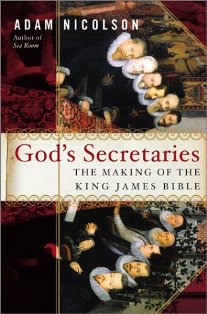
Mr. Nicolson opens God’s Secretaries with a contemporary Jacobethan perspective of the transition between Queen Elizabeth I and King James VI, quite different than the generally accepted one today. James was, in many ways, the exact opposite of Elizabeth, who had ruled for forty-four years with a motto of “Semper Eadem” – “Always the Same.” During Elizabeth’s reign, many problems were not resolved. They were ignored, suppressed, or buried in the interests of not upsetting the fragile status quo, allowing them instead to fester. The war with Spain was reaching the end of its second decade. Religious differences between staunch Catholics, those adhering to the Church of England, and the more extreme Puritan Protestants were at a boiling point. Where Elizabeth was famously known as the “Virgin Queen” and had repeatedly avoided naming the next-in-line for the throne, James already had a large family of five living children, including an heir. Later historians would write of a “dimming of the brilliance” of “Renaissance freshness” that accompanied Elizabeth’s death, but at the time James Stuart was seen as a breath of fresh air after the stagnation of Elizabeth’s reign.
Growing up in a brutal, hostile court in Scotland, crowned king at the ripe old age of thirteen months, James was drawn to peace and adopted “Beati Pacifici” as his motto – “Blessed are the Peacemakers.” He imagined a world where Scotland and England joined as one, the English Church would be unified, peace would reign throughout Europe and prosperity would follow. A new translation of the Bible would be an important part of this unifying effort, taking the best from the several translations in use at the time, solidifying the crown’s authority over the church and creating a single “authorized” version for all to use. James’s utopian vision quickly met its demise against the hard political and religious realities of the day until “almost the only remnant of that dream, a piece of flotsam after the tide has passed, is the King James Bible.”
Relatively little is known about most of the fifty or so men who were tapped by their king to contribute to the creation of the King James Bible. Called Translators (with a capital “T”), they were formed into six sub-committees, each responsible for a certain section of the manuscript. They met in small groups at infrequent intervals over a span of about six years to fulfill the royal mandate. Mr. Nicholson points out that while the idea of a committee producing anything approaching a work of art is antithetical to the “modern frame of mind” that so highly values individuality, it was a given during Jacobean times that on a project of such importance many people would be involved. “Jointness was the acknowledged virtue of the age…Lack of jointness…was considered an overriding error and a sin.”
God’s Secretaries is filled with fascinating nuggets of information about the Bible we read from almost every Sunday. First of all, King James wasn’t looking for a new Bible for personal individual or family study. The purpose of this new translation was to take the place of the Bishops’ Bible, which was read aloud from the pulpit on Sundays. Consequently, the focus of the Translators was more on the way the words sounded when spoken than how they flowed when read silently. Over and over when faced with decisions between slightly different phrasings from previous translations, the Translators chose the phrase that was most pleasing to the ear. Also, the elegantly archaic form of English with which the King James Version was composed (and with which we sometimes struggle mightily four hundred years later) was actually considered antiquated and odd even at the time it was published. Back in 1611, “some critics thought its dependence on a kind of English which seemed sixty or seventy years out of date…made it ridiculous and bogus.”
Mr. Nicholson also touches on early American history, describing the actions and beliefs of the small group of Puritan Separatists who, finding the religious climate in England too unwelcoming and intolerant, would later sail to the New World on the Mayflower. Interestingly, these Puritans initially objected strenuously to the King James Bible as too steeped in monarchy and the ceremonial formality of the Church of England. By the end of the seventeenth century, however, they too had come to adopt the KJV in place of the Geneva Bible they had previously favored.
God’s Secretaries not only elucidates the initial reasons behind the undertaking of this enormous task, it immerses the reader in the climate of Jacobethan times. This backdrop helps us better understand the cultural, social, and political influences upon those practically-anonymous men whose efforts have affected untold millions over the past four hundred years.
“People who try to live like Jesus will inevitably to some extent speak like him”
Begat: The King James Bible & the English Language
By David Crystal
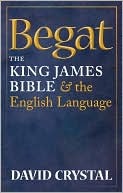
Two hundred fifty-seven. That’s how many idioms Mr. Crystal has identified as coming into common use in the English language expressly because of the King James Version of the Bible. The “skin of one’s teeth,” “fire and brimstone,” “there’s nothing new under the sun,” even “be very afraid” all have their roots in the KJV, arguably the most influential book ever published.
In coming up with the number two hundred fifty-seven, Mr. Crystal makes a distinction between idioms, which have general everyday usage and can apply to various situations, and quotations, which he defines as “expressions which are used only in settings where the religious application is relevant, maintaining their original biblical sense.” So, let’s look at Psalms, for example. “The Lord is my shepherd” (Psalms 23:1) is an extremely well-known phrase found in the King James Version of the Holy Bible, but it is rarely, if ever, used out of the original context and therefore counts as a quotation, not included in the two hundred fifty-seven idioms mentioned above. However, “out of the mouth of babes” (Psalms 8:2) is spoken frequently when a child says something humorous, insightful or prescient.
Idioms in the Old Testament are dealt with in the order in which they appear, starting with Genesis (“let there be light”) and going through Malachi (“root nor branch”). After a brief interlude discussing some of the differences between the Old and New Testaments, Mr. Crystal picks up with a thematic approach to the New Testament, grouping similar topics of idioms together. With the aid of Google (and, I’m sure, other research methods), Mr. Crystal collects several examples of uses to which these idioms have been put, some incredibly clever and some groan-worthy. In the chapter “A Coat of Many Colours” he mentions the Broadway musical “Joseph and the Amazing Technicolor Dream Coat;” the country song by Dolly Parton; a blog for bi-color, tri-color and solid-coated cats; and headlines on articles in biochemistry, publishing, fashion, politics and sociology, just to name a few.
Among the fascinating tidbits throughout the book are the additional translations that Mr. Crystal notes. He refers frequently to at least five other versions of the Bible: Wycliffe’s, Tyndale’s, the Geneva Bible, the Bishops’ Bible, and the Douai-Rheims translation. He even includes an appendix comparing the translations of the 257 idioms across the six versions. It’s sometimes difficult, Mr. Crystal points out, to pin the credit for making a particular phrase a common idiom on the KJV. Some of the phrases (like “my brother’s keeper”) were in multiple translations, some (such as “sour grapes”) were already in common usage before the KJV was published and some (“no rest for the wicked,” for example) take a different form that what is actually found in any translation of the Bible.
Begat may be a bit heavy on linguistics and historical and grammatical minutiae for those not intrigued by the topic, but even so, it’s a great reference to read a chapter or two at a time for curiosity’s sake.
(On a related note, there’s a delightful video at https://kingsenglish.info/ which takes you through 100 idiomatic phrases from the King James Bible – all mentioned in Begat – in three minutes!)
**************************
On My Bedside Table…
Just finished: Ozma of Oz by L. Frank Baum (Reading the series out loud with the kidlets.)
Now reading: Majestie: The King Behind the King James Bible by David Teems (I didn’t finish it in time to include in this column, but I’m really enjoying it!)
On deck: Buzz: A Year of Paying Attention by Katherine Ellison
**************************
Come find me on goodreads.com or email suggestions, comments, and feedback to egeddesbooks (at) gmail (dot) com.