





Erhu in a Chinese Stairwell The music issuing forth from the stairwell of the underground parking garage was haunting. We passed by the stairwell several times a week as we went to and from our teaching assignments at the Xi’an International Studies University in China. Why people chose to play their instruments in the stairwell was, and still is, a mystery to me. Perhaps it was because of the crowded conditions of apartment living on the campus where practicing might annoy one’s neighbors. Plus, the stairwell was covered and provided a sheltered place to bow, blow, or pluck the ancient instruments for which China is famous. While a stairwell is not usually known for it acoustic properties, I was always surprised at the sweetness of the sounds floating up out of it serpentine throat. On one day you could hear the notes of a bamboo flute. On another day it would be a horn or human voice singing in the high-pitched, almost nasally tone of an ancient form of Chinese opera. I don’t know if it was by design or happenstance, but I never heard any modern instruments played there: no guitars (acoustic or electric), no violins, no drums. The stairwell was the preserve of all those mysterious and poignant sounds one usually associates with Asia. It was a delight to anticipate what one might hear emanating from the stairwell on any given day.
Any day was a good day when I heard the sound of an erhu in the stairwell. This “queen” of all Chinese instruments evokes feelings quite unlike any other. Almost by itself it speaks of exotic, far away places. It is the sound you hear in the background music to any Asian-themed movie. It is haunting, mysterious, and sometimes sad and forlorn all at the same time. It speaks of China’s past, present and future.
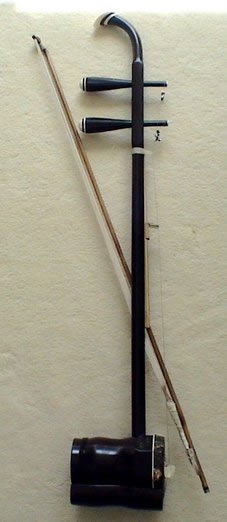
All of these feelings are produced by an amazingly simple instrument. In attempting a description, one is compelled to say that it is “violin like,” except there are only two strings instead of four. Like a violin, there is a resonating box, but it is cylindrical and about the size of a quart jar. The box is held on the lap, and extending up from it is a two-foot-long pole to which are affixed two winding screws of brass that hold and tighten the strings that are secured to the other end of the resonating box. The secret of the erhu’s unique sound is that one end of the resonating box is covered by a stretched, dried, python skin. In the same way the strings of a violin rest on a bridge centered just right between the f-holes, an erhu’s strings and bridge are centered on the taut snakeskin.
Where the erhu and violin part company is that all the notes of the erhu are produced by just these two strings. Moreover, the horse hair strands of the bamboo bow go between the two strings so that the sound is produced by drawing against the left side of one string and the right side of the other with either the front or back of the bow hairs. The varying notes are made by the fingers depressing the strings at various points like a violin, except there is no fingerboard or frets.
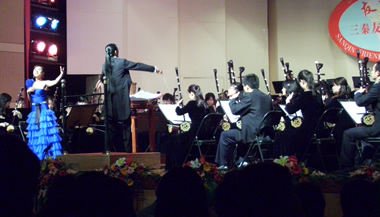
Despite its simple construction, the erhu can produce an amazing range of notes. Whereas a violin has a range of four octaves, the erhu covers almost three. I have attended concerts where an orchestra using all ancient Chinese instruments, including the erhu, played the haunting music of the courts of the old Tang Dynasty.
But I have also been to concerts of a modern Chinese orchestra playing Western classical music like Bizet and Bach-except for the fact that the entire string section consisted of erhus and their more deep-throated cousins the zhanghu and dahu-roughly comparable to the viola and cello. There were no other strings. And I could not tell the difference. It sounded just like I was back home in the Kennedy Center listening to the National Symphony Orchestra. In this context, the erhu is like The Little Engine that Could-it thinks it can hold its own with a violin and it does.
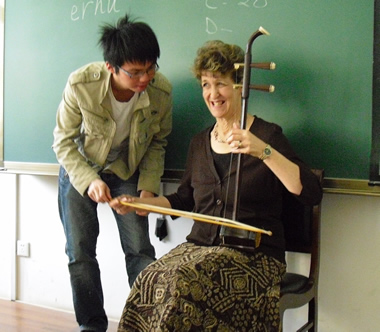
Regardless of its classical leanings, the erhu is an instrument of the people. This is a paradox of sorts because it appears to be difficult to play. A colleague of mine, Linda Terry, once used it as an object lesson in her English class where the objective for her Chinese students was to use English in giving instructions. The look on her face as she attempts to coax a musical note out of the erhu tells the whole story.
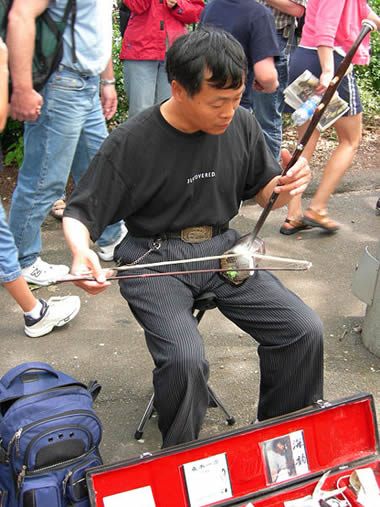
And yet you see the erhu everywhere. While the guitar plays the role of “everyman’s” instrument in the West, in China it is the erhu where it is the instrument of choice for street musicians. On any given day-coming out of a subway, alighting from a bus, on the street corner, or in front of shops-you will hear the evocative notes of the erhu vying for attention above the noise and bustle of city life.
Some play just for the pleasure of it, but others spread a blanket in front of them to catch whatever offerings may come their way. For the visually impaired, it is a source of income, and to increase its effect it may be hooked up to a homemade amplifier and accompanied by bells or cymbals.
In my observation, it is the most commonly played instrument in China. From the concert hall to the street, it is at once both a classical and a folk instrument. It can be found in various forms all over China. The resonating box can be made from wood, bamboo, cow horn, or even horse bone, most with the ubiquitous covering of python skin. No Comments | Post or read comments FEATURES |

May 18, 2026
May 18, 2026