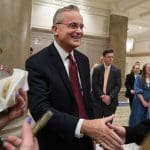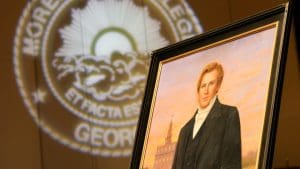



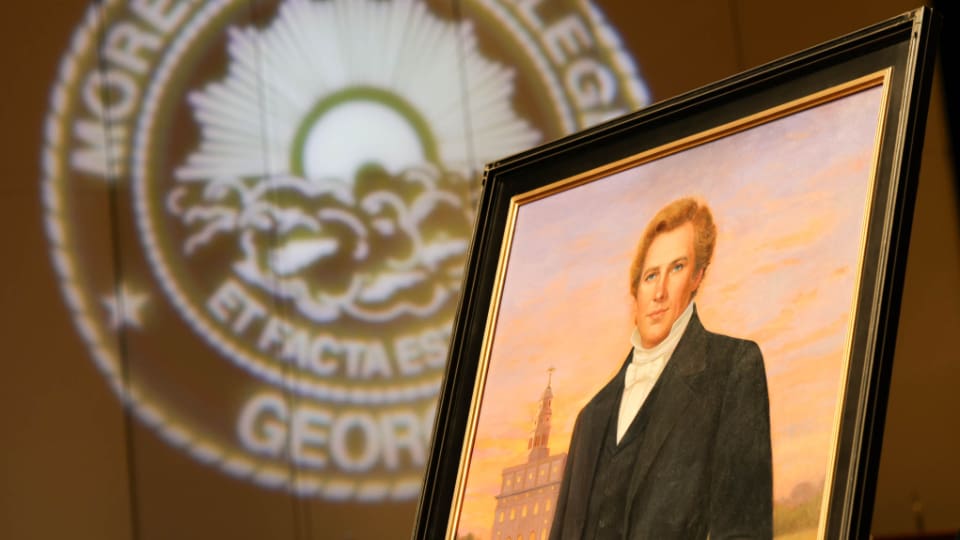


On Sunday, February 1, 2026, a new portrait of the Prophet Joseph Smith was formally unveiled in the International Hall of Honor at Morehouse College’s Martin Luther King Jr. International Chapel in Atlanta, Georgia.
The Hall of Honor houses more than 300 oil portraits representing influential figures from the global civil and human rights movement. Joseph Smith’s likeness now joins that collection, placed between portraits of Abraham Lincoln and President Russell M. Nelson of The Church of Jesus Christ of Latter-day Saints, whose portrait was installed at the historically Black college in 2023.
Joseph Smith’s inclusion reflects his advocacy for universal human rights, particularly during his 1844 campaign for the presidency of the United States. During the unveiling ceremony, the Rev. Dr. Lawrence Edward Carter Sr., dean of the Martin Luther King Jr. International Chapel, highlighted Smith’s call for the abolition of slavery, describing it as “among the most morally ambitious proposals of the antebellum era.”
Drawing from Smith’s presidential platform and passages from the Book of Mormon, the Rev. Dr. Carter emphasized the extraordinary risks the Prophet took by pursuing those ideas publicly. He characterized Smith’s decision to run for office as an act of profound moral bravery, noting that it effectively placed his life in jeopardy.
“He understood the consequences,” the Rev. Dr. Carter said. “But he moved forward anyway. If he had succeeded, consider how many lives might have been spared that were ultimately lost in the Civil War.”
In Smith’s campaign writings, the Prophet pledged that if citizens petitioned to end slavery in slaveholding states, he would employ “all honorable means” to grant their requests and extend freedom to those in bondage.
“We weren’t prepared,” the Rev. Dr. Carter said, referencing Abraham Lincoln’s later words about America’s “better angels.” “Joseph Smith Jr. was articulating those ideals before Lincoln ever reached the presidency.”
In an interview conducted days before the ceremony, Church Historian Spencer McBride explained that while Smith’s bid for the presidency had little chance of success, his platform remains a compelling vision for addressing the nation’s moral and political crises.
Though the plan was never implemented, the Rev. Dr. Carter said it stands as a prophetic statement of what the country could have become — affirming the idea that liberty is not merely a political construct, but a sacred duty owed to all people created in God’s image.
Referencing the Book of Mormon’s invitation for “all to come unto him — black and white, bond and free,” the Rev. Dr. Carter said Smith’s revelations pointed toward a faith without racial boundaries. He also cited Smith’s plea to “break off the shackles from the poor black man and hire him to labor like other human beings.”
The unveiling carried special meaning for Black members of the Church who were present for the event.
Among them was William Kennedy of the Genesis Group, a Church-sponsored, multi-stake organization in Utah that has served Black Latter-day Saints and their families for nearly 55 years. The group focuses on strengthening faith in Jesus Christ, fostering unity, and supporting Church membership.
Kennedy said Joseph Smith’s portrait belongs at Morehouse because of the Prophet’s inclusive vision of the gospel.
“Joseph Smith taught that the gospel is for every kindred, tongue, and people,” Kennedy said. “It took longer than it should have, but what matters is that we continue moving forward. That’s something worth celebrating as Black Latter-day Saints.”
The presence of portraits depicting both Joseph Smith and President Nelson has become a meaningful educational touchstone for Black Latter-day Saints in the Atlanta area.
For Cassie VanDyke, an Atlanta resident, the portraits offer reassurance for her teenage son as he navigates his identity as both a Black man and a member of the Church.
“There’s a tension there,” she said. “It can be hard for him to reconcile those two parts of who he is.”
VanDyke recalled attending a concert at Morehouse with her family, her son’s first visit to the campus. Seeing President Nelson’s portrait made a lasting impression.
“He was genuinely excited,” she said. “For him to see someone who reflects his faith in a place like this — to know he can be a student at Morehouse and a committed Latter-day Saint — that means everything. As a mother, I’m incredibly grateful.”
The Rev. Dr. Carter said he feels a personal responsibility to bring Joseph Smith’s legacy into broader public view.
“I believe he’s been kept in the shadows,” Carter said. “And I feel called to help lift that veil.”
Kennedy added that the significance of the event extends beyond historical recognition.
“This is about what comes next,” he said. “As Church members, we need to actively reach out to those who don’t look like us or worship like us — to find shared ground and become genuine peacemakers.”
The Rev. Dr. Carter echoed that sentiment, urging a more expansive understanding of humanity.
“We have to recognize the full humanity of every person,” he said. “Across nationality, race, culture, economics — all the labels we use to divide ourselves — we must think holistically, inclusively, and compassionately.”