


The Desert Is Not Empty: Living Water in Our Wilderness Wandering
We carry water in plastic bottles now, almost as carelessly as we carry our keys. It arrives through pipes. It gleams behind refrigerator glass. We have made water so convenient that we have forgotten it is not a utility but a miracle, one we have simply learned to bill monthly. It is the difference between a garden and a grave.
Israel, newly escaped from Egypt and stumbling into the terrible school of Sinai, understood this. In the ancient Near East, water meant life, fertility, and the nearness of divine favor. Flowing water, mayim chayyim, “living water,” was not merely useful. It was an image of heaven breaking into barrenness, of God stooping to touch dust and make it bloom.
That is why the water narratives in Exodus matter so deeply. They are not mere travel notes. They are theology in story form: the education of a covenant people learning, slowly and with much complaint, that the God who parted the sea can also lead a thirsty people to water.
Scripture does not flatter us with easy maps. It gives us signs instead.
Mortality is a wilderness, and yet we still behave as though thirst were an insult. We know what it is to leave one bondage only to find ourselves in a dry land we do not understand, to be delivered and yet still disoriented, redeemed and yet still thirsty. Scripture does not flatter us with easy maps. It gives us signs instead: a bitter spring, a tree, an oasis, a rock, a fountain. In the hands of the Lord, the wilderness of Israel becomes a map of the soul. As Alma taught, “this life became a state of probation” (Alma 12:24), and probation, by its nature, is dry country. One learns there what one is really thirsting for.
The Bitter Cup
The first great thirst after the Red Sea comes at Marah. The scene in Exodus 15 is psychologically exact. Three days into the wilderness, Israel finds water and discovers that it is bitter. Hope rises, then collapses. The very thing that promised relief becomes a torment.
How often does life do exactly that, lifting the cup to our lips and filling it with bitterness?
Ancient Jewish interpreters lingered over that bitterness. Some assumed the water was literally brackish. But others read more deeply. Certain rabbinic traditions suggest that the water was not the only bitter thing present. The people themselves were bitter. Having come out of generations of bondage, they still saw the world through Egypt’s eyes: every new thing a threat, every mercy a possible fraud. Their bitterness was not merely a wound they carried; it was a posture they preferred.
So, the bitter water at Marah becomes more than a physical crisis. Israel tastes outwardly what it has chosen to be inwardly.
And then comes one of the most haunting images in the whole Exodus account: “the Lord shewed him a tree” (Exodus 15:25). Moses casts the wood into the waters, and the bitter becomes sweet.
The Jewish tradition often linked this tree to the Tree of Life. Proverbs calls wisdom “a tree of life” (Proverbs 3:18), and some ancient readers saw in the wood at Marah a figure of Torah, the divine word that sweetens what sin and suffering have made undrinkable. Early Christians saw in it a type of the Cross. Both instincts are profound, because both recognize the same principle: God’s answer to bitterness is not a theory but a tree.
But the tree must be received. Moses cast the wood into the water, yes, but Israel had to drink. The sweetening was not a spectacle performed at a distance. It was an invitation that required the mouth, the throat, the willingness to take in what God had offered.
Bitterness refuses the gift; sweetness receives it. Bitterness shuts the hand; sweetness opens it again.
For Latter-day Saints, the symbolism reaches further still. Lehi, too, was led through a wilderness. Nephi, too, speaks of a dark and dreary waste. And at the center of that vision stands the Tree of Life, whose fruit is “most sweet, above all that I ever before tasted” (1 Nephi 8:11).
Then Nephi gives us one of the most luminous keys in all of scripture: he speaks of “the tree of life” and “the fountain of living waters” almost interchangeably (see 1 Nephi 11:25). The sweetness of the tree and the life of the water are both gathered up in the love of God manifest in Christ. The angel’s own question, “Knowest thou the condescension of God?” (1 Nephi 11:16), suggests that the tree is itself a kind of stooping, a bending down of heaven toward the parched earth.
Consider, too, what Alma says of the word of God: “it beginneth to enlarge my soul; yea, it beginneth to enlighten my understanding, yea, it beginneth to be delicious to me” (Alma 32:28). The language is Marah redeemed. What was bitter becomes delicious. What was poison becomes nourishment. The experiment upon the word that Alma describes is, in miniature, the casting of the tree into the waters. It requires desire, a place given in the heart, a willingness to act and to taste. The word does not enlarge the soul that refuses it. It enlarges the soul that receives.
Marah, then, reaches past the brackish springs of Sinai. It is about the Lord’s power to heal the bitterness we have chosen to live in, through the Tree that reveals the love of God. He rarely lifts us out of the wilderness. More often, He transforms the one wandering through it.
There are griefs He does not erase, losses He does not explain in the moment of their weight. But He invites us to meet those griefs differently, to enter them with Him rather than against Him. He can make bitter water drinkable; not by pretending it was never bitter, but by changing what we bring to the cup. By grace, and by our willingness to hold the wound before Him, He can make even that wound a well.
Immediately after Marah comes Elim, and the whole scene feels like an exhale after agony: “twelve wells of water, and threescore and ten palm trees” (Exodus 15:27).
The Ordered Oasis
Scripture rarely wastes numbers. Twelve and seventy are covenant numbers. The twelve evoke the tribes of Israel. The seventy call to mind the elders of Israel and the fullness of witness-bearing ministry.
“Mine house is a house of order, saith the Lord God, and not a house of confusion” (D&C 132:8)
Some Jewish traditions imagined each tribe receiving its appointed spring, as though Elim were not merely abundance but ordered abundance, hospitality with form. This is characteristic of God. He does not simply open a tap and walk away; even His abundance has a shape. One thinks of the Lord’s own declaration: “mine house is a house of order, saith the Lord God, and not a house of confusion” (D&C 132:8). Even His oases have architecture.
And then there are the palm trees. In the desert, palms are not decorative. They are testimony. They mean that somewhere, hidden beneath sand and stone, water is present. They are witnesses with leaves on them. They do their preaching simply by refusing to die.
For Latter-day Saints, the typological beauty is hard to miss. The Doctrine and Covenants says that the Seventy “are also called to preach the gospel, and to be especial witnesses unto the Gentiles and in all the world” (D&C 107:25). In a dry land, the palms are witnesses that water is near, signs that the desert is not godforsaken, that one ought to keep walking.
Yet Exodus is careful: it is not seventy wells and twelve palms. It is twelve wells and seventy palms.
The Seventy bear witness widely, beautifully, indispensably. They stand on the horizon-line of the Church as signs of life in the desert. But the twelve wells correspond to the ministry of the Twelve Apostles, whom the Lord calls “special witnesses of the name of Christ in all the world” (D&C 107:23). The Apostles are not the source of living water. Christ alone is that source. But in the ordered economy of the covenant, the Twelve are stewards of the springs. Through priesthood keys, doctrine, and ordinances, they do not stand between the Saint and Christ. They clear the way. They point to the water and say, Drink.
This does not diminish the Seventy. A palm tree in the desert is not a trivial thing. It is hope made visible. Witness with bark on it. But palms point beyond themselves. They signal that one should press on to the wells.
Water from the Wrong Place
Marah teaches that the Lord can sweeten the bitter heart that will let Him. Elim teaches that the Healer provides ordered refreshment through covenant witness and stewardship. Then comes Rephidim, where the lesson deepens again.
Here there is no water at all. No bitter spring. No oasis. Nothing.
The people quarrel. They ask, in effect, the great question hidden beneath all human panic: “Is the Lord among us, or not?” (Exodus 17:7).
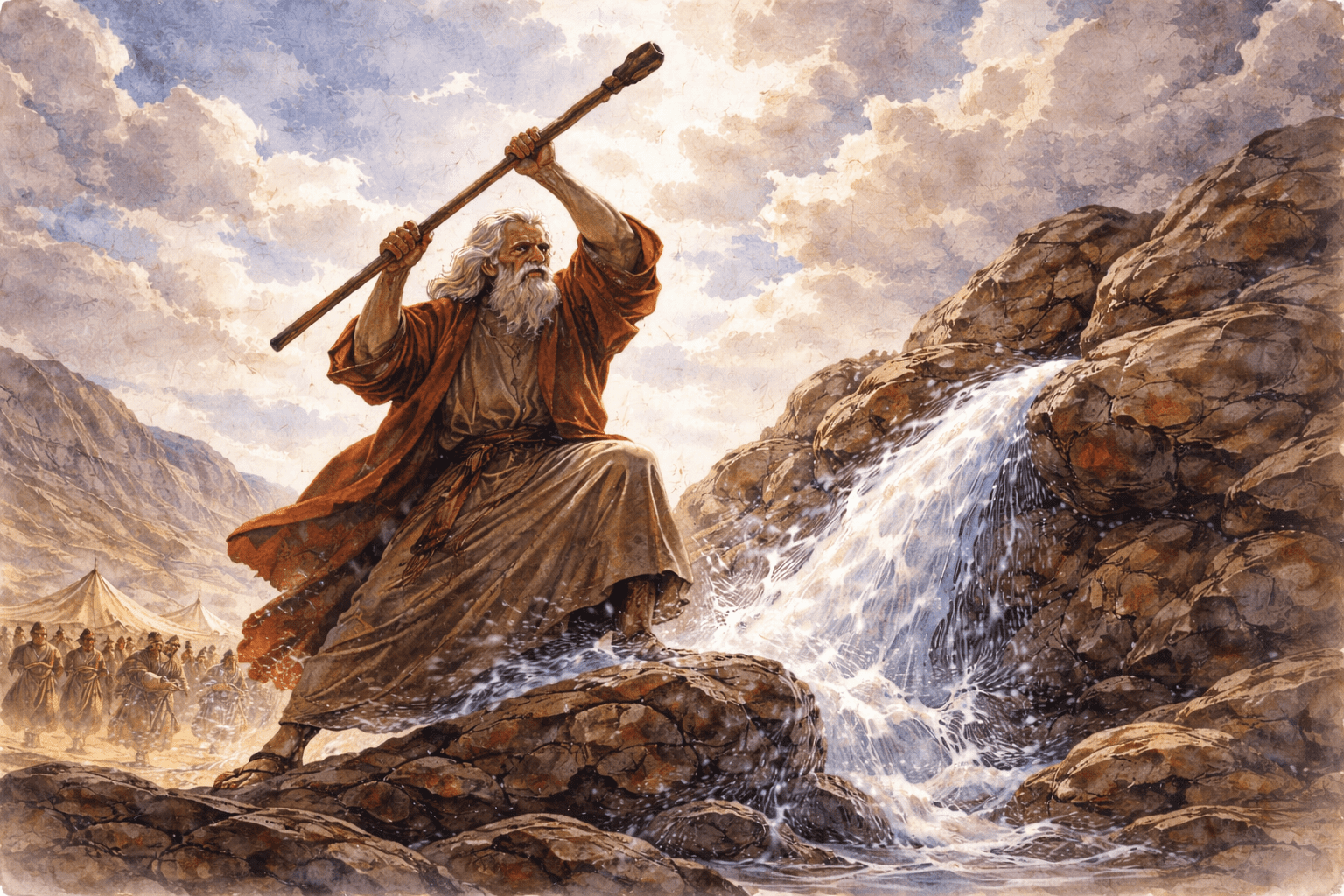
The Lord’s answer is astonishing. Moses is commanded to strike the rock, and water pours forth. He does not guide Israel around barrenness. He brings abundance out of the place least likely to yield it.
Paul gives the typological fulfillment with characteristic boldness: “that Rock was Christ” (1 Corinthians 10:4). He even speaks of the Rock as somehow following Israel through the wilderness. Paul is doing something bolder than explanation. He is telling us that Christ was Israel’s life all along. The water from the rock was geological wonder and gospel at once.
The Book of Mormon confirms this with a directness that Paul, writing to Corinthians steeped in Greek philosophy, could scarcely use. Jacob declares plainly: “we knew of Christ, and we had a hope of his glory many hundred years before his coming; and not only we ourselves had a hope of his glory, but also all the holy prophets which were before us” (Jacob 4:4).
The Lord broke open stone to give drink to the ungrateful, and He would do it again at Calvary.
Moses at Rephidim was not performing a water trick. He was enacting a prophecy. He was striking the figure of the One who would be struck for us all, and from whose wounds living water would flow. As the Psalmist sang, “He clave the rocks in the wilderness, and gave them drink as out of the great depths” (Psalm 78:15). The verb is violent. Clave. The Lord broke open stone to give drink to the ungrateful, and He would do it again at Calvary. The Rock was not destroyed by the striking. It was revealed by it.
The Rock Was Christ
Here the whole drama of living water gathers into one Person. At Marah, He is the Tree that sweetens bitterness. At Elim, He is the hidden source beneath every true palm and every appointed well. At Rephidim, He is the Rock struck for thirsty people.
No wonder He can later stand in Jerusalem and cry, “If any man thirst, let him come unto me, and drink” (John 7:37). No wonder He tells the woman at Jacob’s well that the water He gives becomes “a well of water springing up into everlasting life” (John 4:14). Scripture has been preparing us for this all along. The Lord of Exodus is the Christ of the Gospels, and the Christ of the Gospels is the God of the Restoration, who declared to Joseph Smith: “I am the light and the life of the world” (D&C 11:28).
Still in the Wilderness
And we are still in the wilderness.
That fact must not be sentimentalized. Mortality is not a quaint camping trip with inspirational scenery. The desert does not become less terrible because someone has printed it on a bookmark.
There are Marah seasons when everything one reaches for tastes bitter, and when we must ask ourselves whether the bitterness is in the cup or in the hand that holds it. There are Rephidim seasons when there seems to be no water at all, when the heavens feel like brass and prayer seems to go up only far enough to strike the roof-beams.
If faith means anything serious, it must mean something there: in the dry places, in the silence, in the seasons when the rock looks like only a rock. Not as a way of managing discomfort, but as a way of being in the world that refuses to let the desert have the final word.
But the witness of scripture is that the wilderness is not empty. It is crowded with signs for those who have learned how to see. There is the tree. There are the palms. There are the wells. There is the rock. And there is Christ, still present in the desert, still making sweetness in bitter places, still causing streams to break out from flint.
“For I will go before your face,” He told the early Saints. “I will be on your right hand and on your left, and my Spirit shall be in your hearts, and mine angels round about you, to bear you up” (D&C 84:88). That is not a metaphor. It is a wilderness promise, spoken by the same God who struck the rock at Rephidim.
The Tree Is the Fountain
The Book of Mormon gives latter-day readers an especially precious grace here. Nephi’s vision refuses to let us separate what we are always trying to pull apart: love, life, nourishment, Christ. The tree is the fountain. The fountain is the love of God. The love of God is manifest in the Son. The whole vision presses the images together until we can no longer separate love from life, or Christ from the nourishment of the soul.
A man dying of thirst does not need a lecture on hydrology. He needs water.
A man dying of thirst does not need a lecture on hydrology. He needs water.
“Come unto me all ye ends of the earth,” the risen Christ commands in the Book of Mormon, “buy milk and honey, without money and without price” (2 Nephi 26:25). The invitation is not to a lecture hall. It is to a spring.
Come and Drink
To partake of living water in our own wilderness wandering is to come to Christ where He has appointed Himself to be found: in scripture, in covenant, in sacrament, in the ministry of prophetic witnesses, in the quiet mercies by which He keeps turning deserts into places of encounter. It is to refuse the lie that the world is only machinery and the soul only chemistry. It is to remember that we live in a world where rocks can become fountains, trees can heal water, and palm trees can preach.
But it is also to remember that living water must be drunk. It must be taken in. The spring does no good to the man who stands beside it and will not kneel.
Scripture teaches us to look with that kind of sanctified sight.
The ancients knew that if you saw palms on the horizon, you had reason to hope. Scripture teaches us to look with that kind of sanctified sight. The world sees only sand; faith sees witness. The world sees only rock; faith expects a spring. The world sees only bitterness; faith remembers the tree.
The wilderness of mortality is real, but it is not godless. The Lord has planted His signs here. He has appointed His witnesses. He has caused living water to flow here still. And if we will follow the witnesses, receive the sweetness of the tree, and drink from the Rock who is Christ, we may discover what Israel discovered at Elim: that the desert was never empty after all. It was always a place where heaven had hidden its wells.
Sneaking Past the Watchful Dragons: Re-enchantment and the Sanctified Imagination

I. The Film of Familiarity
We are drowning in data, yet we starve for wonder. In our Sunday School classes, our family councils, and our private devotions, we suffer from a peculiar spiritual vision loss. It is not that we are blind; it is that we see so much that we no longer see anything in particular. We have looked at the universe until it has become, not enormous, but merely obvious. It is what Samuel Taylor Coleridge and William Wordsworth called the “film of familiarity.”1 It is a thin, invisible dust that settles on our eyes, making the miraculous look mundane simply because we have seen it a thousand times.
We possess the doctrines. We have memorized the answers. We can sketch the Plan of Salvation on a chalkboard from memory—premortal life on the left, the veil here, the three degrees of glory stacked neatly on the right.
But somewhere in the repetition, the film thickens. We begin to mistake the map for the country. We are like a starving man who has memorized a menu and believes he has eaten a dinner. We treat the heuristic sketch as if it were the weight of glory itself. What once felt like discovery now feels like review; the thunderous themes of eternity drift past us like notices on a foyer bulletin board—acknowledged, agreed with, but scarcely attended to.
T. S. Eliot’s haunting interrogation has become our biography: “Where is the Life we have lost in living? Where is the wisdom we have lost in knowledge? Where is the knowledge we have lost in information?”2
The very truths that should unmake and remake us lie stacked in the mind—filed, familiar, and functionally inert. Why does this happen? How do truths that once struck like lightning now read like a tax code? The trouble with many of us is not that we doubt the commandments, but that we file them. Thunder is terrifying in the sky; it is quite tolerable when reduced to a numbered subsection in a manual.
C. S. Lewis, the patron saint of the re-enchanted mind, diagnosed the malady with a single image: the “watchful dragons.”
Lewis observed that when we approach religion head-on—when we march up to the front gate of the soul with a clipboard of “thou shalts”—something within us locks the door. We feel guilt, or pressure, or simply the glaze of the over-familiar. Our reason posts itself like a sentry at the gate.
And reason, in our fallen state, is not always the noble faculty we imagine. It can be the soul’s most cunning defense attorney. When we choose badly or harbor secret sin, our reason does not rush to condemn us; it rushes to exonerate us. It constructs arguments. It drafts alibis. It suppresses the truth to protect the ego. It becomes a dragon—guarding the hoard of our own self-will, keeping the sharp, saving sword of the Gospel at bay.
If we desire re-enchantment—if we wish to pierce the film of familiarity and move from dry assent to a living awe—we cannot simply storm the front gate with better syllogisms. We must learn to sneak past the dragons. We must find the back door of the imagination, where the defenses are down and the heart is still listening.
This is not a project of manipulation, but of revelation. It is the logic of parable, type, and shadow. It is the art of the “True Myth.”3
II. The Watchman’s Warning: “Straight and Undiluted”
Here, however, a serious objection arises, particularly for the Latter-day Saint teacher: Is not this talk of “sneaking” and “imagination” a strategy for watering down the hard truths of the Gospel? Are we proposing to distract our youth with fairy tales because they cannot handle the doctrine straight?
President J. Reuben Clark gave voice to this concern in his seminal address, The Charted Course of the Church in Education. Speaking to seminary and institute teachers in 1938, he offered a steely warning against diluting the faith for a secular age.
“You do not have to sneak up behind this spiritually experienced youth and whisper religion in his ears; you can come right out, face to face, and talk with him,” he declared. The youth, he insisted, are “hungry for the things of the Spirit,” and “they want it straight, undiluted.”4 But “straight” does not mean “sterile.” A child does not ask for distilled water; he asks for living water, preferably if it is splashing, sparkling, and liable to get on his shoes.
That warning is vital. If “re-enchantment” meant turning the Gospel into religious entertainment or soft moral uplift, we should reject it out of hand. If imagination meant disguising truth, President Clark would be our fiercest opponent.
But notice what he was actually defending. He was not arguing for a dry, abstract, disenchanted religion. He was arguing for the power of revealed reality. He urged teachers not to “disguise religious truths with a cloak of worldly things” but to offer them “in their natural guise.”
And here is the crux, the twist in the tale: What is the “natural guise” of the Gospel? If reality were left entirely to the modern theologian, he would clothe it in footnotes; God, being more traditional, preferred clouds and trumpets and a burning bush.
It is not a textbook. It is not a manual of ethics. The “straight” Gospel is the story of Gods and angels, gold plates and burning bushes, seer stones that shine in the dark, and a tomb that refused to stay full. To strip the Gospel of its dragons and golden plates in the name of ‘plainness’ is not to make it naked; it is to dress it in the drab costume of a bank clerk. The “natural guise” of the Restoration is, by definition, enchanted. It is the account of a farm boy walking into a grove of trees and seeing a pillar of light that made the noon sun look like a candle.
When we shrink this cosmic drama down to abstract principles and behavioral management, we are the ones disguising the truth. We are the ones diluting it.
To “sneak past the watchful dragons” is not to hide the Gospel; it is to reveal it in a way that bypasses our modern cynicism. It is to do precisely what President Clark demanded: to present the Gospel in its full, terrifying, joyous, and utterly real glory, rather than as a “colorless instruction… in elementary ethics.” Re-enchantment does not lower the bar; it raises it. It demands we present the truth so vividly that it cannot be ignored.
III. The Archetypal Example: The King and the Lamb
If we wish to see how sanctified imagination disarms a hardened heart, we must turn to the scriptures. The Bible is not written as a systematic theology; it is history, vision, parable, and song. One story gives us the pattern.
Consider King David in 2 Samuel 12. David has taken Bathsheba and arranged the death of her husband, Uriah. He is living in unrepentant sin. Yet he is not a man without a conscience; he is the “sweet psalmist of Israel.” How does he endure himself?
The answer is that his “watchful dragons” are fully awake. His reason has built a fortress of excuses: I am the king. War is complex. The circumstances were exceptional. He has, as Paul would later put it, “held the truth in unrighteousness” (Romans 1:18).
If the prophet Nathan had marched into the throne room and read David the Ten Commandments, David might have agreed with every word—while quietly exempting himself. The law, delivered frontally, strikes the frontal lobe, where the dragon reigns. The commandments can bounce harmlessly off the skull like hailstones on a helmet; a story, on the other hand, has the impudence to slip in through the ear.
So Nathan does not begin with law. He begins with a story.
He tells David of a rich man with flocks in abundance, and a poor man with nothing “save one little ewe lamb.” The poor man nourishes it; it grows up with his children; it eats of his own meat and drinks of his own cup. Then, when a traveler arrives, the rich man spares his own flock and steals the poor man’s lamb to feed his guest.
Watch the dragons. They do not roar. They do not even stir. David is listening to a tale, not a charge sheet. He can, for a moment, forget himself.
And because he forgets himself, he finally sees himself. He does what he cannot yet do with his own sin: he judges the case clearly. He feels the kingly rage of a man who loves justice. “As the Lord liveth,” he cries, “the man that hath done this thing shall surely die.”
Only then does Nathan spring the trap. “Thou art the man.”
The truth is already inside the fortress. Before David can raise his shields, the arrow has found his heart. This is not “whispering religion” in the sense of timidity. It is a thunderclap delivered in a form that ensures it will be heard. This is the power of the re-enchanted narrative: it allows us to see ourselves by looking at something else.
IV. Restoration Narratives: The Word Made Tangible
We see this divine strategy woven throughout the Restoration. We speak of the “still small voice,” and rightly so. But the Lord does not content Himself with abstractions. He does not merely whisper ideas; He drops miracles on doorsteps. Heaven is far too courteous to shout in our ears all the time, so it leaves things on the porch—plates, compasses, pillars of light—and waits to see whether we will open the door. He gives us “types and shadows”—solid, visible things that demand we engage our imaginations to understand spiritual law.
Consider three examples of how scriptural imagination slips past our modern dragons.
1. The Fruit of Desire (1 Nephi 8) Many of us know the “Dragon of Duty.” We think of the Gospel as a moral chore chart. Our reason signs off on the rules, but our hearts remain cold. We obey, but we do not delight.
Lehi’s dream of the Tree of Life does not begin with a rule. It begins with an appetite. The Lord does not begin His lesson with a blackboard, but with a banquet.
He does not describe the fruit in terms of doctrines. He speaks in the language of taste and sight: it was “most sweet, above all that I ever before tasted,” and “white, to exceed all the whiteness that I had ever seen.” The vision does not lecture his intellect; it awakens his desire. Before Nephi ever identifies the tree as “the love of God,” Lehi experiences that love as the satisfaction of the soul’s deepest hunger.
This is what Lewis called Sehnsucht—that bittersweet, piercing longing that makes every lesser pleasure taste like ashes. By presenting holiness as delicious, the dream slips past our suspicion of commandments. It reminds us that we are not keeping rules to impress God; we are seeking food because we are starving.
2. The Compass of Providence (Alma 37) We also face the “Dragon of Complexity.” We imagine that divine guidance must be abstract or philosophically dense. When revelation feels small or simple, we doubt its reality.
The Lord’s answer to Lehi in the wilderness was not a treatise on revelation. It was a brass ball in the sand. It is one of the Lord’s oldest jokes that when we demand a theory, He hands us a thing.
The Liahona is a masterpiece of divine pedagogy. Alma calls it a “type” and a “shadow.” (see Alma 37:43-45). It is a tangible, enchanted object that teaches the doctrine of diligence more powerfully than any lecture. It works “according to the faith and diligence” of those who heed it; it fails when they are slothful. It condenses the abstract principle of “heeding the word of Christ” into a device you can hold in your hands. It is the Gospel “straight,” as President Clark demanded, but also the Gospel incarnate.
To imagine that trembling needle is to understand, in miniature, how the Holy Ghost actually guides: sensitive, responsive, quietly insistent, requiring our active response.
3. The Pathos of the Vineyard (Jacob 5) Finally, we contend with the “Dragon of Abstraction.” We nod when told that God is love, but we quietly picture Him as a distant administrator. To cure this, the Lord does not simply repeat, “I care about Israel.” He gives us Zenos’s allegory of the olive tree.
Why a long story about grafting, roots, dung, and branches? Because prose theology can tell us what God is like; a story can make us feel it.
In Jacob 5, we hear again and again the cry of the Lord of the vineyard: “It grieveth me that I should lose this tree.” We watch Him dig and dung and prune. We sense His exhaustion and His strange, stubborn hope. By the end, we know—viscerally—that the scattering and gathering of Israel is not just a timeline; it is the heartbreak and perseverance of divine love.
As Tolkien’s idea of “sub-creation”5 invites us into a fictional world so that we can return seeing the real world more clearly, Zenos invites us down into the soil of the vineyard so that we can see the heart of the Father. The story re-enchants history itself.
V. Analogies for the Modern Saint
How, then, do we bring this home to our classrooms, dinner tables, and ward councils? We must relearn the art of the living analogy—the image that wakes us up.
Lewis provides a powerful tool in his essay “Meditation in a Toolshed.”6 He describes standing in a dark shed when a beam of sunlight breaks through a crack in the door. There are, he says, two ways to relate to that beam. You can look at it, watching the dust motes dance, measuring its angle. Or, you can step into the beam and look along it. When you do, you stop seeing the beam itself and start seeing through it—out to the leaves, the sky, and the sun beyond.
Reason looks at the beam. Reason is forever measuring the window; imagination is forever wanting to jump out of it. It studies Church history, analyzes Hebrew syntax, and maps the cultural background of commandments. All of that is good and necessary. But imagination looks along the beam. It steps into the story and sees the world by that light. We need stories like the ewe lamb or the Liahona not just to illustrate points, but to move us from studying the beam to standing inside it.
The sanctified imagination does not replace doctrine; it launches us from flat ink-lines into lived terrain. It takes us to the dust of Gethsemane, the hill of Cumorah, the waters of Mormon, and the shadows of Liberty Jail.
This is the Incarnation Principle. God did not send a syllabus to save the world. He sent a Son. Heaven’s great scandal is that the curriculum arrived crying in a manger. The Word was made flesh, not footnote. A syllabus can be filed; a Baby must be fed and worshipped. In the same pattern, the Lord gave Joseph plates you could heft, a Urim and Thummim you could touch, and witnesses who could feel engravings under a cloth. These are not decorations on the margins of theology; they are theology translated into touch and sight. They are the “bright shadows” that lead us back to the light.
VI. Conclusion: Recovering the “True Myth”
C. S. Lewis traced his final step into Christian faith to a long, late‑night walk in Oxford with J. R. R. Tolkien and Hugo Dyson. In a letter to his friend Arthur Greeves, he recalls that he had long been stirred by the old pagan tales—stories of sacrifice, of gods who die and rise again—but only on one condition: that they stayed safely outside the Gospels. The moment they appeared in Matthew, Mark, Luke, or John, the enchantment vanished.7
What Tolkien and Dyson pressed upon him was the astonishing alternative. The gospel, they argued, is not less than myth but more. As Lewis later put it, “the story of Christ is simply a true myth: a myth working on us in the same way as the others, but with this tremendous difference that it really happened,” God’s own myth rather than one of “men’s myths.” Through that insight he came to see that the Christian story does not choose between imagination and fact; it weds the two. In Christ, the deep music of myth and the solid timbers of history are joined in one and the same story.
This is the inheritance of Latter-day Saints. We belong to a faith that is a True Myth through and through. The Restoration is not a set of propositions; it is a saga—a farm boy, a buried book, angels in the night, a God who still speaks. It is the one religion modernity should have found incredible and instead has merely found inconvenient.
In such a faith, we are called to be “sub-creators,” in Tolkien’s phrase—to shape words, images, and stories that echo the great Story. Whether we are teaching Primary, talking with our teenagers, or bearing testimony, we will not argue the dragons into submission with tax-code theology.
We must tell the stories. We must hold up the images: the fruit, the compass, the vineyard, the lamb. We have tried long enough to save the rising generation with graphs; perhaps we might dare to try galaxies, gardens, and graves rolled open at dawn.
In doing so, we are not retreating from President Clark’s counsel, but fulfilling it. We are giving the youth the Gospel “straight,” in its “natural guise”—the guise of wonder. For the straight truth is that we live in a universe held together by the word of Christ, where stones can shine, trees can weep, and a boy in a grove can see God.
In such a universe, we must, like Nathan, be brave enough to finally say, “Thou art the man.” We must still call for repentance, covenant, and change. But we will be heard only if we have first been loving enough—and imaginative enough—to tell the kind of story that can slip past the watchful dragons and wake the heart. For in the end, the dragon we must outwit is not doubt, but dullness.
1. Samuel Taylor Coleridge, Biographical Sketches of My Literary Life and Opinions, ed. James Engell and W. Jackson Bate, vol. 7 of The Collected Works of Samuel Taylor Coleridge (Princeton, NJ: Princeton University Press, 1983), 2:6–7.
2. T. S. Eliot, Choruses from “The Rock,” in The Complete Poems and Plays: 1909–1950 (New York: Harcourt, Brace, 1952), 96.
3. C. S. Lewis, “Myth Became Fact,” in God in the Dock: Essays on Theology and Ethics, ed. Walter Hooper (Grand Rapids, MI: William B. Eerdmans, 1970), 66.
4. J. Reuben Clark Jr., “The Charted Course of the Church in Education,” in Charge to Religious Educators, 3rd ed. (Salt Lake City: The Church of Jesus Christ of Latter-day Saints, 1994), 3–16.
5. J. R. R. Tolkien, “On Fairy-Stories,” in Tolkien On Fairy-stories, expanded ed., ed. Verlyn Flieger and Douglas A. Anderson (London: HarperCollins, 2014), 52–55.
6. C. S. Lewis, “Meditation in a Toolshed,” in God in the Dock: Essays on Theology and Ethics, ed. Walter Hooper (Grand Rapids, MI: William B. Eerdmans, 1970), 212–13.
7. C. S. Lewis to Arthur Greeves, 18 October 1931, in C. S. Lewis, The Collected Letters of C. S. Lewis, vol. 1, Family Letters 1905–1931, ed. Walter Hooper (London: HarperCollins, 2000), 977–78. See also C. S. Lewis to Bede Griffiths, 21 December 1941, in C. S. Lewis, The Collected Letters of C. S. Lewis, vol. 2, Books, Broadcasts and the War 1931–1949, ed. Walter Hooper (London: HarperCollins, 2004), 505, where Lewis calls Tolkien and Hugo Dyson “the immediate human causes” of his own conversion.
The Profound Blessing of the Fall
Elder Bruce R. McConkie taught that creation, fall, and atonement are the pillars of eternity. “They are,” he wrote, “the greatest events that ever have or ever will occur. Without any of them, and without all of them inseparably woven together, there would be no salvation, no purpose in life, and no reason for being.” [i]
This would lead us to suppose the subject of the fall is surely study worthy. Interestingly, the enumerated details of the story reveal the conflict of life, and the resolution of the same. On this account, it is useful to review the archetypes, or definitive examples, that are apparent there.
Archetypes Illustrated in the Story of the Fall
1. The Garden is the Archetype Temple
“The events associated with the Garden of Eden make it the archetype of our temples. Here Adam received the priesthood, here Adam and Eve walked and talked with God; here our first parents were eternally married by God himself; here they were taught the law of sacrifice and clothed in garments of skin; and from here they ventured into the lone and dreary world that they and their posterity might prove themselves worthy to return to that divine presence.” [ii]
2. Archetype Candidates for Salvation: Adam and Eve are the representative candidates for salvation. Even their names are name-titles for the roles they play, Adam being “Man” or “Mankind,” and “first father.” (Abra. 1:3) and Eve being Life or Life-giver. “As Adam became the pattern for all his sons, so did Eve for all her daughters. “Eve is an individual and a generic name for all women who believe and obey as she did.”[iii]
3. The Archetype of Salvation: The Father is the example of salvation; he was accompanied in the garden by the Son upon whom salvation would depend by way of the atonement. These two comprised the tree of life.
4. The Archetype of Sin: Satan, who opposes all the Father and Son do and who desires to destroy their work is the master of sin.
5. The Archetype Temptation: Satan uses scripture, speaks with authority, appears as an angel of light (2Nephi 9:9, 2Cor. 11:14), and works on Adam and Eve without ceasing.
6. The Archetype Conflict: The opposition arguments, and the choices resulting from good, better, and best.
7. The Archetype Exercise of Faith: Adam and Eve exercised enough faith in the atonement or the tree of life to make the irretrievable decision to go forward.
8. The Archetype Family Organization: The roles established in the garden
provide the unit leading to exaltation. All other systems of government rest on that first organization.
9. The Archetype Preparation: Adam and Eve are instructed in their mission, washed, anointed, and clothed in holy garments, and they are sent into the world where they are told they will receive further instruction.
Why Didn’t God Just Put Adam and Eve in the Mortal Sphere?
God did not, and perhaps could not, create a sphere of death, sin, and corruption. Such a state was contrary to his nature, which his words “I forbid it” may indicate.
“Had he created such a sphere “then death, sin, and all the circumstances of mortality would be God’s doing, and would be eternal and permanent in their nature.”[iv]
God would not place two children whom he had sired in a state of purity into a sphere of corruption. They must choose to go forward with the plan then the decision was their choice; they could not condemn God for it when the going got rough.
Adam and Eve were capable, required, and privileged to perform the work. Therefore, Alma said, they “brought upon themselves” the fall. (Alma 42:12) The power to bring death was a great power.
Exercising Faith to Partake Was a Process
By faith, Adam dwelling in the peace and serenity of Eden chose to fall that man might be; and this he did knowing that such a course opened the door to immortality and eternal life. “Faith is not only the principle of action, but of power also, in all intelligent beings whether in heaven or on earth…[and] without faith there is no power and without power there could be no creation nor existence.” [v]
Reasoning Process in the Fall
The Quandary
Adam and Eve must grapple with many things: the need to have children, the need to experience good and evil, to work and to grow, the need to gain a body that would die in order to receive resurrection, whether they could receive continued revelation and direction from God in the moral sphere or whether they would be cut off entirely, whether there would be a payment for sin and a reparation for death, whether there would be a return to the full presence of the Father, whether they could achieve the exaltation they desired. Eve, we know, carried with her the desire to have children. There was surely the whispering of her foreordination in her heart that President Joseph F. Smith called the “memory of the soul.”[vi] (The Life Before, p. 174)
Conditions in the Garden Were Instructive
Adam was created in the very fashion, image and likeness of God, and received instruction from, and walked and talked and conversed with him, as one man talks and communes with another. (TPJS, p. 345)
The Father was a resurrected, exalted Man of Holiness. The Son was a spirit personage destined to come into mortality with an inheritance from the Eternal Father and a mortal mother, enabling him to overcome the effects of the Fall. The bodies of Adam and Eve were in a paradisiacal state. Surely these differences in states and roles gave Adam and Eve something to ponder concerning their own mission, and their dependence on the Father and the Son..
An Opposition Was Necessary to Move Them to Action
“And to bring about his eternal purposes in the end of man, after he had created our first parents, and the beasts of the field and the fowls of the air, and in fine, all things which are created, it must needs be that there was an opposition; even the forbidden fruit in opposition to the tree of life; the one being sweet and the other being bitter.
Wherefore, the Lord God gave unto man that he should act for himself. Wherefore, man could not act for himself save it should be that he was enticed by the one or the other.”(2Ne. 2:15-16)
The Temptation
The Serpent (na cash) to hiss and to whisper, to prognosticate. Symbolically speaking, insidious, venomous, subtle or cunning (`aram) He presented himself as an authority, and he came as an angel of light (2 Ne. 9:9; 2 Cor. 11:13-15)
He went straight to the issues which were becoming as God or the matter of exaltation, and the matter of temporal death, and likely spiritual death. He censured God. He used scripture to present his own doctrine and offered a counterfeit. He presented a form of godliness denying the power thereof.
The Words of the Account Are Words of Process in Reasoning.
“When the woman saw that the tree was good for food, “that is for nourishment or substantive in some way, and that it “became pleasant [ta’avah] to the eyes,” a Hebrew idiom meaning ‘a desirable thing,’ and a fruit to be desired [chamad] to make one wise,” or ‘desirable as a means of wisdom [and ] insight,’ she partook. This tree, she saw was to be “desired” [chamad] or precious, too.” When the scripture tells us that Eve saw [ro’ah] it means she had considered and she knew.
What They Had to See [ro’ah]
At some point they must see that in order to gain the fulness of the tree of life represented by Christ and his atonement, they must partake of the tree of mortality and death. They had heard Satan’s argument, they had before them the word of the Father who had ordained them to multiply. They knew the choice to fall would be irretrievable – “thou shalt surely die,” the Father had said. They understood that in a fallen state they could never of their own will and action return to God’s presence. They must partake on a pure faith in the redemption of Christ. What Adam and Eve knew, and what they had to know was sufficient to produce the faith to choose the Fall. Only such a faith could validate so great and so indispensable a work as the Fall.
Why They Partook
“Adam fell that man might be.” (2 Ne. 2:25; Gen. 5:1-2) They chose in order to bring life into the world. This choice was so compelling that it enabled them to cross over the stricture placed upon the mortality tree. Alma said God drew them from the garden. (Alma 42:2)
Why They Partook Has a Bearing on How They Partook
One of them partook first, there is a great point made of this in the scripture. The responsibility to bear children had been given to Eve. She was the individual into whom God had breathed the breath of lives. As God would not coerce man to fall, Adam could not force Eve to follow him into the world of pain and suffering. Eve must be willing – in the most absolute sense – to face death to bring life, to enter the valley of the shadow of death to bring forth children. Both could partake only when she was willing to say, “I will partake.” Her decision was not only a manifestation of faith, but of inexpressible love. That their decision was more united than we generally suppose is shown by the words, she “did eat, and also gave unto her husband with her.” (Moses 4:12)
We ought also understand here that this is the moment in which Eve enabled Adam to become a priest and a king with the gift of eternal posterity. Only she could hand him this gift. That Adam hearkened to his wife in the matter of the Fall suggests his willingness to accept that fatherhood.
What Is the Forbidden Fruit?
Forbidden Fruit: What the real meaning is of the expression forbidden fruit has not been revealed, and it is profitless to speculate. It is sufficient for us to know that Adam and Eve broke the law which would have permitted them to continue as immortal beings, and this course of conduct is termed eating the forbidden fruit.[vii]
Was the Transgression a Sin?
“It is proper and according to the scriptural pattern to speak of the transgression of Adam, but not the sin of Adam. D&C 20:20; 29:40; Job 31:33; Rom. 5:14; 1 Tim. 2:14; Alma 12:31; Second Article of Faith.) Lehi says, for instance, “If Adam had not transgressed he would not have fallen.” Then he explains that while in their state of innocence in the Garden of Eden, Adam and Eve “knew no sin.” (2 Ne. 2:22-23.) Knowledge of good and evil is an essential element in the commission of sin, and our first parents did not have this knowledge until after they had partaken of the fruit of the tree of knowledge of good and evil.”[viii] Joseph Smith taught, “Adam did not commit sin in eating the fruit for God had decreed that he should eat and fall.” [ix]
What the Fall Brought
1. Spiritual death came upon man as God had decreed. “First to take effect was a spiritual death, or in other words, being cut off from the presence of God. This is as Alma describes it, ‘a death as to things pertaining to righteousness.’ (Alma 12:32) Adam experienced this death after partaking of the tree of knowledge of good and evil. How fast the process was we do not know, but it came as a direct result of partaking of the fruit, and the impression given is that it was relatively soon.” [x]
2. Adam and Eve became subject to physical death. At the Fall, blood became the medium of life rather than spirit as had been the case in Eden. Adam died at 930 years after becoming mortal, dying, thus, within the Lord’s day which is 1000 of our years. (Abr. 5:13; 3:4) This physical death was the necessary precursor to resurrection. Creation as we know it occurred with the Fall.
3. Adam and Eve gained knowledge of good and evil necessary to their progression.
4. Adam and Eve obtained the gift of posterity. Lehi said, “They have brought forth children; yea, even the family of all the earth.” (2 Ne. 2: 20)
[i] McConkie, Bruce R., All Things: Their Creation, Fall, and Redemption, p.1.
[ii] McConkie, Joseph Fielding, Gospel Symbolism, p. 258.
[iii] McConkie, Bruce R., Eve and the Fall, Woman, p. 68.
[iv] Matthews, Robert J., The Man Adam, p. 60)
[v] Smith, Joseph, Lectures on Faith, 1:13, 24
[vi] Ostler, Craig, The Life Before, p. 174
[vii] McConkie, Bruce R.. Mormon Doctrine, p. 289.
[viii] Ibid., p. 804.
[ix] Ehat and Cook, The Words of Joseph Smith, p. 63)
[x] Matthews, Robert J., as quoted in McConkie and Millet, The Man Adam, p. 50
Come and See: What Does the Fall Have to Do with Me? Genesis 3-4, Moses 4-5


Maurine
Some people feel like this woman who said:
“If you can show me why the Fall matters—in this moment—then maybe I’ll listen. If not, the kids are crying, and I have reality to deal with.”
Scot
Hello friends, and welcome to Meridian Magazine’s Come Follow Me podcast. We’re Scot and Maurine Proctor and together today we’ll be talking about the fall of Adam and Eve in Genesis 3-4 and Moses 4-5. James Ferrell said, “Here’s why the Fall matters today: While it is true that mankind fell from the presence of God with the Fall of Adam and Eve, the fall is repeated anew many times over, by each of us. And with every personal fall we give away something precious beyond measure—something surprising, even shocking: the very agency we fought to keep in the premortal world. Were it not for the Lord’s Atonement, we would be lost not only eternally but in each and every moment, enslaved to the anger, frustration, resentment, and despair that crush us as we fall. So the Fall is as much a modern event as an ancient one, as is the Lord’s Atonement, which is the lifting remedy that rescues us from the doom and gloom we may feel stuck within.” (James Ferrell, The Hidden Christ: Beneath the Surface of the Old Testament, Deseret Book).
Maurine
Creation, fall, redemption. These are the three pillars of eternity, the story that was Adam and Eve’s and ours too. It is one grand picture. We think of a book like the Old Testament as being dusty and very far away from us, but in reality it is our first story. It is our story. We think of the war in heaven that first set Satan on his path to put men and women in bondage and chains as something that was handled and finished eons ago, but in reality, that war in heaven was just the first skirmish of a war that is raging ever hotter by the year.
Scot, when we first started Meridian Magazine we had a slogan that we used to introduce it. It read the War in Heaven is not over. It has just moved to a new location—earth. So, of course, we are intently interested in how our first parents dealt with this snake who came slithering into the garden.
Scot
We are drawing from two accounts today. One, of course, is Genesis and the other the book of Moses. When Joseph Smith began his new translation of the Bible, he began with Genesis, and this is when he received the revelation that became the eight chapters of the Book of Moses. Though he continued with the entire Bible to the book of Revelation, this book is one of the most expansive parts of his work and gives us much enhanced understanding of Adam and Eve that clarify things that are just not clear in Genesis alone. Between June 1830 and July 1833, he made the initial draft of his Bible translation, however the excerpt that we call the book of Moses was completed by February 1831.
In the book of Moses we see that Adam and Eve had become grandparents before they give birth to Cain. We see them making sacrifices to the Lord and get a glimpse of their expansive understanding of the purpose of the fall. This revelation to Joseph Smith changes our entire perspective on this pivotal experience in the garden.
Maurine
The garden was a paradise that lived the terrestrial order. Adam and Eve were to dress and keep it. The Lord God placed two unique trees there—the tree of life and the tree of knowledge of good and evil.
In Moses 3: 16-17, we read:
16 And I, the Lord God, commanded the man, saying: Of every tree of the garden thou mayest freely eat,
17 But of the tree of the knowledge of good and evil, thou shalt not eat of it, nevertheless, thou mayest choose for thyself, for it is given unto thee; but, remember that I forbid it, for in the day thou eatest thereof thou shalt surely die.
The emphasis here is on agency. They must exercise their agency to continue their progression.
Scot
Joseph Fielding Smith gave this paraphrase of this scripture:
The Lord said to Adam, here is the tree of the knowledge of good and evil. If you want to stay here, then you cannot eat of that fruit. If you want to stay here, then I forbid you to eat it. But you may act for yourself, and you may eat of it if you want to. And if you eat of it you will die. (J. F. Smith, Jr., Doctrines, 1:114).
It is important that they can freely choose, because they will take the consequences of being thrust into a desolate world where they will know pain, grief and death, but it is also the only way forward.
That choice will be critically important for all of God’s children who are destined to be cleansed and taught in a mortal probation. It will also bring two kinds of death. If Adam and Eve partake of the fruit, they will die spiritually in that they will be cast out of the presence of God where they would remain forever if Christ had not entered as the redeemer. They will also have physical bodies which will die.
Maurine
The only way forward is to have mortality’s cleansing and wracking experiences, to experience weakness and sin and let that part of us die step by step with the Savior’s help. I love this scene from one of C.S. Lewis’s Narnia tales called The Silver Chair. A girl named Jill is transported to Narnia, ruled by a lion named Aslan who represents the Savior, though she doesn’t know this at first. Because of her own pride and foolishness she finds herself stranded, alone and terribly thirsty in a strange forest. At last, when she comes to a stream, the mighty lion Aslan is lying there. To her eyes, he is just a lion.
“Are you not thirsty?” said the Lion.
“I am dying of thirst,” said Jill.
“Then drink,” said the Lion…
“Will you promise not to—do anything to me, if I do come?”
“I make no promise,” said the Lion.
Jill was so thirsty now that, without noticing it, she had come a step nearer.
Scot
“Do you eat girls?” she said.
“I have swallowed up girls and boys, women and men, kings and emperors, cities and realms,” said the Lion. It didn’t say this as if it were boasting, nor as if it were sorry, nor as if it were angry. It just said it.
“I daren’t come and drink,” said Jill.
“Then you will die of thirst,” said the Lion.
“Oh dear!” said Jill, coming another step nearer. “I suppose I must go and look for another stream then.”
“There is no other stream,” said the Lion.
Maurine
There is no other stream to redemption besides through mortality, knowing good and evil, and being saved through the atonement of the Savior, Jesus Christ. The garden of Eden is lovely, but incomplete.
With the help of Jeffrey Bradshaw, let’s look closer at the two trees. What kind of tree was the Tree of Knowledge of Good and Evil? We don’t know but Bradshaw notes, “Jewish and Christian traditions often identify the Tree of Knowledge of good and evil as a fig tree, thus heightening the irony later on when Adam and Eve attempt to cover themselves with its leaves. The fruit of the fig tree is known for its abundance of seeds, thus an apron of green fig leaves is an appropriate symbol for Adam and Eve’s ability to ‘be fruitful and multiply’ after the Fall.
The Hebrew expression ‘knowledge of good and evil’ can mean knowledge of what is good and bad, or of happiness and misery—or, most arguably, of ‘everything,’ if ‘good and evil’ can be taken to mean the totality of all that is, was, or is yet to be.”
I once believed that if one were to experience the knowledge of good and evil, it would be the evil that was out there, that one would taste the bitterness of things imposed upon you by others. It is the world. That is true. We do face all of that in mortality, but just as true is that we also find the weakness, triviality, bitterness and small things that we have let become a part of ourselves. We taste that and we don’t like it. We yearn to be shed of these shadows in us. The Lord comes and says, “Here am I.” His atonement is to make us light again, to lift the things that are heavy and hurt
Scot
Now, let’s talk about the tree of life which is in the midst of the garden, and from beneath it flow four rivers that water the whole earth. The midst of the garden, is, of course, the center of the garden, but since rivers flow out from it, we can assume that it is a high place. The earth is brought to life from this tree and its significance is critical.
Bradshaw again notes: “Ancient commentators sometimes identify the symbolism of the Tree of Life with the olive tree. Its extremely long life makes it a fitting representation for eternal life, and the everyday use of the oil as a source of both nourishment for man and fuel for light evokes natural associations when used in conjunction with the ritual anointing of priests and kings, and the blessing of the sick.
Maurine
He writes, “A variety of texts also associate the olive tree with the Garden of Eden. For example, ancient traditions recount that on his sickbed Adam requested Eve and Seth to return to the Garden to retrieve oil — presumably olive oil — from the ‘tree of his mercy.’ Recalling the story of the dove that returned to Noah’s ark with the olive branch in its mouth, one rabbinical opinion gives it that the ‘gates of the garden of Eden opened for the dove, and from there she brought it.’ Two days after a revelation describing how war was to be “poured out upon all nations,” Joseph Smith designated Doctrine and Covenants 88, by way of contrast, as the ‘olive leaf … plucked from the Tree of Paradise, the Lord’s message of peace to us.’” (Jeffrey M. Bradshaw, “The Symbolism of the Tree of Knowledge and the Tree of Life”, Pearl of Great Price Central, https://www.pearlofgreatpricecentral.org/the-symbolism-of-the-tree-of-knowledge-and-the-tree-of-life/).
Scot
An olive tree, of course, reminds us of Gethsemane, which is the place of the olive press, a garden of olive trees where the atonement began. When the Savior was agonizing as he took upon himself our sins, weaknesses, sickness and heartache, he was crushed as the olive is crushed in making olive oil. That the tree of life is an olive tree is a beautiful tradition, but, of course, just a tradition. We don’t know what it is, but we do know that somehow it was a way to biological immortality and only those who were qualified were authorized to receive it.
Now, into this paradise comes the tempter, Satan. Until she partakes of the fruit, Eve does not know who he is. It is then and only then that she says, “I know thee now.” Yet, we know him. He has been a prominent figure for us since the council in heaven, where once he was the son of the morning, who fell from heaven and Moses gives us the story.
Maurine
Moses 4 reads:
1 And I, the Lord God, spake unto Moses, saying: That Satan, whom thou hast commanded in the name of mine Only Begotten, is the same which was from the beginning, and he came before me, saying—Behold, here am I, send me, I will be thy son, and I will redeem all mankind, that one soul shall not be lost, and surely I will do it; wherefore give me thine honor.
2 But, behold, my Beloved Son, which was my Beloved and Chosen from the beginning, said unto me—Father, thy will be done, and the glory be thine forever.
3 Wherefore, because that Satan rebelled against me, and sought to destroy the agency of man, which I, the Lord God, had given him, and also, that I should give unto him mine own power; by the power of mine Only Begotten, I caused that he should be cast down;
4 And he became Satan yea, even the devil, the father of all lies, to deceive and to blind men, and to lead them captive at his will, even as many as would not hearken unto my voice.
Scot
Other prophets have described this fall. The ancient prophet Isaiah poetically described his vision of Lucifer’s premortal rebellion. “How art thou fallen from heaven, O Lucifer, son of the morning! how art thou cut down to the ground, which didst weaken the nations! For thou hast said in thine heart, I will ascend into heaven, I will exalt my throne above the stars of God: I will sit also upon the mount of the congregation, in the sides of the north: I will ascend above the heights of the clouds; I will be like the most High. Yet thou shalt be brought down to hell, to the sides of the pit.” (Isa. 14:12-15.)
John the Revelator, using symbolic language, also referred to this premortal rebellion of Lucifer and the tragic consequences of the War in Heaven when he wrote that “there fell a great star from heaven, burning as it were a lamp, and it fell upon the third part of the rivers, and upon the fountains of waters; and the name of the star is called Wormwood: and the third part of the waters became wormwood; and many men died of the waters, because they were made bitter” (Rev. 8:10-11).
Maurine
Let’s clarify this moment when Satan steps forth. Some have promoted the idea that two opposing plans were presented in the Grand Council for the Father’s consideration. This isn’t true and is contrary to revealed word of God found both in the standard works and the writings of the prophets. God had a plan for the growth and advancement of His children and Satan rebelled, presenting instead a lie. He lied when he said “I will redeem all mankind, that one soul shall not be lost.” It was not in his power to redeem anyone.
The Prophet Joseph said it was the Father who instituted and presented the plan. “God himself, finding he was in the midst of spirts and glory, because he was more intelligent, saw proper to institute laws whereby the rest could have a privilege to advance like himself.
Scot
Bruce R. McConkie wrote:
Who created and presented the plan of salvation as it was adopted in the pre-existent councils in heaven? Did Christ offer one plan which would allow men their agency, and Lucifer sponsor another founded on compulsion?
Although we sometimes hear it said that there were two plans-Christ’s plan of freedom and agency, and Lucifer’s of slavery and compulsion-such teaching does not conform to the revealed word. Christ did not present a plan of redemption and salvation nor did Lucifer. There were not two plans up for consideration; there was only one; and that was the plan of the Father: originated, developed, presented, and put in force by him….
The chief cornerstone of the whole plan was to be the atoning sacrifice of a Redeemer, one of the Father’s spirit sons who was to be born into the world as his literal Son in the flesh. By this means was to be effected a resurrection, a reunion of body and spirit in immortality, the two never again to be separated. Bruce R. McConkie
Maurine
When Moses records that Jesus was the Father’s ‘Beloved and Chosen from the beginning”, it is clear that he was chosen and foreordained to be the Savior of the world. The brother of Jared heard the premortal Christ say, “Behold, I am he who was prepared from the foundation of the world to redeem my people. Behold, I am Jesus Christ (Ether 3:14). He is the firstborn, and in Hebrew understanding, that meant he was the birthright son with the birthright responsibility.
He is described in Abraham as “like unto God.” Elder Bruce R. McConkie continues:
Like unto God-how and in what way? Like him in length of days or the possession of progeny or the exalted nature of his tangible body? No, for the Son of the Father had yet to pass through a mortal probation, to overcome the world, to attain a resurrection, and to come back to his Father with his own glorious and tangible body. But like him in intelligence, in knowledge and understanding, in the possession of truth, in conformity to divine law, and therefore in power. Like him in plan and purpose, in desires for righteousness, in a willingness to serve his brethren, in all things that lead to that fulness of the glory of the Father which none can receive until they live in the eternal family unit as he does…. Like him as a Creator of worlds and planets innumerable.
Scot
Both mortally and premortally, Jesus did “not anything save it be for the benefit of the world; for he loveth the world, even that he layeth down his own life that he may draw all men unto him” (2 Ne. 26:24).
When God the Father asked, “Whom shall I send?” to execute His plan, we already knew. Our eyes were on Him as the one who was Chosen and “prepared from the foundation of the world”.
Elder Neal A. Maxwell characterized the Son this way as, “utterly incomparable in what He is, what He knows, what He has accomplished, and what He has experienced…. In intelligence and performance, He far surpasses the individual and the composite capacities and achievements of all who have lived, live now, and will yet live!… He rejoices in our genuine goodness and achievement, but any assessment of where we stand in relation to Him tells us that we do not stand at all! We kneel!”
Maurine
His stepping forth and saying, “Here am I” was an agonizing obligation, and act of love and courage, and complete fidelity to His father. Could Satan be a greater contrast? According to Doctrine and Covenants 29, he was born before Adam, and we know that his name Lucifer literally means “the Shining One” and “lightbringer”. Apparently he had great talents and abilities. He was persuasive, impressive, and mighty in his sphere and he used all these remarkable abilities, not to support God, but to rebel “against the Only Begotten Son” (D&C 76:25). He wanted adulation, praise, attention and glory, and whenever you see these tendencies in the world or in yourself, you know where they came from.
He says that surely he will save all mankind, “wherefore give me thine honor” (Moses 4:1). He wanted sovereignty. He wanted importance and He wanted to remove God Himself from His place.
This grasping for God’s glory is ironic, because that is the very purpose God was already about—to give His children who would be willing to progress, even amidst all the sorrows of a fallen world his glory. We learn in Section 132 what the end is for God’s worthy sons and daughters. “Then shall they be above all, because all things are subject unto them. Then shall they be gods, because they have all power.” (Doctrine and Covenants 132:20).
Scot
It seems like Satan’s philosophy is so self-deluded and self-seeking that all would be put off, but we cannot underestimate how sophisticated, appealing, multi-layered and nuanced it was. It drew a third part of the hosts of heaven. A third part does not necessarily mean a third. If you divided a group into three, one of them would be a part. So it’s hard to know, but certainly the attraction was vast. He always advertises his philosophy as easier, more fulfilling and immediate, less work, and above all virtuous because everyone is included whether they worked or did not. His plan is to save us all regardless of merit.
Satan’s method is “to destroy the agency of man” and that can be accomplished from any direction.” He can redefine what virtue is and looks like, especially as he is pretending to do it in the name of love. He can force people to conform to a certain philosophy, shaming or punishing them if they see if differently. He can lure people to throw away their agency with immediate gratification, peer pressure or to please others.
Maurine
Or perhaps, most often, he can do what Nehor taught in the Book of Mormon to Alma’s people:
4 And he also testified unto the people that all mankind should be saved at the last day, and that they need not fear nor tremble, but that they might lift up their heads and rejoice; for the Lord had created all men, and had also redeemed all men; and, in the end, all men should have eternal life.
Suggesting to people that there is no sin, or that you and all others can be saved while “every man walketh in his own way, and after the image of his own god” (Doctrine and Covenants 1:16) is to lead people to utter and complete bondage. The commandments were given as a description of what happiness looks like, and to break them is to lead ourselves blindly to disarray and chains. It is ironic how many people cry out “I am free” as they resist God and then find themselves anything but free. What Satan wants is to “to blind men and lead them captive” or to capture their will that they lose agency, ultimately to destroy the world. We see what that looks like.
Scot
So Satan comes to the garden, described as having put it into the heart of a serpent, to tempt Adam and Eve. That he should be identified with a serpent is a lie from the start. We know from the story of the brazen serpent when Moses and the children of Israel are in the wilderness that the serpent is a symbol of Christ. From the beginning Satan is trying to hide his identity and disguise himself with one of the very symbols of Christ. This is always his technique. I am righteous. I am good. My philosophy that will put you in chains is for the good.
The serpent is described as “more subtil than any beast of the field” (Genesis 3:1). Subtle means crafty, sneaky and cunning.
Maurine
He comes to Eve and asks if they can eat of every tree of the garden, Eve answers,
We may eat of the fruit of the trees of the garden; But of the fruit of the tree which thou beholdest in the midst of the garden, God hath said—Ye shall not eat of it, neither shall ye touch it, lest ye die.
And the serpent said unto the woman: Ye shall not surely die;
For God doth know that in the day ye eat thereof, then your eyes shall be opened, and ye shall be as gods, knowing good and evil” (Moses 4: 8-11).
This is a deep dilemma for Eve. They had been given two commandments that seemed, in fact, contradictory. In both Moses and Genesis, it is Adam who is told not to eat of the tree of knowledge of good and evil, before Eve is created. They are both told “Be fruitful, and multiply, and replenish the earth”. It is clear that they cannot multiply and replenish in the garden, how do they solve this? Eve, is the mother of all living, and this surely had a special pull upon her.
Scot
E. Douglas Clark wonders if she pondered the commandment to “multiply and replenish the earth. Did she remember that the first commandment to multiply and replenish had been given to them both, but the second had come only directly to Adam? … Did she see that these two commandments were related? Did she begin to discern why the great gift of posterity had so far not been realized in the garden? Did she deduce that as long as they remained there, they could never keep the first great commandment?”
Clark argues that Eve “knew that Adam had been placed in a situation in which he could not, without, Eve’s help, achieve his potential, for the command not to eat the fruit had come only to him. It was up to her to take the step that Adam could not take. Only if she ate first would he have to eat in order to obey the first great command to multiply. She must eat so her husband could become what he had been created to be, the father of the human race. Eve must eat for his sake and for hers, for the sake of their marriage and mankind.” E. Douglas Clark Echoes of Eden: Eternal Lessons from Our First Parents, (American Fork, Utah: Covenant Communications, Inc., 2010), 53.
Maurine
The Book of Mormon gives us crucial information on this in 2 Nephi 2:
22 And now, behold, if Adam had not transgressed he would not have fallen, but he would have remained in the garden of Eden. And all things which were created must have remained in the same state in which they were after they were created; and they must have remained forever, and had no end.
23 And they would have had no children; wherefore they would have remained in a state of innocence, having no joy, for they knew no misery; doing no good, for they knew no sin.
24 But behold, all things have been done in the wisdom of him who knoweth all things.
When Eve partook of that fruit, it was part of God’s plan, and it had to be done this way so that entering as difficult a place as the world could be her choice. When she gave the fruit to Adam, he also ate so as to fulfill the higher law of staying with his wife and being able to fulfill his role in multiplying and replenishing the earth.
Scot
The scripture continues:
25 Adam fell that men might be; and men are, that they might have joy.
It was a plan for our happiness, and Latter-day Saints look at the fall as a necessary and happy thing and at Eve as having done a courageous and important act. This knowledge from the restored gospel saves us from two ideas that have plighted and darkened the world since Eden. The first is that Eve was somehow morally deficient and weak in partaking of the fruit. That view has not only influenced the world’s outlook on Eve, but on all women who through the millennia have been regarded as lesser and disdained in their identity.
The second wrong idea from the traditional view of Eden is that because Adam sinned, every child born into this earth has that heavy burden of sin upon him or her. It suggests that our natures are inherently evil and that God disdains us. May I say with great power, this is not true.
Maurine
Elder Dallin H. Oaks said:
It was Eve who first transgressed the limits of Eden in order to initiate the conditions of mortality. Her act, whatever its nature, was formally a transgression but eternally a glorious necessity to open the doorway toward eternal life. Adam showed his wisdom by doing the same. And thus Eve and “Adam fell that men might be” (2 Ne. 2:25).
Some Christians condemn Eve for her act, concluding that she and her daughters are somehow flawed by it. Not the Latter-day Saints! Informed by revelation, we celebrate Eve’s act and honor her wisdom and courage in the great episode called the Fall (see Bruce R. McConkie, “Eve and the Fall,” Woman, Salt Lake City: Deseret Book Co., 1979, pp. 67–68).
Scot
Elder Oaks continued:
Joseph Smith taught that it was not a “sin,” because God had decreed it (see The Words of Joseph Smith, ed. Andrew F. Ehat and Lyndon W. Cook, Provo, Utah: Religious Studies Center, Brigham Young University, 1980, p. 63). Brigham Young declared, “We should never blame Mother Eve, not the least” (in Journal of Discourses, 13:145). Elder Joseph Fielding Smith said: “I never speak of the part Eve took in this fall as a sin, nor do I accuse Adam of a sin. … This was a transgression of the law, but not a sin … for it was something that Adam and Eve had to do!” (Joseph Fielding Smith, Doctrines of Salvation, comp. Bruce R. McConkie, 3 vols., Salt Lake City: Bookcraft, 1954–56, 1:114–15).
This suggested contrast between a sin and a transgression reminds us of the careful wording in the second article of faith: “We believe that men will be punished for their own sins, and not for Adam’s transgression” (emphasis added). It also echoes a familiar distinction in the law. Some acts, like murder, are crimes because they are inherently wrong. Other acts, like operating without a license, are crimes only because they are legally prohibited. Under these distinctions, the act that produced the Fall was not a sin—inherently wrong—but a transgression—wrong because it was formally prohibited. These words are not always used to denote something different, but this distinction seems meaningful in the circumstances of the Fall. (Elder Dalllin H. Oaks, “The Great Plan of Happiness” https://www.churchofjesuschrist.org/study/general-conference/1993/10/the-great-plan-of-happiness?lang=eng )
Maurine
After they had partaken of the fruit:
14 …they heard the voice of the Lord God, as they were walking in the garden, in the cool of the day; and Adam and his wife went to hide themselves from the presence of the Lord God amongst the trees of the garden.
15 And I, the Lord God, called unto Adam, and said unto him: Where goest thou?
16 And he said: I heard thy voice in the garden, and I was afraid, because I beheld that I was naked, and I hid myself. (Moses 4).
You can almost hear Satan suggesting to them, “You are naked. Hide, quickly.” What he has introduced to Adam and Eve is shame. Before, a point had been made that they were naked and unashamed. Now a new self-consciousness accompanied by fear has entered their hearts, which is Satan’s tool as he tempts each one of us. The self-consciousness we feel, accompanied by the accusation that we are not enough, is not from the Lord.
Scot
They are already experiencing the consequences of good and evil. When God asks Adam, “Who told thee thou wast naked? Hast thou eaten of the tree whereof I commanded thee that thou shouldst not eat?”, Adam shifts the responsibility to Eve. “The woman thou gavest me, and commandest that she should remain with me, she gave me of the fruit of the tree and I did eat.” Eve follows the same pattern, but explains forthrightly, “The serpent beguiled me and I did eat.” (Moses 4:15-19).
This raises an interesting question. If Eve was doing an act necessary to procreate and multiply and replenish the earth, in what way was she beguiled?
Maurine
We can see some things. She did not know who Satan was, but she listened to his voice. In his typical manner, he gave a mix of lies and truth. He told her that if she ate of the fruit “Ye shall not surely die” and also “then your eyes shall be opened, and ye shall be as gods, knowing good and evil” (Moses 4: 10,11). The first half was a lie and the second part was true. What she understood or didn’t in this discussion, we do not know.
What we do see, however, is that after her eyes are opened, she gives a deep explanation of why it was necessary. “Were it not for our transgression we never should have had seed, and never should have known good and evil, and the joy of our redemption, and the eternal life which God giveth unto all the obedient” (Moses 5:11)
Scot
There are consequences for their fall. The serpent is cursed above all and “upon thy belly shalt thou go, and dust shalt thou eat all the days of thy life.” Some old paintings show the serpent in the garden with legs, but this cursing has special meaning. It means that he can never stand in the presence of God which is a gift given the faithful.
The Lord God tells Adam, that the ground is cursed “for thy sake”. One way to look at this is that it is a blessing to Adam that “by the sweat of thy face shalt thou eat bread” (Moses 4:25), because it is in this process of rigor against resistance that humanity will grow, wrestle with their weaknesses and overcome with the Lord’s help. It is not a favor to a child to shield them from hard things. The Lord was going to allow Adam and Eve to be there in the thick of it with dust on their faces and callouses on their hands—for their sake.
Maurine
To the woman, the Lord God said, that “I will greatly multiply thy sorrow and thy conception…and thy desire shall be to thy husband, and he shall rule over thee.” There are two schools of thought among Latter-day Saints about this phrase “rule over thee.”
One thing is a given. It is clear from modern prophets that in marriage the man and woman are equal partners. Elder L. Tom Perry, said, for instance “there is not a president and a vice-president in a family. We have co-presidents working together eternally for the good of their family…They are on equal footing. They plan and organize the affairs of the family jointly and unanimously as they move forward.” (L. Tom Perry, Church News, 10 April 2004:15).
Scot
Diana Webb notes, “In the phrase translated “he shall rule over thee,” the Hebrew conveys a very different meaning. It says “he shall rule bak,”which is the preposition b– attached to the feminine pronoun for “you.” When I learned Hebrew, I was taught that there is a scarcity of prepositions in the Hebrew language… The preposition b– in this phrase should read, “and he shall rule with you.” Other places in the Bible translate b– before rule as “rule over,” but it is clearly talking about a king and his subjects, or one people ruling over another.
“God has gone out of his way in this chapter and the ones before it to emphasize how the woman is to be an “equal” to the man—a “power” exactly corresponding to him. Together they are to have “dominion” over the earth and populate it. Eve will rule over this newly-created world with her husband. She will be his ezer—his rescuer, his deliverer, his strength.[i]
Maurine
Elder Bruce C. Hafen of the Seventy concurs with this interpretation, teaching that the King James translation of Genesis 3:16 (“and he shall rule over thee”) is a mistranslation. In Hafen’s words, “over in ‘rule over’ uses the Hebrew bet, which means ruling with, not ruling over.” (Diana Webb, Biblical Lionesses).
Scholar Jeffrey Bradshaw sees this differently. He writes, “A modern English translation makes the meaning of this difficult phrase clear: “You will want to control your husband, but he will dominate you.” Looking at the verse in context, it is evident that the Lord is not telling the couple how they should treat each other, but rather describing a tragic tendency in mortal marriages that they must avoid.” (Jeffrey M. Bradshaw, “Was Adam meant to rule over or rule with Eve? https://ldsmag.com/was-adam-meant-to-rule-over-or-rule-with-eve/ )
Scot
Finally, a word on what the Lord did for their nakedness. We read, “I, the Lord God, make coats of skins, and clothed them.” When Adam and Eve are beyond Eden and in the world, to be naked means to be far from the atonement. It is be fragile, vulnerable, easily attacked, susceptible to the heat, the cold, the wind. It is to be susceptible to be acted upon. Naked is a symbol of being in sin.
Nephi tells us about the difference between being naked and being clothed as we stand before the judgment seat. “Wherefore, we shall have a perfect knowledge of all our guilt, and our uncleanness, and our nakedness”. What does the Lord do to protect and provide for us in our nakedness? He clothes us with his atonement. He “encircles us in the robes of his righteousness.” He protects and saves us in his loving embrace.
When the Lord clothed Adam and Eve, an animal from the garden gave its life to do that. What kind of animal? Again, we can only speculate, but it is likely to be a sheep, for surely it would be the perfect symbol of the Redeemer, who is the great, sacrificial Lamb of God.
Maurine
How bewildering and overwhelming it would have been for Adam and Eve to enter the lone and dreary world, but they were also overjoyed that they were not forever cut off from the Lord and could be redeemed. Just as Eve had her perfect summary of the experience, so did Adam. He said, “Blessed be the name of God, for because of my transgression my eyes are opened, and in this life I shall have joy, and again in the flesh I shall see God” (Moses 5:10).
Scot
That’s all for today. We are Scot and Maurine Proctor and this has been Meridian’s Come and See podcast. Next week we’ll discuss Genesis 5 and Moses 6 Thanks to Jenny Oaks Baker for the beautiful music and Michaela Proctor Hutchins our producer. We send our love for a great week until we see you again.
Finders Keepers

I think the most surprising part of Lehi’s– and later, Nephi’s—vision of the Tree of Life, is that some people hold to the rod and partake of the fruit, and then become ashamed and fall away (Nephi 4:24-28). You expect some folks to fall away before their destination, and others never even to attempt the journey. And, of course, we expect people to succeed in their attempt, taste the fruit, and stay faithful. But we feel particular pain and even confusion, in behalf of those who made it all the way, tasted of “the greatest of all the gifts of God,” and still chose to turn their backs on that incredible reward. They find it, but they don’t keep it.
It’s puzzling. But then, look at what’s happening right now. How many of those who are baptized, shortly fall inactive? Why is the average activity level in our wards only fifty per cent? How is it that so many returned missionaries fall away? How can you be so thrilled to find the truth, and then turn from it?
We all know the answers. The first was best summarized by a man I once heard, who said, “The reason people fall away from the church is the same reason they fall out of bed—they’re not in properly.” And, without question, even a returned missionary can fall prey to the shallow roots problem of not ever having had a genuine testimony. Surely there are some who are baptized without honestly feeling a witness from the Holy Ghost. Thousands of members are just “cultural Mormons” who never had that turning point when they knew, solid and sure, that the church was true. These are the souls Satan marks as easy targets—they can be blown down like a house of straw.
Another reason is accommodation. They know it’s true, but they have family pressure that makes attendance a point of contention. Or they don’t wish to live the commandments fully, and feel too guilty to attend. (Yes, they should still come, but they don’t.) Maybe they know it’s true, but they don’t want to commit to that much involvement, that much time. Or they’ve been offended and they choose to nurse those hurt feelings rather than renew their baptismal covenants each week. Maybe they’ve fallen into the habit of not attending, and lack the drive to come back. Sometimes we accommodate our weaknesses even more than our schedules or other demands.
Another reason can be that they don’t have friends or feel needed. This is why President Hinckley told us that new members need a friend, an assignment, and to be “nurtured by the good word of God” (Moroni 6:4). Too many new members feel all the flurry of attention has died down, and there’s no place for them to serve and get involved. Yes, we can say that you have to walk on your own at some point, but shame on us for not extending the hand of friendship whenever we can. Every time I hear about an “unfriendly ward” where people lived for months without a visit or a calling, I cringe. And anyway, Christ has never once told us to walk on our own, has he? He has always been there to help us. Should we be any different?
Rekindling the faith of one who has fallen away does not always need to be grandiose. Simply inviting someone to come and sit with you at church, or to help you teach an evening Relief Society class, or to sing in the choir, can be the turning point. Maybe they’re just waiting for one person to care.
I recall watching a training video in Ward Council, in which Elder David A. Bednar spoke of tremendous success he had in bringing people back, simply by going to their homes and asking them to share their initial conversion story. He would ask them if they’d like that power of the Priesthood again to bless their life, and the lives of their children. Sometimes they just need to remember what it felt like when the Holy Ghost told them this was Christ’s true church, restored.
Satan has mastered the art of lulling us into a state of complacency. He uses laziness, self-pity, distractions, and cynicism to get us to miss a few times, then quickly points out that you’re still doing fine, so why go back now? And the next thing you know, years have passed. New habits have replaced old ones. It’s easier to maintain the current state than embark upon a new one even if we know better.
We see the same phenomenon with temple attendance. How many endowed members become lax in their attendance, allow their recommends to expire, and then just roll along without that blessing in their lives? Too many.
I love what President Hinckley said in his April Conference address of 1999, Find the Lambs, Feed the Sheep: “There is absolutely no point in doing missionary work unless we hold on to the fruits of that effort. The two must be inseparable. These converts are precious. Every convert is a son or daughter of God. Every convert is a great and serious responsibility. It is an absolute imperative that we look after those who have become a part of us. To paraphrase the Savior, what shall it profit a missionary if he baptize the whole world unless those baptized remain in the Church? (see Mark 8:36).”
We often rave about how many baptisms there are in one village, or one area of the world. As if on fire with the Spirit, whole communities line up and missionaries are thrilled. But perhaps we should remember President Hinckley’s words and give equal applause to those flocks who stay. And the local members who work to make it so, long after the missionary is gone.
Finding the church is often the easy part. But keeping it is tricky. Once we taste of the fruit, let us turn to those around us and hug them, rejoice with them, buoy them up when trials appear, and remind them of what they know is true. When we see someone drifting away, let us run after that lost sheep and bring them back. There’s infinite room under that tree. And better still, infinite joy.
Hilton’s new LDS novel, Golden, is available in paperback and on Kindle. All her books and YouTubeMom videos can be found on her website. She currently serves as a Relief Society President.
What Does the Virgin Mary Have to Do with the Tree of Life?

To sign up for Meridian’s Free Newsletter, please CLICK HERE.
“Behold, the virgin whom thou seest is the mother of the Son of God, after the manner of the flesh.” (1 Nephi 11:18)
The Know
When Nephi asked the Spirit of Lord the meaning of the tree seen in his father’s dream (1 Nephi 11:11), the Spirit seemingly changed the subject, and called Nephi’s attention to “a virgin.” Nephi said that “she was exceedingly fair and white,” and “most beautiful and fair above all other virgins” (1 Nephi 11:13, 15).
As this vision proceeds, Nephi sees this woman “bearing a child in her arms” (1 Nephi 11:20), and the angel escorting him told Nephi that she is “the mother of God, after the manner of the flesh,” as found in the original text.[i] From this vision, Nephi somehow comes to understand the meaning of the tree of life (1 Nephi 11:21–22).

In 1998, Daniel C. Peterson noted a fundamental connection between the tree and virgin. The adjectives describing the virgin (“most beautiful,” “exceedingly fair,” “white”) compared to those describing the tree (“exceeding all beauty,” and “exceed[ing] the whiteness of the driven snow”), are synonyms (1 Nephi 11:8).
Just as the tree bore fruit, the virgin bore a child (1 Nephi 11:7, 20). “Clearly,” Peterson noted, “the glimpse given to Nephi of the virgin mother with her child is the answer to his question about the meaning of the tree. Indeed, it is evident that, in some sense, the virgin is the tree.”[ii]
As Peterson goes on to explain, scholars have recently come to accept that in ancient Israelite religion, there was a belief in a divine mother goddess named Asherah, who was represented by the tree of life. The symbolism is widespread throughout the ancient Near East, and can be seen in association with different goddesses by various cultures.
In 2011, Egyptologist John S. Thompson went on to explore additional connections between different Egyptian goddesses and sacred trees. Thompson notes that while most ancient Near Eastern cultures sexualized the tree goddess, the Egyptians emphasized the motherly role, often depicting tree goddesses nursing a child.[iii] The Israelite Asherah was likewise more focused on the nursing mother and less sexualized—she was the “mother of the gods” and also regarded as the mother of the Davidic kings.[iv]
The Why
Nothing is more important in Christian worship than to recognize Jesus Christ as the Son of God, born of a virgin, who became flesh as the express image of his Father (John 17:3; Hebrews 1:1–3).
The Book of Mormon, as another witness and covenant of God, testifies “that Jesus is the Christ, the Eternal God” as he “manifest[s] himself unto all nations” (Book of Mormon Title Page). The ancient abridger Mormon testified that he had written this book “for the intent that ye may believe” the Bible, and so that modern people may know of the marvelous and miraculous works that have been brought to pass “by the power of God among them” (Mormon 7:9).

The notion of a divine mother goddess strongly resonates with Latter-day Saint belief in a Heavenly Mother.[v] While Mary is not to be identified as Heavenly Mother, the ancient Israelite and Egyptian cultural backgrounds shed light on Nephi’s vision and how he made sense of imagery.
Just as Israelite and Egyptian religions associated a sacred tree with a mother of gods and kings, so did Nephi’s guide tie the idea of the tree of life together with the “mother of God, after the manner of the flesh,” whose child was the Messiah, the true Davidic King.
People everywhere can appreciate the beautiful force and effect of Nephi’s revelation. Samuel Zinner, a non-LDS scholar of Enoch studies, has remarked that the symbolism in Nephi’s vision, “implies a theological … continuity between the tree of life, Lady Jerusalem, Lady Nazareth, and the Virgin Mary. These are all ultimately specializations or refractions of Asherah.”[vi]
Margaret Barker, another non-LDS Old Testament scholar, has marveled that Nephi’s vision “is the Heavenly Mother, represented by the tree of life, and then Mary and her Son on earth. This revelation to Joseph Smith was the ancient Wisdom symbolism, intact, and almost certainly as it was known in 600 BCE.”[vii]
By Book of Mormon Central
Visit our website at https://www.bookofmormoncentral.org
Further Reading
Gospel Topics, “Mother in Heaven,” on lds.org at https://www.lds.org/topics/mother-in-heaven?lang=eng
David L. Paulsen and Martin Pulido, “‘A Mother There’: A Survey of Historical Teachings about Mother in Heaven,” BYU Studies 50, no. 1 (2011): 70–97.
Samuel Zinner, “‘Zion’ and ‘Jerusalem’ as Lady Wisdom in Moses 7 and Nephi’s Tree of Life Vision,” Interpreter: A Journal of Mormon Scripture 12 (2014): 281–323.
John S. Thompson, “The Lady at the Horizon: Egyptian Tree Goddess Iconography and Sacred Trees in Israelite Scripture and Temple Theology,” in Ancient Temple Worship: Proceedings of The Expound Symposium, 14 May 2011, ed. Matthew B. Brown, Jeffrey M. Bradshaw, Stephen D. Ricks, and John S. Thompson (Orem, Utah: Interpreter Foundation and Eborn Books, 2014), 217–241.
Daniel C. Peterson, “A Divine Mother in the Book of Mormon?” in Mormonism and the Temple: Examining an Ancient Religious Tradition, ed. Gary N. Anderson (Logan, Utah: Academy for Temple Studies and USU Religious Studies, 2013), 109–124.
Margaret Barker, “The Fragrant Tree,” in The Tree of Life: From Eden to Eternity, ed. John W. Welch and Donald W. Parry (Salt Lake City, Utah: Deseret Book and Neal A. Maxwell Institute, 2011), 55–79.
Margaret Barker, “Joseph Smith and Preexilic Israelite Religion,” in The Worlds of Joseph Smith, ed. John W. Welch (Provo, UT: Brigham Young University Press, 2005), 69–82.
Daniel C. Peterson, “Nephi and His Asherah,” Journal of Book of Mormon Studies 9, no. 2 (2000): 16–25.
Daniel C. Peterson, “Nephi and His Asherah: A Note on 1 Nephi 11:8–23,” in Mormons, Scripture, and the Ancient World: Studies in Honor of John L. Sorenson, ed. Davis Bitton (Provo, Utah: FARMS, 1998), 191–243.
[i] Royal Skousen, ed., The Book of Mormon: The Earliest Text (New Haven, CT: Yale University Press, 2009), 29.
[ii] Daniel C. Peterson, “Nephi and His Asherah: A Note on 1 Nephi 11:8–23,” in Mormons, Scripture, and the Ancient World, ed. Davis Bitton (Provo, UT: FARMS, 1998), 194.
[iii] John S. Thompson, “The Lady at the Horizon: Egyptian Tree Goddess Iconography and Sacred Trees in Israelite Scripture and Temple Theology,” in Ancient Temple Worship: Proceedings of The Expound Symposium, 14 May 2011, ed. Matthew B. Brown, Jeffrey M. Bradshaw, Stephen D. Ricks, and John S. Thompson (Orem, Utah: Interpreter Foundation and Eborn Books, 2014), 225–226.
[iv] Peterson, “Nephi and His Asherah,” 196–198.
[v] See “Mother in Heaven,” online at https://www.lds.org/topics/mother-in-heaven?lang=eng (accessed October 28, 2015).
[vi] Samuel Zinner, “‘Zion’ and ‘Jerusalem’ as Lady Wisdom in Moses 7 and Nephi’s Tree of Life Vision,” Interpreter: A Journal of Mormon Scripture 12 (2014): 313.
[vii] Margaret Barker, “Joseph Smith and Preexilic Israelite Religion,” in The Worlds of Joseph Smith, ed. John W. Welch (Provo, UT: Brigham Young University Press, 2005), 76.
Book of Mormon Extras Lesson 3 – Joseph Smith’s Father Saw the Tree of Life 19 Years Before the Book of Mormon was Published

Please don’t miss another story like this one. Sign up for our Free Newsletter here.
Personal Scripture Study
I love to read the scriptures. But I love even more to study the scriptures, to find myself on a meandering path through doctrine, history, culture, discovery and personal revelation. This week’s lesson on the Tree of Life is a perfect opportunity to go down that path.
Seed
First of all, there’s a big clue to this whole chapter (1 Nephi 8) in the first verse. It seems like a very trivial thing, but it’s not. Nothing in the Book of Mormon is happenstance or trivial.
“And it came to pass that we had gathered together all manner of seeds of every kind, both of grain of every kind, and also of the seeds of fruit of every kind.”
What an interesting introduction to the vision of the Tree of Life. Lehi is going to tell us about the seed HE has gathered—about Lehi’s posterity and the whole dream hinges on his own concerns for his family.
Only a Small Part
Verses 29 and 30 intrigue me. “And now I, Nephi, do not speak all the words of my father. But, to be short in writing…” Please! Don’t be short! I want all his words! Give me more! We see this same pattern in many places in the scriptures.
Joseph Smith does this same thing in the 1838 canonical account of the First Vision: “…and many other things did he say unto me, which I cannot write at this time.” (JSH 1:20) NO! I want more, more, more!
Joseph does it again when he talks of the vision of Moroni: “He quoted many other passages of scripture, and offered many explanations which cannot be mentioned here.” (JSH 1:41) Ahhhh! I would love to have all those explanations and scriptures.
I once type-scripted all the things that Joseph recorded Moroni said, including the long form of every scripture he referred to and some brief history and some added-in words of the history of the Nephites, etc. I read it slowly aloud. It took me about 16 minutes! Yet, the three visits of Moroni took the whole of the night! Those small phrases in verses 20 and 41 of the Joseph Smith History account for the vast majority of the experiences Joseph had!
Mormon does the same thing in his record. Four different times he essentially says: “And now there cannot be written in this book even a hundredth part of the things…” (see Words of Mormon 1:5; 3 Nephi 5:8; 3 Nephi 26:6 and Helaman 3:14). Jacob, Nephi’s brother, says the same thing: “And a hundredth part of the proceedings of this people…cannot be written upon these plates…” (Jacob 3:13). Mormon says in another place, “Behold, I was about to write the names of those who were never to taste of death, but the Lord forbade; therefore I write them not, for they are hid from the world.” Again, I want to know these things!
John refers to this same issue: “And there are also many other things which Jesus did, the which, if they should be written every one, I suppose that even the world itself could not contain the books that should be written.” (John 21:25)
Back to the Tree of Life: Nephi only gives us a part of his father’s words, but then he does show us a pattern of how to obtain the rest of them. I will talk about that pattern in a subsequent article for Lesson 4.
The Tree of Life in Numerous Cultures
The Tree of Life plays an important role in numerous ancient and modern cultures and religions. It is found throughout ancient Iran or Persia. It was found in ancient Egypt where the spheres of the Tree of Life demonstrated the order, the process and method of creation. It was drawn on the fortresses and the armor of ancient Armenia. It was found in Assyria. It is important in the Baha’i Faith. It is central to Buddhism. It was under this tree (called the Bo Tree) where the Buddha sat and obtained Enlightenment. It is important to ancient Chinese traditions. The list could go on and on.
The Tree of Life in Creation
From the Books of Genesis and Abraham we learn the significant location of the Tree of Life. It was “in the midst of the garden.” (see Genesis 2:9 and Abraham 5:9). The midst is the middle or center of the Garden of Eden. But we learn more about its location: “And a river went out of Eden to water the garden; and from thence it was parted, and became into four heads.” (see Genesis 2:10; Abraham 5:10; Moses 3:10). It appears then that the river flowed from the center of the garden, or from the Tree of Life itself and then watered the whole earth. For the water to flow from the tree or the midst or middle of the garden, based on the law of gravity, that center place had to be the highest point of the garden. So, the whole earth received its nourishment from the Tree of Life.
Joseph Smith’s Father Sees the Tree of Life
Lehi and Nephi are not the only ones to have a vision of the Tree of Life. Joseph Smith’s father saw the Tree of Life vision at least 9 years before the First Vision and 19 years before the Book of Mormon was published!
Consider the vision of Joseph Smith, Sr. in 1811 as recorded in Lucy Mack Smith’s history compared back and forth with Lehi’s vision:
“I thought,” said [Joseph Smith, Sr.], “I was traveling in an open, desolate field which appeared to be very barren. As I was thus traveling, the thought suddenly came into my mind that I had better stop and reflect upon what I was doing before I went any farther. So I asked myself, ‘What motive can I have in traveling here, and what place can this be?’”
Notice in Lehi’s vision he says: “methought I saw in my dream, a dark and dreary wilderness.”
Joseph Smith, Sr. continues:
“My guide, who was by my side as before, said, ‘This is the desolate world, but travel on.’ The road was so broad and barren that I wondered why I should travel in it, for, said I to myself, ‘Broad is the road, and wide is the gate that leads to death, and many there be that walk therein; but narrow is the way, and strait is the gate that leads to everlasting life, and few there be that go in thereat.’”
Lehi recorded: “And it came to pass that as I followed him [his guide] I beheld myself that I was in a dark and dreary waste. And after I had traveled for the space of many hours in darkness, I began to pray unto the Lord that he would have mercy on me, according to the multitude of his tender mercies.”
Joseph Smith, Sr. continued:
“Traveling a short distance further, I came to a narrow path. This path I entered, and, when I had traveled a little way in it, I beheld a beautiful stream of water which ran from the east to the west. Of this stream I could see neither the source nor yet the mouth, but as far as my eyes could extend I could see a rope, running along the bank of it about as high as a man could reach, and beyond me was a low but very pleasant valley in which stood a tree such as I had never seen before. It was exceedingly handsome, insomuch that I looked upon it with wonder and admiration. Its beautiful branches spread themselves somewhat like an umbrella, and it bore a kind of fruit, in shape much like a chestnut bur, and as white as snow, or, if possible, whiter. I gazed upon the same with considerable interest, and as I was doing so, the burs or shells commenced opening and shedding their particles, or the fruit which they contained, which was of dazzling whiteness. I drew near and began to eat of it, and I found it delicious beyond description.”
Lehi said of his vision: “And it came to pass that I beheld a tree, whose fruit was desirable to make one happy. And it came to pass that I did go forth and partake of the fruit thereof; and I beheld that it was most sweet, above all that I ever before tasted. Yea, and I beheld that the fruit thereof was white, to exceed all the whiteness that I had ever seen.”
Joseph Smith, Sr. recorded:
“As I was eating, I said in my heart, ‘I cannot eat this alone, I must bring my wife and children, that they may partake with me.’ Accordingly, I went and brought my family, which consisted of a wife and seven children, and we all commenced eating and praising God for this blessing. We were exceedingly happy, insomuch that our joy could not easily be expressed.”
Lehi said: “And as I partook of the fruit thereof it filled my soul with exceedingly great joy; wherefore, I began to be desirous that my family should partake of it also; for I knew that it was desirable above all other fruit. And as I cast my eyes round about, that perhaps I might discover my family also…”
Both Lehi and Joseph Smith, Sr. could not partake of the fruit alone, they had to share it with their family and gather their families in to them (remember gathering seed of every kind?).
Joseph Smith, Sr. continued:
“While thus engaged, I beheld a spacious building standing opposite the valley which we were in, and it appeared to reach to the very heavens. It was full of doors and windows, and they were all filled with people, who were very finely dressed. When these people observed us in the low valley, under the tree, they pointed the finger of scorn at us, and treated us with all manner of disrespect and contempt. But their contumely we utterly disregarded.”
Lehi’s vision was similar: “And I also cast my eyes round about, and beheld, on the other side of the river of water, a great and spacious building; and it stood as it were in the air, high above the earth. And it was filled with people, both old and young, both male and female; and their manner of dress was exceedingly fine; and they were in the attitude of mocking and pointing their fingers towards those who had come at and were partaking of the fruit.”[i]
Joseph Smith, Sr. was given special instructions to gather his own seed in the vision:
“I presently turned to my guide and inquired of him the meaning of the fruit that was so delicious. He told me it was the pure love of God, shed abroad in the hearts of all those who love him and keep his commandments. He then commanded me to go and bring the rest of my children. I told him that we were all there. ‘No,’ he replied, ‘look yonder, you have two more, and you must bring them also.’ Upon raising my eyes, I saw two small children standing some distance off. I immediately went to them and brought them to the tree, upon which they commenced eating with the rest, and we all rejoiced together. The more we ate, the more we seemed to desire, until we even got down upon our knees and scooped it up, eating it by double handfuls.”
Their joy could not be contained in partaking of the fruit together. Joseph Smith, Sr. concluded by asking what the meaning of the building was:
“After feasting in this manner a short time, I asked my guide what was the meaning of the spacious building which I saw. He replied, ‘It is Babylon, it is Babylon, and it must fall. The people in the doors and windows are the inhabitants thereof, who scorn and despise the Saints of God because of their humility.’ I soon awoke, clapping my hands together for joy.”[ii]
Nephi also explained the meaning of the spacious building from his own vision:
“And the multitude of the earth was gathered together; and I beheld that they were in a large and spacious building, like unto the building which my father saw. And the angel of the Lord spake unto me again, saying: Behold the world and the wisdom thereof; yea, behold the house of Israel hath gathered together to fight against the twelve apostles of the Lamb. And it came to pass that I saw and bear record, that the great and spacious building was the pride of the world; and it fell, and the fall thereof was exceedingly great. And the angel of the Lord spake unto me again, saying: Thus shall be the destruction of all nations, kindreds, tongues, and people, that shall fight against the twelve apostles of the Lamb.”[iii]
The Real Meaning to the Tree of Life
Nephi’s greatest desire in his own vision was not only to see the Tree of Life, but to understand what it was. When he was shown the tree by the Spirit, Nephi is asked what he wanted. “To know the interpretation thereof…”[iv] He wanted to know what the Tree meant.
An angel comes and shows him a series of visions. Nephi first sees Jerusalem (to give him orientation, I suppose) and many other cities in his ancient homeland. He is then shown Nazareth. In the city of Nazareth he sees a virgin who is exceedingly fair and white, and “most beautiful and fair above all other virgins.”[v]
Remember: Nephi has asked to know what this symbol of the Tree of Life means. He is shown all these things. He is then asked a question that he does not know the answer to: “Knowest thou the condescension of God?” Nephi fumbles for an answer, “I know that he loveth his children; nevertheless, I do not know the meaning of all things.”[vi]
The angel puts everything together now for Nephi:
“Behold, the virgin whom thou seest is the mother of the Son of God, after the manner of the flesh. And it came to pass that I beheld that she was carried away in the Spirit; and after she had been carried away in the Spirit for the space of a time the angel spake unto me, saying: Look! And I looked and beheld the virgin again, bearing a child in her arms.”[vii]
Then the angel says to Nephi, essentially, “NOW do you know the meaning of the Tree?” He does. The Tree of Life is the perfect representation of the Son of God—of Jesus Christ Himself. It is not just the ethereal love of God, or a symbolic manifestation of the sweetness of the Gospel, it is Jesus Christ—all those who come to the Tree are coming to partake of the Atonement of Jesus Christ and receive eternal life.
The first verse of the chapter now makes more sense about gathering all manner of seed. We are all to gather to the Tree—to come to the Atonement of Jesus Christ. And who are the seed of Christ?
“Behold I say unto you, that whosoever has heard the words of the prophets, yea, all the holy prophets who have prophesied concerning the coming of the Lord—I say unto you, that all those who have hearkened unto their words, and believed that the Lord would redeem his people, and have looked forward to that day for a remission of their sins, I say unto you, that these are his seed, or they are the heirs of the kingdom of God.”[viii]
This makes the dream or vision of Lehi and of Joseph Smith, Sr. all the more powerful—these are essential stories (in all cultures) to bring us to the Son of the Most High God, to Jesus Christ, the Messiah, the Savior of all. How blessed we are to have these visions recorded.
Notes
[i] See 1 Nephi 8: 2-28.
[ii] See Smith, Lucy Mack. The Revised and Enhanced History of Joseph Smith by His Mother. Edited by Scot Facer Proctor and Maurine Jensen Proctor. Bookcraft, Salt Lake City, Utah, 1996, pp. 64-66.
[iii] 1 Nephi 11: 35, 36.
[iv] 1 Nephi 11:11.
[v] 1 Nephi 11:13-15.
[vi] See 1 Nephi 11:16-17.
[vii] 1 Nephi 11:18-20.
[viii] Mosiah 15:11.
Lesson 3: “The Vision of the Tree of Life”

1 Nephi 8-11; 12:16-18
Even as Joseph of Egypt, his forebear, Lehi was a dreamer. Dreams and visions had shown him the impending destruction of Jerusalem and the coming of the Messiah. Obedience to the Lord’s command in a dream led him away from his homeland. Now Lehi was about to have another transcendent dream which was in part a response to something on his mind-seed. As chapter 8 opens, Lehi and his family are gathering seed of every kind to take into the wilderness, but a parallel theme is sounded here. Earlier the Lord had told him that “his sons should take daughters to wife, that they might raise up seed unto the Lord” (1 Nephi 7:1) Lehi has two rebellious sons, Laman and Lemuel. What will become of his seed as their family travels toward a promised land where a new civilization will be established?
His marvelous dream is, in part, a response to those worries. It is a vision of comfort and expanse, centered on the tree of life, an archetypal image so expressive of life’s ultimate spiritual meaning that it appears in many ancient cultures. Some scholars suggest that it is under a tree of life that Buddha sat; they say the Jewish menorah is another form of the tree.
The Centerpiece
The centerpiece of the dream is a tree of exceeding beauty “whose fruit was desirable to make one happy”(8:11). This fruit is so delicious, so exquisite that it brings exceeding joy. Indeed, in Joseph Smith Sr.’s similar dream, the fruit is so enormously enjoyable–beyond anything in this world–that “the more we ate, the more we seemed to desire, until we even got down upon our knees and scooped it up, eating it by double handfuls.” What is this tree that is so irresistibly delicious? Our quick answer is the “love of God,” which is indeed correct, but a more detailed answer is given Nephi in chapter 11 when he, too, sees this tree whose “beauty was far beyond, yea exceeding of all beauty” (11:10). Then he is told what the tree represents as the Spirit shows him the Son of God–his condescension to come to earth, his life, and sacrifice. The tree of life is a symbol of Jesus Christ whose coming here is the ultimate expression of God’s love for us. “For God so loved the world that he gave his only begotten Son…” (John 3:16). The tree is the Savior and his atonement that is represented as so inexpressibly beautiful and sweet.
In this pivotal symbol of a tree converges all the meaning of the gospel. It was the tree of life that stood in the Garden of Eden and nourished Adam and Eve. This was a place of unity with each other and with the Lord. After they fell, eating the fruit of a forbidden tree, they came into a world of duality, division, separation from God. The only way to be at-one again with the Lord comes from the events that took place on another tree–the cross, through Christ’s atonement and resurrection. Some legends even claim the cross was constructed from a branch of the tree of life. Symbolically, at least, this is true.
The tree of life is mentioned again in Alma 32. This time the discussion centers on comparing the word (another designation for Jesus Christ) to a seed. If you plant the word or seed in your heart and nurture it with great diligence and patience, “it shall take root; and behold it shall be a tree springing up into everlasting life” (Alma 32:41).
Notice how personal the idea of eating of the fruit is. Something you eat becomes a part of you. It transforms your very system. Christ’s mission has done the same for us, transforming us from what we were before to a new person–born again.
The fruit of this tree of life was so delicious that Lehi didn’t want to enjoy it alone but immediately looked for his family members to come and eat too. The symbol here was not just of salvation but of an entire family coming to eternal life. Lehi was anxious that not one be lost. He wanted to gather the “seeds of every kind.”
Desert Images
The images that came to Lehi as he stood by the tree in his dream are those of a man of the desert. He saw a river of water leading to the tree and looked to see its source, as a desert dweller would. Then, he saw that many of those who pressed toward the tree became lost in a mist of darkness. The wanderer in the desert can be overtaken by thick, low-lying impenetrable mists that move rapidly through a region and blind all who would travel on.
On the other side of the river from the tree was “a great and spacious building …high above the earth…filled with people…in the attitude of mocking and pointing their fingers towards those who…were partaking of the fruit.” (1 Nephi 8:26,27). The building is high above the air because it has no foundation. These mockers who would belittle others are the very antithesis of Jesus Christ, and the kind of gulf that separates them from the righteous would have been a common sight in Lehi’s desert.
Nephi’s Response
When Laman and Lemuel heard of their father’s vision, they responded by arguing heatedly in their tent about what it meant. Nephi asked what to him was a most natural question, “Have ye inquired of the Lord?” (1 Nephi 15:8). He knew from the most intimate firsthand experience from the Lord from whom they could obtain answers–“Ask, and it shall be given unto you”–but their reply was telling. “We have not; for the Lord maketh no such thing known unto us” (15:9). That paradigm itself sealed their doom, was the mental filter through which all their experience would flow. Believing that the Lord would make no such thing known to them, they wouldn’t ask, wouldn’t trouble themselves, and their belief became its own self-fulfilling prophecy. Nephi would climb the mountain; they would grovel in the tent.
Nephi believed that “he that diligently seeketh shall find” and with that belief approached the Lord. His desire was intense and he was rewarded by being taken to an exceedinly high mountain and being asked a powerful question, “What desirest thou?” (11:1). He was taught as his father had been before him.
Holy Days and Heavenly Mothers
Each Mother’s Day, I’ve gotten into the habit of reflecting on the idea of a Heavenly Mother in Mormonism (I wrote a short piece on this last year, which you can read here). Last year’s reflection stuck with me into the Christmas season, when I realized how closely Christmas was tied to Mother’s Day. Up until then, I was absolutely convinced that the greatest lesson of the Christmas story was Christ’s willingness to condescend from heaven and to become vulnerable by becoming human—an all-powerful God proving to us that both he and the Father have hearts that beat in sympathy with ours.[1]
But as I revisited the Christmas story this last December, I noticed something that I had previously been blind to—an even greater truth that has transformed my heart and my imagination. I still think that Christ’s vulnerability is a vital part of what Christmas “means,” but perhaps understanding that vulnerability this Mother’s Day can, in turn, help us to understand something equally profound—the truly divine power of Motherly love.

Winchester Cathedral, Burne Jones, The Nativity, Adoration of the Shepherds
Christmas and Vulnerability
Let’s start with how the Christmas story relates to vulnerability. In the Book of Mormon, King Benjamin delivers what might be considered the book’s first Christmas sermon, but he doesn’t talk about Christmas in the way that we’re most familiar with. Quoting an angel, Benjamin tells his people that “the time cometh, and is not far distant, that with power, the Lord Omnipotent who reigneth, who was, and is from all eternity to all eternity, shall come down from heaven among the children of men, and shall dwell in a tabernacle of clay, and shall go forth amongst men.” Immediately after this, Benjamin tells us that by choosing to be born into this “tabernacle of clay,” Jesus makes himself vulnerable to “temptations,…pain of body, hunger, thirst, and fatigue” (Mosiah 3:5, 7).
Here, Benjamin suggests that, for a God, to become human means to become vulnerable—to be susceptible to pain, hunger, thirst, fatigue, and everything else that we may struggle with. For Benjamin, one of the true miracles of Christmas was the fact that Jesus, “the Lord Omnipotent,” chose to become absolutely vulnerable—not just to the vicissitudes of life, but to life itself. Births are risky, and were even more so in the ancient world. There was no modern sense of sterility at birth sites and certainly no modern medical equipment. Rooms were dirty, made even dirtier by the noisy animals all around, and as if to highlight this point, Luke tells us that Jesus was placed in an animal’s feeding trough after he was born (Luke 2:7). A holy night, but in less-than-holy surroundings.

Benjamin continues his sermon with the following, “And he shall be called Jesus Christ, the Son of God, the Father of heaven and earth, the Creator of all things from the beginning; and his mother shall be called Mary” (Mosiah 3:8). This last statement puts us firmly into a Christmas setting, and for all of Jesus’ glory and greatness, in the end, Benjamin points us back to Mary, the mother of God.
Earlier in the Book of Mormon, Nephi’s Christmas encounter also deals with this theme of vulnerability. When Nephi asks to understand the tree in Lehi’s dream, an angel begins by showing Nephi a virgin (“most beautiful and fair above all other virgins”) in the city of Nazareth (1 Nephi 11:13-15). The angel then asks Nephi, “Knowest thou the condescension of God?” For us Christians, the answer seems obvious—this is virgin is Mary, and God is going to “condescend”—to voluntarily lower himself from the glory of heaven to the mud of the earth—by being born as a human.
But Nephi is genuinely stumped. Here’s his response: “I know that he loveth his children; nevertheless, I do not know the meaning of all things” (1 Nephi 11:16-17). So instead, the angel has to help Nephi connect the dots: “Behold, the virgin whom thou seest is the mother of the Son of God, after the manner of the flesh” (1 Nephi 11:18). This is apparently still a foreign concept to Nephi, so the angel then shows Nephi “the virgin again, bearing a child in her arms,” and just to make sure that Nephi understands, the angel says “Behold the Lamb of God, yea, even the Son of the Eternal Father!” And finally, to test Nephi’s comprehension, the angel asks, “Knowest thou the meaning of the tree which thy father saw?” (1 Nephi 11:20-21).

Nephi finally gets it, and excitedly responds, “Yea, it is the love of God, which sheddeth itself abroad in the hearts of the children of men; wherefore, it is the most desirable above all things” (1 Nephi 11:22). We often interpret this passage to mean that the tree in Lehi’s dream represents Jesus, and that’s partly correct. But when Nephi says here that “it is the most desirable above all things,” he’s actually talking specifically about the fruit of the tree, which Lehi earlier described as “desirable above all other fruit” (1 Nephi 8:15). The tree, then, represents Mary, who bore (or gave birth to) the fruit, which represents Jesus. This is why the angel spent so much time focusing on Mary—it is the combined loving actions of mother Mary and the voluntary vulnerability of Jesus the son that together result in “the love of God, which sheddeth itself abroad in the hearts” of humanity.
This is the point that really stood out to me this time—just as you can’t have fruit without a tree, you can’t have a son (or even the Son) without a mother. But then I noticed something else. It’s interesting that the angel tells Nephi that Mary is “the mother of the Son of God, after the manner of the flesh” (1 Nephi 11:18)—why didn’t the angel just say that this was the “mother of the son of God?”
One way of reading this is to see here the Latter-day Saint doctrine of Heavenly Parents[2]—just as Jesus had a mother “after the manner of the flesh,” he would also have had a mother “after the manner of the spirit,”[3] and the angel here might be pointing to that particular truth. In thinking about Christmas, then, I became much more sensitive to Mary’s significant role, but I also began to consider Mary’s significance for helping us to better understand the idea of a Heavenly Mother, and that is what I’d like to explore this Mother’s Day.

In writing about the necessity of considering both the son and the mother in the story of Christmas, G.K. Chesterton wrote:
“You cannot chip away the statue of a mother from all round that of a newborn child. You cannot suspend the new-born child in mid-air; indeed you cannot really have a statue of a newborn child at all. Similarly, you cannot suspend the idea of a newborn child in the void or think of him without thinking of his mother. You cannot visit the child without visiting the mother, you cannot in common human life approach the child except through the mother. If we are to think of Christ in this aspect at all…we must admit…that those holy heads are too near together for the haloes not to mingle and cross.”[4]
In this statement, Chesterton is speaking specifically about Mary, but I’d like to suggest that we can also read this in light of a Heavenly Mother—Jesus’ “halo” (or holiness at birth) bears witness to the fact that before he was born of Mary, he was once born of another hallowed (or haloed) Mother—in this sense, their haloes definitely mingle and cross, as the holy Son is the child of holy, Heavenly Parents.[5]
A mother is intimately connected to her children, so much so that each child carries with her or him a permanent reminder of the love that nourished them—a belly button (or, a navel mark). This would have certainly been the case with Jesus—he would have carried with him a constant reminder of his mother Mary’s love, from the cradle to the cross…and beyond. But is it also possible for us to see—through the love of Mary—the love of a Heavenly Mother for her son?
A Vulnerable God
Let’s return to the idea of vulnerability. Jesus’ vulnerability in being born as a human ultimately allowed him not only to take upon himself the sins of the world in Gethsemane and on the Cross, but this vulnerability also allowed him to feel deeply for the sins and the sorrows of the world. We can see a sort of prelude to the vulnerability of Jesus’ atonement in the death of Lazarus—even though we’re told several times that Jesus knows that Lazarus will live again (John 11:4, 23), we’re also told that “when Jesus therefore saw [Mary] weeping, and the Jews also weeping which came with her, he groaned in the spirit, and was troubled” (John 11:33). Then, in what is both the shortest and perhaps most powerful verse in our scriptures, we see that “Jesus wept” (John 11:35).

Shortly thereafter, Jesus travels to Gethsemane, where we see the mortal culmination of Jesus’ vulnerability. The Book of Mormon prophet Alma describes this vulnerability in the following:
“And he shall go forth, suffering pains and afflictions and temptations of every kind; and this that the word might be fulfilled which saith he will take upon him the pains and the sicknesses of his people. And he will take upon him death, that he may loose the bands of death which bind his people; and he will take upon him their infirmities, that his bowels may be filled with mercy, according to the flesh, that he may know according to the flesh how to succor his people according to their infirmities. Now the Spirit knoweth all things; nevertheless the Son of God suffereth according to the flesh that he might take upon him the sins of his people, that he might blot out their transgressions according to the power of his deliverance” (Alma 7:11-13).
Notice here that Jesus “breaks” the bands of death, but does not “break” or eliminate the infirmities of his people; rather, he takes upon himself their infirmities so that he may “succor,” or “run to” us—to weep both for us and with us.
Motherly Love and the Atonement
Let us return to Mary, the mother of God. In the book of Moses we read, “behold, all things have their likeness, and all things are created and made to bear record of me, both things which are temporal, and things which are spiritual; things which are in the heavens above, and things which are on the earth, and things which are in the earth, and things which are under the earth, both above and beneath: all things bear record of me” (Moses 6:63). What, then, might be the heavenly “likeness” or “meaning” of mother Mary cradling the vulnerable baby Jesus in her arms?
I would like to suggest that just as Jesus’ vulnerability as an infant required the nurturing love of a mother, so, too Jesus’ vulnerability in performing an infinite atonement would have required an infinite, nurturing love—a love that would have surrounded Jesus in the same way that Mary surrounded Jesus after his birth. In other words, we may see in mother Mary a type and shadow of a Heavenly Mother, whose glorified, perfected, and infinite love may have cradled Jesus when he was infinitely vulnerable—in atoning for the sins of the world. And just as mother Mary’s love was necessary for the infant Jesus to survive (who was physically naked), perhaps the love of a Heavenly Mother was necessary for the spiritually naked Jesus to survive the demands of the atonement. I believe that this may be a glimpse of what it means to be created in the image of God—male and female. This ability to cradle the vulnerable with a higher, holier sort of love may be seen as the divine heritage of Heavenly Mother’s daughters.

I also believe that this same inheritance of a Heavenly Mother can be seen in the creation and functioning of the Women’s Relief Society in Mormonism. Perhaps the reason why “Charity never faileth” is because the source of this highest form of love is Heavenly Mother herself, a gift that she offers each of her daughters.[6] In one of his first sermons to the Relief Society after it had been established, Joseph Smith suggested that this ability to lovingly embrace the vulnerable “is according to your natures—it is natural for females to have feelings of charity.”
In this same sermon, he also explained one of the primary purposes of organizing the Relief Society in the following: “You are now plac’d in a situation where you can act according to those sympathies which God has planted in your bosoms. If you live up to your privileges, the angels cannot be restrain’d from being your associates.”[7]
The Relief Society Declaration states that women are “beloved spirit daughters of God,” who, among other things, “find nobility in motherhood and joy in womanhood.” This is what I have found as I revisited the Christmas story, and it has taken on even greater significance for me this Mother’s Day. Each of us had a mother who provided a sacred space within herself in which we were able to grow, and some of us were fortunate enough to have a loving mother cradle us in our own vulnerable infancy. Like these mothers, I see Mary, the mother of God enveloping her terribly vulnerable child Jesus with the sort of holy love that can only be the inheritance of a perfect Mother.
I also see this particular nativity scene foreshadowing another Mother who envelops her infinitely vulnerable child Jesus from Gethsemane to Golgotha, providing a sacred space within which he could atone for our sins and our sorrows, and without which, we would have been lost. So in addition to remembering our own mothers, I hope that we will also remember the importance of Mary, mother of God, as well as the absolute necessity of God the Mother during this holy Mother’s Day.
Jacob Rennaker has a Ph.D. in Religion from Claremont Graduate University and blogs at Believing is Seeing.
[1] See The God Who Weeps by Terryl and Fiona Givens (2012) for an excellent treatment of this subject.
[2] This doctrine is affirmed at the very beginning of The Family: A Proclamation to the World (1995) states that “All human beings—male and female—are created in the image of God. Each is a beloved spirit son or daughter of heavenly parents, and, as such, each has a divine nature and destiny.”
[3] E.g. W.W. Phelps’ statement that “Christ kept his first estate Lucifer lost his by offering to save men in their sins on the honor of a God, or on his father’s honor.—Christ hated sin, and loved righteousness, therefore he was anointed with holy oil in heaven, and crowned in the midst of brothers and sisters, while his mother stood with approving virtue, and smiled upon a Son that kept the faith as the heir of all things!” (“The Answer,” Times and Seasons, Dec. 15, 1844 [vol. 5, no. 10]). For an excellent selection of Mormon teachings about Heavenly Mother, see David Paulsen and Martin Pulido, “‘A Mother There:’ A Survey of Historical Teachings About Mother in Heaven,” BYU Studies 50:1 (2011), pp. 70-97 (available for free here: https://byustudies.byu.edu/showTitle.aspx?title=8669).
[4] G.K. Chesterton, “The God in the Cave” in The Everlasting Man (1925).
[5] Once again, see The Family: A Proclamation to the World (1995).
[6] This idea of charity as ultimately coming from Heavenly Mother may be suggested in Mormon’s discourse on charity in Moroni 7. We read that “charity suffereth long, and is kind, and envieth not, and is not puffed up, seeketh not her own.” Here, Mormon describes “charity” using a distinctively feminine pronoun (instead of simply saying “charity…seeketh not its own”). He continues, “Wherefore, my beloved brethren, if ye have not charity, ye are nothing, for charity never faileth. Wherefore, cleave unto charity, which is the greatest of all, for all things must fail—But charity is the pure love of Christ, and it endureth forever; and whoso is found possessed of it at the last day, it shall be well with him” (Moroni 7:45-47). One way of reading that “charity is the pure love of Christ” is to say that “charity” is another word for “the pure love of Christ,” or the pure love which Christ has for each of us. However, another way to read this phrase is to say that “charity” is the pure love which one feels toward Christ, which was perhaps best exemplified by the pure love that mother Mary demonstrated toward the vulnerable baby Jesus.
The related idea of “mercy” having its source in Heavenly Mother may also be seen in D&C 88:40, which states that “mercy hath compassion on mercy and claimeth her own,” suggesting that mercy may be a divinely feminine principle.
[7] Nauvoo Relief Society Minute Book, April 28, 1842. This should also draw our attention to the fact that, according to Luke, during Jesus’ deepest agony in Gethsemane “there appeared an angel unto him from heaven, strengthening him” (Luke 22:43).
FEATURES