


April 3, 1836: The Restoration of Temple Keys–Moses and Elias
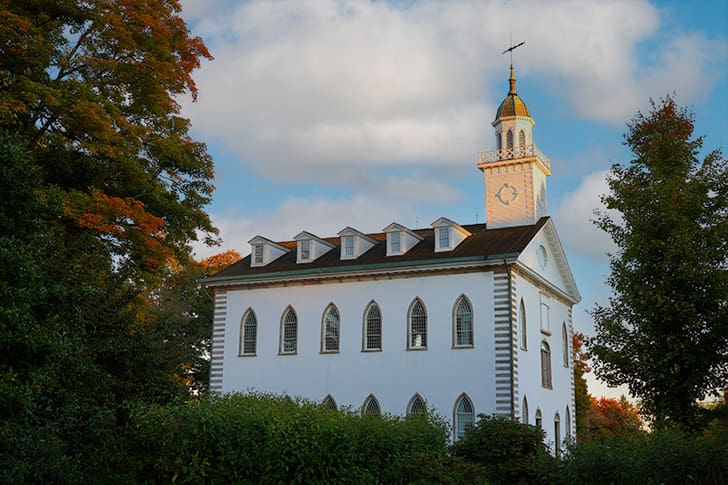
One hundred and ninety years ago, in a remarkable series of visions inside the newly dedicated Kirtland Temple, Joseph Smith and Oliver Cowdery received the keys of temple work. This series of articles seeks to increase understanding of the priesthood keys restored on that occasion.
It includes excerpts from The Heart of Our Covenants: Temple Principles that Draw Us unto Christ by Valiant K. Jones. Used by permission. See www.valiantjones.com or www.cedarfort.com.
When Jesus Christ visited the Nephites after his resurrection, He recited the words that had been given to the prophet Malachi in the old world. These included a prophecy of the future return of Elijah: “Behold, I will send you Elijah the prophet before the coming of the great and dreadful day of the Lord; and he shall turn the heart of the fathers to the children, and the heart of the children to their fathers, lest I come and smite the earth with a curse” (3 Nephi 25:5-6; see also Malachi 4:5-6). Moroni repeated this prophecy, with some modifications, when he appeared to Joseph Smith (see D&C 2 and JS-H 1:36-38).
This prophecy was fulfilled when Joseph Smith and Oliver Cowdery received a remarkable series of visions in the Kirtland Temple on April 3, 1836. The first was an appearance of Jehovah—Jesus Christ himself—who accepted the newly completed and dedicated Kirtland temple. Following this, visions of three special messengers appeared, in sequence, which Joseph described as follows:
“The heavens were again opened unto us; and Moses appeared before us, and committed unto us the keys of the gathering of Israel from the four parts of the earth, and the leading of the ten tribes from the land of the north.
“After this, Elias appeared, and committed the dispensation of the gospel of Abraham, saying that in us and our seed all generations after us should be blessed.
“After this vision had closed, another great and glorious vision burst upon us; for Elijah the prophet, who was taken to heaven without tasting death, stood before us, and said: Behold, the time has fully come, which was spoken of by the mouth of Malachi—testifying that he [Elijah] should be sent, before the great and dreadful day of the Lord come—To turn the hearts of the fathers to the children, and the children to the fathers, lest the whole earth be smitten with a curse—Therefore, the keys of this dispensation are committed into your hands; and by this ye may know that the great and dreadful day of the Lord is near, even at the doors” (D&C 110:11-16).
These three heavenly messengers bestowed upon Joseph Smith and Oliver Cowdery important priesthood keys. President Russell M. Nelson taught that priesthood keys “refer to the right to preside over priesthood authority in the name of the Lord Jesus Christ.”1 This series of articles will review the restoration of the keys of temple work that occurred on April 3, 1836, including their meaning and significance.
The Keys of the Gathering of Israel on Both Sides of the Veil
Moses was a fitting custodian of the keys of the gathering of Israel because it was he who led the children of Israel from Egypt as one body before they were dispersed. That dispersion was first into separate lands of inheritance in Canaan and later among all the nations of the earth. The keys that Moses bestowed on Joseph and Oliver authorized global missionary work, imparting priesthood power to those who would spread the gospel under the direction of all the modern prophets who have carried those keys since 1836. Every missionary of this dispensation has preached gospel truths with power and authority because of the restoration of these priesthood keys.
However, the keys restored by Moses were not given solely for the gathering of people into the gospel net of salvation. They were also given for the gathering of people to temples so that all souls born in all time periods can have the opportunity to receive the blessing of exaltation and eternal families. The keys that Moses restored prepare receptive children of God to receive the blessings of the keys of Elias and Elijah that followed. The keys of Moses needed to be imparted before temple work could begin because, as President Nelson has pointed out, the gathering of Israel occurs “on both sides of the veil.”2
When we search out the names of our ancestors, we are functioning within the spirit of the keys of Moses as much as within the spirit of keys of Elijah. The restored keys of the gathering of Israel function both on the earth and in the spirit world.
The final visitor on that important April 3rd was the prophet Elijah. His role in the restoration of the priesthood keys will be discussed in more detail later; however, the Bible Dictionary gives this summary of his keys: “Elijah held the sealing power of the Melchizedek Priesthood. He appeared on the Mount of Transfiguration in company with Moses (also translated) and conferred the keys of the priesthood on Peter, James, and John (Matt. 17:3). He appeared again, in company with Moses and others, on April 3, 1836, in the Kirtland (Ohio) Temple and conferred the same keys upon Joseph Smith and Oliver Cowdery.
All of this was in preparation for the coming of the Lord, as spoken of in Mal. 4:5–6 (D&C 110:13–16). As demonstrated by his miraculous deeds, the power of Elijah is the sealing power of the priesthood by which things bound or loosed on earth are bound or loosed in heaven. Thus the keys of this power are once again operative on the earth and are used in performing all the ordinances of the gospel for the living and the dead.”3
The keys restored by both Elijah and Moses are clear and beautiful—they make sense. However, our understanding of Elias and the keys he restored is less clear. Frankly, Elias has long been a bit of an enigma for many members of the Church. Part of this is because even his historical identity is unclear. In addition, there is the issue of Elias being both a person and a title. And what is the relationship between the keys of Elias and those of Elijah? Also, at first glance, the keys restored by Elias are not aligned in an obvious way with any particular ordinance. It is all rather confusing. The following discussion will be an attempt to shed some light on all of this.
Who Was Elias?
It is important to recognize that Elijah and Elias are the same name coming to us in English from two other languages. They are like Pedro and Pierre or Carlos and Charles. Elijah is a transliteration into English from the Hebrew form of the name, and Elias is a transliteration from the Greek form of the same name.
Hebrew, Greek, and English are all written in different alphabets or scripts, so when proper names are translated, the best available equivalent letters are typically chosen. However, sometimes adjustments are made because there is no equivalent letter or in order to make the name appear more reasonable in the new language. Thus, when doing a translation directly from Hebrew, early writers chose Elijah in English; but when early translators started with the Greek transliteration of the same name and then anglicized that, they chose Elias. Other KJV Old Testament/New Testament equivalent names include Elisha/Eliseus (Luke 4:27), Isaiah/Esaias (John 12:38), Joshua/Jesus (Acts 7:45), Judah/Judas (Matthew 1:2-3), and Noah/Noe (Matthew 24:38). Additional equivalent names include Miriam/Mary, Hannah/Anna, and Jacob/James.4
When Jesus said, as written in the KJV, “But I tell you of a truth, many widows were in Israel in the days of Elias, when the heaven was shut up three years and six months, when great famine was throughout all the land” (Luke 4:25), He was clearly referring to the Old Testament prophet we know of as Elijah the Tishbite. Likewise, when John the Baptist told the priests and Levites that he was not the Christ or Messiah, and they asked, “What then? Art thou Elias?” (John 1:21), they were asking if he was the Old Testament prophet Elijah—for they knew of the prophecy that Elijah would appear before the coming of the Messiah (see Malachi 4:5-6).
It would not be wrong for us to substitute Elijah in place of Elias in our minds wherever the latter is encountered in the KJV New Testament. In fact, most of the other English translations of the Bible use Elijah in all passages in the New Testament where the King James Version uses Elias. So first and foremost, Elias refers to Elijah the Tishbite.
In addition, Jesus referred to John the Baptist as Elias, meaning Elijah (see Matt. 11:13-14). When the angel Gabriel appeared to Zacharias and prophesied that his wife, Elizabeth, would bear a son who should be named John, the angel said of him, “And many of the children of Israel shall he turn to the Lord their God. And he shall go before him in the spirit and power of Elias [i.e., Elijah], to turn the hearts of the fathers to the children, and the disobedient to the wisdom of the just; to make ready a people prepared for the Lord” (Luke 1:16-17).
Thus, John the Baptist was to be a forerunner of the first coming of Christ “in the spirit and power of Elias [i.e., Elijah]” just as Elijah himself was to be a forerunner of the second coming of Christ. Both would prepare people’s hearts to receive Jesus Christ before He arrived. This provides the basis for the use of Elias as a title, meaning forerunner.
The Prophet Joseph Smith expounded on this second use of Elias. He taught, “The spirit of Elias is to prepare the way for a greater revelation of God…. And when God sends a man into the world to prepare for a greater work, holding the keys of the power of Elias, it was called the doctrine of Elias, even from the early ages of the world.”5
Joseph Smith used Elias in other ways as well. The Bible Dictionary summarizes all of these ways and then states, “Thus the word Elias has many applications and has been placed upon many persons as a title pertaining to both preparatory and restorative functions.”6 Apparently, the duplication of this name in two forms in the King James Bible—Elijah and Elias—provided an impetus for the Lord to inspire Joseph Smith in many ways regarding Elias and the doctrine of Elias.
For Latter-day Saints, the most important event which occurred under the name of Elias took place when the Lord sent a heavenly messenger under that appellation to Joseph Smith and Oliver Cowdery in the Kirtland temple on April 3, 1836. The Bible Dictionary says of this messenger, “A man called Elias apparently lived in mortality in the days of Abraham, who committed the dispensation of the gospel of Abraham to Joseph Smith and Oliver Cowdery…. We have no specific information as to the details of his mortal life or ministry.”7
The lack of specific information regarding this restorer of priesthood keys has led some to conjecture that this angel may have been a prophet known in the Old Testament by some other name. President Joseph Fielding Smith, as an apostle, stated8 that Elias and Noah are the same person.9 President Smith also stated that “some think him to be Melchizedek.”10 Elder Bruce R. McConkie confirmed the uncertainty of the identity of the Elias who appeared in the Kirtland temple, writing, “Whether he was Abraham or Melchizedek or some other prophet, we do not know.”11
Elder McConkie later conjectured, “Apparently this Elias lived in the day of Abraham, and may even have been Abraham himself.”12 It is also possible that the Elias who appeared in the Kirtland temple was none of these, but was a separate prophet who lived in ancient times and whose earthly name was the Hebrew equivalent of Elijah and Elias. The statement on Elias from the Bible Dictionary, cited earlier, seems to agree with this possibility.13
In addition to all these possibilities regarding the identity of Elias, I offer another proposal. It is possible that the two separate visions in the Kirtland Temple, wherein a single messenger appeared each time—the first in the name of Elias and the second in the name of Elijah—were both carried out by the same ancient prophet: Elijah the Tishbite. Perhaps he was directed by God to appear twice under his two separate but related names in order to restore two separate but related priesthood keys, both of which he held.
It is interesting to note that in the New Testament record of a similar occasion—when keys were given to Peter, James, and John on the Mount of Transfiguration—Moses and Elijah appeared together at the same time (see Matt 17:3 and Mark 9:4). Yet in the Kirtland temple, the three messengers appeared sequentially—an arrangement that would have accommodated a repeat appearance by Elijah. Also, this theory creates a stronger parallel with the New Testament record, which speaks of a visit by only those two messengers (see Matt 17:1-13, Mark 9:2-13, and Luke 9:28-26). Perhaps Joseph and Oliver also received only two messengers, with one of them appearing twice in subsequent visions. Perhaps these modern seers were so taken by the glory of their visions and so focused on the messengers’ words that they did not recognize the equality of the angels’ features in the two appearances.
God often works within the paradigms we hold ourselves to, and if Joseph Smith believed that the references to Elias and Elijah in his KJV Bible were references to two separate prophets (and some of the ways Joseph used Elias suggest that he did), then it is possible that God chose to use that paradigm to emphasize the restoration of two separate but related priesthood keys. God rarely clarifies our misunderstandings unless we ask, and it is possible that Joseph never even considered that Elias and Elijah could have been the same person.
Of course, this proposal is only a conjecture; however, there is nothing in Doctrine and Covenants 110 that is inconsistent with this theory. Joseph’s many and varied references to Elias confirm he was not settled on who Elias was. However, this does not affect his stature as a prophet; it simply makes him human. The Lord stated that the revelations in the Doctrine and Covenants “were given unto my servants in their weakness, after the manner of their language, that they might come to understanding” (D&C 1:24; see also 2 Nephi 31:3). In other words, the revelations were given in the imperfect language paradigms that Joseph comprehended so that the principles God deemed most important could be revealed.
Remember, also, that Jesus himself contributed to the complexity of this issue when he referred to John the Baptist as Elias/Elijah (see Matthew 11:7-14). Regardless of all this, if we were to take the second key-bearer at his word when he said he was Elias and then invoke the simplest interpretation of his name, we would conclude that this messenger was Elijah the Tishbite.
Regarding the identity of Elias, Elder John A. Widtsoe wrote, “When Elias, the man, lived, and what he did in his life, must for the present remain in the field of conjecture.”14 Both the Bible and the Book of Mormon refer to many unnamed prophets, confirming that ancient prophets were not always identified.15 The messenger who came as Elias to the Kirtland Temple was undoubtedly a great prophet when he lived on earth, but when he appeared to Joseph and Oliver, his mortal life and mission were secondary in importance to the keys that he was restoring. Maybe this is why the Lord provided this messenger with some anonymity by having him introduce himself as Elias.
All this aside, we must not be so concerned about the identity of Elias that we overlook his purpose. This is an issue faced by people who become attached to a particular missionary who has been teaching them the gospel. If that missionary gets transferred before their baptism, they must decide if it is the missionary or the underlying priesthood authority that matters for their baptism. So it is with Elias. His specific identity and background were not as important as his priesthood authority. Regardless of who this Elias was in mortal life, the most important thing we need to know about him is that he restored important priesthood keys to Joseph Smith and Oliver Cowdery in the Kirtland temple in 1836. That much is certain, and that part is what matters most.
Elias and the Dispensation of the Gospel of Abraham
Regarding the purpose of the heavenly messenger who came in the name of Elias, Joseph and Oliver wrote that he “committed the dispensation of the gospel of Abraham” (D&C 110:12). To understand this declaration, it is helpful to recognize that the word gospel can sometimes be used as a synonym for the word covenant16 and to understand the word dispensation in the sense of dispensing or bestowing rather than as an epoch of time on the earth. With these clarifications, this passage can be interpreted as saying that Elias “committed the bestowing of the covenant of Abraham.”
Consistent with this interpretation, the 2025 Doctrine and Covenants Seminary Teacher Manual explains: “Elias committed the dispensation of the gospel of Abraham. This includes the restoration of the Abrahamic covenant.”17 The fulness of this covenant, which includes the promises of endless posterity, priesthood power, and an eternal promised land inheritance in God’s presence,18 is bestowed through the ordinance of temple marriage. Thus, the keys restored by Elias are the keys of eternal marriage.
This link to eternal marriage becomes clearer when we consider the promise given by Elias “that in us and our seed all generations after us should be blessed.” This statement echoes the promise Abraham received that “in thy seed after thee . . . shall all the families of the earth be blessed” (Abraham 2:11). This promise could only be fulfilled through the union of Abraham with Sarah. Likewise, these same blessings are bestowed on couples married in the temple, where they are sealed together eternally and bestowed the blessing of Abraham, Isaac, and Jacob.
President Nelson confirmed this understanding of the keys of Elias, teaching, “In 1836, keys of ‘the gospel of Abraham’ were conferred (D&C 110:12). In 1843 the Lord declared to the Prophet Joseph Smith that ‘Abraham received promises concerning his seed, and of the fruit of his loins—from whose loins ye are. . . . This promise is yours also, because ye are of Abraham’ (D&C 132:30–31). . . . The ultimate blessings of the Abrahamic covenant are conferred in holy temples. These blessings allow us to come forth in the First Resurrection and inherit thrones, kingdoms, powers, principalities, and dominions, to our ‘exaltation and glory in all things’ (D&C 132:19).”19 Of course, these blessings described by President Nelson are the blessings pronounced upon every couple sealed in eternal marriage.
To paraphrase a little differently the Doctrine and Covenants 110 declaration of the keys restored by Elias, we could say that he bestowed upon Joseph and Oliver a dispensing of the same good news that many generations earlier had been given to Abraham. And what was this particular good news or gospel? It was that Joseph and Oliver now had the power to administer a binding, covenant-marriage link for men and women on earth so that all generations that would come after them would be blessed. Elder Bruce R. McConkie taught, “Elias restored the great commission, given of God to Abraham our father, whereby the seed of Abraham has power to gain eternal blessings forever through eternal marriage; that is, Elias restored the marriage discipline that had eternal efficacy, virtue, and force in the days of Abraham, Isaac, and Jacob.”20
The authority to bind couples in eternal marriage has existed since Adam, but it was strongly associated with Abraham, who was promised that his seed would be as vast as the sands of the sea (see Genesis 22:17, 32:12), so this authority was also called the good news of Abraham or the gospel of Abraham (see Abr. 2:9-11). This approach of naming a divine power after a remarkable prophet is similar to what occurred with the Melchizedek Priesthood, which also existed on the earth since Adam, but which was renamed “because Melchizedek was such a great high priest” (D&C 107:2).
Similarly, the Lord said to Abraham, “For as many as receive this Gospel shall be called after thy name, and shall be accounted thy seed, and shall rise up and bless thee, as their father” (Abraham 2:10). So the new and everlasting covenant of marriage is also called the gospel of Abraham or the Abrahamic covenant, and Elias restored the keys of this covenant.
Elder McConkie elaborated further on this role of Elias, “This Elias … ‘committed the dispensation of the gospel of Abraham’ (D&C 110:12) … meaning the great commission which God gave Abraham in his day. That commission dealt with families, those of Abraham and his seed, who were and are promised continuance ‘in the world and out of the world … as innumerable as the stars; or, if ye were to count the sand upon the seashore ye could not number them’ (D&C 132:30).
As Joseph Smith records it, what Elias actually said to him and Oliver Cowdery was that ‘in us and our seed all generations after us should be blessed’ (D&C 110:12). And so, the Lord be praised, the marriage discipline of Abraham was restored; it is the system that enables a family unit to continue in eternity; it is the system out of which eternal life grows.”21
The heavenly messenger who declared himself to be Elias restored the keys of eternal marriage. I believe these keys encompass not only the temple marriage ceremony but also the temple endowment ceremony, since the endowment prepares us for eternal marriage.22
On their own, the keys restored by Elias are limited to ceremonies performed for the living. When Elias bestowed his priesthood keys, he said, “all generations after us should be blessed.” The keys of Elias provide blessing to posterity who come after us, but they do nothing for ancestors who came before us. In order to bring the same blessings to them, additional priesthood keys were needed. The subsequent visit by Elijah restored the keys that extended those sealing ordinances to the dead—to those progenitors in the spirit world who had not entered into gospel covenants with God while they were living on the earth.
To be continued…
Valiant K. Jones is the author of The Heart of Our Covenants: Temple Principles that Draw Us unto Christ. For more information, see www.valiantjones.com or www.cedarfort.com.
1. Russell M. Nelson, “Keys of the Priesthood,” Ensign, Oct. 2005, 40.
2. Russell M. Nelson, “Hope of Israel,” Worldwide Youth Devotional June 3, 2018, Conference Center, Salt Lake City, Utah, churchofjesuschrist.org/study/broadcasts/worldwide-devotional-for-young-adults/2018/06/hope-of-israel?lang=eng; see also Russell M. Nelson, “The Gathering of Scattered Israel,” Ensign, November 2006, churchofjesuschrist.org/study/ensign/2006/11/the-gathering-of-scattered-israel?lang=eng.
3. Elijah” Bible Dictionary, lds.org/scriptures/bd/elijah?lang=eng.
4. Even though Jacob and James are equivalent names, both are used in the KJV New Testament. For an interesting discussion of these names, see gotquestions.org/James-vs-Jacob.html.
5. Joseph Smith Jr., Teachings of the Prophet Joseph Smith, pp. 335-336.
6. “Elias” Bible Dictionary, lds.org/scriptures/bd/elias?lang=eng, emphasis in the original.
7. Ibid.
8. Joseph Fielding Smith, Conference Report, April 1960, p. 72, archive.org/details/conferencereport1960a/page/n73; see also Joseph Fielding Smith, Answers to Gospel Questions, Vol. 3, pp. 139-141.
9. This conclusion is based on D&C 27:6-7, which says that Elias announced to Zacharias the birth of his future son, John the Baptist. In Luke 1:19, this birth announcement is attributed to the angel Gabriel, whom Joseph Smith declared to be Noah (see Teachings of the Prophet, p. 157). The conclusion of all of this is that Elias is Noah. However, when we remember that Elias is sometimes used as a title meaning forerunner, we realize that the scripture in D&C 27 is probably saying that the angel Gabriel was a forerunner. He was a forerunner to John the Baptist who was a forerunner to Christ. Both Gabriel and John the Baptist were each an Elias.
10. Joseph Fielding Smith, Doctrines of Salvation, Vol. 1, p. 107.
11. Bruce R. McConkie, “Elias,” Mormon Doctrine, p. 220.
12. Bruce R. McConkie, “This Final Glorious Gospel Dispensation,” Ensign, April, 1980, lds.org/ensign/1980/04/this-final-glorious-gospel-dispensation?lang=eng.
13. The Bible Dictionary statement that, “A man called Elias apparently lived in mortality in the days of Abraham” raises some questions. To suggest that this unknown man carried a name that was distinct from the name Elijah ignores the etymology of the name Elias. Remember that Elias is derived from the same Hebrew name as Elijah after passing through Greek, so it is highly unlikely that an ancient prophet would have carried the Greco-Hebrew name Elias. However, it is possible there were two separate ancient prophets with the same Hebrew name and that the Lord has chosen to distinguish them in our day by calling one Elijah and the other Elias. The Old Testament has no record of a second prophet named Elijah, but it is not unreasonable to consider that there could have been multiple men with that name. I assume that this is what the Bible Dictionary statement is suggesting as a possibility.
14. John A. Widtsoe, Evidences and Reconciliations: Aids to Faith in a Modern Day, pp. 243–244.
15. See Hosea 12:13; 1 Samuel 2:27; 1 Kings 13:1-3, 11; 1 Kings 20:13, 22; 28; 2 Kings 23:18, Zechariah 7:3; 1 Nephi 1:4.
16. In D&C 39:11 and 66:2 the Lord refers to the gospel as a covenant. These verses likely refer to the covenant called the law of the gospel; however, they also suggest that gospel and covenant can be synonyms.
17. “Lesson 124—Doctrine and Covenants 110, Part 2: The Restoration of Priesthood Keys,” Doctrine and Covenants Seminary Teacher Manual, churchofjesuschrist.org/study/manual/doctrine-and-covenants-seminary-teacher-manual-2025/393-doctrine-and-covenants-110-part-2?lang=eng.
18. Kent P. Jackson, “The Abrahamic Covenant: A Blessing for All People,” Ensign, February 1990, churchofjesuschrist.org/study/ensign/1990/02/the-abrahamic-covenant-a-blessing-for-all-people?lang=eng; see also, “The Abrahamic Covenant,” Liahona, February 2022, churchofjesuschrist.org/study/liahona/2022/02/the-abrahamic-covenant?lang=eng.
19. Russell M. Nelson, “Special Witnesses of Christ,” Ensign, April 2001, churchofjesuschrist.org/study/ensign/2001/04/special-witnesses-of-christ?lang=eng; see also Russell M. Nelson, “The Everlasting Covenant,” Ibid.
20. Bruce R. McConkie, A New Witness for the Articles of Faith, p. 508; quoted by Robert L. Millet, “The Ancient Covenant Restored,” Ensign, March 1998, lds.org/ensign/1998/03/the-ancient-covenant-restored?lang=eng. See also Bruce R. McConkie, “The Keys of the Kingdom,” Ensign, May 1983, churchofjesuschrist.org/study/ensign/1983/05/the-keys-of-the-kingdom?lang=eng.
21. Bruce R. McConkie, “This Final Glorious Gospel Dispensation,” Ibid.
22. For a discussion of how the endowment can be seen as the first part of the eternal marriage ceremony, see Valiant K. Jones, the Heart of Our Covenants, Cedar Fort, 2025, pp. 18-24.
It is Thy House, a Place of Holiness- The Kirtland Temple
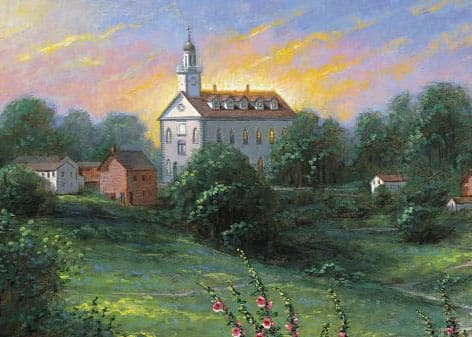
Cover image via Gospel Media Library.
Voices of the Restoration: The Kirtland Temple
One of the often-used skills in scripture study is taking the “them, there and then” of what you read and applying it to the “me, here and now” of today. In other words, put yourself in the shoes of those who walked and lived the actual stories you read.
For example, place yourself in the shoes of Enos the son of Jacob. Enos let the words of his father sink deep into his heart and prayed throughout the day and night in a wrestle to know whether the gospel of Jesus Christ was true. Have you ever had the words of a prophet or parent sink deep into your heart? If so, you can relate to Enos, his feelings and the miracle of the manifestation given to him after his wrestle with God. Relating to scriptures to our own lives is powerful.
As you read D&C 109-110, how can you take the “them, there and then” of 1836 and bring it into the “me, here and now” of 2021?
Let’s imagine you were seated in the Kirtland temple on March 27, 1836 for the dedication of the temple. As such, you would likely have been seated in one of the 60 handcrafted wooden pews of the lower auditorium in the temple. With almost 1,000 people admitted into the session, you would be seated as close together as possible. Children were seated on their parent’s laps.
Sylvia Cutler Webb wrote, “The house was so crowded the children were mostly sitting on older people’s laps; my sister sat on Father’s, and I on my mother’s lap…. I was privileged to be there.”
Everyone in attendance had been asked to be clean physically—having bathed, washed their clothes and wearing their Sunday best, and spiritually—having repented, done their best to reconcile to the Lord, repent and approach the meeting with clean hands and pure hearts. Joseph had told them, “Be prepared in your hearts, be faithful in all things…. We must be clean every whit.”[i]
If you made it inside the temple, you were likely among the 1,000 saints who lined up beginning at 7 am for the 9 am service. Others, hundreds, who could not get inside the temple were directed to a nearby schoolhouse or remained outside near the open temple windows hoping to glean whatever they could hear.
Seated inside, you face the pulpit. In the temple there were two sets of elevated pulpits (or you could call them alters) with one set in the lower auditorium on the first level and the other set on the second level. The pulpit you are facing has a drop-leaf table in front of it for preparing the sacrament. The initials MPC for Melchizedek presiding council and other designating initials are engraved in gold letters on the curved panels of the pulpits. Behind you, in the back of the room was a second pulpit representing the Aaronic priesthood.
Almost everyone in attendance has given almost everything, all their living and effort to the construction of the temple. Heber C. Kimball, after arriving in Kirtland and seeing the saints attempting to build such a building in their extreme poverty, would say, “The church was in a state of poverty and distress, in consequence of which it appeared almost impossible that the commandment [to build the temple] could be fulfilled, at the same time our enemies were raging and threatening destruction upon us.”[ii]
For four years, you and the saints have labored. Labor that could have been directed to your own home, farm and family. Daniel Tyler recalled, “How often I have seen those humble, faithful saints of the Lord, after toiling all day in the quarry, or on the building…retiring to their homes with a few pounds of corn meal…and the corn meal [and a little milk] was all that they and their families had to subsist upon.”[iii]
No doubt, you feel as if you are bringing not only a sacrifice of time, work and worldly means to place on the alter in front of you, but also your willingness to obey and effort to personally be clean as commanded by revelation. You have been told that this will be a day of Pentecost.
As you sit, waiting for the meeting to begin, the miracles that have already happened in the building of the temple run through your mind. A few months earlier, Elder Roger Orton “saw a mighty angel riding upon a horse of fire, with a flaming sword in his hand, followed by five others, encircle the house, and protect the saints, even the Lord’s anointed, from the power of Satan and a host of evil spirits, which were striving to disturb the Saints.”[iv]
Evil men and women had tried to stop the saints in their efforts. Persecution, ridicule and harassment was typical throughout the construction. In fact, it seemed to increase in its intensity the closer the time came to completion.
However, your focus remains on the miracles that brought you to this place rather than the hardships you’ve endured. The temple design was given in vision, building supplies were miraculously found, financing secured, health of workers restored, manifestations of the spirit given, and perhaps most of all, the satisfaction that the impossible had been accomplished. The impossibility of building a house to the Lord in extreme poverty and also becoming a godly people had in fact, happened.
As you sit awaiting the meeting to begin, it’s likely you reflect on the increased level of conversion and commitment that you’ve found in your life as a result of the sacrifices made over the last four years in Kirtland. Later that day, you will sing “sacrifice brings forth the blessings of heaven.”
No doubt, the temple dedication on March 27 was spirit-filled because their sacrifice and hardships had been so arduous and trying. You see, when we give more we appreciate more. I believe the “me, here and now” lesson for us is this: we often must keep our covenants by sacrifice. That is the path to godliness. And godliness is the objective of the gospel of Jesus Christ.
And for the saints in 1836, it was through their sacrifice they became more godly. As they became more clean, charitable and godly, they could then see and feel what it was like to live and think like Jesus Christ.
Contrast their life with ours today. Nowadays it seems we live in a GPS society.
Think about a GPS. We turn on GPS and it gives turn-by-turn directions and we don’t have to give it a deliberate thought. We don’t have to think about where is north or south, we don’t have to imagine where our intended location is in the city. GPS has taken the thinking out of the driving process. Likewise, so many things in our modern life have become this easy. We want instant entertainment, instant google answers, and this conditions us to expect all the complexities of life reduced to a simple search result.
But the truth is, life doesn’t work that way. We don’t learn or grow in that type of environment. Our Heavenly Father, who knows us from the beginning, understands that building a temple, going on Zion’s camp, stretching our limits, and giving up worldly things creates godliness within us. And that is the objective of life.
At 9 am the brethren are in place on the pulpit and the meeting begins. After Sydney Rigdon speaks, hymns are sung, and sustaining’s made, you return in the afternoon and Joseph Smith reads he dedicatory prayer as revealed to him and recorded in D&C 109.
In that prayer, Joseph would ask God to accept the temple and the “workmanship of their hands” in obedience to the commandment received from Jesus Christ to build a temple. He asks that the saints would be found worthy in the sight of the Lord, to secure a fulfillment of the promises that:
- God’s glory may rest upon his people and upon his house
- That the house may be sanctified and consecrated to be holy
- And that God’s presence may be in this house.
- And that all people who shall enter shall feel God’s power
Then the prophet says, “We ask thee, Holy Father, that thy servants may go forth from this house armed with thy power, and that thy name may be upon them, and thy glory be round about them, and thine angels have charge over them.”
How would you feel? That this temple, built by your hands was in fact the house in which Jesus Christ would appear personally? It was to be a home for the angels of heaven. It would be the endowment house for elders who would later convert thousands of saints in Canada and England.
In 1836, these ordinances and endowments would be given to many saints. On March 30, a solemn assembly was held in the temple. On this occasion, Joseph Smith, the presidency, the seventies, high councils, bishops and their quorums were in attendance. The ordinance of the washing of the feet was conducted. Joseph gave messages and instruction throughout the day. Joseph then declared that the elders were now prepared to go forth and preach the gospel. Many elders left the next day.
On Easter Sunday, April 3, 1836, one week after the dedication, the leaders of the church were gathered together in the temple. After administering the sacrament, Joseph and Oliver retired to the pulpit area and with the curtains drawn began to pray.
It is then that Jesus Christ appears to them above the pulpit described in D&C 110 as on a “work of pure gold.” Then, Jesus Christ accepted the temple and the offering of the saints, “Let the hearts of your brethren rejoice, and let the hearts of all my people rejoice, who have, with their might, built this house to my name. For behold, I have accepted this house and my name shall be here and I will manifest myself to my people in mercy in this house.”
Then, one of the most important events of this, the final dispensation in God’s kingdom took place. The restoration of the keys for the work of the last days.
Moses appears and bestows upon Joseph Smith the keys of the gathering of Israel. Then, Elias bestows the keys of the dispensation of the gospel of Abraham. Then, Elijah comes and brings the sealing keys of the holy priesthood. The keys to seal ancestors and families together across time. The keys to destroy the devastating effects of death and to create a link in the hearts of fathers to children and children to fathers.
Why are these rights that were restored called “keys?” One definition of keys is “a means of gaining access to or understanding something.” For example, you can open locked doors with keys. Also, if you have the key to an exam, you have the insights and answers. Perhaps what the Lord was restoring was the authority to begin in earnest the gathering of Israel and unlocked the insights and answers that would come forth by his angels and his spirit to facilitate that great work.
Another definition of key is “the means of operation” like a key on a keyboard. If we want a computer to work properly we must use the right key. Likewise, if we want the gathering of Israel to unfold in God’s way and timing, we must rely on the keys. We must be willing to follow the guidance of those who have been set apart by those holding those keys.
All of these definitions of “keys” are vitally important. Too often we think our way is the right way. Sometimes we seek to go about achieving the end goal in what seems like the world’s way. But what was restored on earth on April 3, 1876 were keys, the means to gain access to the power of restoration, the gospel of Abraham and its promises, and the sealing power. Access to the power and understanding to do things in the Lord’s way. This is why following the prophet is so essential. He holds the keys to this power and understanding.
Who better than Moses to restore the keys of the gathering of Israel? Moses was called and empowered with the rights and insights to lead God’s children to the promised land. Those same rights, insights and power were given to Joseph Smith and reside with Russell M. Nelson today. Moses may very well have an ongoing role in that great work even today.
We know very little about Elias. He apparently lived in the days of Abraham. But he restored the dispensation of the gospel of Abraham. A dispensation is a system of order, way of governing, the organization brought about for a particular time and purpose.
So, the dispensation of the gospel of Abraham includes a system of laws, promises and ordinances. The great Abrahamic covenant which promises eternal increase through celestial marriage and other blessings are part of the laws, promises and ordinances of the gospel of Abraham. Did these keys include authority to bring forth and administer temple ordinances? That seems appropriate.
Then, Elijah appears to Joseph and Oliver and tells them, “The time has fully come which was spoken of by the mouth of Malachi—testifying that Elijah should be sent, before the great and dreadful day of the Lord come—to turn the hearts of the fathers to the children, and the children to the fathers lest the whole earth be smitten with a curse.”
“This sealing power bestowed upon Elijah, is the power which binds husbands and wives, and children to parents for time and eternity. It is the binding power existing in every Gospel ordinance. … It is by this power that all the ordinances pertaining to salvation are bound, or sealed, and it was the mission of Elijah to come, and restore it.”[v]
No wonder angels attended the events of that week. Orson Pratt would write, “God was there, his angels were there, the Holy Ghost was in the midst of the people, the visions of the Almighty were opened to the minds of the servants of the living God, the veil was taken off from the minds of many; they saw the heavens opened; they beheld the angels of God; they heard the voice of the Lord; and they were filled from the crown of their heads to the soles of their feet with the power and inspiration of the Holy Ghost….”
Joseph has already been given the apostolic keys from Peter, James and John. Now they were given the authorization to put those keys into full effect. It was now Joseph’s job to transfer those keys to the apostles and put them into action. Perhaps, this was Joseph’s last major undertaking as prophet. This event in 1836 may be one of the most significant in God’s work on this earth and in the plan of salvation.
The blessings given to the saints in the Kirtland temple, inspired and empowered the saints in a miraculous and incredible way. The Kirtland temple stands as a place where the saints were endowed with power from on high. There they received the promises of Jesus Christ.
It was from the temple, the appearance of Jesus Christ to accept their offering and the restoration of the keys that would enable the work of this final dispensation to begin with the rights, insights and authority necessary to roll forth and fill the whole earth.
So, what lessons can we learn from the events of 1836 and the dedication of the Kirtland temple? What are the “me, here and now” lessons for us today?
First, the Lord Jesus Christ keeps his promises and delights to bless and honor those who obey his word and strive to keep their covenants by sacrifice. The blessings given to the saints were remarkable and miraculous. And they extended beyond the events of Kirtland and 1836. They would empower them for the future events to lay the foundation of the church on the earth.
Second, there is learning and godliness found in the work of the Lord and in sacrificing for the work of the Lord. Be willing. Don’t turn away because of the apparent difficulty, or in the case of these saints, the impossibility of the task at hand.
Elder Maxwell said, “I am going to preach a hard doctrine to you now. The submission of one’s will is really the only uniquely personal thing we have to place on God’s altar. It is a hard doctrine, but it is true. The many other things we give to God, however nice that may be of us, are actually things He has already given us, and He has loaned them to us. But when we begin to submit ourselves by letting our wills be swallowed up in God’s will, then we are really giving something to Him. And that hard doctrine lies at the center of discipleship.”[vi]
Third, the keys of the dispensation of the fullness of times have been restored. The rights, insights, power and heavenly alignment for the gathering of Israel, the ordinances of the gospel of Jesus Christ and the sealing power are on the earth and used by those who have been called by authority. We have been endowed with power to do the work of Jesus Christ and as such we can sing and shout with the armies of heaven, “Hosanna to God and the Lamb! Let glory to them in the highest be given, Hence forth and forever amen and amen.”
These voices of the restoration: Jesus Christ, Moses, Elias, Elijah, Joseph and the hundreds of saints who testified of the events in the Kirtland temple speak to us today. My hope is that we can follow their voices and examples in our lives and honor their sacrifice through our efforts to live and do the work of the gospel of Jesus Christ on the earth today.
[i] History of the Church 2:309, as quoted in Joseph Smith’s Kirtland, Karl Ricks Anderson, pg. 169.
[ii] History of the Church 1:450, as quoted in Joseph Smith’s Kirtland, pg. 164.
[iii] Lorenzo Young, “Young’s Narrative,” in Fragments of Experience, 43; as quoted in Joseph Smiths Kirtland, 160.
[iv] History of the Church 2:386-87, as quoted in Joseph Smith’s Kirtland, pg. 165.
[v] Joseph Fielding Smith, Elijah the Prophet and His Mission, 5.
[vi] Elder Neal A. Maxwell, Insights from My Life, Ensign, August 2000, p. 9.
FEATURES