


Book of Mormon Evidence: Wordplay on Jared

The name Jared is significant within the Nephite record. Jared was a leader of the people known as the Jaredites, who originated during the time of the infamous tower spoken of in Genesis 11:1–11. The name may also trace back to the Jared mentioned in Genesis 5:18–20, who was the father of Enoch. Matthew Bowen explains,
To know with certainty the origin and meaning of the name Jared as a “Jaredite” name, one must more precisely ascertain the origins and language of the Jaredites. Given that Amaleki, Mormon, and Moroni describe the Jaredites as having come from “the tower” or “the great tower,” an Asiatic origin if not an outright Mesopotamian origin seems certain.
If such is the case, the name Jared as attested in the Book of Mormon plausibly represents a hebraized cognate of the Semitic/Akkadian noun wardu(m) or warad, which denotes “slave, servant” (cf. theophoric warad—names like Warad-Sin, “Servant of the moon[-god]”), a noun which in turn derives from the Akkadian verb, warādu(m), “go down,” “descend.” Akkadian wardu(m)/warādu(m) provides a useful analogy for the name Jared in terms of yered/yārad, “go down” or “come down” (i.e., “descend”). The Nephites may have understood the name Jared either as “slave/servant [of Deity]” or “as a hypocoristicon meaning God shall/has descended” and the gentilic designation Jaredites as “those who go down” or “bring down” (cf. yōrĕdîm, môrîd[îm]).1
Understanding these linguistic roots may be valuable, as it appears that Book of Mormon authors evoked several layers of wordplay in connection with this name. This article builds, and significantly expands, upon Bowen’s prior research on this topic.2
Jaredite Origin Story
There is a prominent theme of elevation and directionality right from the outset of the Jaredite origin story.3 In his abridgment of this people’s history, Moroni explained that “Jared came forth with his brother and their families, with some others and their families, from the great tower” (Ether 1:33). The tower of Babel, of course, came to be viewed over time as a symbol of elevated pride, associated with a people who thought they could ascend into heaven through their own power and artifice.4
What catches the eye is the way that the text immediately reports a downward journey away from the land of the tower. After giving instructions for the people to gather their families and provisions, the Lord told the brother of Jared, “Thou shalt go at the head of them down into the valley which is northward” (Ether 1:42). The Lord then declared, “And there will I bless thee and thy seed, and raise up unto me of thy seed, and of the seed of thy brother, and they who shall go with thee, a great nation. And there shall be none greater than the nation which I will raise up unto me of thy seed, upon all the face of the earth” (Ether 1:43).
In other words, rather than the people lifting themselves up into heaven by building a tower, they were first instructed to travel downward, perhaps symbolizing the path to humility. As the prophet Nephi declared, “O Lord, wilt thou not shut the gates of thy righteousness before me, that I may walk in the path of the low valley, that I may be strict in the plain road!” (2 Nephi 4:32). Only if the Jaredites humbly followed the Lord’s directives in the valley would the Lord then “raise up” their seed unto him.5
In the next chapter, we learn that “Jared and his brother, and their families, and also the friends of Jared and his brother and their families, went down into the valley” (Ether 2:1) and “when they had come down into the valley of Nimrod the Lord came down and talked with the brother of Jared; and he was in a cloud, and the brother of Jared saw him not” (Ether 2:4). This was no chance meeting, as the Lord had previously designated this low-elevation setting in the valley for their encounter: “And there will I meet thee, and I will go before thee into a land which is choice above all the lands of the earth” (Ether 1:42).
Further backing for the validity of this connection comes from ancient traditions involving the posterity of Seth who, specifically in the days of Jared, broke their covenant and descended from a holy mountain in order to mingle with the posterity of Cain. One version of this story can be found in a Syriac work known as The Cave of Treasures. The careful reader will notice that within this account, the name of Jared is repeatedly juxtaposed with the concept of descent:
In the days of Jared, in his 500th year, the children of Seth broke the oath their forefathers had made them swear and began to descend from the holy mountain to the villainous camp of Cain the murderer’s children. The descent of Seth’s children was thus: In Jared’s fortieth year, at the end of the first millennium (which lasted) from Adam until Jared, in these years there appeared those craftsmen of sin and disciples of Satan, for it was he who was their teacher. … When Satan found himself an occasion through this wrongdoing he was exceedingly glad that thereby he could make descend and bring down the children of Seth from the holy mountain. … When Jared heard and began to know their words, (he said:) “I implore you by Abel’s innocent blood: Do not go down from this holy mountain! Remember and think of the oaths which our fathers Seth, Enosh, Kenan and Mahalalel made us swear.” Enoch also told them: “Listen, children of Seth, whoever breaks the commandment of Jared and his fathers’ oaths and goes down from this mountain, can never come up again.” But they did not wish to listen to Jared’s advice and the words of Enoch. They became bold, broke the commandment, and 100 valiant men went down. … After them a multitude of others became bold, too, went down and also fell.6
Apparently noticing the relevance of Jared’s name in this account, the translator of this work specifically noted that the “name ‘Jared’ means ‘descent’ in Hebrew.”7 Thus, there is precedent for connecting the name of Jared with the physical descent of his people from a higher location.
In the case of the Book of Mormon, however, the drop in elevation doesn’t hold the same negative connotation. On a typological level, the story appears to evoke the themes of descent and ascent embedded in the Plan of Salvation and woven throughout scripture.8 Noticing close textual affinities with several biblical passages, Bowen has noted that “Moroni appears to have intentionally described the Lord’s theophanic ‘condescensions’ using language from Exodus and its etiological descriptions of the function of the tent of the meeting.”9
When viewed in light of Bowen’s detailed comparisons and the broader typological context, the language of descent—both in relation to the Jaredites and the Lord himself—hardly seems to be happenstance. Moreover, the repeated names of Jared and the brother of Jared couldn’t be more narratively conspicuous.
The Fall and the Falling Down of Jared upon the Mount
As part of his theophany on Mount Shelem, the brother of Jared explained to the Lord that “because of the fall our natures have become evil continually” (Ether 3:2). With this concern on his mind, “the brother of Jared fell down before the Lord” once the Lord revealed a portion of his body (Ether 3:6). The reader is then informed that “the Lord saw that the brother of Jared had fallen to the earth; and the Lord said unto him: Arise, why hast thou fallen?” (Ether 3:7). The Lord eventually explained, “Because thou knowest these things ye are redeemed from the fall; therefore ye are brought back into my presence; therefore I show myself unto you” (Ether 3:13).
We thus see that the falling down of the brother of Jared is narratively connected to the broader doctrine of the Fall of mankind. The unusual degree of emphasis on these fall-related details strongly suggests they may be playing off of Jared’s own descent-related name. Eventually, we are told that “the brother of Jared came down out of the mount” and prepared his people so they could cross the great waters (Ether 6:2).
Jaredite Themes of Service and Captivity
As noted previously, the name of Jared “plausibly represents a hebraized cognate of the Semitic/Akkadian noun wardu(m) or warad, which denotes “slave, servant.”10 With this in mind, themes of servitude and captivity are worth exploring in the account of the Jaredites. Not long after they reached their promised land, the Jaredite colony wanted to anoint a king among themselves. Yet the brother of Jared warned them against this course of action, stating, “Surely this thing leadeth into captivity” (Ether 6:23). The people, however, didn’t listen to this wise counsel and within three generations a descendant of the first king rebelled against his father and took him captive. According to the narrator, this “brought to pass the saying of the brother of Jared that they would be brought into captivity” (Ether 7:5).
The rest of the record shows the validity of Jared’s warning, as captivity (often linked with servitude) becomes a recurring and problematic theme throughout the generations. In chapter eight, this evil was renewed by another man named Jared: “And Jared rebelled against his father, … and he did carry away his father into captivity, and did make him serve in captivity; And now, in the days of the reign of Omer he was in captivity the half of his days” (Ether 1–4).
In chapter ten, a king known as Kim had a brother who “did bring him into captivity; and he did remain in captivity all his days; and he begat sons and daughters in captivity, and in his old age he begat Levi; and he died. And it came to pass that Levi did serve in captivity after the death of his father” (Ether 10:15). Later, in the same chapter, the kingdom was taken from a king known as Hearthom: “And he served many years in captivity, yea, even all the remainder of his days. And he begat Heth, and Heth lived in captivity all his days. And Heth begat Aaron, and Aaron dwelt in captivity all his days; and he begat Amnigaddah, and Amnigaddah also dwelt in captivity all his days; and he begat Coriantum, and Coriantum dwelt in captivity all his days; and he begat Com” (Ether 10:30–31).
In chapter twelve, we read that “Shiblom was slain, and Seth was brought into captivity, and did dwell in captivity all his days” (Ether 11:9). Later, “there arose another mighty man; and he was a descendant of the brother of Jared. And it came to pass that he did overthrow Moron and obtain the kingdom; wherefore, Moron dwelt in captivity all the remainder of his days; and he begat Coriantor. And it came to pass that Coriantor dwelt in captivity all his days … and he died, having dwelt in captivity all his days” (Ether 11:17–23). Finally, in chapter thirteen, “there arose up Shared, and he also gave battle unto Coriantumr; and he did beat him, insomuch that in the third year he did bring him into captivity” (Ether 13:23). Note that the name Shared may hold a similar meaning to that of Jared.11
These somewhat redundant details are reported here for effect, showing that the Jaredites indeed perpetuated a distinctive and enduring tradition of capturing and enslaving kings and their families. Interestingly, the notion of servitude—on a nationwide scale—is actually at play near the very outset of Moroni’s abridgment. Concerning the Jaredites’ impending inheritance of their land of promise, Moroni emphasized three times in a row that they needed to “serve” God. This comes as a repeated element (B) in an extended alternate parallelism (Ether 2:10–12):12

A passage from the Book of Mormon highlighting Jaredite descent, service, and captivity, underscoring the symbolic meaning of the Jaredite name.
Near the end of the record, after narrating generations of destruction and captivity among the Jaredites, Moroni again reiterated this divine pronouncement upon the land: “And now I, Moroni, proceed to finish my record concerning the destruction of the people of whom I have been writing. For behold, they rejected all the words of Ether; … wherefore the Lord would have that all men should serve him who dwell upon the face thereof” (Ether 13:1–2).13
Tellingly, this same theme comes up again in the context of Jaredite abominations in Alma 37:23: “And the Lord said: I will prepare unto my servant Gazelem, a stone, which shall shine forth in darkness unto light, that I may discover unto my people who serve me, that I may discover unto them the works of their brethren, yea, their secret works, their works of darkness, and their wickedness and abominations.”14 This subtle consistency is rather remarkable when one considers that the record of the Jaredites hadn’t yet been dictated by Joseph Smith at that time.15
When the textual data is looked at carefully and in the aggregate, the Jaredite record is, to a significant degree, about a people who should have served the Lord but instead repeatedly served in captivity under earthly kings, due to their own pride and wickedness. All of this ties in thematically with the meaning of “slave, servant” in the name Jared—and, by extension, the Jaredites.
Allusions to the Jaredite Pride and Downfall in Nephite Texts
Although the Nephites had their own problems with wicked kings, they did not exhibit the same pattern of ever-shifting generational servitude under competing rulers that plagued the Jaredites. As understood by Hugh Nibley, this surprising cultural practice likely stemmed from the Jaredites’ Asiatic origins.16
That being said, Nephite leaders and prophets certainly seemed to take this cultural lesson to heart. It appears, for instance, that the record of the Jaredites was one of the major motivating factors that led King Mosiah to abandon the Nephite monarchy in favor of a system of judges.17 Later commentary by Alma, Mormon, and Moroni likewise suggest a clear-eyed awareness of Jaredite wickedness and the cause of their destruction.
It may be significant that in a number of instances, statements from these Nephite prophets invoke downward directionality in immediate connection to the Jaredites, suggesting an awareness of the meaning behind the name. At the same time, such remarks are sometimes juxtaposed with the imagery of building or lifting something up, likely alluding to the great tower from which the Jaredites originated. It should be noted that the Hebrew verb yrd (from which the name Jared likely derives) can also occasionally mean “to go up” in addition to the more common usage of “to go down.”18
The first instance comes from Mormon’s abridgment of the book of Omni, where he mentioned a large stone engraved with “an account of one Coriantumr, and the slain of his people. … It also spake a few words concerning his fathers. And his first parents came out from the tower, at the time the Lord confounded the language of the people; and the severity of the Lord fell upon them according to his judgments” (Omni 1:21–22).19
Likewise, Alma, when speaking to his son Helaman, commanded him to withhold from his people information about the secret oaths and abominations of the Jaredites, “lest peradventure they should fall into darkness also and be destroyed” (Alma 37:27). Alma later echoed this language when giving a prophecy about the Nephite downfall, suggesting it would correspond to the reintroduction of the Jaredite wickedness: “Yea, and then shall they see wars and pestilences, yea, famines and bloodshed, even until the people of Nephi shall become extinct—Yea, and this because they shall dwindle in unbelief and fall into the works of darkness” (Alma 45:11–12). The concept of “works of darkness” stretches back to the antediluvian period in conjunction with secret combinations—both of which are expressly linked to the Jaredites in Nephite texts.20
Mormon later drew attention to Alma’s admonition, again using downward imagery: “Now behold, it is these secret oaths and covenants which Alma commanded his son should not go forth unto the world, lest they should be a means of bringing down the people unto destruction” (Helaman 6:25).21 Ironically, this impending downfall was being caused, in part, because the Nephites “began to seek to get gain that they might be lifted up one above another; therefore they began to commit secret murders, and to rob and to plunder, that they might get gain” (Helaman 6:12). This wickedness was ultimately traced back to Cain’s covenant with Satan and later to the wickedness at the great tower:22
And also it is that same being who put it into the hearts of the people to build a tower sufficiently high that they might get to heaven. And it was that same being who led on the people who came from that tower into this land; who spread the works of darkness and abominations over all the face of the land, until he dragged the people down to an entire destruction, and to an everlasting hell. (Helaman 6:28)
Using similar language, we read in the same chapter that the people did “build up unto themselves idols of their gold and their silver” (Helaman 6:31). If that weren’t enough, the up-down dichotomy emerges once again in Helaman 6:38. Concerning the Gadianton robbers, we read:
And it came to pass on the other hand, that the Nephites did build them up and support them, beginning at the more wicked part of them, until they had overspread all the land of the Nephites, and had seduced the more part of the righteous until they had come down to believe in their works and partake of their spoils, and to join with them in their secret murders and combinations.
The somewhat odd terminology—using “build up” and “build them up” in connection to idols and the Gadianton robbers—hardly seems accidental. This language of building typologically correlates with the building of the great tower. Not only is this a key element of the Jaredite origin story but the “tower” is explicitly mentioned in this very chapter—twice—in connection with the origin of the secret oaths and covenants that were afflicting Nephite society (Helaman 6:28). That being the case, the consistent downward oriented language (“fell upon,” “bringing down,” “dragged the people down,” and “come down to believe”) seems to be an intentional inversion of the people of Babel, and all who followed after them, who were lifted up in their pride.
On several occasions, Moroni repackaged this imagery as a warning to future Gentiles not to replicate the errors of the Nephites and Jaredites before them.23 In Mormon 8:7, Moroni noted that “the Lamanites have hunted my people, the Nephites, down from city to city and from place to place, even until they are no more; and great has been their fall; yea, great and marvelous is the destruction of my people, the Nephites” (Mormon 8:7). This echoes the complete downfall of the Jaredites which occurred at the very same hill.24 Moroni then warned the Gentiles using language that repeatedly alludes to Nephite and Jaredite wickedness:
- “And it shall come in a day when the blood of saints shall cry unto the Lord, because of secret combinations and the works of darkness. Yea, it shall come in a day when the power of God shall be denied, and churches become defiled and be lifted up in the pride of their hearts” (Mormon 8:27–28)
- “Yea, it shall come in a day when there shall be churches built up that shall say: Come unto me, and for your money you shall be forgiven of your sins. O ye wicked and perverse and stiffnecked people, why have ye built up churches unto yourselves to get gain?” (Mormon 8:32–33)
- “And I know that ye do walk in the pride of your hearts; and there are none save a few only who do not lift themselves up in the pride of their hearts” (Mormon 8:38)
- “Yea, why do ye build up your secret abominations to get gain” (Mormon 8:40)
One should notice the repackaging of the “built up” imagery that echoes the great tower story back in Helaman 6. Then, after all this, Moroni again evoked downward imagery, warning future Gentiles that “the sword of vengeance hangeth over you” (Mormon 8:41). In other words, the divine sword is poised to fall upon the wicked—an image that is stated more explicitly in a number of passages throughout the Book of Mormon.25
Moroni’s stark warning to modern readers in Ether 2:11 continues this theme: “And this cometh unto you, O ye Gentiles, that ye may know the decrees of God—that ye may repent, and not continue in your iniquities until the fulness come, that ye may not bring down the fulness of the wrath of God upon you as the inhabitants of the land have hitherto done.”26 Moroni brought up the matter once more Ether 8:23 in connection to “murderous combinations,” with the phrases “get above” and “built up” juxtaposed with “fall upon”:27
Wherefore, O ye Gentiles, it is wisdom in God that these things should be shown unto you, that thereby ye may repent of your sins, and suffer not that these murderous combinations shall get above you, which are built up to get power and gain—and the work, yea, even the work of destruction come upon you, yea, even the sword of the justice of the Eternal God shall fall upon you, to your overthrow and destruction if ye shall suffer these things to be.
A final example comes from an epistle from Mormon to his son Moroni. In this case, however, the upward inversion holds a positive meaning. Instead of talking of people “lifted up” in pride or attempting to “build up” idols or robbers or secret combinations or a tower, Mormon instead prays for Christ to lift up Moroni: “And if they perish it will be like unto the Jaredites, because of the wilfulness of their hearts, seeking for blood and revenge. … My son, be faithful in Christ; and may not the things which I have written grieve thee, to weigh thee down unto death; but may Christ lift thee up” (Moroni 9:23–25).
We thus see a remarkably consistent use of downward-upward language in Nephite texts in connection with the Jaredites. In many instances the Jaredites are explicitly mentioned, but in other instances a continuity with their destruction is clearly implied due to key words such as “secret combinations,” “get gain,” “works of darkness,” etc. This inverted imagery appears to thematically build on the origin story of the Jaredites, who came from the great tower (a symbol of being lifted up in pride) and the very name of the Jaredites themselves (denoting “descent,” “to go down,” “to come down,” and even “to go up”).
Conclusion
On several different levels, Book of Mormon authors appear to have been aware of the meanings—involving both descent and servitude—that likely stand behind the name Jared. This can be seen in (1) the themes of descent and the Lord’s condescension when the Jaredites first departed from the great tower, (2) the emphasis on the brother of Jared falling down in connection with the Fall of mankind in his encounter with the Lord on Mount Shelem, (3) the theme of generational captivity and servitude to mortal kings throughout the Jaredite record, which was forewarned by the brother of Jared and was in ironic contrast to the service that they should have rendered to God himself, and (4) the repeated use of downward imagery connected to the Jaredite destruction and works of wickedness, often in contrast to upward imagery that harks back to the building of the tower at their point of origin.
When this textual data is viewed in its entirety, a very strong case can be made that the Nephite authors were well aware of the Jaredite etymology and that this name holds deep thematic significance throughout the Book of Mormon. This adds to a growing body of evidence, involving dozens of other names and terms in the text, that seem to be attended by Semitic or Egyptian wordplay.28
At the same time, many of the textual patterns related to Jared and the Jaredites in this study are themselves quite sophisticated. Even if one were to conclude that these proposed instances of wordplay were not intentional, it would be difficult to argue that many of these subtle textual consistencies weren’t intended. This study thus provides another line of evidence, among many, pointing to the Book of Mormon’s remarkable textual complexity.29
Further Reading
Matthew L. Bowen, “Coming Down and Bringing Down: Pejorative Onomastic Allusions to the Jaredites in Helaman 6:25, 6:38, and Ether 2:11,” Interpreter: A Journal of Latter-day Saint Faith and Scholarship 42 (2021): 397–410.
Matthew L. Bowen, “‘Where I Will Meet You’: The Convergence of Sacred Time and Sacred Space as the Etiological Function of the Tent of Meeting” in Sacred Time, Sacred Space, and Sacred Meaning: Proceedings of the Third Interpreter Foundation Matthew B. Brown Memorial Conference, The Temple on Mount Zion, 5 November 2016, ed. Stephen D. Ricks and Jeffrey M. Bradshaw (The Interpreter Foundation; Eborn Books, 2020), 1–42.
Matthew L. Bowen, “Getting Cain and Gain,” Interpreter: A Journal of Latter-day Saint Faith and Scholarship 15 (2015): 115–141.
For more of Meridian Magazine’s articles on the Jaredites, click here.
Endnotes
1. Matthew L. Bowen, “Coming Down and Bringing Down: Pejorative Onomastic Allusions to the Jaredites in Helaman 6:25, 6:38, and Ether 2:11,” Interpreter: A Journal of Latter-day Saint Faith and Scholarship 42 (2021): 400; emphasis added.
2. Much of the textual data in this article was initially derived from Bowen, “Coming Down and Bringing Down,” 397–410. Although some of the analysis in this article skirts along the same general lines, most of the articulations of the data are original and not directly derived from Bowen’s research.
3. See Bowen, “Coming Down and Bringing Down,” 401.
4. It is possible that the people were attempting to build an unsanctioned temple-like structure. In that case, their attempt to get to heaven may not have been so much about the physical height of the building itself (although it could still have been exceedingly tall for its day) but rather was about facilitating a spiritual ascent.
5. Interestingly, the next line in Nephi’s psalm includes imagery connected to heavenly ascent, specifically the clothing of the righteous in heavenly raiment: “O Lord, wilt thou encircle me around in the robe of thy righteousness!” (2 Nephi 4:33). For an explanation of clothing imagery in connection to the temple endowment, see Jeffrey M. Bradshaw, Freemasonry and the Origins of the Latter-day Saint Temple Ordinances (The Interpreter Foundation and Eborn Books, 2022), 119–126.
6. Alexander Toepel, “The Cave of Treasures: A New Translation and Introduction,” in Old Testament Pseudepigrapha: More Noncanonical Scriptures, vol. 1, ed. Richard Bauckham, James R. Davila, and Alexander Panayotov (Eerdmans, 2013), 548–549.
7. Toepel, “The Cave of Treasures,” 548.
8. The Jaredites first traveled into a low valley, perhaps typifying the Fall of Adam and Eve (Ether 1:42). The brother of Jared then encountered the Lord, but the Lord was veiled by a cloud, symbolic of the non-sight communication with God through the medium of the Holy Ghost (Ether 2:4). The Jaredites then traveled through a wilderness with the Lord (still veiled) as their guide, symbolizing mankind’s journey through mortality. The brother of Jared, on his own, then went to a mount of “exceeding height” and encountered the Lord face to face and was “redeemed from the fall” (Ether 3:1, 13). This unique encounter with the Lord helped the brother of Jared, as the Lord’s chosen prophet, to prepare his people to successfully cross the ocean, a common symbol of death and hell in the ancient Near East, before they reached the “promised land,” typifying the heavenly abode prepared for the righteous (Ether 6:12). See also Scripture Central, with Jeffrey M. Bradshaw, “The Two-Part Pattern of Heavenly and Ritual Ascent,” Book of Moses Essay 32 (December 4, 2020); John S. Thompson, “The Jaredite Exodus: A Literary Perspective of a Historical Narrative,” Journal of Book of Mormon Studies 3 no. 1 (1994): 104–112.
9. Bowen, “Coming Down and Bringing Down,” 402. See also, See Matthew L. Bowen, “‘Where I Will Meet You’: The Convergence of Sacred Time and Sacred Space as the Etiological Function of the Tent of Meeting” in Sacred Time, Sacred Space, and Sacred Meaning: Proceedings of the Third Interpreter Foundation Matthew B. Brown Memorial Conference, The Temple on Mount Zion, 5 November 2016, ed. Stephen D. Ricks and Jeffrey M. Bradshaw (The Interpreter Foundation; Eborn Books, 2020), 1–42.
10. Bowen, “Coming Down and Bringing Down,” 400.
11. See Stephen D. Ricks, Paul Y. Hoskisson, Robert F. Smith, and John Gee, Dictionary of Proper Names & Foreign Words in the Book of Mormon (Eborn Books; The Interpreter Foundation, 2022), 307: “if Jaredite names can be traced to Semitic roots, SHARED may be related to the Ugaritic šrd, ‘to present (an offering), bring down from God,’ probably a causative Š-stem from the root √yrd, ‘to descend,’ SHARED could thus mean ‘offering’ or ‘presentation (of an offering, sacrifice).’ One may also note a possible parallel construction, with the interchange d > t, in the Hebrew noun šārēt, ‘service,’ in cultic ritual (Numbers 4:12 and 2 Chronicles 24:14), from the verb šrt meaning “to serve” in cultic ritual”; bolds altered from original to adjust emphasis. Although this cultic context of servitude may not precisely match the servitude in captivity as practiced among the Jaredites, the ideas are not entirely unrelated either.
12. Donald W. Parry, Poetic Parallelisms in the Book of Mormon: The Complete Text Reformatted(Neal A. Maxwell Institute for Religious Scholarship, 2007), 521–522. See also Scripture Central, “Book of Mormon Evidence: Alternate Parallelisms,” Evidence 281 (December 7, 2021).
13. Significantly, Moroni had just recorded, before his lengthy editorial insertion in chapter twelve, that “Coriantor begat Ether, and he died, having dwelt in captivity all his days” (Ether 11:23). In other words, Moroni’s reminder about the need to “serve” God comes in immediate contrast to a series of kings who served in captivity to one another (Ether 11:18–23).
14. For a related consistency, see 2 Nephi 10:15–19: “For he that raiseth up a king against me shall perish, for I, the Lord, the king of heaven, will be their king, and I will be a light unto them forever, that hear my words. Wherefore, for this cause, that my covenants may be fulfilled which I have made unto the children of men, that I will do unto them while they are in the flesh, I must needs destroy the secret works of darkness, and of murders, and of abominations. … Wherefore, I will consecrate this land unto thy seed, and them who shall be numbered among thy seed, forever, for the land of their inheritance; for it is a choice land, saith God unto me, above all other lands, wherefore I will have all men that dwell thereon that they shall worship me, saith God.”
15. For many additional details that fit this situation, see Scripture Central, “Book of Mormon Evidence: Mosiah-First Translation,” Evidence 86 (September 19, 2020).
16. See Hugh Nibley, Lehi in the Desert/The World of the Jaredites/There Were Jaredites, The Collected Works of Hugh Nibley, Volume 5 (Deseret Book and FARMS, 1988), 205–210.
17. In his speech on this subject, Mosiah specifically called attention to King Noah and how, because of his wickedness, the people “were brought in bondage” (Mosiah 29:18). Mosiah then explained that if it had not been “for the interposition of their all-wise Creator, and this because of their sincere repentance, they must unavoidably remain in bondage until now …. And behold, now I say unto you, ye cannot dethrone an iniquitous king save it be through much contention, and the shedding of much blood” (Mosiah 29:19–21). For the connections between these statements and Jaredite history, see John A. Tvedtnes, “King Mosiah and the Judgeship,” Insights: A Window on the Ancient World 20, no. 11 (2000): 2; Scripture Central, “Book of Mormon Evidence: Jaredite History,” Evidence 7 (September 19, 2020).
18. See Ludwig Köhler, Walter Baumgartner, and Johann Jakob Stamm, The Hebrew and Aramaic Lexicon of the Old Testament, vol. 2, trans. and ed. M. E. J. Richardson (Brill, 2001), s.v. “יָרַד” (3953).
19. See Scripture Central, “Book of Mormon Evidence: Large Engraved Stones,” Evidence 94 (September 19, 2020). See also Genesis 11:5–7: “And the Lord came down to see the city and the tower, which the children of men builded. And the Lord said … Go to, let us go down, and there confound their language, that they may not understand one another’s speech.”
20. See, for instance, Helaman 6:28–30: “And also it is that same being who put it into the hearts of the people to build a tower sufficiently high that they might get to heaven. And it was that same being who led on the people who came from that tower into this land; who spread the works of darkness and abominations over all the face of the land, until he dragged the people down to an entire destruction, and to an everlasting hell. Yea, it is that same being who put it into the heart of Gadianton to still carry on the work of darkness, and of secret murder; and he has brought it forth from the beginning of man even down to this time. And behold, it is he who is the author of all sin. And behold, he doth carry on his works of darkness and secret murder, and doth hand down their plots, and their oaths, and their covenants, and their plans of awful wickedness, from generation to generation according as he can get hold upon the hearts of the children of men.” See also Ether 8:16: “And they were kept up by the power of the devil to administer these oaths unto the people, to keep them in darkness, to help such as sought power to gain power, and to murder, and to plunder, and to lie, and to commit all manner of wickedness and whoredoms.” See also, Scripture Central, “Book of Moses Evidence: Theme of Darkness,” Evidence 479 (January 31, 2025).
21. For further insight and analysis of these passages, see Bowen, “Coming Down and Bringing Down,” 403–405.
22. See Scripture Central, “Book of Mormon Central: Wordplay on Cain,” Evidence 267 (November 8, 2021). See also Bowen, “Coming Down and Bringing Down,” 405: “When Mormon subsequently asserts that Satan ‘put[s] it in the heart of Gaddianton to still carry on the work of darkness, and of secret murder’ he uses the language of continuity: Gaddianton ‘still carr[ied] on’ what he had acquired from Jaredite sources—the same Jaredites who had earlier in their turn, carried the works of darkness from records that harked back to Cain and his followers. In other words, Mormon sees Cainitic, Jareditic, and Nephite secret combinations on a kind of continuum.”
23. See Bowen, “Coming Down and Bringing Down,” 408–409.
24. Moroni pointed out that the Jaredites gathered around the hill Ramah for the final battle, the same hill in which Mormon buried the Nephite records (i.e., the hill known to the Nephites as Cumorah). Note that the text mentions that after several rounds of battle, “they had all fallen by the sword, save it were Coriantumr and Shiz, behold Shiz had fainted with the loss of blood. And it came to pass that when Coriantumr had leaned upon his sword, that he rested a little, he smote off the head of Shiz. And it came to pass that after he had smitten off the head of Shiz, that Shiz raised up on his hands and fell; and after that he had struggled for breath, he died. And it came to pass that Coriantumr fell to the earth, and became as if he had no life” (Ether 15:29–32). Thus, the text depicts an utter and total fall of the people, including the very last combatants. Mormon’s statement also echo the fall of the “great and spacious building” in Lehi’s dream and Nephi’s vision, which has a strong typological resemblance with the Tower of Babel (1 Nephi 11:36). See Scripture Central, “What is the Significance of the Great and Spacious Building? (1 Nephi 12:18),” KnoWhy 546 (January 17, 2020).
25. See, for example, 1 Nephi 22:13; Alma 26:19, Alma 60:29; Helaman 13:5; 3 Nephi 20:20; Ether 8:23.
26. Concerning this passage and its relationship to Mormon’s commentary in Helaman 6, see Bowen, “Coming Down and Bringing Down,” 407: “The Nephites had, in essence, become ‘Jaredites’ (i.e., pejoratively ‘those who go down’ to destruction) by ‘com[ing] down to believe in’ what amounted to ‘Jaredite’ works and ‘bring[ing] down’ their own ‘people unto destruction.’”
27. Another example, although less clearly related, comes from the words of Jesus in 3 Nephi 16:10: “At that day when the Gentiles shall sin against my gospel, and shall reject the fulness of my gospel, and shall be lifted up in the pride of their hearts above all nations, and above all the people of the whole earth, and shall be filled with all manner of lyings, … and of secret abominations; and if they shall do all those things, … I will bring the fulness of my gospel from among them.” Moreover, if the Gentiles won’t repent, explains the Lord, then “I will suffer my people, O house of Israel, that they shall go through among them, and shall tread them down” (3 Nephi 16:15). The inclusion of “secret abominations” in this discussion could hearken back to the prototypical Jaredite wickedness. After all, the only other usage of this phrase in the Book of Mormon is set within that context (see Alma 37:26–27).
28. For a decent but incomplete sampling, use the Theme tab and search under “Linguistics” and then “Wordplays” at https://scripturecentral.org/evidence. See also, Matthew L. Bowen, Ancient Names in the Book of Mormon: Toward a Deeper Understanding of a Witness of Christ (Interpreter Foundation; Eborn Books, 2023); Matthew Bowen, Name as Key‑Word: Collected Essays on Onomastic Wordplay and the Temple in Mormon Scripture (Eborn Books & The Interpreter Foundation, 2018).
29. For an incomplete sampling of such research, use the Theme tab and search under “Complexity” at https://scripturecentral.org/evidence.
Supporting the Idea of a Small Geography for the Action of the Book of Mormon

This article first appeared in Sic et Non. To see the original article, CLICK HERE.
I came across the claim today — far and away not for the first time, but I was reminded of it yet again this morning — that “intellectually bankrupt Mopologists” such as I, with our notions of a relatively small (i.e., non-hemispheric and not even continental) geography for the Book of Mormon and of a relatively small population of Jaredites, Nephites, and Lamanites surrounded by other peoples, have redefined the Book of Mormon. We’ve made it a lineage history, although supposedly not a single apostle or prophet has ever defined it that way — nor, for that matter, has the Book of Mormon itself. Thus, we’ve clumsily destroyed the Book of Mormon in our hopeless and desperate attempt to save it.
However, as William James used to say, the only thing needed to disprove the claim that all crows are black is one white crow. Accordingly, I give you President Anthony W. Ivins, First Counselor in the First Presidency of the Church of Jesus Christ of Latter-day Saints, speaking in the Church’s April 1929 General Conference:
So I say one by one criticisms which have been made regarding the Book of Mormon are falling by the way through the investigation of scientists who understand their business. I thank the Lord for them and that which they are undertaking to do. I have never had any fear that a thing would be discovered to disprove the truths contained in this book.
We must be careful in the conclusions that we reach. The Book of Mormon teaches the history of three distinct peoples, or two peoples and three different colonies of people, who came from the old world to this continent. It does not tell us that there was no one here before them. It does not tell us that people did not come after. And so if discoveries are made which suggest differences in race origins, it can very easily be accounted for, and reasonably, for we do believe that other people came to this continent.
There is a great deal of talk about the geography of the Book of Mormon. Where was the land of Zarahemla? Where was the City of Zarahemla? and other geographic matters. It does not make any difference to us. There has never been anything yet set forth that definitely settles that question. So the Church says we are just waiting until we discover the truth. All kinds of theories have been advanced. I have talked with at least half a dozen men that have found the very place where the City of Zarahemla stood, and notwithstanding the fact that they profess to be Book of Mormon students, they vary a thousand miles apart in the places they have located. We do not offer any definite solution. As you study the Book of Mormon keep these things in mind and do not make definite statements concerning things that have not been proven in advance to be true. (Anthony W. Ivins, Conference Report [April 1929], 16.)
So much for the claim that not a single apostle or prophet has ever viewed the Book of Mormon in such a way. One white crow.
And what about the allegation that the Book of Mormon doesn’t support the idea of a limited geography that is contained within, but is not identical to, the Americas? For that, I refer you to the opening pages of John L. Sorenson’s 1986 classic An Ancient American Setting for the Book of Mormon, where Professor Sorenson systematically examines the geographical indicia — e.g. the distances and directions — given within the text. He demonstrates that a limited geographical model is not only permitted by the Book of Mormon but, in fact, demanded by it.
Professor Sorenson published An Ancient American Setting nearly four decades ago. President Ivins delivered his Conference address more than ninety-six years ago. I think that enough time has elapsed that critics of the Church should up their game. They should no longer get away with alleging that not a single apostle or prophet has ever claimed that there might have been peoples in the New World other than those who figure prominently in the Book of Mormon. Enough time has passed that detractors who flatly declare that the Book of Mormon text does not admit of a limited-geographical reading should be called on it.
To see the original article, CLICK HERE.
Are there ideas about what the Jaredites might look like?

Daris Howard has written a new book on the Jaredites called, The Book of Mormon: The Jaredites (Insights into the Scriptures).
I had just finished an Education Week class on the Jaredites when a lady approached me.
“Brother Howard, I have a question,” she said. “I loved your presentation, but it left me with a big question. Do you have any idea what the Jaredites looked like?”
“Well, we know that Moroni used the word ‘fair’ to describe the people,” I replied.
“True,” the woman said. “But if they came through Asia, and possibly left people there as you suggested, would that mean the Jaredites were of an Asian complexion? Would those people be considered fair?”
I couldn’t answer either of those questions. “Fair” might mean something different to different people according to the dictionary definition. It might mean light skin and hair, or it could mean that they were pretty or handsome.
I had never considered the question of what the Jaredites might have looked like before, and it gave me something to think about. The reason I had never pondered it at great length was because I thought there was no way of knowing. I thought more about her question, and the Jaredites coming through Asia and wondered if that might be a key to learn what they looked like. With this in mind, I started my search and began coming across some things that might give us some insights.
In a previous part of my book, I cover the ideas that the Jaredites were probably not all destroyed, but were destroyed as a nation. God said he would destroy Israel, and yet we know many of them survived, but not as a nation.
So, what does the Jaredites among the Nephites have to do with what they might have looked like? As previously mentioned, Moroni, or Moroni taking from the words of Ether, tells us they were fair. Speaking of Coriantumr, the scripture says:
Ether 13:17 – But he repented not, neither his fair sons nor daughters; neither the fair sons and daughters of Cohor; neither the fair sons and daughters of Corihor; and in fine, there were none of the fair sons and daughters upon the face of the whole earth who repented of their sins.
Nibley tells us the word “earth” and “land” are almost always used interchangeably [5]. So, this is probably referring to the land, or country, of the Jaredites.
In an earlier part of my book, I discuss the idea that the most likely scenario for the Jaredite travel would be across Siberia to China, as mentioned by the woman from my Education Week presentation. I don’t have room here to discuss the reasons many, including myself, believe that, but will use it for a premise in this article for what the Jaredites might have looked like.
An important scripture opens up some information that can help us on the search.
Ether 2:5 And it came to pass that the Lord commanded them that they should go forth into the wilderness, yea, into that quarter where there never had man been.
This would mean that if they traveled through Asia, they were the first ones there, at least after the flood. When the Lord takes a people through an unpopulated land, it seems he has at least some of them stay there to multiply and replenish the earth in that region. In addition, when a person considers that Jared kept asking his brother to request of the Lord that more people could join them, their group may have been large. This could mean that the Jaredite party was likely too large to all travel across the sea in the barges, especially with animals and supplies for nearly a year-long voyage.
So, if they were the first people in the region where they traveled, and that area was in Asia, could this give clues about what the Jaredites looked like? Could archeology add anything to the scriptures in this area? The answer is only if we could find out the physical characteristics of the most ancient inhabitants of that land.
That might be difficult, because even in looking at old human remains that could be found, usually only skeletal fragments existed. A person wouldn’t know hair color or complexion by them. Of course, today modern DNA testing might help, but if there was intermingling of nationalities, it could be convoluted. Another question is, could the people who are in Asia now be their descendants?
These were tough questions to answer, especially since people have often been conquered, destroyed, or driven out of lands they first inhabited. That could have happened here. Tracing back to the first inhabitants would be difficult, and just looking at the people who live there now would be insufficient.
This all boils down to two things: Is there any way to find out what the first people of Asia looked like? And is there any way to prove whether or not the people living there now are descendants of those first people?
As I considered this, I thought of some things I had read from Thor Heyerdahl. He became increasingly interested in some hieroglyphics in Azerbaijan that he felt connected the Azerbaijanis to the Norwegian people [48]. He talked about how legends from Norway, where he was from, said that a man named Odin was the one who led people there.

A quick read of Mythopedia tells us that Odin was considered a god in the Norse legend and was also a wanderer [49][WL]. You may not be as familiar with him as with Thor, the hammer-wielding deity. In some sources, Thor and Odin are brothers, and in others, Thor is Odin’s son. But Heyerdahl believed Odin was real man, a tribal leader who led his people to the northern regions, and later his descendants created legends that raised him to the level of deity. Legends of Odin are not confined just to Norse folklore, either, but are also found extensively in Germanic folklore. He also appears frequently in stories from other lands. If he was a real person who led a people to those lands, the question was, where did they come from?
Azerbaijan is in the Caucasus region near the Black Sea and is on the edge of Asia. But Heyerdahl believed there could have been groups traveling west, north, and south who were connected to Odin. Much of his work, and the work of others, say they feel Odin’s people traveled from eastern lands on their journeys to their new home or homes [48].
It is possible that instead of coming from the Caucasus region or even just east of the Caucasus region, as Heyerdahl proposed, the people of Odin came from even farther to the east and spread themselves from Azerbaijan to Norway and beyond. But why did they leave their homes and travel to new ones? That is another discussion which I won’t address here, but it could be they were driven out by others who supplanted them.
I wondered whether Odin might have led people out of Asia to European countries. In particular, could the Jaredite descendants be the forebears of the Scandinavians, Azerbaijanis, Germans, and other European people? If so, we would know a lot about what they might have looked like by considering their descendants today. However, even though legend can be a basis for the beginning of an idea, a person needs more to create a foundation for a convincing argument toward a particular conclusion.
We do have Moroni’s account that the Jaredites were a “fair” people. But does that necessarily mean they were possibly the red-headed or blond people we now find in many of these countries? “Fair” is a personal interpretation, as previously mentioned, and could mean many things, including simply that they were beautiful. I felt I needed more information to really consider this as a feasible idea.
I started searching for material about archeology work in Asia, but nothing I found related to people as far back as the time of the Jaredites. And further, the features of being “fair” relate primarily to skin or hair. These characteristics decay and cannot be distinguished on skeletal remains.
Then I came across some fascinating material. In the first part of the nineteen hundreds, explorers came across mummies in the Tarim Basin, a desert where conditions existed that left the skin and hair of the mummies intact. Aurel Stein was one of the best-known of these explorers [50].
What made the mummies unique was that they were often tall. These mummies in the Tarim Basin are among the oldest ones found in China. In addition, the arid, hot sandy conditions there lent themselves to preserving skin and hair, probably better than the best embalming techniques of any ancient culture. The ancient Egyptians knew that salt was an anti-bacterial agent, and a preservative, and used it heavily in embalming. The Tarim Basin has a naturally salty atmosphere, providing natural protection to the bodies.
What was striking about these well-preserved mummies was the color of their hair and skin. Some of them were blond or red-haired and fair-skinned. Some could probably be 6 feet tall or more [51][WL], though some question that. The dating techniques put them as far back as 2000 BC. The Jaredites and the Tower of Babel were probably around 2400-2000 BC. Interestingly, the mummies at the lower levels, the oldest ones, are more of the type that were tall and red-headed or blond. Those on the higher levels, which would be from more recent centuries, look more like those who live in Asia now.
In his book The Early Empires of Central Asia, published in 1939, McGovern claims from his research, and in-depth knowledge of the Chinese people, that the Indo-Europeans came from central Asia [52][WL]. Breasted, in his book Ancient Times, a History of the Early World, published in 1916, claims that these Indo-Europeans were the Scythians “the great white race” [53]. The idea of the Asian lands having white people seems to be common in many early books, but as we move further into the 1900s, the idea of a white race preceding those who are there now faded.
Though books were making this claim, and though the discovery of the mummies was groundbreaking, at that time, men like Stein had other things to draw their interest. Little attention was paid to the mummies until 1988 when Victor Mair, a sinologist (expert in Chinese language, literature, history, society, etc.), came across some of these mummies in a backroom of a museum. His fascination and writing about them opened doors, and soon, others became interested in these mummies.
Besides their light skin and the color of their hair being unusual for that area, some of their clothes were as well. Their clothing included kilts with weaves that are like those in Scotland. Some experts believe these clothes hint at a migration from the steppe lands toward Europe, and not the other way around. According to textile experts, such as Elizabeth Barber, these textiles show that the people of Europe and their ideas, such as woven fabric, came from a people moving from the East to the West [50]. The weave is almost identical to cloth from Scotland, and weaves are unique and strong indicators of culture.
Early DNA testing showed that these mummies have strong tendencies toward matches with Europeans [50]. In other words, these more ancient mummies tend to match the appearance of the people of Europe, such as Germany or Scandinavia, and their DNA shows they are more closely related to the people of Europe than they are to the people who more commonly inhabit Asia now.
An even more recent analysis is also interesting. An article in a recent National Geographic magazine says that the people of Europe had three different migrations. Through DNA testing of ancient human remains from other areas and comparing them to Europe, scientists have discovered the three waves of European immigrants [54][WL]. The first one has been talked about much in science. That is that the first people came out of Africa and spread to all lands. According to scientists, the second wave was from the Middle East. But the final wave, which DNA science puts as in the last 5,000 years, has DNA matching remains in Russia and farther to the east. This would put this migration around 3,000 BC. (Note that the Jaredites would have been around 2,500 BC.) This would also mean that the remains of many in Asia whose hair and skin were not preserved likely had hair and skin colors matching the Europeans, based on DNA.
What is my final analysis of what the Jaredites looked like? If the Jaredites were the first people in Asia, then it appears likely that if there were those of the Jaredites left behind to populate those lands, they likely were the predecessors of modern-day northern Europeans. That would mean the Jaredite descendants later became those people. From allof this analysis, I feel that the Jaredites looked much like the Vikings, Scandinavians, Germans, and those of the British Isles. We, of course, do not know this for sure, but there is a lot of evidence that it could be the case.
This leads us to one last question. If they were first in Asia, what forced the Jaredite descendants out of those lands? Hugh Nibley discusses events causing great migrations [5]. He says that great cataclysmic events often caused people to move. They would take over the lands of those who stood in their way, and those people would then move, encroaching on the lands of others, eventually forcing them out or destroying them.
Such an event, and this type of chain reaction, could have forced the Mongols or the Huns, as we know much of the people of Asia today, to move east. This could have forced those in the east to move north and west. This would match what the legend of Odin says, as well as what much of the DNA and archeology suggest as possibilities.
With books from the early 1900s taken from Chinese manuscripts, such as by Breasted [53] and McGovern [52], stating that central Asia was where the white race came from, why were the mummies such a surprise? During the 1900s, especially with World War II occupations of China, and other strife, there were many upheavals in the societies of Asia. This seemed to have created nationalism and pride in their past and their culture. According to Mallory, Mair [50], and others, promoting ideas that other civilizations had preceded the current inhabitants of these lands had to be treated carefully to not antagonize the people and the government leaders.
But it is quite clear from the manuscripts, modern day findings, and technology, that the possibility of a white race preceding the current inhabitants in the Orient is not only plausible but likely.
I, by no means, feel this analysis is exhaustive on the subject. But I do hope that it gives the reader a basis for doing their own research and coming to their own conclusions.
(Note: An interesting documentary, which includes information on the Tarim mummies, is the Lost Treasures of the Silk Road by Xterra. This can be found in the documentary section of Amazon videos.)
Bibliography
[5] H. Nibley, “The World of the Jaredites,” in The Collected Works of Hugh Nibley Volume 5, Salt Lake City, Utah: Deseret Book Company, 1988, pp. 153–282.
[48] T. Heyerdahl, “The Azerbaijan connection Challenging Euro-centric theories of migration,” Azerbaijan International, vol. 3.1, no. Spring, pp. 60–61, 1995, [Online]. Available: http://azer.com/aiweb/categories/magazine/31_folder/31_articles/31_thorazerconn.html
[49] T. Apel, “Odin.” Accessed: Apr. 22, 2023. [Online]. Available: https://mythopedia.com/topics/odin
[50] J. P. Mallory and V. H. Mair, The Tarim Mummies. New York, New York: Thames & Hudson, 2000.
[51] C. Coonan, “A meeting of civilizations: The mystery of China’s Celtic mummies.” http://www.independent.co.uk/news/world/asia/a-meeting-of-civilisations-the-mystery-of-chinas-celtic-mummies-5330366.html (accessed Jul. 25, 2022).
[52] W. M. McGovern, The Early Empires of Central Asia. The University of North Carolina Press, 1939. [Online]. Available: https://ia801601.us.archive.org/25/items/in.ernet.dli.2015.535974/2015.535974.early-empires.pdf
[53] J. H. Breasted, Ancient Times a History of the Early World. Ginn and Company, 1916.
[54] A. Curry, “Genetic testing reveals that Europe is a melting pot, made of immigrants,” National Geographic, 2019. [Online]. Available: https://www.nationalgeographic.com/culture/article/first-europeans-immigrants-genetic-testing-feature
Why is the Brother of Jared Not Named—Or Is He?

Editor’s Note: Daris Howard is well-loved for his weekly short stories on Meridian, but he has a special love for studying the Jaredites in the Book of Mormon and has presented classes for years about this at BYU-Idaho Education Week. His insights have resulted in a new book, The Book of Mormon: The Jaredites (Insights into Scriptures). https://www.amazon.com/dp/1629860336 Page references in the article

The question most often asked about the story of the Jaredites in the Book of Mormon is “Why is The Brother of Jared not named?”
My answer to that is that I think he is. Let me explain what I mean.
Before I discuss this, it should be mentioned that we know the name of Jared’s brother as Mahonri Moriancumer, given through modern revelation to the prophet Joseph Smith [34]. So why didn’t Moroni record that in The Book of Mormon?
Something else should be considered; it appears that Jared is the oldest, while his younger brother is the prophet. I suggest Jared is the oldest because he is the one who makes the decisions for the people and asks his brother to go to the Lord on behalf of the people. Having an older brother leader and a younger brother prophet is not without precedence.
In Egypt, Aaron was one of the leaders of the people, and Moses was his younger brother and also the prophet. Moses, of course, was called by God and became more of the leader under God’s direction than Aaron. In the Book of Mormon, this type of relationship appears to hold with Ammon and Aaron, the sons of Mosiah. A person might include Laman and Nephi in this list. In modern times, Hyrum was the patriarch, and Joseph was the prophet. Again, an older brother is a leader and a younger brother is the prophet. This age ordering could be important, as we will see later on.
There are many reasons that have been given as possibilities for the lack of a name. The list I have found from other scholars includes:
- The record is kept by those in Jared’s family line, and Ether included only the names of his progenitors.
- The brother of Jared may have omitted his name out of modesty (John the Beloved did essentially the same thing in the Gospel of John, which he wrote).
- Moroni may have omitted the name in his abridgment because of difficulty in translating (or “transliterating”) the name into the Nephite language.
- In the Roman practice of damnatio memoroae, names were intentionally removed from the record. Egyptian factions also wiped out names and statues of heretical rivals. In Ether 11:17–18, a direct descendant of the brother of Jared, and rival king, is also not named.
1) Record kept by Jared’s descendants. Both Hugh Nibley [5] and Daniel Ludlow [12] suggests the reason might be because Ether (and possibly other record keepers) were descendants of Jared, so only his lineage is given. This is a plausible scenario. However, we have names of people given who were not Ether’s progenitors, including all those who led the fight in the final battles, so it is unlikely this is the reason.
2) The Brother of Jared’s name was omitted out of modesty. The idea that The Brother of Jared left his own name out because of modesty is suggested by Ludlow [12]. This seems unlikely since there are too many instances in the book of Ether where names have been omitted. Some of these are men lusting for power, and the probability such men would have their names omitted is close to zero. If the brother of Jared was the only one, it would be understandable. But since there are so many others, the omissions are common, so there needs to be a more common reason.
3) Moroni having trouble with translation. Moroni having trouble with the translation is also suggested by Ludlow [12] and seems plausible since Moroni talks about how challenging it was. Moroni’s written language, based on Egyptian, was more symbol and meaning based and could have caused problems between the translations. For this reason, the challenge to translate from the Jaredite language to the Nephite language tends to be a reasonable idea for why The Brother of Jared’s name was not given. I think this is half of the equation, but not the complete answer.
4) The Roman practice of damnatio memoroae. Wikipedia mentions the Roman practice of damnatio memoroae [35] but does not credit the person who made this suggestion. It is true that names were intentionally removed from records. Egyptian factions also wiped out the names and statues of heretical rivals. In Ether 11:17–18, a direct descendant of the brother of Jared, a rival king, is also not named, as are many others, which makes this seem unlikely.
Now that I have reviewed what others have considered, I would like to suggest here a couple more possible reasons from my own research.
- Custom of deferring to the leader.
- Sumerian naming conventions.
5) Custom of deferring to the leader. There was a custom of naming convention in Asia (the culture most similar to that of the Jaredites) of deferring to leaders. This was because of many reasons, but one big reason was that a king would work to make his legacy, and he did not want someone else receiving his glory because they had the same name.
In ancient Chinese and Japanese cultures, certain restrictions were put into law regarding someone else having a name similar to the emperor or his progenitors [37]. This was both a cultural and a religious norm. A person with a name like the emperor’s, or his ancestors’, was considered as lacking education and respect and bringing shame on himself and the emperor. This could include just writing the name of the emperor without permission. The result of violations of the law could be severe, including death for the person and their family members.
Sometimes when someone became the emperor, anyone with a similar name had to change their name, or at least remove or change important characters, to avoid the execution of the law. Some emperors would change their own names when they became emperors to avoid the problem. It also became common practice for the parents of a child who could grow up to be an emperor to give the child a unique or uncommon name to avoid problems should the child become the emperor. Sometimes, those close to the emperor could be given names based on relation such as “Brother of” the emperor or “Sister of” the emperor.
Since I finished my book, we have actually seen a form of this in North Korea. As Kim Jong Un’s daughter, Kim Ju-ae, has come to prominence as his possible successor, any girl with that same name was forced to change her name. (See https://www.scmp.com/news/asia/east-asia/article/3209935/north-korea-forces-people-same-name-kim-jong-uns-daughter-ju-ae-change-it-report.)
There is a lot more to this that we don’t have space for here, but it could be that since Jared was the leader, his brother’s name was not mentioned so as not to diminish from Jared’s preeminence. I feel the scriptures indicate a mutual respect between the brothers, and I don’t feel this is an appropriate explanation.
6) Sumerian Naming Convention. The Sumerian naming convention seems to give a plausible explanation as to why The Brother of Jared is not named.
As I worked further on this, I searched Sumerian references for anything related to names or parts of them as possible prefixes and suffixes. Sumer was an area in Mesopotamia where possible ties could be found to the Jaredites. Their culture predated the Babylonians, however no one knew they existed until relatively recently [29].
There have been many clay tablets found in the Mesopotamian valley. Many of these had writings that could not be interpreted. In the 1800s, a pillar was found with different writings. Many scholars thought they were different things. But, as multiple people worked on the translation, they eventually realized the various writings were of the same thing, like the Rosetta Stone. Working on these ultimately made it possible to translate them and gain the understanding to translate the clay tablets and other writings. These translations brought to light the culture and people of Sumer who were not known before that time. The abundance of tablets and other writings gave us more understanding of them and surrounding areas, like Akkad and Elam, than we have of many ancient civilizations [29].
The Sumerians, or related people, were likely the ones building the Tower of Babel or living in that vicinity. The Jaredites, therefore, would likely have come from that culture. Some of the names in the book of Ether are extremely Sumerian. For example, one of the most powerful Sumer city-states was Kish, and Kish is the name of a king in Ether 10.
17 And it came to pass that Corom did that which was good in the sight of the Lord all his days; and he begat many sons and daughters; and after he had seen many days he did pass away, even like unto the rest of the earth; and Kish reigned in his stead.
18 And it came to pass that Kish passed away also, and Lib reigned in his stead.
In fact, “Kish” is part of names throughout the book of Ether, such as Akish and Riplikish. It can also be found in a Nephite name later, KishKumen. It is also a Bible name. In fact, King Saul was the son of a man named Kish (1 Samuel 9:1-2).
In Sumer, names were often given based on something about the person and could be a whole sentence. These names were often words compounded together and could be long,
Names could also be changed after birth to match something about the person. For example, a girl who was found as the only survivor after her village was washed away was given the name Tila, meaning “The one who survived” [38]. Some of these names are found on clay-baked tablets from the Temple School of Nippura [39].
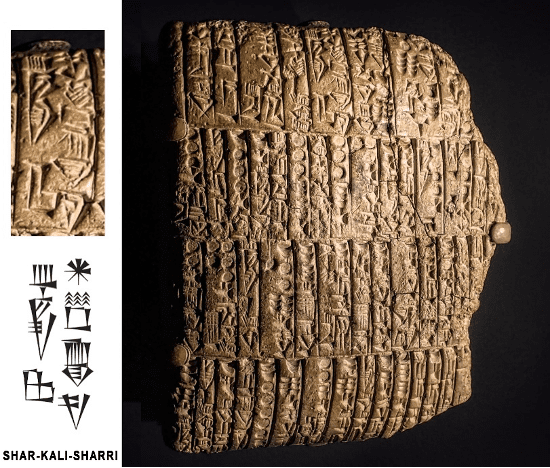
Example tablet from Nippura
Examples of Sumerian names can be useful. Here are a few examples of some names from Sumer that are listed along with their word meaning [40]:
Ses-tur: little brother
Ama-i-de: mother by the canal
Abzu-kurgal: the Abzu is a great mountain
Ĝakanaheti: may (this child) live for my sake
Gu-be: next to the riverbank
Guduga: one with a sweet voice
Iginisig: blue/green eyed one
Inimzida: having righteous words
The name Jared is a pre-flood name, first found in Genesis 5:18-20:
18 And Jared lived an hundred sixty and two years, and he begat Enoch:
19 And Jared lived after he begat Enoch eight hundred years, and begat sons and daughters:
20 And all the days of Jared were nine hundred sixty and two years: and he died.
The name Jared as found in the Book of Jubilees, a noncanonical book that is found in some religions and correlates to the Old Testament book of Genesis, indicates the name Jared means “to descend” (Jubilees 4:15) [41]. This could relate to the descending of angels in early Biblical writings. So, in Sumerian, we might consider Jared to mean “He Who Descends,” or perhaps “He Who Came Down From Heaven.” As a parent, I can imagine a mother naming her baby this.
As explained in the Sumerian name convention, a name can be given related to the person and what they have done. This can be changed later in life. This is not without precedence in other cultures. The Chinese were another culture that did this a lot, as were the Native Americans.
I had a good friend when I was young whose last name was Red Fox. Native American names and their translation can also give us some insight. A small sampling includes [42]:
For Men:
Dustu – Cherokee. Spring frog
Enapay – Sioux. Appears bravely.
Keokuk – Sauk. One who is alert and watchful.
Kosumi – Miwok. Fishes for salmon with a spear.
Seattle – Salish. Man of high status.
For Women:
Nokomis – Chippewa. Daughter of the moon.
Winona – Sioux. The first daughter.
Hawaiians still give such names today. I have some Hawaiian friends with names long enough that they are almost impossible for someone who does not speak the language to remember. I can’t say the names, let alone remember them, so we use something much shorter.
In the Sumerian King List, there are names of the kings recorded on baked clay tablets [43]. In the list, the names are translated, along with their meaning, when known. In most cases, these kings became kings after their fathers, and their name meant “Son of WhoeverTheLastKingWas.” Dumu, “Son of” or “Child of” appears to be the most common part of a name. Other common things include a city, land, or something that indicated the place the person came from.

At least in one case in the Sumerian List of Kings, there is a brother reference. Manishtushu means “brother of Rimush, the son of Sargon.” (His brother was the king before him.)
As I considered the naming convention of the Sumerians, I realized the names of the people in the book of Ether likely all had a meaning. And it came to me that the name of the brother of Jared could translate just as that. His name is “The Brother of Jared” when translated. It is possible that when Moroni translated the record using the interpreters, the translation given was the name’s meaning and not how the name sounds. This could mean that others whose names we considered as not given actually were given, but in the form of the meaning.
For example, information on Sumer [44] talks about how a common name for a king, or at least a portion of the king’s name, would be lu-gal. This means “great man” or “king” and might be the reason we find some men in the book of Ether given as “A Mighty Man” or something similar. That might be the translated name by meaning and not by sound.
Ether 11: 15 And it came to pass that there arose a rebellion among the people, because of that secret combination which was built up to get power and gain; and there arose a mighty man among them in iniquity, and gave battle unto Moron, in which he did overthrow the half of the kingdom; and he did maintain the half of the kingdom for many years.
Ether 11: 17 And it came to pass that there arose another mighty man; and he was a descendant of the brother of Jared.
In other words, maybe in wondering why the brother of Jared is not named, we (or at least I) have been looking beyond the mark. Maybe “The Brother of Jared” is his name as translated by meaning, and not phonetically, and that is the reason it is in the book of Ether that way. Perhaps Mahonri Moriancumer even translates as “The Brother of Jared,” and we have, therefore, actually had his name in the book of Ether in its meaning form and not in its phonetic form.
I think that if Mahonri Moriancumer does translate to “The Brother of Jared,” that this is only a portion of the translation. The reason for this is that in Sumerian names, Mah (as is part of the name Mahonri) has a definition of “chief, exalted, or large” [45]). It is interesting to note that the brother of Jared is called a large man. (Note the phrase “mighty man” is also here again.)
Ether 1: 34 And the brother of Jared being a large and mighty man, and a man highly favored of the Lord, Jared, his brother, said unto him: Cry unto the Lord, that he will not confound us that we may not understand our words.
It might be that the full translation by meaning of his name is something like “A Large and Mighty Man, The Brother of Jared” which Moroni, or the Urim and Thummim, shortened to “The Brother of Jared.”
Perhaps in cases where we see the book of Ether say a “mighty man,” that man’s name is something like “Lu-gal” which means “A Mighty Man” or “A Great Man.” That would mean we have no reason to wonder further about men referred to in this way, because that is the name they are given, and the translation is in meaning form.
Even in our English language, many names also have meanings, though most of us don’t know them until we want to name a baby and look it up. For example, the name “Andrew” means “power.” So perhaps in our language, we could be saying, “and there arose Andrew” instead of “and there arose a Mighty Man.”
Obviously, not all names in the book of Ether are given in a form that tells us their meaning. But it seems reasonable that in the translation, some of the names could be given in their meaning form and some in phonetic form.
Conclusion – the Brother of Jared’s Name
In conclusion, I feel that the Sumerian naming form and the difficulty in translating from the Jaredite writings to the Nephite written language are the two reasons that makes the most sense when answering the question as to why some people don’t appear to be named in the book of Ether. It could be either of these, or a combination of both such that “The Brother of Jared” is actually his name.
Personally, I feel it is the combination of these two. I feel that because the Egyptian language was so hard to write, some Jaredite phonetic name translations might have been almost impossible for Moroni to include. It is likely that when that was the case, he instead translated it using the meaning form. It also raises a question as to whether the Urim and Thummim presented it to him that way, or if he was forced to make that decision himself. Whichever way it was, I feel some names in the book of Ether were given in phonetic form when it was feasible in the Nephite reformed Egyptian, and when it wasn’t feasible, they were given in their meaning form, such as appears to be the case with “The Brother of Jared.”
FEATURES