



The Most Corrosive Claim in American Politics: “Everything You’ve Been Told Is Wrong”


The following first appeared in Public Square Magazine.
The religious right is in a crisis of discernment.
Following Charlie Kirk’s assassination in September, many religious conservatives began to ask “What now?” Kirk had been a unifying voice and a coalition builder. With his Turning Point USA organization, Kirk brought together diverse voices to advance Christian conservatism. An evangelical Christian himself, Kirk assembled a team of Catholics, Jews, Latter-day Saints, and others to promote the cause. He reached and mentored racial and sexual minorities who might otherwise avoid the conservative movement, as Amir Odom explained in a viral video after Kirk’s death.
But lacking Kirk’s unifying force, the conservative movement has fractured along political fault lines that were already emerging. Now, the fault lines have become much deeper and more public, particularly between conservatives who believe in the U.S. constitution versus Christian Nationalists who seek an authoritarian Christian ruler instead of our often-contentious pluralistic political system.
The religious right is in a crisis of discernment.
Political commentators are contributing to the rifts, particularly through their conspiracy theories. Take Candace Owens as an example. Immediately following Kirk’s passing, the popular commentator began formulating conspiracy theories that Israel was involved in Kirk’s killing.
Commentator Tucker Carlson has also cultivated disillusionment with the Constitution and free society. In a recent commentary on Venezuela prior to the arrest of Nicolás Maduro, Carlson followed a similar pattern he has in the past: he identifies a country under an authoritarian regime, then suggests to his viewers that everything you have been told is wrong.
Carlson said of Venezuela: “Nicolás Maduro and his government are very left wing on economics, not on social policy, by the way, which is kind of interesting. In Venezuela, gay marriage is banned. Abortion is banned. Sex changes for transgenderism are banned.”
“And by the way, the U.S. backed opposition leader who would take Maduro’s place if he were taken out is, of course, pretty eager to get gay marriage in Venezuela,” he adds.
Again, the pattern is to look at a regime that is oppressive, illiberal, and in conflict with the United States. Then, make the case to Americans that we have been deceived about that country: Show viewers that in that authoritarian-ruled country, good things are happening that are not happening in free Western societies.
In the case of Venezuela, Carlson’s hinting that authoritarian socialism has enabled the implementation of conservative social policies around marriage and gender that should be the envy of the American right.
The effect of this commentary is to leave viewers thinking “I’ve been deceived by elites. People and governments I’ve been told are bad, are in fact benign or even good. Up is down, and down is up.”
The unstated message is “trust me to be your new guide to reality.”
I recently saw the outcome of this commentary in a response to one of my social media posts on Tucker Carlson, as a commenter admitted Carlson was “the only journalist I trust to do real journalism.”
Tucker Carlson’s message appeals, in part, because he is often correct in cases where prominent people and institutions are wrong. After Carlson was accused of promoting a “great replacement conspiracy theory” in 2023, the Biden administration allowed a massive influx of immigration and resettlement using federal dollars, under an expansion of the notion of “humanitarian parole”.
Around that same time, Carlson began warning that Joe Biden was in cognitive decline and the executive branch was being run by staffers and presidential advisors — predating revelations near the end of Biden’s term about the full extent of decline that had been covered up.
A good lesson for critics is this: if you think it is important to limit the influence of a commentator like Tucker Carlson, the worst thing you can do is give people legitimate reasons to believe he is right and he is presenting a more accurate picture of reality than you are.
Tucker Carlson’s message appeals, in part, because he is often correct.
Critics of Carlson (I count myself among them) also have a challenging task of persuading people that his essential formula is wrong. To understand why, I think of KGB defector Yuri Bezmenov and his interviews on YouTube, where he details the Soviet process for subverting societies—with constant reference to the word “destabilize.” Bezmenov explained that the objective of KGB psychological operations is “to change the perception of reality, of every American, to such an extent that despite the abundance of information, no one is able to come to sensible conclusions in the interests of defending themselves, their families, their community and their country.”
Anytime a commentator is spending most of their time negating, disrupting, deconstructing, and telling you “everything you’ve been told is wrong,” they are destabilizing.
Of course, there are times and situations where that mental toolset is appropriate. But when it becomes compulsive, when it becomes a person’s constant default approach to the world, that person is showing you that something awful is going on inside.
When asked more about KGB strategies of subversion, Bezmenov described being instructed to “try to get into large circulation, established conservative media, reach filthy rich movie makers, intellectuals, so-called academic circles. Cynical, egocentric people who can look into your eyes with angelic expression and tell you a lie.”
“These are the most recruitable people: people who lack moral principles, who are either too greedy or suffer from self-importance. They feel that they matter a lot.”
None of this is to suggest that Tucker Carlson and other right-leaning influencers are somehow doing the bidding of Russia. What I am highlighting, however, is that our adversaries have been very open about their intentions to destabilize our society, and whether consciously or not, many of our influencers follow the patterns that these open enemies employ to undermine our social fabric and our institutions.
Tucker Carlson’s efforts to upend conventional wisdom have led him to moral inversion, where he condemns Israel for its campaign against Hamas, but is only able to muster morally ambiguous commentary about Russia’s rampage in Ukraine.
Recently, his criticisms of Israel have turned into something resembling obsession, and in a recent episode of his show, he and a guest suggested that the COVID virus was engineered to have a lower impact upon Jews.
This downward spiral of antisemitism on his show was on full display with the recent guest appearance of Nick Fuentes, a commentator distinguished by his open admiration of Hitler (and Stalin), as well as countless examples of vile remarks toward women and minorities.
And here we find the crisis of discernment on the right, particularly among the religious right. In the coalition that Charlie Kirk formed, there are people who hold conservative and even extreme-right positions on issues like immigration or foreign policy. Not all of these people have a Christian worldview, including a Christian understanding of Israel and its biblically-described role in the world.
Many people on the right feel deeply disillusioned by the failures of our institutions, even ones that are trusted to promote a conservative vision for America. Figures like Tucker Carlson and Candace Owens step in and validate people’s sense of disillusionment. They throw gasoline on the fire by leading their viewers into some mixture of true narratives intermixed with cynical conspiracy mongering.
In this way, they offer a constant stream of destabilizing commentary, steadily removing the mental guardrails of their audiences and cultivating a new receptivity toward extreme and morally-inverted viewpoints.
Standing against this process are Christian commentators like Catholic professor Robert George and the evangelical leadership of the Christian satire site The Babylon Bee, as well as other commentators like Ben Shapiro, who is Jewish.
They offer a constant stream of destabilizing commentary.
They know that the Judeo-Christian tradition carries its own set of mental and spiritual guardrails, and a truly principled person of faith can discern processes of destabilization, and their destructive impacts on the soul.
In my view, only a genuinely religious understanding of the world can guard against the pull of authoritarianism that finds so much appeal in a destabilized soul. A believer can see that destabilizing a mind with constant narratives of “everything they tell you is wrong” is the exact process employed in graduate schools to indoctrinate postmodernism and modern flavors of Marxism.
Whereas Christ fasted and prayed in the wilderness and ended up spiritually grounded enough to reject the temptation to power, destabilization is the exact opposite process, preparing souls to accept the lie that power is the only pursuit of real value.
The electoral success of Charlie Kirk’s coalition has been remarkable, and a cause for celebration on the right. But now there is a harder process ahead. The problems facing America’s religious right are spiritual in nature, and they require the teaching and practice of humble and searching discernment.
Charlie Kirk’s Assassination: A Time to Renounce Violence and Follow the Church’s Wise Counsel

The murder of a young father, Charlie Kirk, at Utah Valley University was a deeply troubling event for my wife and me. I don’t think we’ve seen any other talk show host or political commentator be so good at being kind to his opponents. We had both been impressed with his civility toward those who disagreed with him. He strove to be a solid Christian in his interactions, in my opinion. His work, almost a ministry, involved traveling to college campuses and openly engaging in civil conversations with students, allowing them to criticize him, raise difficult questions, and freely express their opinions on political and social issues. He loved young people and sought to help them see a world in a less blighted way than they were getting from the indoctrination of often radical professors. Through his work, tens of thousands of young people were influenced for good, in my personal opinion. Even though he was not in any position of political power, I suspect that it was his great influence that drove someone or some group to assassinate him.
Based on what I’ve seen, Kirk remained calm and respectful as he interacted with sometimes angry opponents. He generally gave them time to ask questions, took time to listen and understand, and often showed great mastery of random topics that were raised. I didn’t agree on every position but was usually impressed with how he responded. He was not looking for chances to embarrass others or to throw out cheap insults. Rather, I believe he was hoping to help students gain new perspectives on the need for freedom of speech, free markets, economic liberty, a Constitutional republic, healthy families, etc. He also dared to discuss some of the most challenging topics such as abortion and the humanity of an unborn child.
A wonderful tribute to his approach comes from a reporter who disagreed with him on many issues. See Adam Rubenstein, “The Charlie Kirk I Knew,” The Free Press, Sept. 10, 2025. He describes the time when he spent a week with Kirk to write an article about him:
In the week I spent following him around, what I found most striking was how someone at such a young age could command the attention and respect that he did—and in such a short period.
The profile [I wrote] was fair, and by no means a puff piece. And while his flack reached out to me to tell me that I was a Never Trump reptile (or something like that), Charlie texted me a link to my own story and said, “Well done!”
That was Charlie. If I had to use a single word to capture him, it would be gracious. We could disagree about anything—and we did—but he would, without fail, engage civilly and explain his point of view. He did not do this, as many do, to make himself feel smart. He did it so he could share the other side of something he cared about. And he cared deeply.
That’s the spirit he took to the hundreds of campuses he visited. Not denunciation. Not shouting down. Never an insult. He sought to debate ideas, and did so in hostile territory. Charlie all but re-created the public town square on these campuses with a tent and an irrepressible smile in an era where many people of his generation can’t look up from their phones….
He had a mission. It filled him with meaning. And that, above all, was why he convinced countless young people to listen to him, to change their lives for the better, to stand up for things that used to be called common sense.
How pained we have been to see many among a radical minority (I hope it’s a small minority) of the left rejoicing over his death. This can be galling if not infuriating to those mourning his loss. I can understand the anger, for example, that mourners gathered for a vigil before the Capitol building in Boise, Idaho experienced when a political activist drove by the crowd and yelled profanity regarding Charlie Kirk. Others had also gathered to taunt the mourners. Sadly, the result of the provocations was an ugly outbreak of violence.
How should we respond to such insults and provocations? I suggest that the guidance of the Church shortly after the assassination should be followed now and for all potential clashes ahead. In a post on the Church’s X account shortly after the killing, the Church offered this statement:
Following the shooting of an American political commentator [Charlie Kirk], the following statement has been issued attributable to Church spokesman Doug Andersen: “It is with great sadness that we learn of the shooting that took place at Utah Valley University resulting in the death of Charlie Kirk. Our prayers go out to his family at this time. We condemn violence and lawless behavior. We also pray that we may treat one another with greater kindness, compassion and goodness. For members of the Church, we reaffirm the Savior’s teaching and admonition is to love our neighbor.” [emphasis added]
The answer to contentious times may well be to ramp up love for our neighbors, including those who show anger toward us. While some wonder if growing political violence means we could one day face another civil war, modern revelation tell us to “renounce war and proclaim peace” (Doctrine and Covenants 98:16). May we seek paths of peace in the midst of violent contention.
Earlier that day, before the shooting, the Church posted an inspired statement from Elder D. Todd Christofferson that can also help us in the aftermath of the murder:
The Lord expects us to be peacemakers. Difficult as it may seem to be, we have the responsibility to pray for those who may persecute us, as Jesus said in the Sermon on the Mount. We need to learn to leave judgment to Him.
Mourners who may have responded to offensive taunting with violence rather than patience, calmness, and control, may have missed an opportunity to do good and may have done a disservice to the memory of peaceful Charlie Kirk and to the cause of liberty. I personally have struggled to exhibit such patience and control at various times in my life, so I know it’s not easy when caught off guard, but it’s worth mentally preparing to choose the calm, loving path ahead of time when we might face provocation.
Those who are aligned in any degree with the pro-American, pro-Constitution, and Christian views of Charlie Kirk would do well to understand and emulate Charlie’s graciousness and patience in dealing with angry opponents. I think we also must understand the agenda of radical revolutionaries in our midst. Some leading radicals seem to be trained agitators who follow a well-tried playbook for overthrowing a government or nation, one that has long been a key approach for Marxist or other subversive revolutionaries in many areas. Agitators work carefully to stir up large, angry protests or riots and take advantage of arrests or violence against their group to create martyrs and gain more publicity to stir up more support and revolt. Lawbreaking and chaos are a goal, not an unfortunate side effect.
This playbook has been refined more recently by such leaders in chaos and subversion of governments as — it really hurts to have to say this — our own CIA (but also agencies within other nations as well, both friends and foes). See, for example, the now-declassified 1983 field guide for revolution and subversion aimed at Nicaragua, “Contras Manual on Psychological Operations in Guerrilla Warfare,” now available at Archive.org and also in the CIA’s own online reading room (PDF document). An easy way to digest the key parts of this document is through the discussion of a former State Department specialist, Mike Benz, in his online discussion of June 2, 2025. This may also be considered in light of training programs from the CIA-aligned Institute of Peace, such as a video by a leader at the Institute of Peace who seems to reflect awareness of the CIA manual as she encourages lawbreaking (blocking roads, civil disobedience, and deliberately seeking imprisonment) as forms of “non-violent” actions to cause change.
For a deeper dive into the evolution of our intelligence agencies, also see the 40-minute lecture at Hillsdale College by Mike Benz, “The History of the Intelligence State,” which begins by considering George Kennan’s influential 1948 memo, “The Inauguration of Organized Political Warfare,” shortly after the CIA’s successful rigging of an election in Italy. The use of crime, whether organized crime or other crime, including chaos in the streets, and even assassination (as Benz discusses, beginning with the CIA’s famous “heart attack gun” around 32:45 in his HIllsdale lecture), can be a vital part of the toolkit for controlling or subverting a nation. If that toolkit, which has been used many times to influence other nations, is now being turned against our own nation, it’s time to recognize what great peril we are in, quite consistent with Moroni’s warning on secret combinations in our day (e.g., Ether 8).
At this very moment in U.S. history, understanding the tools, tactics, and strategies of those who may be seeking power and revolution in our own nation should give us pause when we are tempted to play the role that some dangerous groups may be seeking to elicit from us with their provocation. Here the advice just given to us (again) by the Church may be more urgently needed than ever. And the nuanced teachings of the Book of Mormon on coping with corruption and violence from secret combinations may be more needed than ever in this contentious time.
Being charitable toward opponents does not mean we must allow them to have their way without pushing back. Charlie Kirk was a good example, in my opinion, of standing firm on his principles and boldly but kindly teaching others and opposing evil. There is still much to oppose. The radical left (contrary to the desires of most voters, including many Democrats and Republicans) seems to be going all out to fund and support attorney generals and others who will be soft on crime. Cities under that pernicious influence may have no-cash bail, no prosecution of many crimes, goals for downsizing prison population even as crime increases, opposition to actual law enforcement, and a tendency to treat criminals as victims, if not heroes to be celebrated and funded. Crime and chaos in the streets may be an important step toward their ultimate goals, goals that most of their angry followers may not understand. Self-defense may certainly be necessary during such times, but when we respond in anger or throw unnecessary punches when we are provoked, we may be falling into a devilish trap that only strengthens the enemies of peace and freedom.
On such issues where organized evil seems to be at play, we can find helpful insights from the Book of Mormon’s extensive, diverse, and nuanced teachings on secret combinations — a topic that needs to be explored more seriously by modern scholars and students of the Book of Mormon.
The Book of Moses, or something like it on the brass plates that Lehi brought to the New World, seems to have strongly influenced Book of Mormon writers on the topic of secret combinations. It gives foundational insights into their operations and their harmful influence. From these ancient texts, we learn that violence is the key to Satan’s political and economic power through his secret combinations. They are rooted in oaths of secrecy to cover up their crimes, especially the murders that they may commit. It is covered-up murder, over and over again, that characterizes the founding and perpetuation of secret combinations in the Book of Moses and the Book of Mormon. Murder is used to eliminate an opponent, to silence a whistleblower, to gain wealth, or to vacate a throne or office of power. We also see that violent crime, even to the point of widespread internal chaos or civil war, is often the result of secret combinations and their poisonous influence on a society as they permeate many institutions. See my series on secret combinations beginning with “A Practical Guide to the Book of Mormon’s Most Neglected Theme: Secret Combinations” at Meridian Magazine, Oct. 14, 2024, followed by Part 2, Part 3, and Part 4.
We don’t yet know if the assassination of Charlie Kirk was the result of an orchestrated conspiracy or just one lone, deranged man who happened to be a well-trained, well-equipped expert shooter who could calmly kill with one shot from over 200 yards away. But seemingly political murders of this kind are often an indicator of the pernicious work of secret combinations, whether very small or very large. And in any case, it may be an indicator of the terrible moral corruption of a society tainted with influential secret combinations, as shown in the Book of Mormon.
One of the great and hopeful lessons of the Book of Mormon is that secret combinations are vulnerable. Sometimes a single courageous person can expose them and set them back. One of the most powerful strategies used against them was successfully applied by the converted Lamanites. After discovering the existence of Gadianton robbers among them, “the Lamanites did hunt the band of robbers of Gadianton; and they did preach the word of God among the more wicked part of them, insomuch that this band of robbers was utterly destroyed from among the Lamanites” (Helaman 6:37). They achieved victory through both the immediate action of hunting them down to stop their crimes, but also the prophylactic, healing action of preaching among the more wicked part of them (I believe this means the more wicked part of the Lamanites, not just among the more wicked part of the robbers, but I may be wrong).
Living and sharing the Gospel may be the most important thing we can do — but let’s not forget the importance of also resisting evil by being active, outspoken, and informed in our communities and society. We can resist great evil by understanding and exposing it, or at least voting against it when possible, such that the schemes and plots of truly dangerous criminals may be stopped.
Charlie Kirk’s detailed knowledge of many issues and his ability to respond so effectively in debates was a key to his remarkable success. He also shared the message of Christ and often testified of Him, but he knew so much about modern issues and the associated facts that he could communicate and teach effectively on numerous topics. He sought to do good on multiple levels, and he put his life on the line to carry out that work. He was so effective, so gifted, that some imagine that he could have been a remarkable if not unstoppable candidate for the Presidency in the future.
What a terrible loss for his wife and young children, and how tragic that so many cannot sense that as they rejoice at the lethal silencing of a political opponent whose offense was that he could out-debate them all. We need more Charlie Kirks among us. He will be missed and remembered by many.
Charlie Kirk’s Murder is Close to Home
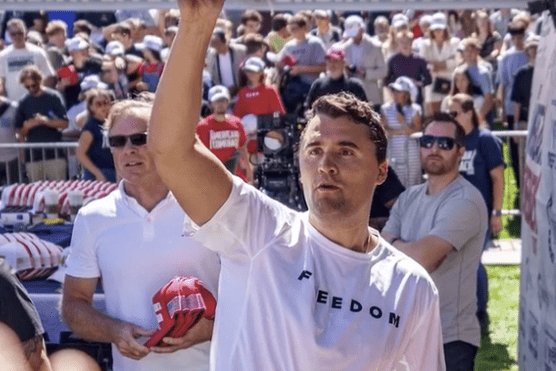
Founder of Turning Point USA, Charlie Kirk, was fatally shot in the neck just a few minutes after beginning his talk at Utah Valley University, not far from our home. UVU is a campus nestled under rising, protective mountains, filled with Latter-day Saint students, in a valley that we always somehow believe is safe. We cling to the illusion that it is far from the violence and chaos that is rocking so much of the world, but, of course, we are wrong. The evil, like silent tendrils, is creeping everywhere.
Kirk was a 31-year-old father of two, who organized a political movement beginning at age 18, to give conservative students a stronger voice and their ideas a place on campus. He wanted to rally behind the Constitution, religion, and the freemarket system and he was shot under a tent for an America Comeback ralley. He, who was a champion for free speech, was shot for raising his voice.
Our own family chatbox lit up as soon as Charlie, was shot. This sniper’s bullet felt personal because it happened so near to us and to someone with such a vital life left to give. The texts from family came quickly, “I’m sick and can’t catch my breath.” “I feel sick too.” “Horrifying.” These were accompanied by many comments of relief that our grandson, a UVU student, is out of town and was not there. The sadness and fear on the text string was palpable.
It was all sudden, surprising, a sniper’s bullet piercing the peace of a usually quiet place. It was a politicallly-targeted assasination, meant to silence ideas.
Former Utah congressman Jason Chaffetz, who was there, said that Utah was like the last place on the planet this would happen. Yet, really, there is no last place. Our innocence is shattered.
At the same time, while Charlie’s fate was still unclear, a nation called for prayers. “Pray for Charlie in his darkest moment,” many pled online.
What has drummed through my head are a few lines from John Donne’s famous poem, “For Whom the Bell Tolls.” It used to be that in English villages, the church bell would signal when someone died by ringing. It was called the death knell. Donne’s poem was based on that.
No man is an island
Entire of itself.
Each is a piece of the continent,
A part of the main…Each man’s death diminishes me,
For I am involved in mankind.
Therefore, send not to know
For whom the bell tolls,
It tolls for thee.
We are diminished by the senseless murders like Charlie Kirk’s at UVU or Iryna Zarutska on a Charlotte train. We are less when violence strikes children at a Catholic school who are praying. We remember something. We are a part of the whole. All murders are close to home. We are involved in all mankind and right now we are shrinking, shrinking because we have been taught to hate each other, to blame the victim, to celebrate upheaval. We have been told we must deconstruct our society, our language, our families, our religions, most basic values. We are told to silence our voices. We watch as a voice was silenced today. The bell tolls for all of us when others become victims to evil intent and ideas that raise a sniper’s gun.
The Church released this statement about Charlie Kirk’s death:
It is with great sadness that we learn of the shooting that took place at Utah Valley University resulting in the death of Charlie Kirk. Our prayers go out to his family at this time. We condemn violence and lawless behavior. We also pray that we may treat one another with greater kindness, compassion and goodness. For members of the Church, we reaffirm the Savior’s teaching and admonition is to love our neighbor.
FEATURES