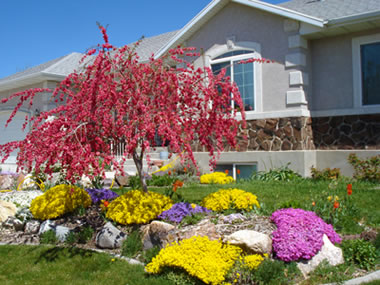





Turning the Arts of the Children to Their Fathers We call the little flowered mound in our front yard the “Gertrude Stowell Romney Memorial Flower Garden.”
It is a laughable shadow of the expansive flower garden Grandma Gertrude saw when she looked out through her dining room’s windowed doors.
But it is beautiful when everything is in bloom.and it serves the important function of allowing us to explain to our grandchildren who Gertrude Stowell Romney was.gentle, soft-spoken, frail and frugal mother of six, dutiful wife of businessman Junius Romney, poet, beloved ward Relief Society President, and constant doer of good her entire life.
Gertrude and her husband and their four children at the time fled Colonia Juarez, Mexico during the Mexican Revolution in 1912 with little more than the clothes on their backs. She and Junius endured long separations while he struggled to earn enough to put food in their mouths, and save enough to enable them to find a place to start over.
Gardening, both vegetable and floral, was just one of the many arts Grandma practiced, and that same art turns our hearts to her each time we consider those lovely flowers. Junius and Gertrude died when I was relatively young. I did not know them near well enough. But my personal quest to come to know my grandparents began many years later with an invitation to write the script for a family reunion program honoring them. The art I am most comfortable practicing is songwriting, so I began writing a song about grandpa and grandma based on a famous anecdote that to this day is repeated at family weddings. After many hours of labor, I had it almost finished when I began feeling a knot in the pit of my stomach telling me that it was not right to memorialize them with that anecdote as the focus. So, disappointed and frustrated, I called my cousin Joe Romney in Rexburg, Idaho, to ask what records he had that would help me learn about my grandparents. He sent me letters grandpa had written during his long separations from grandma, and which I didn’t even know existed. I called my uncle Paul Romney, the only surviving child of Junius and Gertrude, and a storyteller of inexhaustible resources. After many hours I started to know my grandparents in a way that amazed and humbled me. And I began to see that memorializing them in art on the basis of a single comic episode in their lives would have been a gross dishonor to them and a great disservice to my extended family. So I started over, this time paying tribute to a grandfather whose micro-philanthropy was astonishing in its breadth and depth, and a grandmother whose unconditional love was born out in countless acts, some of epic proportions. And the art I created-a song entitled “The Left and the Right Hands of Love”-was judged, by all who heard it at the reunion, to be a fitting tribute to our progenitors.
And at that reunion my own heart was turned to my grandfather, whom I had always viewed as an austere, didactic, hard-nosed businessman, in a remarkable and marvelous way. I felt for the first time that I truly loved, honored, and cherished him as my progenitor, and that I wanted him for my friend.
Something else happened at the reunion that provided an “Ah-ha!” moment for me-they all clamored to hear it again and get a copy of the song for themselves and their families. My story in song had become memorable, enjoyable, and repeatable. That is what the arts can do for the stories of our ancestors-make them memorable, enjoyable, and repeatable. And the specific art used is almost inconsequential! It can be quilting, drama, storytelling, literature, music, dance, cooking, pottery, sewing, painting, puppetry, weaving, even architecture! (The control room in my recording studio is the “Joseph C. Clive Control Room” in honor of my maternal grandfather-also a musician.)
And the experience of having my heart turned to my ancestors so powerfully through the arts led to a major life change. I felt moved to organize the nonprofit Utah Pioneer Heritage Arts (www.upharts.org), whose purpose is to turn the hearts of children to their fathers through the arts. That root has yielded branches galore. The Scandinavian Heritage Festival appealed to Utah Pioneer Heritage Arts (UPHA-www.upharts.org) for help in reclaiming the authentic Scandinavian cultural elements that were the hallmark of early festivals, and we have, in deed, found resources, which have helped them renew those arts for this year’s festival. Beyond that, we use modern arts to turn people’s hearts to those early Sanpete County pioneers whose legacy of dedication, self-denial, and devotion to God bless our lives even today. The Scandinavian Heritage Festival and Utah Pioneer Heritage Arts, with the sponsorship of A-1 Pioneer Moving & Storage and Spudnuts, are sponsoring two contests to encourage songwriters, cowboy poets, storywriters and storytellers to turn their arts to their fathers by setting the stories of the first settlers of Sanpete County in their respective art forms, and thereby make them memorable, enjoyable, and repeatable. Snow College is supporting the effort by turning the arts of their choral, dance, and English departments to Sanpete’s pioneer settlers and creating and performing songs, dances and stories memorializing those settlers which will be performed at the Scandinavian Heritage Festival. No Comments | Post or read comments FEATURES |

May 24, 2026
May 24, 2026