




Reflections on Twenty Years in the Tabernacle Choir, Part 2
By Brian C. Roberts
Photography 2006 Debbie Gehris. All rights reserved.
Editors’ note: Our dear friend, Brian Roberts, has just completed 20 years of service in the Mormon Tabernacle Choir. We pled with Brian to take some hours to transform from being a singer to a writer and give Meridian readers a perspective on his experiences in the choir. The following is a heartwarming, inside voice from the choir we all love. Please don’t miss the miscellaneous interesting facts at the end of this article.
If you missed Part 1 of this article, click here.
Choir Tours
There are many other experiences that stand out, particularly the tours. I remember with fondness my first “tour” with the Choir in August 1986 to Vancouver, British Columbia, Canada for the World Expo, which included a concert in Seattle – and an impromptu fireside in Victoria on Vancouver Island. The day following the concert in Seattle, we boarded a ferry to Vancouver Island, where our buses took us to the beautiful Butchart Gardens and eventually on to a chapel where the local ward had fixed us a scrumptious lunch of freshly broiled and steamed salmon. In gratitude for their efforts, we gave a special fireside where some of the Choir leadership spoke and Jerry led the Choir in Isaac Watts’ “When I Survey the Wondrous Cross.” The Spirit was overwhelming. Many in the congregation were very moved, including many of us in the Choir, and there was not a dry eye anywhere. The goodness of these wonderful Saints in Canada was met with appreciation on the part of the Choir.
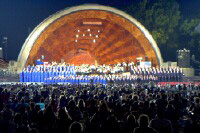
Most of the Choir during the 2003 tour to the Northeast performed with the Boston Pops from the famed Esplanade.
A similar experience occurred in 1992, when the Choir made a trip to Jerusalem at the special invitation of the mayor of that city and close friend of President Howard W. Hunter (then President of Quorum of the Twelve), Teddy Kollek. The Choir and Bonneville International took advantage of this opportunity to film the Choir in several key sites in Israel for a special video (In a Land Called Israel), including the traditional site where the Savior delivered His Sermon on the Mount, the Mount of Olives, the Shepherd’s Field near Bethlehem, and the Garden Tomb, where some latter-day prophets have felt impressed was the vicinity of the Savior’s resurrection and initial appearance to Mary Magdalene (John 20 11-18).
For this video, the Choir recorded all the pieces at the Tabernacle prior to leaving on the tour and sang to the recording from the various locations. At the Garden Tomb, they used “When I Survey the Wondrous Cross.” But the Choir gave more than “lip-synch” service to this powerful anthem of redemption and exaltation. Testimony came through strong and clear that He indeed had risen and “Were the whole realm of nature mine, That were a present far too small, Love so amazing, so divine, Demands my soul, my life, my all.” It was a moment to cherish.

Here I am admiring the National Medal of Arts.
An experience I had during the Choir’s 1991 tour to Eastern Europe and the Soviet Union stands out as one of the more poignant to me. The final stop on that trip was Leningrad, now St. Petersburg. As at several venues during the course of this tour, our concert was held in a classic European concert hall. This one, the Philharmonia Hall, was as exquisite as any in which we had performed – and one of the smallest stages as well. It required some clever staging to fit everyone on for the performance. In order to make it work, they put a row of chairs on the front edge of the stage where medium height people sat during the concert. One of those was me. This gave me a remarkable perspective of the audience I had not previously had.
As the concert began and we took our places on stage, a couple out in the audience caught my attention – who I perceived to be an older woman and her son. Their look epitomized what you would expect to see of Russian farmers on the pages of National Geographic – haggard and hardened by years of struggle. Perhaps they were remnants of those that survived the siege of Leningrad during World War II. Regardless, their faces echoed the trials of life and said to me, “Give your best to entertain us; we are not easily impressed.”
With the first strains of our opening number, I made it my purpose to sing especially to this woman and her son and to the extent I could, convey the love of Christ to them. The program itself was one of Jerry Ottley’s traditional ones for tours. The music was heavier at first (and included three beautiful, sacred pieces by the beloved Russian composer Sergei Rachmaninoff). After the intermission, the music became lighter, being filled with toe-tapping songs of Americana. With each number the woman and her son and the audience as a whole would quietly sit and observe and then politely applaud at its conclusion, which applause grew in intensity as the performance wore on. By the time the Choir finished their final number and sang their traditional encore of “Battle Hymn of the Republic,” the audience in unison rose to their feet in thunderous applause, tears of joy flowing over every cheek, including my little farm family.
As had been the case throughout this tour, following the conclusion of the concert, we were encouraged to mingle with members of the audience – an integral part of our missionary calling. As we exited through the back stage door of the hall, I stopped to linger, hoping I might see someone I recognized in the audience, particularly the two I felt so attached to during the performance. I wandered for a time and eventually began to head towards the buses when out of the corner of my eye, I was approached by none other than the “son” that I had watched so intently from on stage. He came to me, clasped my right hand in both of his, and in the little English he knew and with tears streaming down his face repeated over and over, “Thank you, Thank you, THANK YOU!” Again, the Choir had touched a heart and perhaps lightened a heavy burden, and I was so grateful that I was part of that effort.
The Nauvoo Temple Dedication
Another experience that stands out was the dedication of the Nauvoo Temple in 2002. As Craig Jessop relates it, he and President Christensen were approached by President Hinckley to have about 80 Choir members come to Nauvoo for the dedication services. Craig countered and asked if the entire Choir could come, but President Hinckley indicated, “You’re too expensive; you’ll take up every hotel room in the area!” Then Craig and President Christensen suggested the idea of giving a concert in Quincy, Illinois for the citizens there in gratitude for the compassion their ancestors showed the early Saints following the expulsion from Missouri during the winter of 1839. They also added that the Choir would pay for the trip themselves and find hotel rooms outside the Nauvoo area. President Hinckley warmed to the idea and the wheels were set in motion to pull it off. The Choir would stay in Quincy, do a concert there, and bus to and from Nauvoo for the dedication services.

My last broadcast from the Tabernacle before its closure for renovation, November 2004.
The arrangements were made and the Choir made the trip in groups to accommodate the sessions. Not everyone in the Choir could fit in the Temple at one time, so the Choir was split into four groups of about 80 singers each that would participate in at least two dedicatory sessions a piece. I was in the first group of singers to leave for Illinois.
The trip itself was uneventful, but the arrival in Nauvoo for that first rehearsal was one to remember. I recall from my earlier trips traveling up the highway to Nauvoo and being told to watch for the tall water tower that could be seen above the trees. That would give you an idea of what the Saints must have felt as they came up the river and would see the Temple rising above the horizon. What a thrill that would have been for them then. Now, as we traveled, we could actually see the newly restored temple rising in all its splendor and the feeling was one of awe.
I was not prepared, however, for the overwhelming emotion I would have as the bus finally pulled into Nauvoo and I disembarked and walked up to the Temple site. I was overcome with gratitude and appreciation for the tremendous sacrifice the early Saints made to complete the original edifice so they might obtain the promised blessings before being driven to the West. The tears came uncontrolled and I openly wept.

While the rest of the Choir (the “Not ready for prime-time singers”), including yours truly, were voice to the Choir from an adjoining tent.
This carried over to all the events during those eventful few days. That first dedicatory session was full of spirit and testimony. From the moment I entered the House of the Lord, I knew that this was a special occasion, particularly given the date, June 27th, the anniversary of the deaths of the Prophet Joseph and his brother Hyrum. The solemnity of the event was underscored as bells tolled marking the hour of martyrdom as the session began.
As President Hinckley spoke of the great sacrifice of the Nauvoo Saints, you could not help but weep for them, yet at the same time feel of their great joy at the rededication of their beloved temple. And no matter the hymn being sung, whether “Come, Come Ye Saints” or “Praise to the Man” or any of the others on the program, it was easy to imagine the choirs of early Nauvoo being there in the temple with us, lifting their voices right along. And when President Hinckley bore witness that not only the early Saints – Joseph, Hyrum, Brigham Young and so many others – were there to rejoice with us, but the presence of the Father and the Savior was there as well to accept our humble offering. The veil was indeed very thin that session, as it was for each session. It was a humbling experience and an honor to participate.
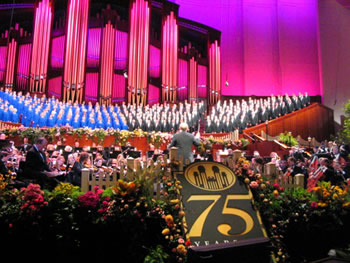
The 75th Anniversary Broadcast of Music and the Spoken Word.
As for the concert in Quincy, it evolved into a benefit affair for the city and all proceeds that came from it were donated. President Hinckley even made an appearance at the beginning of the performance to express his personal thanks to the citizens of Quincy, both past and present, for the generosity they have shown to the Church. Later, when the audience was asked how many were descendents of those in Quincy who helped the early members of the Church, a good number of individuals stood. It was then asked who in the Choir had ancestors that were part of that trek of Saints that were assisted by the citizens of Quincy, and nearly 80% of Choir rose to their feet. The sight was moving and the impact very touching. We were all so grateful for Craig’s insistence we all go and President Hinckley’s willingness to allow us.
General Conference
But the experiences that will stand out in my memory are each and every General Conference. My first was so very significant, being a solemn assembly when Ezra Taft Benson was sustained as the 13th President of The Church of Jesus Christ of Latter-day Saints. I remember as a student at Ricks College witnessing on television the solemn assembly for President Spencer W. Kimball back in 1974, and the powerful witness that I had received at that time that he was in reality a living prophet, a spokesman for the Lord. But the feeling here was matched, if not exceeded. And that same feeling was repeated at the sustaining of Howard W. Hunter as the 14th President of the Church and Gordon B. Hinckley as the 15th. These men were indeed preserved for a very special purpose at a very special time, and I gladly raised my arm to the square to sustain them as a prophet, seer and revelator and President of the Church.
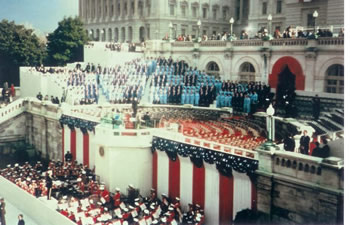
At the U.S. Capitol for the Bicentennial Inauguration (of President George H.W. Bush).
Similar feelings were experienced at every conference. I was humbled to sit at the feet of the Lord’s anointed and hear first hand their counsel as they were “moved upon by the Holy Ghost” and to know I was hearing “scripture… the will of the Lord… the mind of the Lord… the word of the Lord, and… the voice of the Lord, and the power of God unto salvation” (D&C 68:3). There were many instances when the spirit was so strong that singing became very difficult as emotions welled up in my throat and my contribution had to be limited to my countenance.
Conclusion
But now it all has come to an end. My 20 years of service have been completed and it is time for me to move on. I have had many people ask me over the course of the past several months whether or not I will be sad with this passing chapter of my life. I would be less than honest if I said I would not be affected. How could anyone give 20 years of their life to so great a cause and not have some angst at its completion?
I remember how I felt as I left my mission to Korea back in 1977. The member of my stake presidency who released me expressed well the feelings I experienced at that time. As I boarded that plane in Seoul and the wheels lifted off the ground, I could just feel that special spirit – that mantle needed to fulfill my mission call – leave me. And I felt it was being transferred to another who was in more need of it. This is how I feel about this call.
As I have reflected on my release, I have seen great wisdom in the policy that was established shortly after Jerold Ottley became the Choir’s music director (service is restricted to 20 years or age 60, whichever comes first). My time in the Choir has been phenomenal and the Choir has changed so much since I joined – all for the better. But that time is now done and it is important for me to step aside so that someone else can take that special spirit I had to fulfill my call and continue to help improve the Choir.
The words of President Hinckley sum it up quite well:
Personnel changes have occurred through the years, but the quality of performance has only improved. This choir is one of the great treasures of the Church. I think it is one of the great treasures of America. I regard it as the outstanding choir in all the world. May it continue its great mission of providing lofty and inspiring music at home and abroad. Gordon B. Hinckley, “Remember … Thy Church, O Lord,” Ensign, May 1996, 82.
Indeed it will – for ages to come and even into the Millennium, at which point I look forward to joining them and the other angels in singing praises at the return and reign of Christ, our Master.
Miscellaneous interesting facts during my time in the Choir:
Number of miles traveling to and from Temple Square for rehearsals, broadcasts and concerts – 160,000 (averaging 125 trips per year)
Number of accidents going to and from Temple Square – 1 (on May 4, 2006 – you figured the odds would catch up sooner or later)
Number of broadcasts – more than 1,000 (a quarter of all the broadcasts done to date)
Number of Christmas concerts – 80 (1 dress rehearsal, 2 formal concerts, 1 mini after the broadcast over the course of the 20 years)
Number of General Conferences participated – 41 (every Sunday session, about a dozen Priesthood sessions, a dozen Saturday morning sessions, plus 3 solemn assemblies)
Number of suits worn – 9 (burgundy, 2 royal blue (one double-knit and one polyester), 2 navy, 3 black (one was my own when I first joined), tan, white and a tuxedo), of which I was able to maintain the same size the entire 20 years!
Number of recording projects participated in with the Mormon Tabernacle Choir –
30+ CD’s (including the most recent “You’ll Never Walk Alone,” scheduled for later release)
10 DVD’s and VHS videos
Number of hours in the above events (rehearsals, broadcasts, conferences, recordings, concerts, etc.) – roughly 8,000, which doesn’t include my commuting time… 10,000 if you ask my wife!
Number of people performed for – more than 3 billion (thanks in large part to the Opening Ceremony of the 19th Winter Olympic Games in 2002)
Number of foreign countries visited – 18 on 4 continents
Number of U.S. states visited – 23 plus the District of Columbia (most of them more than once)
Number of pieces sung – 7000 (in reality the Choir only has about 1500 numbered pieces in their library, so even when throwing in all the hymns in the hymnbook, there is an obvious number of those pieces repeated over and over and over and over!)
Number of red pencils used – more than a dozen (however, the frequency of use has decreased of late because there’s no place left on the score to mark!)